

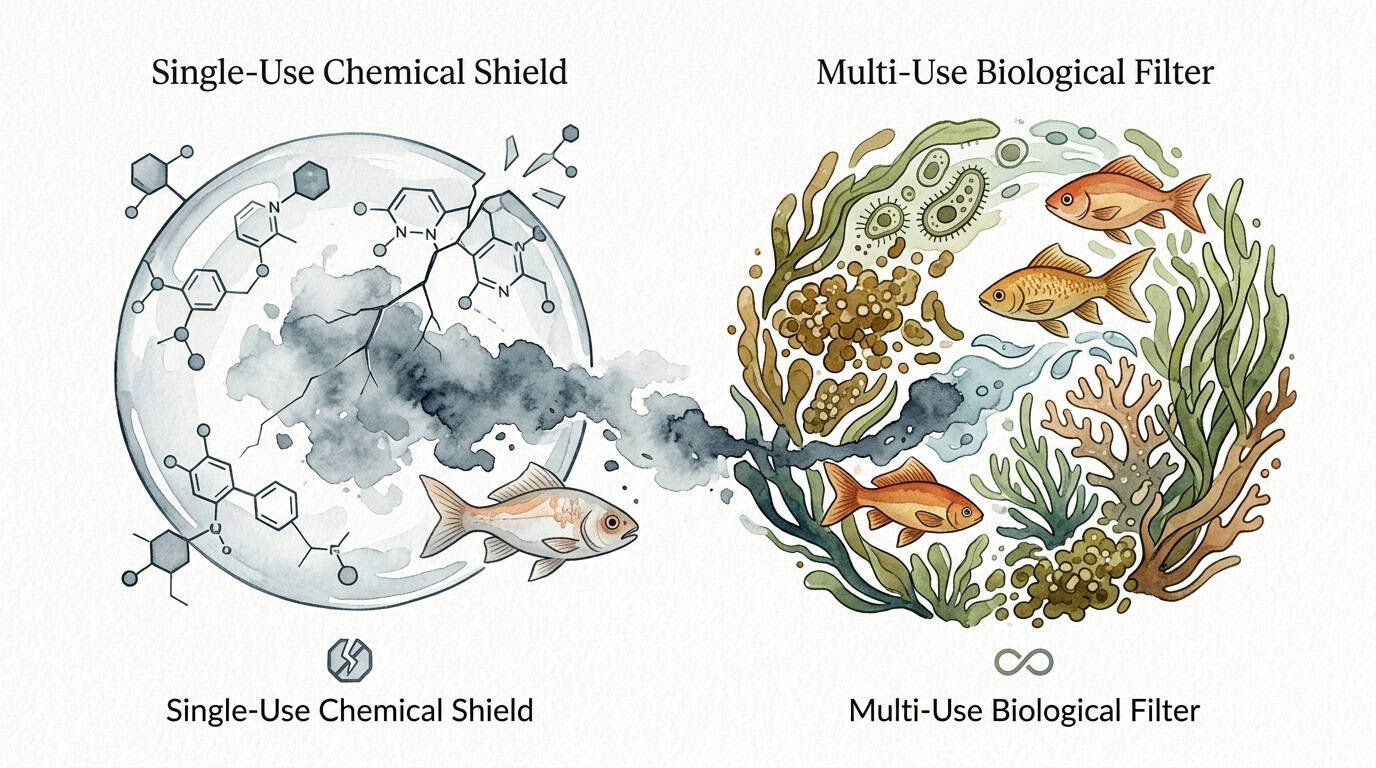
How Nitrifying Bacteria Protect Fish from Ammonia
Nitrifying bacteria protect fish by converting toxic ammonia (NH3) into nitrite (NO2-) and then into relatively harmless nitrate (NO3-). This two-step biological process, known as nitrification, utilizes specialized aerobic microbes that oxidize nitrogenous waste. By maintaining these bacterial colonies on porous filter media, aquarists prevent lethal ammonia spikes, ensuring a stable environment where fish can survive and thrive without constant chemical intervention.
Don’t just hide the ammonia—turn it into plant food. Nitrifying bacteria are the unsung heroes of fish health. They take toxic fish waste and convert it into the very nutrients that make your pond plants thrive.
Understanding the mechanical and biochemical pathways of nitrogen conversion is essential for maintaining any intensive aquatic system. While chemical additives provide a temporary shield, a robust biological filter offers a multi-use, self-sustaining solution to the constant production of metabolic waste. This guide analyzes the mechanics of nitrifying bacteria and how to optimize their performance for maximum system stability.
How Nitrifying Bacteria Protect Fish from Ammonia
Nitrifying bacteria are chemoautotrophic organisms that derive energy from the oxidation of inorganic nitrogen compounds. In an aquatic environment, fish excrete ammonia primarily through their gills as a byproduct of protein metabolism. Without intervention, this ammonia accumulates to toxic levels, causing extensive tissue damage and respiratory failure.

These bacteria colonize surfaces within the filtration system, forming a complex matrix known as a biofilm. Within this biofilm, two distinct groups of microbes work in tandem to neutralize waste. The first group, ammonia-oxidizing bacteria (AOB), initiates the process. The second group, nitrite-oxidizing bacteria (NOB), completes the conversion. This transition from a highly toxic gas (NH3) to a nutrient (NO3-) is the foundation of the nitrogen cycle in man-made habitats.
In real-world applications, such as Recirculating Aquaculture Systems (RAS) or residential ponds, these bacteria function as a living processing plant. They do not merely remove the ammonia; they recycle it. This process mimics natural ecosystems where nitrogen flows from animal waste to bacterial processors and finally to primary producers like plants and algae.
The Biochemistry of Nitrification
Nitrification is a two-stage aerobic process governed by specific stoichiometric requirements. Understanding these chemical reactions allows for the mechanical optimization of the filter environment. The process requires high levels of dissolved oxygen and a consistent source of inorganic carbon (alkalinity).
The first stage involves the oxidation of ammonia into nitrite. This is typically performed by genera such as Nitrosomonas and Nitrosospira. The simplified chemical equation for this reaction is:
NH3 + 1.5 O2 ? NO2- + H2O + H+
This reaction is highly energy-efficient for the bacteria but demanding for the system. It produces hydrogen ions, which directly consume the water’s buffering capacity. For every milligram of ammonia oxidized, approximately 7.14 mg of alkalinity (as CaCO3) is consumed. Without adequate buffering, the pH of the system will crash, eventually inhibiting the bacteria themselves.

The second stage involves the oxidation of nitrite into nitrate. This is performed by nitrite-oxidizing bacteria (NOB) such as Nitrospira and Nitrobacter. Modern research indicates that Nitrospira is the dominant NOB in most stable aquarium environments, whereas Nitrobacter often thrives in high-nutrient wastewater scenarios. The equation for this stage is:
NO2- + 0.5 O2 ? NO3-
The final product, nitrate, is significantly less toxic than its precursors. Most freshwater fish can tolerate nitrate levels in the range of 20–50 ppm indefinitely, whereas ammonia levels as low as 0.25 ppm can cause chronic stress and gill damage.
Operational Benefits of Biological Filtration
Biological filtration offers measurable efficiency advantages over mechanical or chemical alternatives. While a mechanical filter can remove solid waste, it cannot address dissolved ammonia. Chemical resins, often referred to as a “Single-Use Chemical Shield,” have a finite capacity and must be replaced or recharged frequently.
Nitrifying bacteria provide a self-replicating workforce. Once a colony is established on a high-surface-area medium, it adjusts its population density based on the available nutrient load. If the fish population increases, the bacterial colony grows to meet the demand, provided there is enough physical space and oxygen.
Cost-efficiency is a primary driver for choosing biological systems. After the initial investment in high-quality bio-media, the ongoing operational cost is primarily related to maintaining water flow and aeration. Unlike chemical media, which represent a recurring expense, a well-managed biological filter can function effectively for years with minimal maintenance.
Challenges and Common Failure Points
System failure often stems from a misunderstanding of the environmental needs of nitrifying microbes. These organisms are highly sensitive to sudden changes in water chemistry. A rapid shift in pH (greater than 0.5 units) can “stun” the bacteria, leading to a temporary cessation of nitrification and a subsequent ammonia spike.
Chlorine and chloramine exposure is perhaps the most frequent cause of “New Tank Syndrome” in established systems. Tap water used for water changes must be neutralized; even trace amounts of chlorine can decatastrophize a bacterial colony in minutes. This effectively resets the biological filter, forcing the system to re-cycle from scratch while fish are present.
Oxygen deprivation is another critical failure point. Nitrification is an aerobic process. In the event of a pump failure or significant power outage, the bacteria within the filter media can consume the available dissolved oxygen rapidly. Once conditions become anaerobic, the nitrifying bacteria begin to die, and other anaerobic microbes may produce toxic hydrogen sulfide as a byproduct.
Environmental Constraints and Limitations
Biological filtration is not a universal solution and has clear physical boundaries. Temperature is a major limiting factor. Nitrifying bacteria operate optimally between 25°C and 30°C. When temperatures drop below 10°C, their metabolic rate slows significantly. In outdoor pond systems during winter, biological activity may drop to near zero, requiring a reduction in feeding to prevent ammonia accumulation.
Low pH environments also pose a challenge. Nitrification efficiency drops sharply as pH falls below 6.5. At very low pH levels, ammonia shifts into its ionized form, ammonium (NH4+), which is less toxic but also less available as a fuel source for nitrifying bacteria. This can lead to a “stalled” cycle where the biological filter becomes dormant.
The presence of certain medications can also inhibit or kill beneficial bacteria. Many common treatments for parasitic or bacterial fish infections are non-discriminatory, meaning they destroy the “good” bacteria in the filter along with the pathogens. During medication cycles, it is often necessary to monitor ammonia levels closely or move fish to a separate quarantine tank.
Comparison: Biological Filter vs. Chemical Shield
Comparing these two approaches reveals significant differences in long-term sustainability and operational complexity. Chemical shields, such as zeolite or ammonia-binding resins, work via ion exchange or adsorption. They are effective for emergency spikes but lack the scalability of biological systems.
| Feature | Biological Filtration | Chemical Shield (Resins/Zeolite) |
|---|---|---|
| Capacity | Self-scaling based on load | Finite; fixed by volume of media |
| Maintenance | Low (occasional rinsing) | High (frequent replacement/recharge) |
| Operating Cost | Minimal (energy for pumps) | High (recurring purchase of media) |
| Response Time | Slow (needs time to grow) | Instant (upon contact) |
| Sustainability | Permanent ecosystem component | Temporary/Emergency use |
Practical Tips for Maximizing Efficiency
Optimization starts with the selection of the correct bio-media. Media efficiency is measured by Specific Surface Area (SSA), which is the total area available for bacterial attachment per unit of volume. High-porosity materials like sintered glass, ceramic rings, or specialized plastic media (e.g., K1/K5) provide thousands of square feet of surface area in a compact footprint.
- Maintain high dissolved oxygen: Ensure the filter is well-aerated. Bacteria consume 4.18 mg of oxygen for every 1 mg of ammonia processed.
- Protect the biofilm: Never wash bio-media in untreated tap water. Use water siphoned from the aquarium or pond to rinse away debris without killing the bacteria.
- Monitor Alkalinity: Check the carbonate hardness (kH) regularly. If kH drops below 3–4 degrees (50–70 ppm), the nitrification process may slow down or stop entirely.
- Stagger cleaning: If the filter contains multiple sponges or media bags, clean only half at a time. This ensures that a significant portion of the bacterial colony remains intact.
Advanced Considerations: Kinetics and Design
Serious practitioners often look toward Moving Bed Bio-Reactors (MBBR) for maximum efficiency. Unlike static filters where water may find a “path of least resistance” and bypass some media, an MBBR keeps the media in constant motion via air injection. This ensures every piece of media is exposed to nutrient-rich water and prevents the buildup of dead zones.
The rate of nitrification is also influenced by the concentration of ammonia, a principle described by Monod kinetics. In high-density systems, the bacteria grow faster because the “food” source is more concentrated. However, there is a saturation point where adding more ammonia does not increase the rate of processing. Designing a system requires balancing the expected ammonia production (based on fish weight and feeding rate) with the available SSA of the media.
Temperature-compensated design is another advanced tactic. In large-scale aquaculture, operators may heat the biological filter independently of the main tank to maintain peak bacterial efficiency during colder months. This allows for higher feeding rates and faster fish growth without risking water quality issues.
Scenario: Ammonia Load Calculation
Consider a 100-gallon pond containing 10 medium-sized koi. If these koi are fed 20 grams of a 40% protein food daily, they will produce a specific amount of nitrogenous waste. Approximately 16% of protein is nitrogen, and roughly 80% of that nitrogen is excreted as ammonia.
Calculation: 20g (food) × 0.40 (protein) × 0.16 (nitrogen) × 0.80 (excretion) = 1.024 grams of ammonia per day. To process this safely, the system needs enough bio-media to support a bacterial colony capable of oxidizing 1 gram of ammonia every 24 hours. Using high-efficiency media with an SSA of 500 m²/m³, a relatively small volume of media (approximately 2–3 liters) would be sufficient, provided flow rates and oxygen levels are optimized.
Final Thoughts
The role of nitrifying bacteria in protecting fish from ammonia cannot be overstated. These microorganisms provide a critical service by transforming a toxic metabolic byproduct into a usable nutrient. By focusing on the biological needs of the filter—specifically oxygen, alkalinity, and surface area—the system becomes a self-regulating environment that requires minimal chemical intervention.

Success in fish keeping is fundamentally the art of culturing bacteria. While the fish are the visual focus, the health of the microscopic colony in the filter dictates the longevity and stability of the entire system. Practitioners who prioritize the mechanics of the nitrogen cycle find themselves spending less time on emergency water changes and more time observing a thriving aquatic habitat.
Applying these principles ensures that ammonia remains a managed variable rather than a lethal threat. Whether managing a small home aquarium or a commercial aquaculture facility, the underlying biochemistry remains the same: provide the bacteria what they need, and they will protect the fish.
Frequently Asked Questions About How Nitrifying Bacteria Protect Fish from Ammonia
How long does it take for nitrifying bacteria to colonize a new filter?
The colonization process, often called “cycling,” typically takes four to six weeks under standard conditions. Ammonia-oxidizing bacteria usually establish themselves first, leading to a spike in nitrite levels. Following this, nitrite-oxidizing bacteria begin to grow, eventually bringing both ammonia and nitrite levels to zero. This timeline can be shortened to one to two weeks by using “bottled bacteria” starters or by seeding the new filter with media from an established, healthy system. Temperature plays a major role; the process is significantly faster at 25–28°C compared to cooler temperatures below 15°C.
Can you have too much biological filtration in a fish tank?
Technically, it is impossible to have “too much” biological filtration in terms of bacterial capacity. The bacterial population is self-limiting and will only grow to the size supported by the available ammonia and nitrite. However, having a filter that is mechanically oversized for the tank can lead to excessive water flow or current, which may stress certain fish species. The main advantage of “over-filtering” is the added safety margin. If a fish dies and goes unnoticed, or if you accidentally overfeed, a larger colony of bacteria can respond more quickly to the resulting ammonia spike, preventing a system crash.
Do nitrifying bacteria die if the filter is turned off?
Nitrifying bacteria are aerobic and require a constant supply of oxygenated water. If a filter is turned off, the dissolved oxygen within the media is consumed rapidly. In a stagnant environment, the bacteria can begin to die off within hours. After roughly four to six hours of zero flow, significant die-offs occur, and the filter may become anaerobic. If this happens, it is critical to rinse the media thoroughly with tank water before restarting the pump, as stagnant filters can harbor toxic gases and organic sludge that could harm the fish if flushed back into the main tank.
Does UV sterilization kill nitrifying bacteria?
UV sterilizers primarily kill free-floating microorganisms that pass through the unit’s housing. Since the vast majority of nitrifying bacteria live in the biofilm attached to filter media, gravel, and decor, a UV sterilizer will not harm an established biological filter. It may slightly slow down the initial cycling of a new tank if the bacteria have not yet found a surface to attach to, but in a matured system, UV light is an excellent tool for controlling algae and pathogens without impacting the nitrogen cycle. The beneficial nitrifiers are “sessile,” meaning they prefer to stay stuck to surfaces rather than drifting in the water column.
How can I tell if my nitrifying bacteria are working correctly?
The only reliable way to verify the health of your biological filter is through regular water testing using a liquid test kit. In a functioning system, the ammonia and nitrite levels should always read 0 ppm, regardless of when the fish were last fed. The presence of nitrate indicates that the cycle is complete and the bacteria are successfully converting waste. If you see even a trace of ammonia (0.25 ppm or higher) in an established tank, it suggests that the bacterial colony has been compromised by a recent event, such as a large water change without a dechlorinator, over-cleaning of the media, or a significant increase in the fish load.