

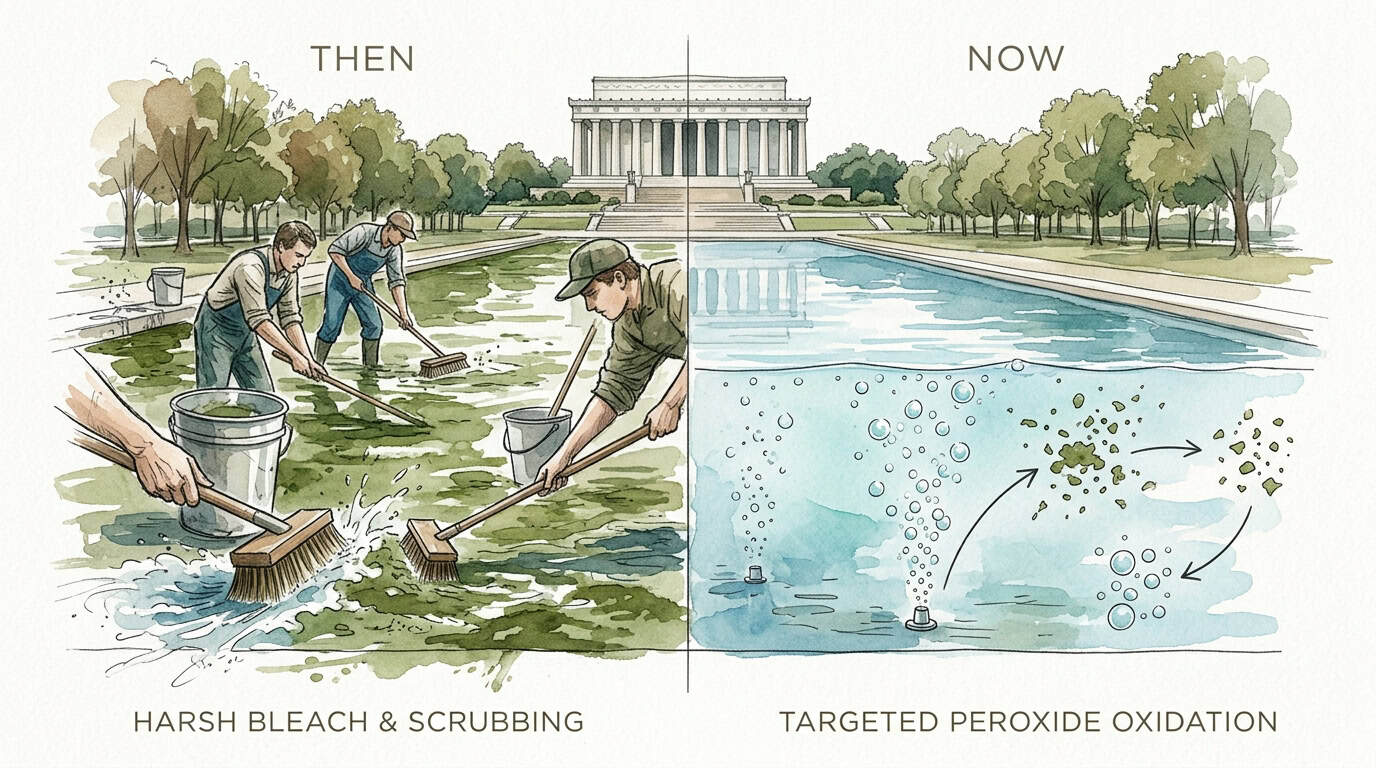
The National Park Service added hydrogen peroxide to the Lincoln Memorial Reflecting Pool in June 2026 as a targeted oxidation treatment to remediate a massive algae bloom that occurred immediately after a $14.2 million renovation. Unlike traditional chlorine, hydrogen peroxide acts as a rapid algaecide that breaks down into water and oxygen, providing a temporary “turbocharge” to the pool’s new ozone nanobubbler filtration system without leaving toxic chemical residuals in the 6.75-million-gallon basin.
This isn’t the peroxide from your medicine cabinet—it’s a high-tech tool for modern water management. Why did the NPS dump hydrogen peroxide into the Reflecting Pool? It marks a massive shift from ‘kill everything’ chemicals to ‘target only algae’ oxidation. Here is the science behind the bubbles.
Maintaining a clear “water mirror” in a shallow, sun-drenched basin is a mechanical and chemical balancing act. When standard filtration systems fail to keep up with rapid biological growth, technicians must turn to advanced oxidation processes (AOP) to restore clarity.
The transition from harsh scrubbing and heavy chlorination to targeted peroxide application represents an evolution in how the National Mall manages its most iconic water features. Understanding this chemical intervention requires a deep dive into the engineering challenges of stagnant water bodies.

Why Was Hydrogen Peroxide Added to the Lincoln Memorial Reflecting Pool?
The primary reason for the addition of hydrogen peroxide (H2O2) to the Lincoln Memorial Reflecting Pool was the sudden proliferation of “residual algae” following the completion of the 2026 renovation. Although the pool was equipped with a state-of-the-art ozone nanobubbler filtration system, the initial startup phase coincided with a severe heat wave in Washington, D.C. This combination created an environment where biological growth outpaced the mechanical system’s ability to suppress it.
In early June 2026, the water turned a vivid green, obscuring the “American Flag Blue” polyurethane coating applied to the basin floor. The National Park Service (NPS) deployed 12% industrial-grade hydrogen peroxide as a curative measure. At this concentration, the chemical acts as a powerful oxidizer that physically ruptures the cell walls of algae (lysis), causing the organic matter to die and float to the surface where it can be vacuumed or skimmed away.
Hydrogen peroxide is used in large-scale public water features because it is environmentally neutral upon reaction. In a high-traffic area like the National Mall, where ducks and other wildlife frequent the water, using traditional chlorine bleach can lead to the formation of harmful disinfection byproducts (DBPs) like trihalomethanes. Hydrogen peroxide avoids this issue by decomposing entirely into water and pure oxygen.
How Targeted Oxidation Works in Large-Scale Water Features
The process of de-greening a 6.75-million-gallon pool using hydrogen peroxide is an exercise in stoichiometric precision. While onlookers saw workers pouring gallon jugs into the water, the underlying mechanics involve a specific chemical reaction known as oxidation.
When H2O2 is introduced to water containing organic matter, it releases free radicals—specifically hydroxyl radicals (•OH). These are among the most powerful oxidizing agents available in water treatment, second only to fluorine. The radicals aggressively attack the lipid membranes and photosynthetic structures of algae.
The mechanical steps involved in this treatment include:

- Baseline Assessment: Technicians measure the current turbidity and pH levels of the pool to determine the necessary dosage.
- Strategic Application: The peroxide is typically added near the circulation inlets or in stagnant “dead zones” where algae growth is most concentrated.
- Nanobubble Synergy: The Reflecting Pool uses nanobubbler technology to inject gaseous ozone (O3) into the water. When hydrogen peroxide is added, it reacts with the ozone to form even more hydroxyl radicals, a process known as the peroxone method.
- Mechanical Removal: Once the algae is oxidized, it loses its buoyancy or clumps together. Maintenance crews then use high-volume vacuums and skimmers to remove the dead organic mass from the system.
This process is considered “targeted” because, at controlled concentrations (typically 30–50 parts per million), it is lethal to single-celled organisms like algae but relatively benign to larger organisms once diluted.
Benefits of Peroxide-Based Algae Remediation
The decision to use hydrogen peroxide over traditional sanitizers like sodium hypochlorite (liquid bleach) is driven by several operational and environmental advantages. For a high-profile site like the Lincoln Memorial, these benefits are measurable in both ecological safety and aesthetic results.
No Chemical Residue: The most significant benefit is the decomposition profile. Because H2O2 breaks down into H2O and O2, there is no buildup of salts or chlorides in the water. This is critical for the longevity of the pool’s concrete structure and the newly applied polyurethane liner.
Rapid Reaction Time: Hydrogen peroxide works almost instantly upon contact with organic matter. In a public-facing scenario where a “green pool” is a PR liability, the speed of peroxide oxidation allows for a visible improvement in water clarity within hours.
Wildlife Safety: Chlorine-based treatments can irritate the respiratory systems and feathers of the many ducks that inhabit the National Mall. At the concentrations used by the NPS, hydrogen peroxide is considered a milder alternative that poses significantly less risk to local fauna.
Increased Dissolved Oxygen: As a byproduct of the reaction, oxygen is released back into the water. This helps prevent the water from becoming anaerobic (low oxygen), which would otherwise lead to foul odors and further biological decay.
Challenges and Mechanical Pitfalls in Manual Dosing
Despite its effectiveness, the manual application of hydrogen peroxide to a body of water the size of the Reflecting Pool presents significant logistical challenges. Technical experts have pointed out several pitfalls associated with the June 2026 treatment.
One major challenge is distribution uniformity. The Reflecting Pool is over 2,000 feet long and 167 feet wide. Simply pouring bottles from the edge does not ensure even distribution throughout the 6.75 million gallons. This can lead to “hot spots” where the concentration is high enough to be hazardous, and “dead zones” where the algae remains untreated.
Another pitfall is dosage accuracy. To reach a therapeutic concentration of 50 ppm in a pool of this volume, roughly 8,000 liters of 12% hydrogen peroxide are required. If the dosage is too low, the algae will simply recover; if it is too high, it could potentially damage the specialized blue sealant or harm aquatic birds.
Mechanical limitations also play a role. The Reflecting Pool is a relatively stagnant system compared to a modern swimming pool. Without high-rate turnover and filtration, the oxidized (dead) algae remains in the water column as “cloudiness” until it is manually vacuumed. This is why the pool often appears white or cloudy immediately after a peroxide treatment.
Limitations of Chemical Algaecides in Open Water Systems
Chemical treatments are rarely a permanent solution for open-air water features. The Lincoln Memorial Reflecting Pool faces several inherent limitations that make chemical remediation an uphill battle.
- Nutrient Loading: The pool is exposed to bird droppings, urban runoff, and organic debris. These provide a constant supply of nitrogen and phosphorus—the primary fuel for algae blooms.
- Thermal Absorption: The 2026 renovation painted the basin a darker “American Flag Blue.” Darker colors absorb more thermal energy from sunlight, raising the water temperature. Warm water holds less dissolved oxygen and accelerates the metabolic rate of algae.
- Stagnation: While the pool has a filtration system, it does not have the high-velocity jets found in commercial pools. Stagnant water allows for the formation of thermal layers where algae can thrive undisturbed by mechanical filtration.
- UV Degradation: Hydrogen peroxide is highly sensitive to ultraviolet light. In the direct sun of a D.C. summer, the peroxide degrades rapidly, often losing its effectiveness within 24 to 48 hours. This necessitates frequent re-application if the underlying filtration issues are not resolved.
Comparison: Chlorine Bleach vs. Hydrogen Peroxide (H2O2)
When deciding on a remediation strategy for the Reflecting Pool, engineers must weigh the pros and cons of traditional vs. modern oxidizers.
| Factor | Chlorine (Bleach) | Hydrogen Peroxide |
|---|---|---|
| Primary Function | Disinfection (Killing Bacteria) | Oxidation (Destroying Organics) |
| Byproducts | Chloramines, Trihalomethanes | Water and Oxygen |
| Environmental Impact | High; toxic to aquatic life | Low; breaks down naturally |
| Surface Safety | Can bleach or degrade coatings | Generally safe for liners |
| Persistence | Leaves a residual for days | Dissipates rapidly in sunlight |
For the Reflecting Pool, the lack of toxic byproducts and the synergy with ozone technology make hydrogen peroxide the technically superior choice for short-term remediation.
Best Practices for Algae Suppression in Public Monuments
Managing a site as historically significant as the Lincoln Memorial requires a specialized set of best practices. Successful algae suppression is rarely about a single chemical “fix” and more about an integrated management plan.
Maintain High Dissolved Oxygen: Ensuring that oxygen levels remain high prevents the water from becoming stagnant. The use of nanobubblers is a best practice because these microscopic bubbles remain suspended in the water for long periods, providing a constant oxidative environment.
Routine Mechanical Cleaning: No chemical can replace the manual removal of debris. Regular vacuuming of the basin floor is essential to remove the “sludge” that serves as a nutrient bed for new algae.
Water Source Management: In some years, the NPS has switched between city potable water and water drawn from the Tidal Basin. City water is often preferred for initial fills because it has lower starting nutrient levels, although it is more expensive.
Continuous Monitoring: Real-time sensors for oxidation-reduction potential (ORP) and temperature allow technicians to apply peroxide *before* a bloom becomes visible to the naked eye. Proactive dosing is significantly more efficient than reactive “shock” treatments.
Advanced Considerations: Nanobubble Technology Integration
The 2026 treatment of the Reflecting Pool is a real-world example of **Advanced Oxidation Processes (AOP)**. The “nanobubble” system mentioned by the NPS is a sophisticated engineering solution that goes beyond traditional aeration.
Nanobubbles are gas-filled bubbles typically less than 200 nanometers in diameter. Because of their size, they do not rise to the surface and burst like larger bubbles; instead, they stay in suspension for weeks. They possess a negative surface charge and high internal pressure. When they eventually collapse or interact with contaminants, they release a burst of energy and hydroxyl radicals.

When the NPS adds hydrogen peroxide to a system already saturated with ozone nanobubbles, they are creating a “dual-oxidant” environment. The peroxide acts as a catalyst for the ozone, accelerating the production of radicals. This setup is designed to be the “permanent” solution for the pool, with the manual peroxide bottles serving only as a temporary boost during the system’s initial calibration or during extreme weather events.
Scenario: Managing a 6.75-Million Gallon Bloom
To visualize the scale of this task, consider a typical remediation scenario. On a Monday morning, the pool exhibits a 20% increase in turbidity. By Tuesday afternoon, under direct 95°F sun, the water is opaque green.
The engineering team calculates that the current ozone output is insufficient to combat the bloom. They initiate a “shock” treatment. They deploy crews to manually dose the west end of the pool—where the most iconic photos are taken—with 12% hydrogen peroxide. Within four hours, the green algae begins to turn white (bleaching) and die.
By Wednesday morning, the water is cloudy but no longer green. The filtration system, now running at 100% capacity, begins to pull the dead organic matter into the filters. Specialized vacuum bots crawl the 2,028-foot-long floor to remove the settled remains. This coordinated effort between chemical oxidation and mechanical filtration is what eventually restores the “American Flag Blue” reflection.
Final Thoughts
The addition of hydrogen peroxide to the Lincoln Memorial Reflecting Pool is a calculated technical response to the biological realities of a massive, shallow water feature. While the sight of workers pouring chemicals into a national monument may seem primitive, it represents the application of modern oxidation chemistry aimed at maintaining aesthetic standards without compromising environmental safety.
This strategy relies on the synergy between liquid oxidizers and advanced nanobubble technology. By using hydrogen peroxide as a targeted algaecide, the National Park Service can manage the transition between a newly renovated basin and a stabilized, self-cleansing ecosystem.
For practitioners and observers alike, the lesson of the Reflecting Pool is clear: the most effective water management strategies are those that leverage the natural decomposition cycles of oxygen-based chemicals to keep our public spaces both beautiful and ecologically sound.
Frequently Asked Questions About Why Hydrogen Peroxide Added to the Lincoln Memorial Reflecting Pool?
Is the hydrogen peroxide used in the Reflecting Pool safe for ducks?
Yes, the National Park Service and the Department of the Interior have stated that the hydrogen peroxide treatment is safe for the local wildlife, including the many ducks that visit the pool. Unlike chlorine, which can create toxic disinfection byproducts and cause respiratory distress in birds, hydrogen peroxide breaks down quickly into water and oxygen. At the diluted concentrations targeted for algae control—typically between 30 and 50 parts per million—the chemical is effective at killing single-celled algae while remaining benign to larger organisms. Furthermore, the rapid degradation of the chemical ensures that it does not persist in the environment or accumulate in the feathers or systems of the wildlife.
How much hydrogen peroxide is needed to treat the entire pool?
The Lincoln Memorial Reflecting Pool holds approximately 6.75 million gallons of water. To achieve a therapeutic concentration capable of killing a massive algae bloom, a significant volume of chemical is required. Water treatment experts estimate that to reach a concentration of 50 ppm using 12% industrial-grade hydrogen peroxide, the NPS would need to add approximately 8,000 liters (over 2,000 gallons) of the solution. Because manual pouring is less efficient than automated injection, actual usage might vary, but the sheer scale of the pool necessitates thousands of gallons for a full-basin “shock” treatment.
Why didn’t the new nanobubble system prevent the algae in the first place?
While the ozone nanobubbler filtration system is a state-of-the-art solution, it is designed for maintenance rather than the immediate remediation of an established “bloom.” Several factors contributed to the 2026 failure: the system was in its initial “startup” phase, the supply lines contained residual algae from months of dormancy, and an intense heat wave accelerated biological growth beyond the system’s design capacity. Additionally, the new dark blue coating on the pool’s floor increased solar heat absorption, raising the water temperature and creating a “petri dish” effect that required the supplemental peroxide boost to bring the system back into balance.
Does hydrogen peroxide change the color of the pool’s water?
The hydrogen peroxide itself is a clear liquid and does not dye the water. However, its effect on the algae causes a visible transformation. When the peroxide oxidizes the algae, it destroys the chlorophyll, causing the green water to turn cloudy or milky white as the organic matter dies. This is often seen as a sign that the treatment is working. Once the dead algae is removed through filtration or vacuuming, the water returns to its intended clear state, allowing the “American Flag Blue” color of the basin floor to be visible once again.
How long does the hydrogen peroxide remain effective in the water?
Hydrogen peroxide is a highly reactive and unstable molecule, especially when exposed to direct sunlight and high temperatures. In an open-air environment like the National Mall, the chemical typically dissipates within 24 to 48 hours. This lack of persistence is one of its environmental benefits, as it leaves no toxic footprint. However, it also means that peroxide is a “curative” treatment rather than a “preventative” one. To maintain long-term clarity, the pool must rely on its mechanical ozone and nanobubbler systems, as the peroxide provides only a temporary window of intense oxidation.