

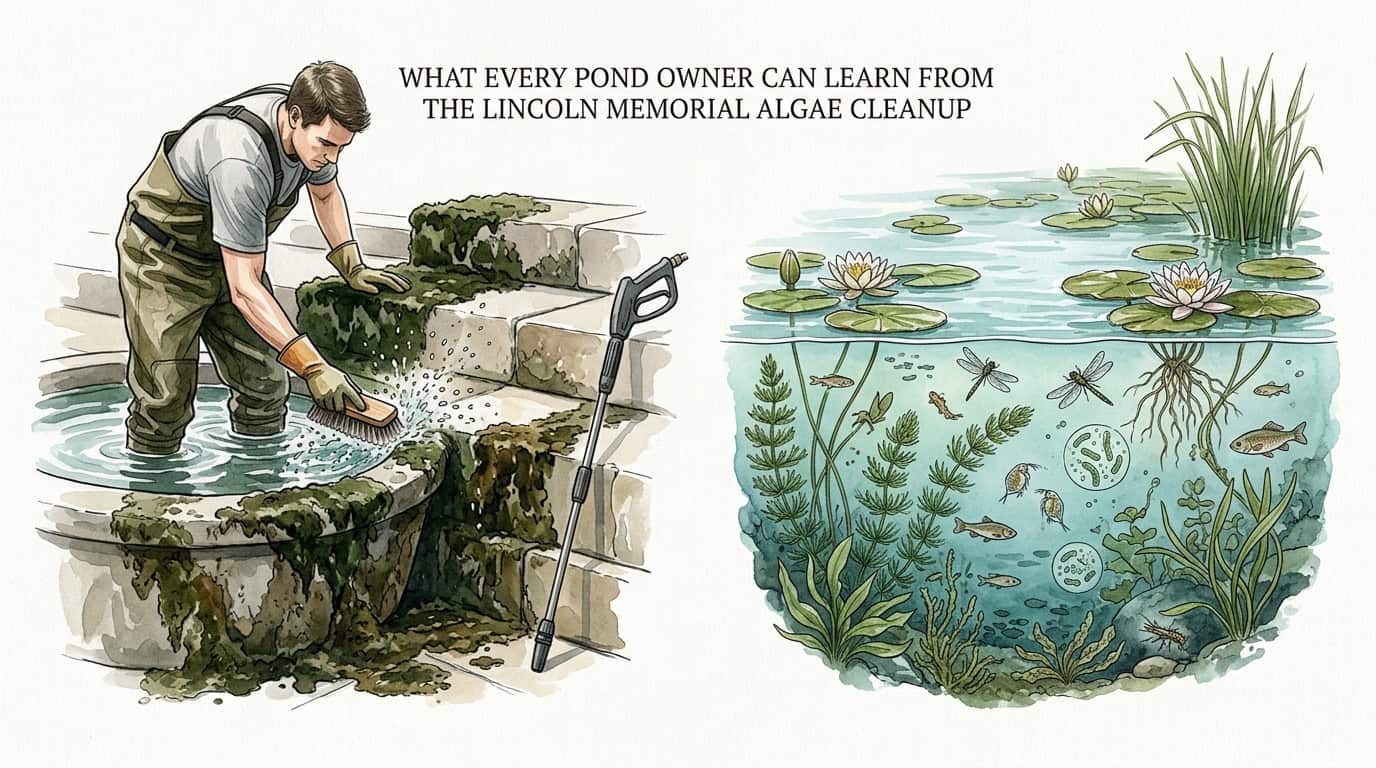
If you are working harder than your pond’s ecosystem, you are doing it wrong. The Lincoln Memorial cleanup is an engineering marvel, but for pond owners, it’s a cautionary tale. Learn how to switch from active labor to passive biological success.
Pond management often feels like a perpetual battle against nature, where the owner spends more time on maintenance than enjoyment. However, engineering a self-sustaining aquatic environment is not about superior strength or more frequent scrubbing; it is about mechanical optimization and biological synergy.
The recent challenges at the Lincoln Memorial Reflecting Pool provide a data-rich case study on the limits of high-input mechanical systems. By analyzing the failure points of this multimillion-dollar asset, pond owners can implement more efficient, lower-maintenance strategies for their own private water bodies.

What Every Pond Owner Can Learn from the Lincoln Memorial Algae Cleanup
The Lincoln Memorial cleanup demonstrates that mechanical filtration and chemical sterilization cannot substitute for a balanced ecosystem. Despite utilizing $14 million in renovations, ozone nanobubbler technology, and industrial-grade hydrogen peroxide, the 6.75-million-gallon pool was overtaken by algae within days of refilling. The key lesson is that attempting to maintain “sterile” water in an outdoor environment creates a biological vacuum that opportunistic species will inevitably fill. True stability requires nutrient competition through biological filtration rather than just mechanical removal.
The Technical Complexity of the Lincoln Memorial Reflecting Pool
The Lincoln Memorial Reflecting Pool is a 2,030-by-167-foot concrete structure designed as a “water mirror.” Following a $30.7 million renovation in 2012 and subsequent $14 million updates in 2026, the system was engineered to move away from potable municipal water in favor of treated water from the Tidal Basin. The current infrastructure includes a high-capacity pump building, 58 fill outlets, and a circulating system capable of processing 800 gallons per minute.
The system utilizes advanced oxidation processes (AOP), specifically ozone disinfection, to neutralize organic matter. During the 2026 renovation, the National Park Service also integrated nanobubble technology. These nanobubblers produce microscopic oxygen bubbles that remain suspended in the water column longer than standard aeration, theoretically breaking down algal cell walls through oxidation and increasing the dissolved oxygen (DO) levels to inhibit anaerobic decay.
Despite these specifications, the pool remains highly susceptible to cyanobacteria blooms. The shallow depth—ranging from 18 inches at the edges to 30 inches in the center—allows for rapid thermal gain. In the humid, high-temperature environment of Washington, D.C., the water temperature quickly reaches the optimal range for rapid phytoplankton reproduction, exceeding the capacity of the mechanical systems to keep the water clear.
How Mechanical Sterilization Fails (And Why Algae Still Wins)
Mechanical sterilization focuses on the active removal or destruction of organic material. In the Reflecting Pool, this involves three primary vectors: ozone injection, mechanical filtration, and chemical dosing with hydrogen peroxide. While these methods are effective in controlled, indoor environments like swimming pools, they face significant efficiency drops in large, outdoor, open-system environments.
The primary failure point is nutrient loading. In a sterile system, there are no “beneficial” organisms (like aquatic plants or nitrifying bacteria) to consume the nitrogen and phosphorus introduced by bird waste, wind-blown debris, and atmospheric deposition. This creates a nutrient-rich environment. When the ozone system or nanobubblers fail to neutralize 100% of the spores, the surviving algae face zero competition for these nutrients, leading to an exponential growth curve known as a “bloom.”

Furthermore, residual algae in supply lines often act as a seed source. If the pipes or pumps are not completely sterilized during downtime, refilling the pool introduces a pre-existing colony into a warm, nutrient-dense basin. Without a biological “immune system” to keep these populations in check, the mechanical system is forced into a reactive cycle of heavy chemical dosing and manual scrubbing.
Benefits of Passive Biological Balance
Switching from active mechanical dominance to passive biological balance involves using the nitrogen cycle to perform the labor. In a balanced ecosystem pond, biological filters—such as wetland filters or bog filters—provide a massive surface area for nitrifying bacteria to colonize. These bacteria convert toxic ammonia into nitrites and then into nitrates.
The measurable benefit of this approach is energy efficiency. A mechanical system like the one at the Lincoln Memorial requires constant power for high-pressure pumps and ozone generators. A biological system uses the natural metabolism of microbes and plants to sequester nutrients. Once established, these systems require significantly less watt-per-gallon input to maintain water clarity.
Additionally, biological balance provides systemic resilience. While a mechanical failure in a sterile pool leads to immediate water degradation, a biological system has “buffers.” Diverse microbial colonies can adapt to sudden spikes in nutrient loading, preventing a total system crash and reducing the need for emergency chemical interventions.
Challenges and Common Mistakes in Pond Maintenance
The most frequent error in pond ownership is over-reliance on chemical “quick fixes.” When algae appears, many owners reach for algaecides. While effective in the short term, these chemicals kill the algae, which then sinks to the bottom and decays. This decay releases the very nutrients (nitrogen and phosphorus) that fueled the initial bloom, creating a feedback loop of recurring growth.
Another common mistake is insufficient biological surface area. Many off-the-shelf filters are undersized for the volume of water they serve. For a pond to stay clear without manual scrubbing, the biological filter should ideally be 10-25% of the pond’s total surface area. Without this space, the bacteria cannot process nutrients fast enough to outcompete algae.
Owners also frequently underestimate the impact of UV exposure and temperature. Like the Reflecting Pool, shallow ponds with high sun exposure act as incubators. Failing to provide shade through lily pads or floating plants allows the water to hold less dissolved oxygen, which stresses the beneficial bacteria and favors the growth of hardy cyanobacteria.
Limitations: When High-Tech Isn’t Enough
Environmental variables can sometimes override even the best-engineered systems. In periods of extreme heat (above 90°F), the metabolic rate of algae increases while the oxygen-carrying capacity of the water decreases. In these scenarios, even high-output nanobubblers may struggle to maintain the necessary redox potential to prevent a bloom.
Furthermore, the physical design of the water body dictates its maintenance requirements. A rectangular, concrete basin like the Lincoln Memorial Reflecting Pool has “dead zones”—areas where water circulation is minimal. Algae and debris accumulate in these corners, regardless of the filtration system’s overall capacity. Pond owners with similar formal designs must account for these mechanical limitations by increasing flow rates or adding dedicated jets to eliminate stagnation.
Active Manual Scrubbing vs. Passive Ecosystem Balance
The choice between these two styles depends on the desired aesthetic and the available maintenance budget. Formal reflecting pools prioritize a “glass” look, which requires high-energy active management. Ecosystem ponds prioritize biological health, which uses natural processes to achieve clarity.
| Metric | Active Manual System | Passive Ecosystem System |
|---|---|---|
| Initial Cost | High (Complex machinery) | Moderate (Liner, rocks, plants) |
| Operational Energy | High (Continuous pumping/AOP) | Low (Efficient circulation) |
| Chemical Input | Frequent (Chlorine, Peroxide) | Minimal (Bacteria boosters) |
| Labor Required | High (Scrubbing, vacuuming) | Low (Pruning, skimmer emptying) |
| Resilience | Low (Fails if power/chems stop) | High (Self-adjusting biology) |
Practical Tips for Optimizing Your Pond
To reduce your manual labor and improve water quality, implement the following technical adjustments:
- Maximize Dissolved Oxygen: Use aeration to maintain DO levels above 6.0 mg/L. This supports aerobic bacteria that break down organic sludge (muck).
- Implement a Wetland Filter: Route a portion of your water through a gravel bed planted with aggressive nutrient consumers like Iris or Canna. This acts as a mechanical sieve and a biological reactor.
- Monitor the Redox Potential: Serious practitioners use ORP (Oxidation-Reduction Potential) meters to measure the water’s ability to cleanse itself. A target of 250mV to 400mV indicates healthy, oxidizing conditions.
- Control the Sludge: Use “muck-eating” bacteria (heterotrophic strains) to digest the organic layer on the pond floor, preventing nutrient recycling.
Advanced Considerations: The Role of Cyanobacteria
It is important to distinguish between “green water” algae and cyanobacteria (often called black or blue-green algae). Cyanobacteria are technically bacteria that photosynthesize. They are much harder to kill because they can fix nitrogen from the atmosphere, meaning they can thrive even when the water has low nitrate levels.
Controlling cyanobacteria requires a multi-pronged approach: high circulation to prevent the stratification they prefer, aggressive UV-C sterilization to disrupt their DNA, and competitive exclusion by high-surface-area biofilters. In the case of the Lincoln Memorial, the “black spots” often seen on the bottom are resilient colonies of these organisms that have anchored to the concrete pores, requiring mechanical abrasion or concentrated oxidizers like hydrogen peroxide to dislodge.
Example Scenario: Scaling the Lessons
Consider a 10,000-gallon backyard pond. If the owner manages it like the Lincoln Memorial—using only a sand filter and occasional chlorine—they will likely face a bloom every time the temperature spikes or it rains (introducing nitrogen). The energy cost to run a large pump 24/7 to clear the water is significant.
Conversely, if that same 10,000-gallon pond is equipped with a 2,000-gallon intake bay (a large skimmer) and a 1,500-gallon wetland filter, the biology takes over. The water stays clear because the plants and bacteria “starve” the algae. The owner’s only job is to empty the skimmer basket once a week and prune the plants seasonally. This represents a 70% reduction in annual maintenance hours compared to the “sterile” approach.
Final Thoughts
The Lincoln Memorial Reflecting Pool cleanup is a stark reminder that even the most advanced mechanical systems have limits. For the pond owner, the goal should not be to fight nature with more machines, but to design a system that leverages natural processes for mechanical efficiency. By focusing on nutrient sequestration and biological competition, you can achieve crystal-clear water without the need for constant manual labor.
Biological success is passive. It works while you sleep. By investing in the proper filtration surface area and maintaining a healthy microbial population, you transform your pond from a labor-intensive chore into a self-regulating asset. The data from the National Mall is clear: engineering a vacuum is a temporary fix; engineering an ecosystem is a permanent solution.
Frequently Asked Questions About What Every Pond Owner Can Learn from the Lincoln Memorial Algae Cleanup
Why does the Lincoln Memorial Reflecting Pool keep getting algae despite new filters?
The Reflecting Pool suffers from “biological vacuum” syndrome. Because the system is designed to be sterile, it lacks the beneficial bacteria and aquatic plants that naturally compete with algae for nutrients. When sunlight, heat, and nitrogen (from birds or rain) are introduced, any surviving algae spores have no competition, allowing them to reproduce at an exponential rate. Furthermore, the shallow concrete design causes the water to heat up rapidly, creating an ideal incubator for cyanobacteria. Even high-tech systems like ozone and nanobubblers can be overwhelmed by the sheer volume of 6.75 million gallons when environmental factors are optimized for algal growth.
Is hydrogen peroxide safe for cleaning ponds like it is used at the Lincoln Memorial?
Hydrogen peroxide (H2O2) is a powerful oxidizer that is used as a reactive treatment to kill algae on contact. In the Reflecting Pool, it is used because it breaks down into water and oxygen, leaving no toxic residue. For pond owners, it can be an effective “spot treatment” for string algae or submerged blooms. However, it must be dosed accurately based on the pond’s volume to avoid harming fish or beneficial microbes. While it provides a quick cleanup, it does not solve the underlying nutrient problem. Without addressing why the algae grew in the first place, the bloom will simply return once the peroxide has dissipated.
What are nanobubblers and should I use them in my pond?
Nanobubblers are a specialized aeration technology that produces bubbles significantly smaller than standard diffusers. These microscopic bubbles have a neutral buoyancy, meaning they stay suspended in the water for days rather than floating to the surface and popping. This drastically increases the dissolved oxygen levels throughout the entire water column. For the Lincoln Memorial, they are used to oxidize organic matter and prevent stagnation. For a private pond owner, nanobubblers are an excellent “advanced” tool for keeping water clear and healthy, especially in deep or heavily stocked ponds where oxygen depletion is a risk. However, they should be used as a supplement to, not a replacement for, biological filtration.

What is the difference between green water and the “black algae” seen in reflecting pools?
“Green water” is typically caused by single-celled planktonic algae suspended in the water column, which can often be managed with a UV clarifier. The “black algae” often mentioned in the context of the Lincoln Memorial is usually a form of cyanobacteria. These organisms are much more resilient; they form a thick, sticky biofilm that anchors to concrete and rocks. Cyanobacteria are technically bacteria, not true algae, and some strains can produce toxins. They thrive in high-nutrient, low-oxygen environments. Controlling them requires aggressive oxidation (like ozone or peroxide), high circulation, and ensuring that beneficial bacteria occupy all available niches in the pond’s ecosystem to starve them out.
How can I make my pond maintenance more “passive” like an ecosystem?
To move toward passive management, you must increase your pond’s biological capacity. This is achieved by installing a wetland or bog filter—a dedicated area where water flows through layers of gravel and the roots of aquatic plants. This setup provides a massive surface area for nitrifying bacteria to live. These bacteria do the “work” of processing fish waste and decaying leaves, while the plants sequester the resulting nitrates. By building a system that balances nutrient input with biological uptake, you reduce the need for manual scrubbing, vacuuming, and chemical additives. Essentially, you are building a natural water treatment plant that runs on sunlight and microbial metabolism.