

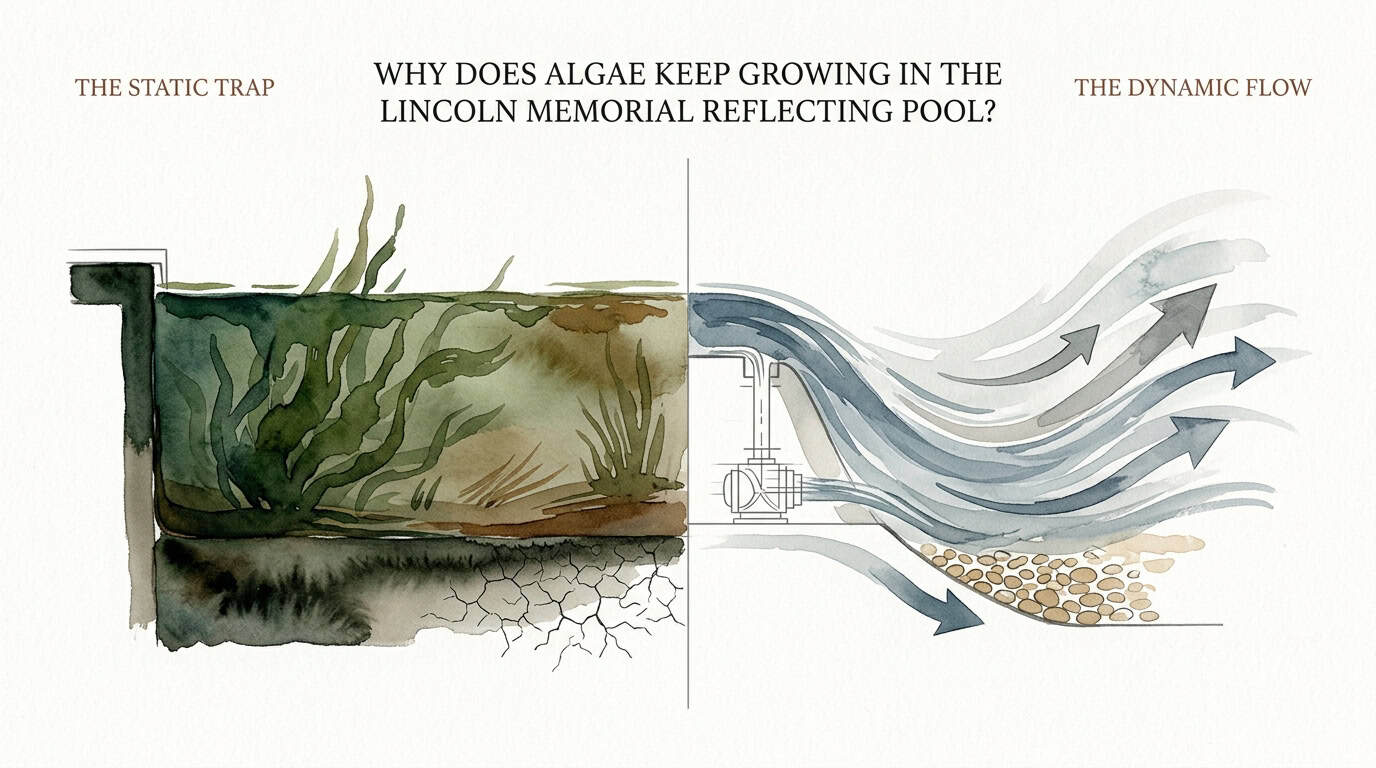
Algae keeps growing in the Lincoln Memorial Reflecting Pool because it is a shallow, 6.75-million-gallon basin that functions as a high-nutrient, high-temperature heat sink. Despite an ozone filtration system, the pool’s massive surface area absorbs significant solar radiation, while organic matter from waterfowl and windblown debris provides the phosphorus and nitrogen necessary for rapid blooms. The system’s inability to maintain a completely sterile, dynamic flow across its entire 2,029-foot length allows stagnant pockets to facilitate algae reproduction.
Nature hates a vacuum, but it loves a still pool. See why the Lincoln Memorial is the perfect petri dish. Ever wonder why the National Park Service is constantly battling green water? It comes down to the difference between static and dynamic systems. Understanding this can save your own water features from the same fate.
The Lincoln Memorial Reflecting Pool is often viewed as a simple decorative element, but from a hydraulic and biological perspective, it is a massive industrial-scale water management challenge. Maintaining a crystal-clear reflection requires a delicate balance of mechanical filtration, chemical treatment, and nutrient control. When any of these variables deviate from their set points, the system reverts to its natural state: a productive freshwater ecosystem.
Managing this body of water involves navigating the tension between historic preservation and modern aquatic engineering. The National Park Service (NPS) must ensure the pool remains a visual mirror for the Washington Monument while dealing with millions of gallons of water exposed to the elements. This tension is where technical optimization meets environmental reality.

Why Does Algae Keep Growing in the Lincoln Memorial Reflecting Pool?
The Lincoln Memorial Reflecting Pool is a rectangular, man-made basin located on the National Mall in Washington, D.C. It measures approximately 2,029 feet (618 meters) in length and 167 feet (51 meters) in width. With a depth of approximately 18 to 30 inches, it holds roughly 6.75 million gallons of water. Its primary function is aesthetic: to provide a symmetrical reflection of the Washington Monument and the Lincoln Memorial.
Algae growth in this specific environment is a result of “The Static Trap.” In aquatic engineering, a static trap occurs when a large volume of water lacks sufficient turnover or turbulence to prevent biological colonization. Because the pool is so shallow, sunlight penetrates the entire water column, hitting the bottom surface and warming the water rapidly. This thermal gain accelerates the metabolic rates of algae spores that are constantly introduced via the air and local wildlife.
This issue is not unique to D.C. It is a common problem in civil engineering and large-scale landscaping. Any time a system prioritizes “stillness” for visual effect, it sacrifices the “dynamic flow” that naturally inhibits algae growth. Without the mechanical intervention of pumps and filters, the pool would become a marsh within months.
The Mechanics of Algae Proliferation
To understand why the pool turns green, one must look at the mechanical and biological inputs. The process of algae growth is governed by the availability of three primary components: sunlight, nutrients, and temperature. In the Reflecting Pool, these three factors are often present in excess.
Solar Radiation and Thermal Gain: The pool’s dark bottom and shallow depth make it an efficient solar collector. On a 90-degree day in Washington, the water temperature can rise significantly. High temperatures decrease the solubility of oxygen in the water while simultaneously increasing the growth rate of Cyanobacteria and other algae species.
Nutrient Loading: This is perhaps the most significant challenge. The National Mall is home to a massive population of migratory and resident waterfowl, primarily Canada geese and mallard ducks. These birds introduce significant amounts of phosphorus and nitrogen through fecal matter. In a closed-loop system like the Reflecting Pool, these nutrients accumulate rather than being washed away, essentially “fertilizing” the water.

The Ozone Filtration System: Following a major renovation in 2012, the NPS installed a high-tech ozone treatment system. Ozone (O3) is a powerful oxidizing agent that kills bacteria and algae on contact. Water is pulled from the pool, treated with ozone in a mechanical room, and then circulated back. However, ozone has a very short half-life. Once the treated water returns to the pool, the ozone quickly reverts to oxygen (O2), leaving the main body of water without a residual disinfectant like chlorine would provide.
How the National Park Service Manages the System
The NPS employs a multi-stage approach to keep the water clear, though the sheer scale of the pool makes this an uphill battle. The process involves mechanical, chemical, and manual interventions designed to reset the biological clock of the basin.
Mechanical Circulation: Pumps located at the western end of the pool circulate water through the filtration system. The goal is to move the entire 6.75 million gallons through the filters at a rate that prevents stagnation. However, due to the pool’s length, “dead zones” can occur near the edges or in the middle where water movement is minimal.
Chemical Buffering: While ozone is the primary disinfectant, the NPS occasionally uses other EPA-approved algaecides or dyes. Aquatic dyes can be used to limit light penetration to the bottom of the pool, thereby “shading” the algae and slowing photosynthesis. This is a common tactic in large-scale pond management where mechanical filtration alone is insufficient.
Manual Scrubbing and Draining: When biological growth exceeds the system’s capacity to keep up, the NPS must perform a “hard reset.” This involves draining the entire 6.75 million gallons—a process that takes days—and manually scrubbing the concrete floor and walls. This removes the “biofilm,” a slimy layer of bacteria and algae that clings to the surfaces and provides a foundation for future growth.
Benefits of the Current Management System
The 2012 upgrade moved the pool from using potable city water to using filtered water from the nearby Tidal Basin. This shift provided several measurable advantages in terms of sustainability and cost-efficiency.
Water Conservation: Before the renovation, the pool was filled with treated drinking water from the D.C. municipal supply. When it got dirty, it was simply drained into the sewer and refilled. The current system recirculates and cleans the water, significantly reducing the demand on the city’s potable water infrastructure.
Cost Efficiency: While the initial investment in the ozone plant was high, the long-term cost of purchasing millions of gallons of city water was unsustainable. By treating and recycling water, the NPS reduced operational costs over the decade, even when accounting for the electricity required to run the pumps and ozone generators.
Environmental Impact: Ozone treatment is generally more environmentally friendly than heavy chlorine usage. Chlorine can react with organic matter in the pool to create trihalomethanes (THMs), which are toxic byproducts. Ozone leaves no chemical residue, making the water safer for the local wildlife that inevitably uses the pool as a habitat.
Challenges and Common Failure Points
Despite the advanced technology, the Reflecting Pool still turns green several times a year. This usually happens during specific “stress events” that overwhelm the system’s design parameters.
The “Duckling” Problem: In May 2017, a major algae bloom was linked to a parasite carried by snails, which were in turn attracted by the organic waste of ducklings. The NPS had to drain the pool to protect the health of the birds and the public. This highlights a common mistake in water management: focusing only on the water chemistry while ignoring the macro-biology (animals and insects) of the site.
System Capacity vs. Nutrient Input: The ozone system is designed for a specific “loading rate.” If the number of geese increases by 50% during a migratory season, the nutrient input can exceed the ozone’s ability to oxidize the waste. In technical terms, the Biological Oxygen Demand (BOD) becomes too high for the system to maintain equilibrium.
Mechanical Downtime: Like any industrial system, the pumps and ozone generators require maintenance. If a pump fails during a D.C. heatwave, the lack of circulation for even 24 hours can trigger a massive bloom that takes weeks to reverse.
Limitations of the Design
It is important to recognize that the Lincoln Memorial Reflecting Pool was designed primarily for its visual and historical impact, not for ease of maintenance. This creates inherent limitations that no amount of technology can fully overcome.
Surface-to-Volume Ratio: The pool is exceptionally shallow relative to its surface area. In limnology (the study of inland waters), this is the worst-case scenario for water quality. Deep lakes stay cool at the bottom; shallow pools heat up uniformly, turning into incubators for microscopic life.
Urban Runoff: The pool is surrounded by paved paths and turf. During heavy rain, runoff from these surfaces carries fertilizers from the grass and pollutants from the walkways directly into the water. The pool acts as a catch-basin for the surrounding environment.
No Natural Filtration: Unlike a natural pond, the Reflecting Pool has no “littoral zone” (an area of aquatic plants) to absorb excess nutrients. It is a sterile concrete box. In a balanced ecosystem, plants like water lilies or reeds would compete with algae for nutrients. Here, the algae have no competition.
Static vs. Dynamic Systems: A Comparison
To understand why the NPS struggles, it helps to compare the Reflecting Pool to other types of water features. The following table illustrates the differences between the current “Semi-Dynamic” system and other common configurations.
| Feature | Static (Old Pool) | Dynamic (Moving River) | NPS System (Hybrid) |
|---|---|---|---|
| Flow Rate | Zero / Near-Zero | High | Low/Moderate Recirculation |
| Algae Risk | Extreme | Low | Moderate/High |
| Maintenance | Drain & Fill | Natural Scouring | Continuous Filtration |
| Water Source | Potable (City) | Natural Runoff | Tidal Basin (Filtered) |
The Reflecting Pool is trapped in a “Hybrid” state. It attempts to be dynamic through mechanical pumping, but its physical dimensions keep it effectively static in many areas. This is why the “Static Trap” is so difficult to escape without massive chemical intervention.
Practical Tips for Large-Scale Water Features
For those managing large water features or even backyard ponds, the lessons from the Lincoln Memorial are invaluable. Optimization requires a proactive rather than reactive approach.

Increase Circulation in Dead Zones: Most algae blooms start in corners or areas with low flow. Using small submersible “jet” pumps can keep water moving in these spots, preventing the stagnation that allows spores to settle and grow.
Control the Source: It is much easier to keep nutrients out of the water than to remove them once they are in. Discouraging waterfowl and ensuring that landscape fertilizer does not wash into the pool are the two most effective ways to prevent blooms.
Monitor Temperature: If you see a heatwave approaching, increasing the filtration rate or adding a temporary UV sterilizer can prevent a bloom before it starts. Once the water turns green, you are already behind the curve.
Advanced Considerations: The Role of Biofilms
Experienced water managers know that the “green water” you see is only half the problem. The real issue is the biofilm attached to the concrete walls. Biofilms are complex colonies of bacteria and algae that secrete a protective slime. This slime makes them resistant to chemical treatments like chlorine or ozone.
When the NPS “shocks” the pool or increases ozone levels, they may kill the free-floating algae (planktonic algae), but the biofilm remains. As soon as the chemical levels drop, the biofilm releases new spores into the water. This is why manual scrubbing is periodically necessary; you must physically break the “biological anchor” that the biofilm provides.
Furthermore, the porosity of the concrete itself plays a role. Micro-cracks in the aging concrete provide a refuge for these colonies. Sealing the concrete with a non-porous epoxy coating can reduce the surface area available for biofilm attachment, though this is a massive and expensive undertaking for a 2,000-foot pool.
Example Scenario: The July Heatwave Bloom
Consider a typical July in Washington, D.C. The air temperature hits 95 degrees for four consecutive days. The water temperature in the Reflecting Pool climbs to 85 degrees. At the same time, a local goose population of 200 birds is active in the area.
The ozone system is running at 100% capacity, but it can only process a certain volume of water per hour. Because the pool is so large, the water in the center of the basin hasn’t seen the ozone chamber in 12 hours. In that time, the phosphorus from the geese and the high heat allow the algae population to double every few hours. By day three, the water has a visible green tint. By day five, the “reflection” is gone, replaced by a thick soup.
In this scenario, the failure wasn’t the ozone system itself; it was the “residence time” of the water in the pool. The water simply stayed in the sun too long before being filtered again. To solve this, the NPS would need to either increase the pump flow rate (requiring more energy and larger pipes) or add a residual disinfectant that stays in the pool water, such as copper sulfate or chlorine.
Final Thoughts
The ongoing battle with algae in the Lincoln Memorial Reflecting Pool is a masterclass in the challenges of maintaining artificial aquatic systems. It demonstrates that even with multi-million dollar ozone filtration and high-tech monitoring, the fundamental laws of biology and thermodynamics still apply. Shallow, nutrient-rich water in the sun will eventually grow algae.
For the National Park Service, success is measured not by the total absence of algae, but by the management of its growth. By understanding the “Static Trap” and the limits of ozone treatment, they can keep the pool clear for the majority of the year. However, as long as the pool remains an open-air basin, the “hard reset” of draining and scrubbing will remain a necessary part of the maintenance cycle.
Ultimately, the Reflecting Pool serves as a reminder that man-made structures require constant energy and intervention to resist the natural tendency toward ecological succession. Whether you are managing a national monument or a small koi pond, the principles of circulation, nutrient control, and temperature management are the keys to clarity.
Frequently Asked Questions About Why Does Algae Keep Growing in the Lincoln Memorial Reflecting Pool?
Why doesn’t the National Park Service just use more chlorine?
While chlorine is an effective algaecide, using it at the scale of 6.75 million gallons presents significant environmental and logistical challenges. Chlorine reacts with organic matter (like the leaves and bird droppings found in the pool) to create harmful byproducts called trihalomethanes. Furthermore, the pool is a habitat for local wildlife; high levels of chlorine could be toxic to the ducks and geese that frequent the National Mall. The NPS opted for ozone treatment because it is a more environmentally sustainable solution that leaves no chemical residue, even though it lacks the long-term “residual” killing power of chlorine.
Does the pool use D.C. drinking water to stay full?
No, one of the major goals of the 2012 renovation was to stop using potable (drinking) water. The pool now utilizes water from the Tidal Basin. This water is pumped to a treatment facility where it is filtered and treated with ozone before entering the Reflecting Pool. This saves millions of gallons of city water annually and reduces the cost of maintaining the feature. However, because Tidal Basin water is already rich in organic nutrients, it places a higher demand on the filtration system than pre-treated city water would.
How often is the Lincoln Memorial Reflecting Pool drained?
The frequency of draining depends on the severity of algae blooms and the accumulation of debris. On average, the pool is drained and cleaned once or twice a year. This “hard reset” is typically scheduled in the spring or after a particularly bad summer bloom. Draining is a labor-intensive process that involves pumping out all 6.75 million gallons and using high-pressure hoses and brushes to scrub the concrete floor. This is necessary because some algae and bacteria form a “biofilm” on the concrete that chemical treatments cannot easily penetrate.
Can the geese be moved to prevent the algae growth?
Removing the geese is practically impossible. The National Mall is an open public space, and Canada geese are a protected species under the Migratory Bird Treaty Act. While the NPS uses various non-lethal “harassment” techniques—such as border collies or strobe lights—to discourage the birds from congregating in specific areas, the birds are naturally drawn to the water. Their presence is a primary source of nitrogen and phosphorus, which act as fertilizer for algae. Short of enclosing the pool in a dome, managing bird waste remains an unavoidable part of the maintenance equation.
Does the algae growth damage the actual structure of the pool?
The algae itself is mostly an aesthetic and health concern rather than a structural one. However, the conditions that allow algae to thrive can lead to other issues. For example, the accumulation of organic muck can clog the intricate intake and output pipes of the circulation system. Additionally, the frequent draining and cleaning required to manage algae can put stress on the concrete and expansion joints. Over time, the biological activity and the subsequent cleaning cycles contribute to the wear and tear of the basin, requiring periodic multi-million dollar restorations.