

Pond Talk is an Amazon Associate. As an Amazon Associate we earn from qualifying purchases.
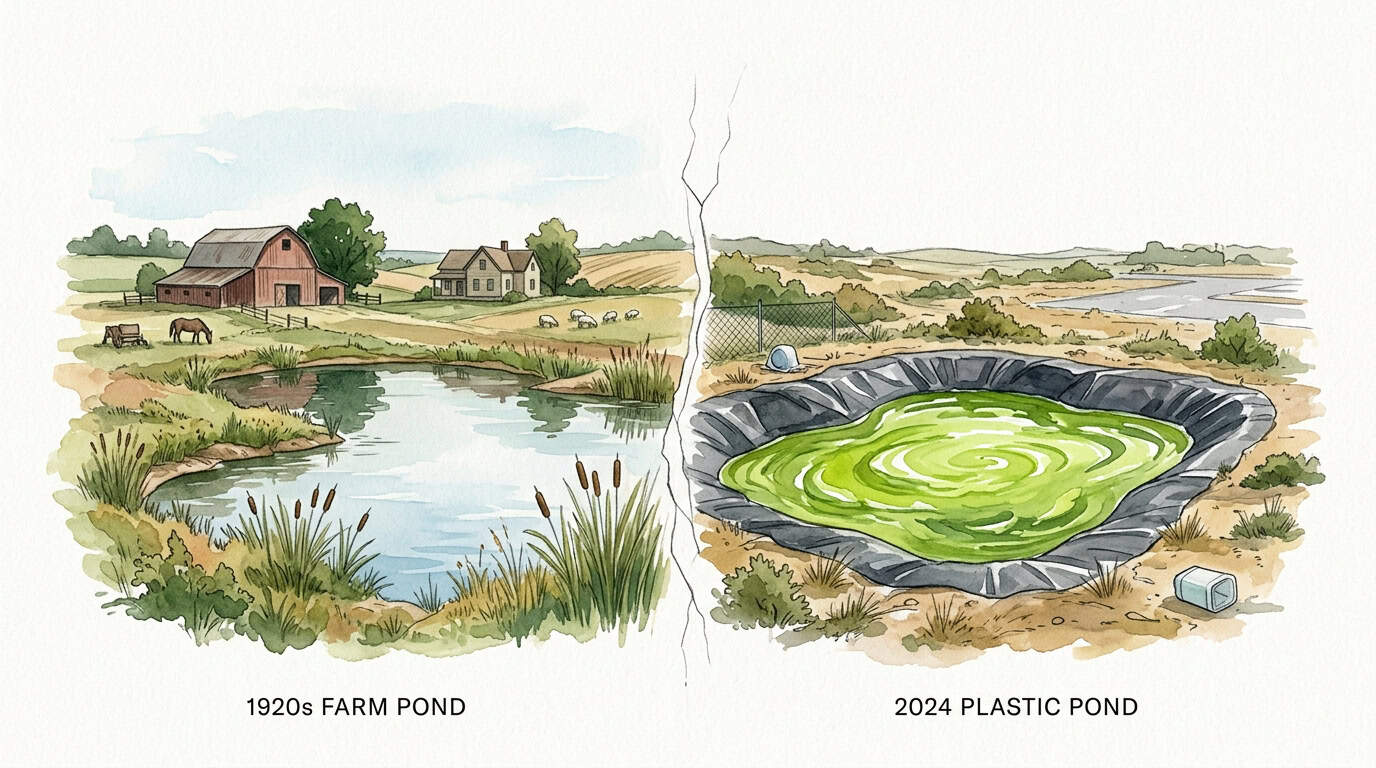
Why did your grandfather’s pond never need a filter, but yours turns green in a week?
We have traded deep, cool, complex ecosystems for shallow, hot plastic tubs. Discover the physics of why modern ponds are designed to fail—and how to apply ‘old world’ logic to keep your water crystal clear.
The modern approach to pond building often prioritizes aesthetics and ease of installation over biological stability. This leads to a constant battle against nature, involving expensive UV sterilizers, chemical additives, and high-energy mechanical filtration. Understanding the fundamental mechanics of aquatic ecosystems allows for the design of a system that manages itself through physics and biology.
Modern hobbyists frequently struggle with “pea soup” water because they ignore the thermal and chemical realities of water management. A shift in perspective from “aquarium in the ground” to “self-contained ecosystem” is required to achieve long-term clarity and health. This guide breaks down the technical requirements for a stable pond environment.

Why Modern Ponds Turn Green
Algae blooms are a symptom of an imbalance between nutrient input and nutrient export. In a modern plastic pond, the volume of water is typically too low relative to its surface area. This configuration leads to rapid temperature fluctuations and high levels of solar penetration, which are the primary catalysts for phytoplankton growth.
Most modern ponds are shallow, often less than three feet deep. This lack of depth prevents thermal stratification and allows the entire water column to heat up quickly during daylight hours. Warm water holds less dissolved oxygen than cool water, which stresses aerobic bacteria and fish, further degrading the water quality.
Nutrient loading is another critical factor. In a closed system like a backyard pond, nitrogen and phosphorus enter through fish food, decaying plant matter, and wind-blown debris. Without a massive biological filter or a high density of competing aquatic plants, these nutrients remain available for algae. Algae are opportunistic organisms that can outcompete higher plants when conditions are unstable.
The use of smooth liners like EPDM or PVC also contributes to the problem. These surfaces do not provide the necessary surface area for beneficial periphyton and biofilm to colonize. In contrast, an old farm pond with a clay bottom and rocky edges provides trillions of microscopic niches for the bacteria that process waste into harmless gases or plant food.
The Physics of Thermal Mass and Depth
The primary reason a 1920s farm pond remained clear without a pump is its thermal mass. Water has a high specific heat capacity, meaning it takes a significant amount of energy to change its temperature. A deep pond utilizes the insulating properties of the earth to maintain a stable temperature at its lower depths.
Depth creates a “thermocline,” a layer where the temperature changes rapidly. Below this layer, the water remains cool and dense. This cool water acts as a heat sink for the entire system, preventing the rapid spikes in temperature that trigger algae spores to germinate. Modern ponds, being shallow, lack this buffer and effectively become “solar cookers” for organic matter.
Gas exchange is also driven by temperature and surface agitation. In a deep pond, the ratio of surface area to total volume is optimized to prevent excessive evaporation while allowing for sufficient oxygen absorption. When a pond is too shallow and wide, evaporation rates climb, concentrating salts and nutrients, which creates a brine-like environment that favors certain types of string algae.
Pressure also plays a role at greater depths. Increased hydrostatic pressure at the bottom of a deep pond can influence the solubility of gases. While this is more relevant in large-scale limnology, the principle remains that a deeper column of water allows for more complex vertical movement of nutrients and organisms, preventing the “dead zones” common in flat-bottomed plastic ponds.
How the Ecosystem Logic Functions
To replicate the success of “old world” ponds, one must understand the nitrogen cycle as it applies to open-air systems. The process begins with ammonia, excreted by fish or produced by decaying organic matter. In a healthy system, Nitrosomonas bacteria convert ammonia into nitrites, and then Nitrobacter convert nitrites into nitrates.
Nitrates are the final product of this aerobic process and serve as the primary food source for plants. In a modern pond with no plants, these nitrates accumulate until they reach a concentration that supports a massive algae bloom. To prevent this, a biological “bog filter” or “upflow wetland” is required. This mimics the natural marshes found at the edges of stable lakes.
Water must be forced through a substrate of varying sizes—usually gravel or lava rock—where billions of nitrifying bacteria live. This substrate acts as a mechanical sieve and a biological reactor. As the water passes through the roots of aquatic plants embedded in this gravel, the plants strip the nitrates and phosphates directly from the water column.
The goal is to create “nutrient starvation” for the algae. If the higher plants (lilies, rushes, and submerged oxygenators) are consuming the nutrients as fast as they are produced, the algae have nothing to feed on. This is a competition of efficiency. Modern systems often fail because they rely on mechanical filters that trap solids but do not remove dissolved nutrients.
Benefits of Natural System Design
The primary advantage of following ecosystem logic is the drastic reduction in maintenance. A pond designed with a proper biological balance requires almost no chemical intervention. You do not need to buy “algae fix” or “clarity boosters” because the system handles its own waste processing.
Operational costs are also significantly lower. Many modern ponds require high-pressure pumps to run bead filters or pressurized canisters. These pumps consume a high amount of electricity. In contrast, a natural system uses low-head, high-volume pumps to move water through a bog filter, which requires much less energy to operate.
Longevity is a major factor. Plastic liners degrade over time, especially when exposed to UV light at the edges. A pond designed with significant rock cover and deep zones is protected from the elements. The biological maturity of the system increases over years, making it more resilient to external shocks like heavy rain or temporary power outages.
The aesthetic value of a natural pond is fundamentally different. Instead of a sterile blue or black tub, you have a living landscape. The water becomes part of the local ecology, attracting beneficial insects, birds, and amphibians that further help to control pests like mosquitoes. This creates a feedback loop of health that a filtered tub can never achieve.
Challenges and Common Design Mistakes
One of the most frequent errors is the “rock shelf” mistake. Many builders create shallow shelves around the perimeter to hold decorative rocks. These shallow areas become traps for debris and heat up rapidly in the sun, turning into “algae factories.” If you must have rocks, they should be integrated into a vertical or steeply sloped wall to minimize shallow stagnant water.
Over-stocking fish is another critical failure point. Every fish added to a pond increases the nutrient load. Most people treat a pond like an outdoor aquarium, but an ecosystem has a specific “carrying capacity.” If the fish population exceeds the ability of the plants and bacteria to process waste, the system will collapse into a green mess.
Improper pump placement often leads to “dead spots.” If the water is not circulating through the entire volume of the pond, organic matter will settle in the corners and rot anaerobically. This produces hydrogen sulfide and other toxins that can kill fish and promote the growth of harmful bacteria. The pump should be positioned to ensure total water turnover every 1-2 hours.
Using the wrong substrate in a bog filter is a common technical pitfall. If the gravel is too fine, it will clog with “muck” (detritus) within a year, leading to channeling. If it is too coarse, there isn’t enough surface area for the bacteria. A graduated approach—large rocks at the bottom, medium in the middle, and pea gravel at the top—is the standard for efficiency.
Limitations and Environmental Constraints
Natural ecosystem ponds require more space than a standard plastic tub. To achieve a self-cleaning balance, you typically need a “regeneration zone” (the planting area) that is at least 30% to 50% of the size of the main swimming or fish area. In small urban backyards, this footprint may be prohibitive.
There is a “startup lag” with biological systems. While a UV filter can clear a pond in 48 hours, a biological filter may take 6 to 8 weeks to fully colonize with bacteria and for plants to establish. During this period, the pond may look worse before it looks better. This requires a level of patience that many modern consumers lack.
Environmental factors like heavy leaf fall can overwhelm any system. If a pond is located directly under a large oak or maple tree, the sheer volume of organic matter falling into the water will exceed its processing capacity. In these cases, mechanical intervention like a skimmer or a net is mandatory, regardless of how “natural” the design is.
Climate also dictates the limits of this approach. In extremely arid regions, the evaporation from a large-surface-area pond can lead to rapid mineral buildup. This requires frequent water changes or the use of reverse osmosis water to prevent the pond from becoming too alkaline for most aquatic life.
Comparing the Old World and the Modern Approach
The following table illustrates the mechanical and biological differences between traditional farm pond logic and the typical modern plastic pond installation.
| Feature | 1920s Farm Pond Logic | 2024 Plastic Pond Logic |
|---|---|---|
| Depth | 6–15 feet (Thermal stability) | 1–3 feet (High heat gain) |
| Filtration | Biological/Wetland (Passive) | UV/Mechanical (Active) |
| Nutrient Management | Plant uptake & Sedimentation | Chemical additives & Filter pads |
| Energy Use | Zero to Low (Gravity/Wind) | High (24/7 Electric Pumps) |
| Maintenance | Seasonal (Minimal) | Weekly (Filter cleaning) |
| Ecosystem Diversity | High (Snails, frogs, microbes) | Low (Mostly just fish) |
Practical Tips for Pond Optimization
If you are struggling with a green pond, the first step is to measure your nitrate levels. If they are high, you do not need more chemicals; you need more plants. Introduce fast-growing floating plants like Water Lettuce or Water Hyacinth. These plants are incredibly efficient at pulling nutrients directly from the water column through their hanging roots.
Improve your aeration. Algae thrives in stagnant, low-oxygen environments. Adding an air stone or a waterfall increases the surface tension break, allowing carbon dioxide to escape and oxygen to enter. This supports the aerobic bacteria in your filter that are responsible for breaking down waste.
Stop overfeeding your fish. Most pond owners feed their fish daily, but in a mature ecosystem, fish should find a large portion of their diet from insects, algae, and larvae. Excess food is just raw fuel for an algae bloom. In the summer, only feed what the fish can consume in 30 seconds, and in the winter, stop feeding entirely when the water drops below 50 degrees Fahrenheit.
Utilize beneficial bacteria additives only as a “starter.” You do not need to add them every week if your biological filter is sized correctly. Instead, focus on providing the bacteria with a home—more surface area. Adding a bag of crushed lava rock to your waterfall or filter box can provide the extra square footage needed for a larger bacterial colony.
Advanced Considerations for Serious Practitioners
For those looking to optimize their system to the highest level, the Redox potential (Oxidation-Reduction Potential) is a key metric. This measures the ability of the water to “clean itself” through oxidation. A high Redox potential indicates that there is plenty of oxygen available to break down organic matter. This can be monitored with electronic probes and managed through aggressive aeration and ozone injection in extreme cases.
Understand the Phosphorus-to-Nitrogen ratio. Algae often becomes “limited” by one of these two nutrients. In many backyard ponds, Phosphorus is the limiting factor. If you can lock up the phosphorus using specialized media like lanthanum-infused clays or through specific plant species, you can stop algae growth even if nitrate levels are relatively high.
Consider the role of “Periphyton.” This is the complex mixture of algae, cyanobacteria, heterotrophic microbes, and detritus that attaches to submerged surfaces. While people hate “slime” on their rocks, this periphyton is actually a massive biological filter. In a balanced system, you want a thin layer of green/brown fuzz on every surface. Scrubbing your rocks clean actually resets the biological clock and invites a more aggressive algae bloom.
Thermal stratification management is vital for larger ponds. In summer, the bottom water can become anoxic (devoid of oxygen). Using a “bottom-to-top” aeration system or a sub-surface circulator can prevent this, ensuring that the entire volume of water remains biologically active. This prevents the “turnover” events in autumn where toxic bottom water mixes with the surface and causes fish kills.
Example Scenario: The 1,000-Gallon Retrofit
Imagine a standard 1,000-gallon “kidney bean” pond with a plastic liner, 2 feet deep, running a 2,000 GPH pump into a small pressurized canister filter. The owner fights green water every July. The solution is not a bigger UV light, but a redesign of the flow and biology.
Step one: Build a 200-gallon “upflow bog” at the head of the pond. This is a separate basin filled with 12 inches of 3/4-inch gravel. The pump is moved from the bottom of the pond to a skimmer box. The water is then pumped into the bottom of the bog, where it rises through the gravel and back into the pond via a waterfall.
Step two: Plant the bog heavily with Iris, Pickerel Weed, and Canna Lily. These plants will thrive on the fish waste being pumped into the bottom of the gravel bed. Step three: Add a layer of river rock over any exposed liner in the main pond to provide surface area for biofilm and protect the liner from UV degradation.
Results: Within six weeks, the plants in the bog begin to grow rapidly. The nitrate levels in the main pond drop from 40 ppm to near zero. The “pea soup” water clears as the phytoplankton are starved of nutrients. The owner now only needs to trim the plants once a year and empty the skimmer basket of leaves. The physics of nutrient sequestration and surface area have replaced the need for chemical intervention.
Final Thoughts
Maintaining a clear pond is a matter of managing energy and nutrients according to the laws of physics. By moving away from shallow, unbuffered plastic environments and toward deeper, plant-heavy ecosystems, we can create water features that are both beautiful and self-sustaining. The “old world” logic of grandfather’s pond was not a secret; it was simply an adherence to natural balance.
The transition from a mechanical mindset to a biological one requires patience and a willingness to let nature do the work. Focus on depth, surface area, and nutrient competition. When these three factors are in alignment, the water will remain clear regardless of the weather or the season.
Experiment with your own system by adding more biological surface area and increasing your plant density. Observe how the system responds to changes in light and temperature. The more you understand the underlying mechanics, the less you will rely on the “quick fixes” sold in bottles, leading to a more resilient and enjoyable aquatic environment.
Amazon and the Amazon logo are trademarks of Amazon.com, Inc, or its affiliates.