

Pond Talk is an Amazon Associate. As an Amazon Associate we earn from qualifying purchases.
Technical Guide to Biological Pond Infrastructure and Sustainable Algae Control
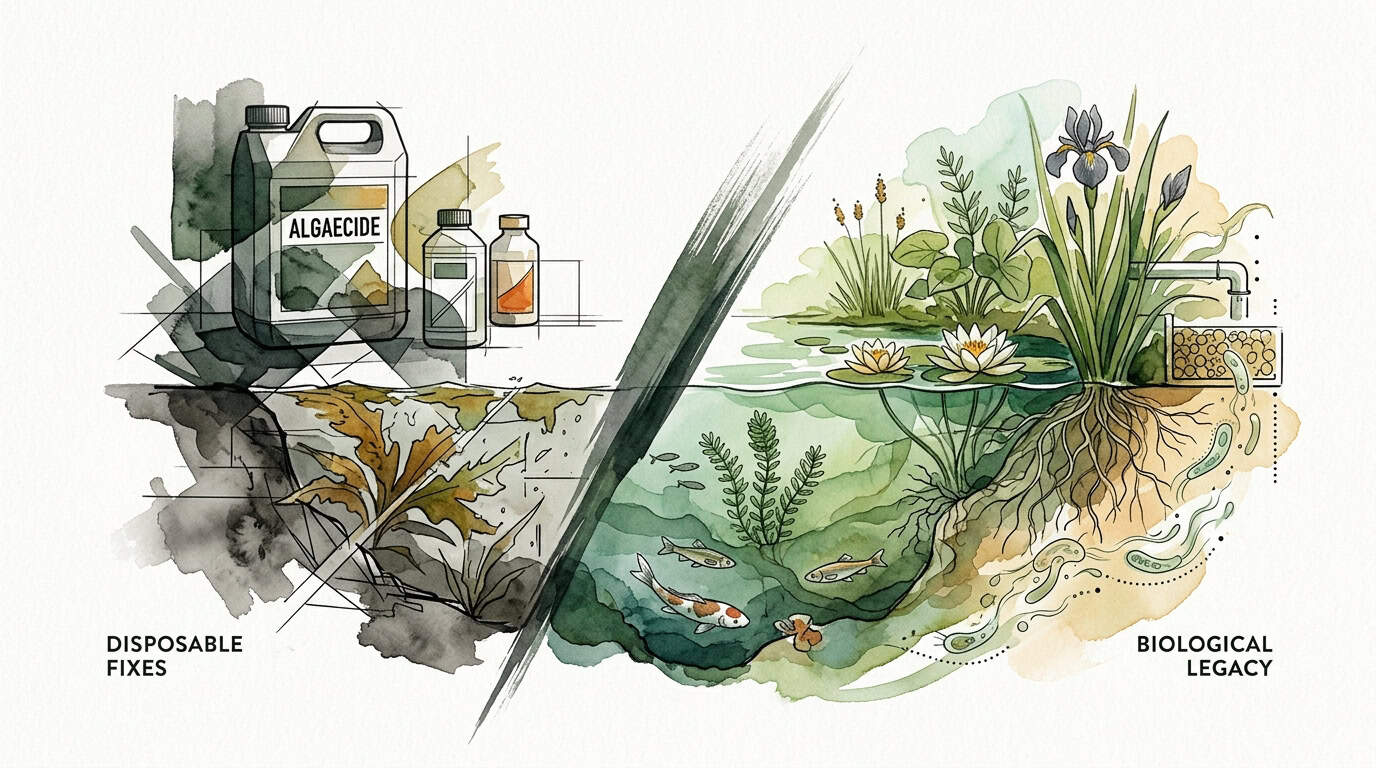
Are you buying a clear pond every weekend, or are you building one that stays clear for a lifetime? The cycle of plastic tools and monthly chemical bills is a trap. True pond mastery isn’t about what you buy at the store today; it’s about the biological infrastructure you leave for tomorrow. Shift from temporary fixes to a legacy of clear water.
Achieving permanent water clarity requires a departure from reactive maintenance. Most pond owners rely on algaecides or mechanical filtration units that provide immediate, short-lived results. These methods address the symptoms—visible algae—rather than the root cause: nutrient imbalance within the aquatic ecosystem.
A technical approach focuses on establishing a robust biological engine. This system processes organic waste into harmless gases or biomass that can be physically harvested. This guide details the mechanics of nutrient cycles and the engineering required to maintain a self-regulating pond environment.

Sustainable Pond Algae Control Systems
Sustainable pond algae control systems prioritize the management of Nitrogen (N) and Phosphorus (P) through biological competition and sequestration. Algae is an opportunistic organism that thrives when there is an abundance of dissolved nutrients and sunlight. Instead of attempting to kill the algae, a sustainable system ensures that the algae has nothing to eat.
These systems utilize high-surface-area media and specific vegetative zones to host billions of beneficial microorganisms. Nitrifying bacteria convert toxic ammonia into nitrites and then into nitrates. In a balanced system, higher-order plants or anaerobic bacteria then remove these nitrates, effectively starving the algae out of the water column.
You find these systems in professional aquaculture, large-scale koi habitats, and public botanical gardens. They function as living kidneys for the water. While a plastic canister filter might handle solids, a sustainable biological system manages the chemical makeup of the water at a molecular level.
Visualizing this concept involves looking at the pond as a closed loop. Every gram of fish food added to the system is an input of nitrogen and phosphorus. If the biological infrastructure is insufficient to process this input, algae will inevitably grow to fill the void. Building a sustainable system is an exercise in increasing the processing capacity of the pond’s “living filter.”
How Biological Nutrient Export Functions
Effective algae control relies on the principles of the nitrogen cycle and phosphate binding. The process begins with mechanical pre-filtration to remove large solids before they break down. This prevents the biological stage from becoming clogged with debris, which would reduce oxygen levels and efficiency.
The primary engine of the system is the aerobic bio-reactor. This stage uses specialized media with high Specific Surface Area (SSA). Media such as K1 micro-spheres or high-density ceramic rings provide the housing for Nitrosomonas and Nitrobacter bacteria. These microbes require constant oxygenation to perform the oxidation of ammonia.
Secondary processing involves anoxic or anaerobic zones. In these low-oxygen environments, different strains of bacteria strip oxygen molecules from nitrates (NO3), releasing nitrogen gas (N2) into the atmosphere. This process, known as denitrification, is the only way to “permanently” remove nitrogen from the water without physical harvesting.
Vegetative filtration, or bog filtering, serves as a tertiary stage. Plants like Anacharis or Water Hyacinth act as nutrient sinks. They absorb phosphates and nitrates directly into their tissue. Regularly trimming and removing these plants physically exports the nutrients from the system, preventing them from recycling back into the water upon plant decay.
Advantages of Biological Infrastructure
Structural biological systems offer significantly higher stability compared to chemical interventions. A well-established bio-film can withstand minor fluctuations in temperature or bioload without failing. This creates a “buffer” that prevents the sudden algae blooms commonly seen after heavy rains or heatwaves.
Operational expenditure (OPEX) is drastically lower over the long term. While the initial investment in high-quality media and pump infrastructure may be higher, the recurring cost of algaecides, flocculants, and replacement UV bulbs is virtually eliminated. The system relies on natural metabolic processes rather than expensive synthetic compounds.
Water quality metrics remain consistent in biological systems. Chemical treatments often cause “yo-yoing” water chemistry, where oxygen levels plummet as algae dies off, leading to fish stress and further nutrient release. Biological systems maintain high dissolved oxygen levels and stable pH, which are critical for the health of ornamental fish and indigenous microfauna.
Scalability is another major benefit. Biological filters can be expanded by simply increasing the volume of media or the size of the bog zone. This allows the system to grow alongside the fish population, ensuring that as the bioload increases, the filtration capacity remains adequate to prevent nutrient accumulation.
Common Pitfalls in Pond Management
Cleaning biological media with chlorinated tap water is a frequent error. Chlorine and chloramines are designed to kill bacteria; rinsing a bio-filter with a garden hose can annihilate months of bacterial growth in minutes. This triggers a “new pond syndrome” where ammonia spikes and algae blooms because the biological engine has been turned off.
Undersizing the filtration system based on “manufacturer recommendations” often leads to failure. Many commercial filters are rated for ponds without fish. Once a fish load is introduced, the nutrient input exceeds the filter’s processing capacity. Engineers should always calculate the filtration requirements based on the total daily protein input (fish food) rather than just the water volume.
Over-reliance on Ultraviolet (UV) clarifiers can mask underlying issues. A UV light will kill suspended algae (green water), but it does nothing to remove the nitrates and phosphates that the algae was feeding on. This leaves the water clear but chemically “loaded,” which can lead to outbreaks of filamentous algae (string algae) that the UV light cannot reach.
Inadequate oxygenation is a silent killer of biological systems. Nitrifying bacteria are highly aerobic. If the water’s dissolved oxygen (DO) levels drop—due to heat or lack of agitation—the bacteria become dormant or die. This stops the nutrient conversion process, allowing ammonia to build up and creating an environment where anaerobic pathogens can thrive.
Limitations of Biological Systems
Space requirements are a primary constraint for biological infrastructure. A truly effective bog filter should ideally cover 10% to 25% of the pond’s total surface area. In small urban yards, dedicating this much space to filtration can be difficult, forcing a reliance on more compact, less efficient mechanical solutions.
Initial “cycling” time is a mandatory waiting period that cannot be bypassed. It takes weeks or even months for a robust bacterial colony to establish itself on new media. During this phase, the pond remains vulnerable to algae blooms and water quality fluctuations. Impatient hobbyists often turn to chemicals during this window, which further delays the biological establishment.
Seasonal performance variations occur in temperate climates. Bacterial metabolism slows down significantly as water temperatures drop below 50°F (10°C). While nutrient levels also tend to drop in winter, the transition periods of spring and fall can be challenging as the bio-load increases before the bacteria have fully “woken up.”
System complexity increases with the addition of specialized zones. Managing a bog filter requires knowledge of aquatic plant care and sediment management. If the bog is not designed with a “clean-out” port, it can eventually become a source of pollution as trapped solids rot in the substrate, releasing hydrogen sulfide gas.
Comparison of Filtration Strategies
| Feature | Chemical/Mechanical (Disposable) | Biological Infrastructure (Legacy) |
|---|---|---|
| Initial Cost | Moderate | High |
| Ongoing Cost | High (Chemicals & Parts) | Very Low (Electricity only) |
| Water Stability | Fluctuating | High / Self-Regulating |
| Maintenance Frequency | Weekly / Bi-Weekly | Monthly / Seasonal |
| Nutrient Export | None (Recycles) | Active (Gas & Biomass) |
Practical Tips for System Optimization
Monitor the Carbonate Hardness (KH) of your water regularly. Nitrification is an acid-producing process that consumes carbonates. If the KH drops too low, the pH will crash, killing the beneficial bacteria and potentially the fish. Maintaining a KH of at least 100-150 ppm ensures the biological filter has the “fuel” it needs to operate.
Select filter media based on protected surface area rather than total volume. Bacteria grow in the “nooks and crannies” that are protected from heavy water shear. Fluidized bed media like K1 are highly efficient because the constant motion knocks off dead bio-film, ensuring that only the most active, young bacteria are processing the water.
Implement a “pre-filter” sieve or drum filter before the biological stage. Removing solids before they enter the bio-chamber prevents the media from becoming “sludged up.” This maintains high oxygen levels in the bio-filter and ensures that every square inch of surface area is available for nitrifying bacteria.
- Maintain a total pond volume turnover of at least once per hour.
- Ensure the pump intake is located at the opposite end from the return to prevent “dead zones.”
- Use air stones directly underneath submerged bio-media to maximize oxygen saturation.
- Avoid overfeeding; only provide what the fish can consume in two minutes to reduce nutrient loading.
Advanced Considerations for Water Chemistry
Redox Potential (ORP) is a valuable metric for advanced practitioners. Oxygen Reduction Potential measures the “cleansing power” of the water. A higher ORP indicates that the water has a high capacity to oxidize organic waste. Biological systems naturally tend toward a healthy ORP range (250mV to 350mV), whereas overloaded systems will show much lower values.
Dissolved Oxygen (DO) levels fluctuate based on temperature and salinity. Warm water holds less oxygen than cold water. In high-stocking-density environments, supplemental aeration is non-negotiable. If DO levels drop below 6 mg/L, the metabolic rate of nitrifying bacteria slows down, leading to a temporary spike in ammonia and nitrite.
Phosphate binding using lanthanum-modified clay or specialized resins can be used in the initial stages of a pond build. While the biological system is maturing, these binders physically lock up phosphates, making them unavailable to algae. This acts as a bridge to prevent “green water” while the plants and bacteria establish their dominance.
Denitrification in deep gravel beds or specialized anoxic filters (such as the Kevin Novak Anoxic Filtration System) targets the removal of nitrates. These systems use iron-rich clay (laterite) to create specific electrical charges that pull ions into the media where facultative anaerobic bacteria can process them. This is the pinnacle of biological infrastructure.
Example Scenario: Overhauling a 2,000-Gallon Pond
Consider a 2,000-gallon pond that suffers from chronic string algae and high nitrate levels (40+ ppm). The current setup uses a standard pressurized canister filter with a 25-watt UV light. Despite the UV light, the water is clear but the rocks are covered in thick green mats.
The overhaul begins by installing a 200-gallon bog filter alongside the pond. The bog is filled with 3/8″ pea gravel and planted heavily with Iris and Pickerel Rush. A new pump ensures a flow rate of 2,500 gallons per hour, directing 50% of the flow through the bog and 50% through a new moving-bed bio-reactor filled with 50 liters of K1 media.
After six weeks, the Iris plants show significant growth, indicating they are actively sequestering nitrogen. Nitrate levels in the water drop to 5 ppm. Because the nutrients are being absorbed by the bog plants and processed by the moving bed media, the string algae begins to turn brown and detach from the rocks. The “biological legacy” is now established, and the owner no longer needs to apply weekly algaecide treatments.
Total maintenance now consists of emptying a pre-filter basket once a week and trimming the bog plants once a month. The chemical balance is maintained by the ecosystem rather than the owner’s wallet.
Final Thoughts
Establishing a sustainable pond algae control system is an investment in biological engineering. By focusing on the infrastructure—surface area, oxygenation, and nutrient export—you create an environment where water clarity is a natural byproduct of a healthy ecosystem. This approach moves away from the “disposable fix” mentality and toward a permanent, self-sustaining legacy.
True mastery of the pond environment requires patience and a technical understanding of the nitrogen cycle. While chemical shortcuts offer immediate gratification, they fail to address the underlying nutrient load. Building a robust biological engine ensures that your pond remains a source of clarity and stability for years to come.
As you continue to refine your system, focus on the data. Monitor your nitrate and phosphate levels, observe the growth rates of your aquatic plants, and adjust your filtration capacity to match your fish population. The transition from a consumer of pond products to a manager of an aquatic ecosystem is the most effective way to achieve permanent water clarity.
Amazon and the Amazon logo are trademarks of Amazon.com, Inc, or its affiliates.