

Pond Talk is an Amazon Associate. As an Amazon Associate we earn from qualifying purchases.
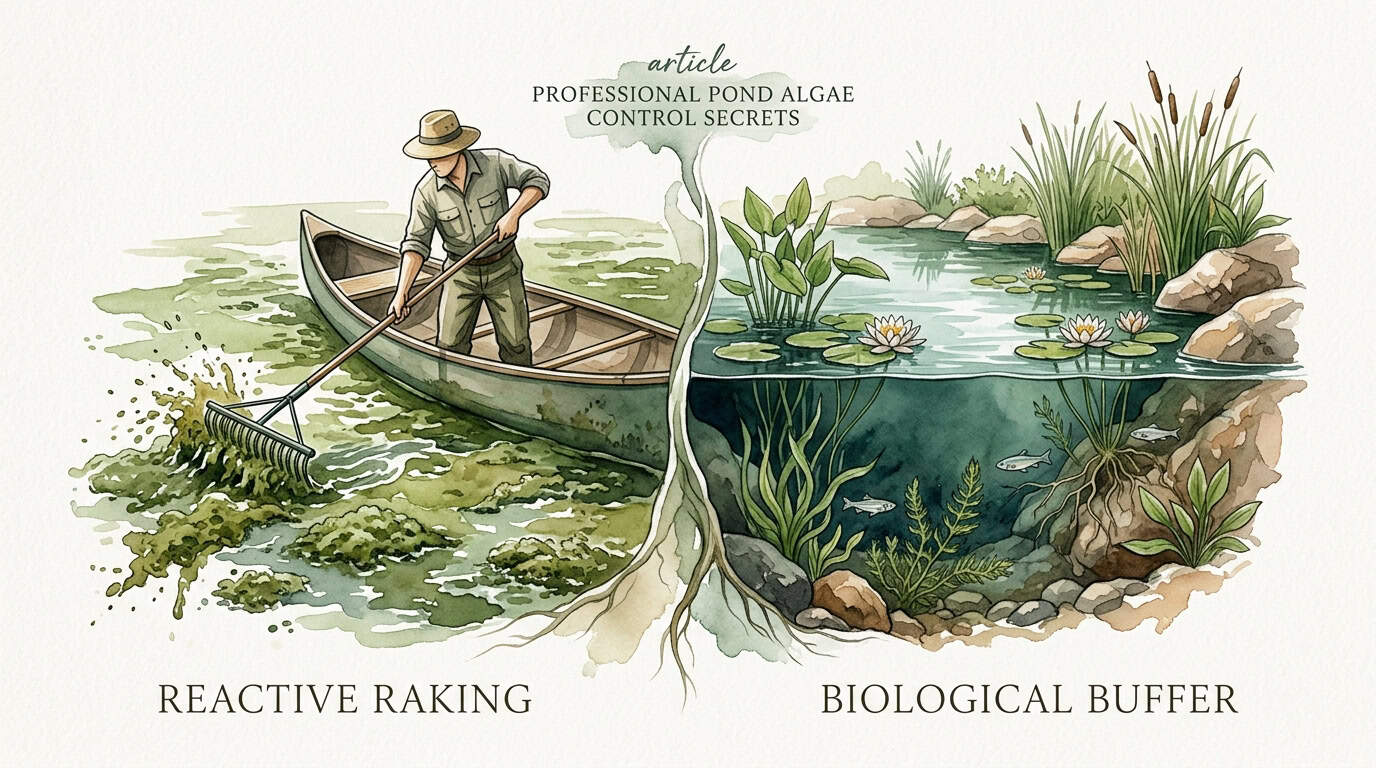
Professionals never touch a rake; they let the water’s biology do the heavy lifting. If you are spending every Saturday pulling slime, you are treating the symptom, not the source. Learn how pro pond managers build ‘biological buffers’ that make algae growth physically impossible.
Water management is often misunderstood as a mechanical cleaning task. Most pond owners view algae as an invader that needs to be removed physically or killed with chemicals. Professional pond managers view algae as a biological indicator of a nutrient surplus. This guide explains how to shift from reactive maintenance to proactive biological engineering.
Managing a pond requires an understanding of the nitrogen and phosphorus cycles. When these cycles are balanced, the water remains clear because the nutrients are consumed by beneficial organisms before algae can access them. This state of equilibrium is what professionals call a biological buffer.

Professional Pond Algae Control Secrets
Professional pond algae control focuses on the limitation of essential growth factors. Algae requires three main components to thrive: sunlight, warm temperatures, and nutrients (specifically nitrogen and phosphorus). While sunlight and temperature are often outside of an operator’s control, the nutrient profile of the water is a variable that can be manipulated.
The secret to professional-grade clarity is the transition from reactive raking to the establishment of a robust microbial community. Professionals use specific strains of heterotrophic bacteria to outcompete algae for dissolved nutrients. This process is known as nutrient sequestering. When the bacterial population is high enough, it consumes the bio-available phosphorus (BAP) that algae needs to reproduce.
Biological buffers act as a metabolic sink. These systems consist of high-surface-area media, aerobic environments, and diverse bacterial colonies that process organic waste. Instead of allowing muck to accumulate on the pond floor, these buffers break down organic matter into harmless gases or stable mineral forms. This prevents the “internal loading” effect where decaying matter at the bottom fuels new algae blooms in the spring.
How the Biological Buffer Works
A biological buffer operates on the principle of competitive exclusion. In any aquatic environment, organisms compete for the same limited resources. If you saturate the environment with beneficial bacteria, those bacteria will utilize the available nitrogen and phosphorus, leaving nothing for the algae.
Nitrification is the first stage of this process. Aerobic bacteria, specifically Nitrosomonas and Nitrobacter, convert toxic ammonia into nitrites and then into nitrates. While nitrates can still fuel plant growth, they are much less toxic to aquatic life than ammonia. A professional system ensures that this conversion happens rapidly to prevent ammonia spikes that stress fish and encourage certain types of filamentous algae.
Denitrification is the second stage, often overlooked in basic pond setups. This occurs in anaerobic or hypoxic zones where specific bacteria convert nitrates into nitrogen gas, which then escapes into the atmosphere. Professionals carefully balance these zones to ensure that nitrogen is actually removed from the system rather than just changing form.
Phosphorus management is the final and most critical component. Unlike nitrogen, phosphorus does not have a gas phase in the pond cycle. It must be either consumed by plants and bacteria or chemically bound into the sediment. Professionals use biological catalysts to increase the rate at which bacteria sequester phosphorus into their cellular structure, effectively locking it away from algae.
Benefits of Biological Nutrient Management
The primary advantage of a biological approach is long-term stability. Chemical treatments provide a quick “kill” but often result in a rebound effect. When algae dies off rapidly from an algicide, it sinks to the bottom and decays, releasing all its stored nutrients back into the water. This creates a feedback loop that requires more chemicals over time.
Operational efficiency is significantly higher with biological buffers. Once a microbial community is established, the man-hours required for pond maintenance drop by roughly 80%. There is no need for manual raking, and the frequency of water testing and chemical application is greatly reduced.
Environmental health is another major benefit. Biological management preserves the delicate balance of the pond’s ecosystem. Excessive chemical use can harm non-target species, including beneficial insects, amphibians, and zooplankton. A biologically buffered pond supports a diverse food web, which further helps in controlling algae through natural predation.
The reduction in “muck” or organic sludge is a measurable benefit of this method. Heterotrophic bacteria are capable of digesting the organic layer at the bottom of the pond, effectively “dredging” the pond biologically. This increases the total volume of the pond and improves water clarity by reducing suspended solids.
Challenges and Common Pitfalls
Establishing a biological buffer is not an instantaneous process. One of the most common mistakes is lack of patience. Bacterial colonies require time to colonize surfaces and reach a population density capable of impacting nutrient levels. Many operators abandon the method after two weeks because they do not see immediate results, reverting to harsh chemicals that kill the very bacteria they were trying to grow.
Oxygen levels are the most frequent point of failure. The bacteria required for high-efficiency nutrient cycling are aerobic, meaning they require dissolved oxygen (DO) to function. If a pond has poor circulation or low DO levels, the biological buffer will collapse. This leads to an anaerobic state where nutrients are released from the sediment even faster, exacerbating algae problems.
Alkalinity and pH fluctuations can also stall biological progress. Nitrifying bacteria consume carbonates as they process nitrogen. If the pond’s alkalinity (KH) is too low, the pH will crash, which can be lethal to both the bacteria and the fish. Professionals monitor KH levels and supplement with carbonates to keep the biological engine running smoothly.
Temperature sensitivity is a realistic challenge. Microbial activity slows down significantly as water temperatures drop below 50 degrees Fahrenheit. A system that works perfectly in July may seem stagnant in November. Understanding the metabolic rates of different bacterial strains at various temperatures is essential for year-round management.
Limitations of Biological Control
Biological buffers have physical limits regarding the amount of waste they can process. In systems with extreme “external loading,” such as ponds receiving heavy agricultural runoff or those with a massive overpopulation of waterfowl, biology alone may not be enough. The inflow of nutrients must be managed alongside the internal biological capacity.
The depth of the pond can also be a limiting factor. Shallow ponds (less than 4 feet) heat up quickly and have a high surface-area-to-volume ratio, making them more prone to rapid algae blooms. In these cases, the biological buffer must be significantly oversized to handle the thermal stress and high light penetration.
Physical space for bio-media is sometimes a constraint. To process a specific amount of nitrogen, you need a specific amount of surface area for bacteria to grow. If the pond design does not allow for a large enough bio-filter or “bog” area, the system will never reach full efficiency.
Extreme pH levels also limit biological efficacy. If the source water is naturally very acidic or very alkaline, the types of bacteria that can survive are limited. This reduces the diversity of the microbial community and makes the pond more susceptible to specific types of hardy algae that thrive in those conditions.
Comparison: Reactive Raking vs. Biological Buffer
The following table compares the two primary methods of pond management based on operational metrics.
| Metric | Reactive Raking/Chemicals | Biological Buffer System |
|---|---|---|
| Labor Intensity | High (Weekly tasks) | Low (Monthly monitoring) |
| Initial Cost | Low (Tool cost) | Moderate (Equipment/Bacteria) |
| Long-term Cost | High (Recurring chemicals) | Low (Minimal inputs) |
| Nutrient Levels | High (Stored in muck) | Low (Sequestered/Gassed off) |
| Ecosystem Impact | Negative (Disruptive) | Positive (Supportive) |
Practical Tips for Implementation
Start by maximizing Dissolved Oxygen. Aeration is the engine that drives the biological buffer. Use bottom-mounted diffusers rather than surface fountains to ensure the entire water column is oxygenated. Professional standards suggest a turnover rate of at least 1.5 to 2 times every 24 hours.
Introduce a diverse blend of bacterial strains. Single-strain products are rarely effective in the complex environment of a pond. Look for products containing both Bacillus and Pseudomonas strains, as these are highly effective at breaking down different types of organic matter. Apply bacteria when water temperatures are rising for maximum colonization efficiency.
Monitor your Carbon-to-Nitrogen (C:N) ratio. Bacteria need carbon to process nitrogen. In some very clean or “new” ponds, the bacteria may be carbon-limited. Adding a small amount of liquid carbon or specialized “bio-catalysts” can jumpstart the nutrient sequestering process.
Manage the “littoral zone.” The shallow areas around the edge of the pond are where most biological activity occurs. Planting native aquatic vegetation in these areas creates a natural bio-filter. These plants compete directly with algae for nutrients and provide a massive amount of surface area for beneficial biofilm to grow.
Advanced Considerations for Professionals
Advanced practitioners focus on the Redox potential of the water. Oxidation-Reduction Potential (ORP) is a measurement of the water’s ability to cleanse itself. A high ORP indicates that the water has a strong capacity to oxidize organic waste. Professionals use ORP meters to fine-tune their aeration and bacterial dosing schedules.
Enzyme supplementation is another advanced technique. Enzymes are not alive; they are biological catalysts that break down complex organic molecules into simpler forms that bacteria can consume more easily. In ponds with heavy leaf fall or thick muck layers, adding cellulase and protease enzymes can double the speed of organic decomposition.
Total Suspended Solids (TSS) management is critical for water clarity. Even if nutrients are low, a pond can look “dirty” if fine particles are suspended in the water. Professionals use flocculants or ionic polymers to bind these particles together, allowing them to sink to the bottom where the biological buffer can process them.
Substrate selection in the bio-filter is a science of its own. The Specific Surface Area (SSA) of the media determines the maximum bacterial load the system can support. Materials like expanded clay, specialized plastics, or volcanic rock provide thousands of square feet of surface area in a small footprint, allowing for highly compact and efficient biological buffers.
Scenario: The 500,000-Gallon Nutrient Load
Consider a 500,000-gallon pond that receives runoff from a nearby lawn. This pond has an estimated phosphorus input of 5 pounds per year. In a standard pond, 5 pounds of phosphorus can theoretically support the growth of 2,500 pounds of wet algae.
A professional manager installs a biological buffer consisting of a high-efficiency aeration system and a monthly bacterial inoculation program. By maintaining DO levels at 8 mg/L and providing a bio-media surface area of 50,000 square feet, the microbial community is able to sequester 4.5 pounds of that phosphorus into bacterial biomass or stable sediment.
The result is that only 0.5 pounds of phosphorus remain bio-available for algae. This reduces the potential algae growth from 2,500 pounds down to just 250 pounds, which is easily managed by the pond’s natural zooplankton population. The water remains clear, and no raking or algicides are required throughout the season.
Final Thoughts
Shifting from reactive maintenance to a biological buffer system is the hallmark of professional pond management. By focusing on the underlying nutrient cycles rather than the visual symptom of algae, you create a self-sustaining ecosystem that requires less work and fewer chemicals. The key is to provide the right environment—oxygen, surface area, and alkalinity—for beneficial biology to thrive.
Success in this approach requires a long-term perspective and an understanding of aquatic microbiology. While the initial setup may involve more technical planning than simply buying a rake, the dividends in water quality and time saved are substantial. Professionals don’t fight nature; they optimize it.
As you implement these strategies, remember that every pond is a unique chemical and biological environment. Start with the basics of aeration and bacterial supplementation, monitor your results with data, and adjust your inputs based on the specific needs of your water. With consistency, you can achieve a state of permanent clarity that makes manual algae removal a thing of the past.
Amazon and the Amazon logo are trademarks of Amazon.com, Inc, or its affiliates.