

Pond Talk is an Amazon Associate. As an Amazon Associate we earn from qualifying purchases.
If your pond is an island, it is destined to become a swamp. Most algae problems start 20 feet away from the water. Integrating your pond into a larger garden system turns toxic runoff into life-giving resources and stops the green bloom before it starts. This approach treats the pond not as a static ornament but as a functional component of a hydrological cycle.
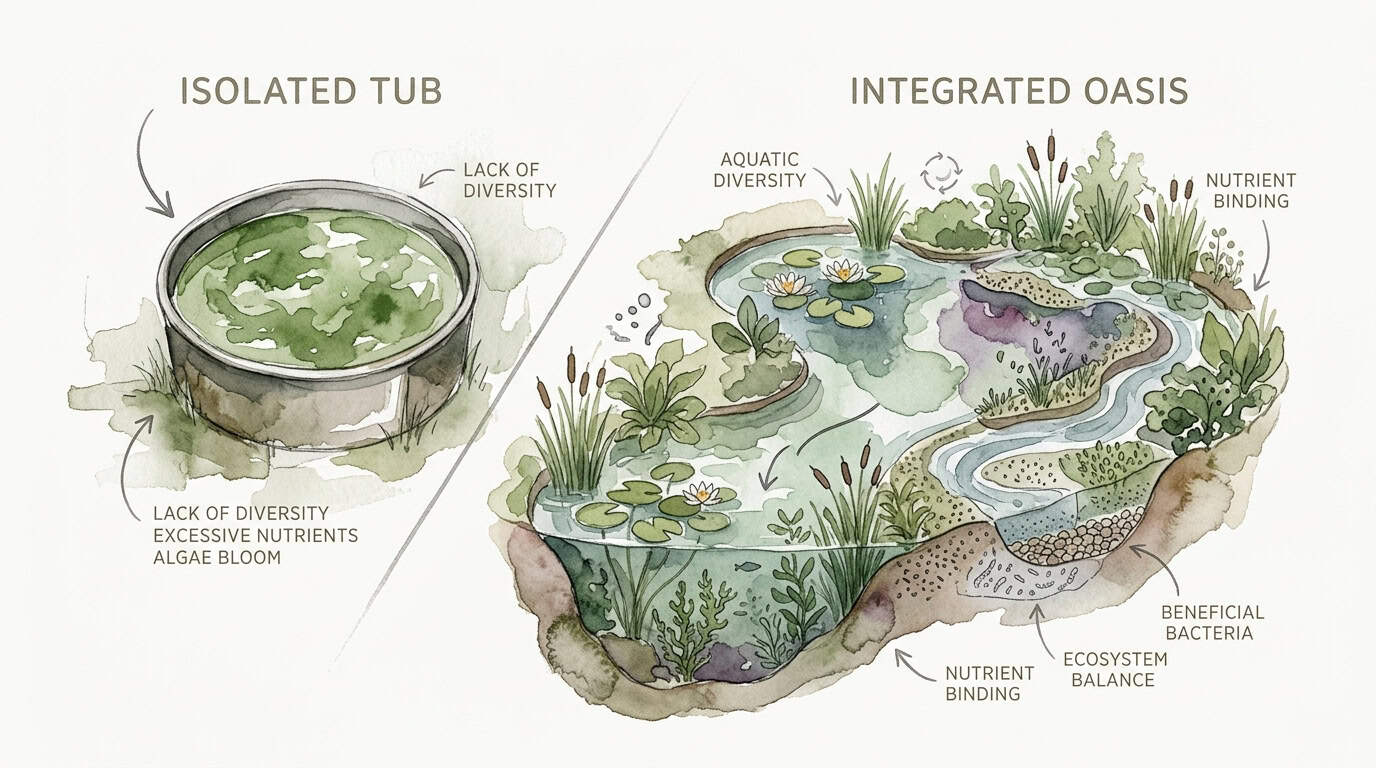
Traditional pond management relies on mechanical filtration, chemical additives, and high-energy ultraviolet sterilizers. These methods attempt to isolate the water body from its environment. In contrast, permaculture design treats the pond as a biological engine. It uses the surrounding landscape to pre-filter water, regulate temperature, and cycle nutrients through multiple trophic levels before they can fuel an algae outbreak.
Achieving a balanced aquatic ecosystem requires an understanding of nutrient loading and sediment transport. When nitrogen and phosphorus enter an isolated pond through surface runoff, they have nowhere to go. Algae, being the most opportunistic organism in the water column, rapidly consumes these nutrients. Designing a pond as an integrated oasis ensures that terrestrial and marginal plants intercept these nutrients first.

This technical guide explores the mechanics of designing a pond system that self-regulates. We will examine the transition from an isolated tub to an integrated oasis, focusing on the biological and physical parameters that dictate water clarity and system health.
Permaculture Pond Design For Algae
Permaculture pond design for algae focuses on the principle of nutrient sequestration. In a standard backyard pond, water is often kept in a plastic or rubber liner with minimal interaction with the surrounding soil. This creates a closed system where any organic matter—leaves, grass clippings, or fish waste—accumulates at the bottom. Without a mechanism to remove these nutrients, the water becomes hyper-eutrophic, leading to massive algae blooms.
A permaculture pond functions as a nutrient sink that is actively “mined” by plants. The design incorporates a watershed-first mentality. This means the designer looks at the entire drainage area contributing to the pond. Instead of allowing raw runoff to enter the water, the design uses “zones” of vegetation and physical barriers to process water before it reaches the main basin.
In real-world applications, this design is used in farm ponds, ecological restoration projects, and high-efficiency residential landscapes. The goal is to maximize the “edge effect,” which is the interface between land and water. This edge is where the highest biological activity occurs. By increasing the complexity of this interface, we increase the system’s capacity to process nitrogen and phosphorus.
The system works by mimicking natural wetlands. In nature, ponds are rarely isolated; they are connected to swales, marshes, and ephemeral streams. These features slow the movement of water, allowing sediment to drop out of suspension and plants to absorb dissolved minerals. When applied to pond design, these natural features become deliberate engineering choices that prevent the conditions that favor algae growth.
How It Works: The Mechanics of Nutrient Cycling
The primary driver of algae growth is an excess of dissolved nutrients, specifically nitrogen (N) and phosphorus (P). To control algae, the pond design must provide a more efficient way to utilize these nutrients. This is achieved through three primary mechanisms: biological filtration, physical sedimentation, and competitive exclusion.
Biological filtration occurs in the “bog filter” or “regeneration zone.” This is a shallow area of the pond, or a secondary basin, filled with porous gravel and planted with aggressive aquatic macrophytes. As water is circulated through the gravel bed, nitrifying bacteria convert ammonia into nitrites and then nitrates. The plants then absorb these nitrates for growth. This process removes the primary food source for algae from the water column.
Physical sedimentation involves the use of swales and silt traps. A swale is a level-bottomed trench dug on the contour of the land. When it rains, water fills the swale instead of rushing directly into the pond. The swale allows the water to infiltrate the soil, where terrestrial plants can filter it. Any water that eventually reaches the pond has been “pre-cleaned” by the soil and root systems of the surrounding garden.
Competitive exclusion is the use of higher plants to outcompete algae for light and nutrients. Floating-leaf plants, such as water lilies, provide shade that lowers water temperature and limits the light available for photosynthesis in the lower water columns. Submerged oxygenators, such as Hornwort or Anacharis, absorb nutrients directly from the water, leaving little for the algae to consume.
To implement this, follow these steps:
- Identify the primary drainage paths on your property and intercept them with vegetated swales.
- Design the pond with varying depth zones, including a dedicated regeneration zone that comprises at least 30% of the total surface area.
- Install a low-energy pump to circulate water from the deep zone through the bog filter.
- Plant a diverse polyculture of marginal, floating, and submerged plants to ensure year-round nutrient uptake.
Benefits of Integrated Pond Systems
The most immediate benefit of an integrated pond system is the drastic reduction in manual maintenance. Because the system is designed to process its own waste, the need for chemical treatments or frequent mechanical filter cleaning is nearly eliminated. The biological load is managed by the ecosystem itself, leading to long-term stability.
Water quality is significantly higher in integrated systems. The continuous biological filtration provided by the bog and swale system results in water that is not only clear but also chemically balanced. This creates a safer environment for aquatic life, such as fish and beneficial invertebrates, which further contribute to algae control by grazing on any small outbreaks that do occur.
Thermal stability is another major advantage. Isolated ponds, especially those with dark liners, can fluctuate wildly in temperature. Integrated ponds are often buffered by the surrounding vegetation and the cooling effect of the soil in the swales. Cooler water holds more dissolved oxygen, which is critical for the aerobic bacteria that break down organic sludge at the bottom of the pond.
The creation of a diverse habitat is a functional benefit. Integrated ponds attract dragonflies, which prey on mosquitoes, and frogs, which consume pests. This biodiversity creates a resilient system that can withstand environmental stressors, such as heatwaves or heavy rainfall, without collapsing into a “swamp” state.
Challenges and Common Mistakes
A frequent error in pond design is the failure to calculate the nutrient load relative to the plant biomass. If a pond has a large fish population but a small regeneration zone, the plants will be overwhelmed. The excess nutrients will inevitably result in algae. Maintaining a proper ratio between the “waste producers” (fish and runoff) and the “waste processors” (plants and bacteria) is essential.
Poor sediment management is another common pitfall. If swales are not properly sized or if the pond lacks a silt trap, heavy rains will wash loose soil directly into the basin. This soil carries phosphorus, which is often the limiting nutrient for algae growth. Once phosphorus enters the pond and settles into the bottom muck, it is difficult to remove and will continue to fuel algae for years.
Inadequate water circulation can lead to anaerobic zones. These “dead zones” occur in deep pockets where oxygen levels are low. In these conditions, different sets of bacteria take over, releasing hydrogen sulfide and phosphorus back into the water column. This “internal loading” can trigger algae blooms even if the external runoff is clean. Ensuring that water moves through all areas of the pond, particularly the bog filter, is vital.
Selecting the wrong plants can also cause issues. Some ornamental plants are not aggressive enough to compete with algae, while others might become invasive and choke the entire pond. Researching native aquatic species that are adapted to the local climate and nutrient levels is a necessary step in the design process.
Limitations and Environmental Constraints
Integrated pond systems require more physical space than isolated tubs. Because the design relies on swales, bog filters, and riparian buffers, it may not be suitable for very small urban lots where every square foot is paved. The landscape must be able to accommodate the “20 feet away” infrastructure that makes the system work.
Soil type plays a major role in the effectiveness of swales. In heavy clay soils, infiltration rates are slow, which may lead to standing water in the swales for extended periods. In very sandy soils, water might move too quickly to be properly filtered. Designers must adjust the size and composition of their swales to account for these geological realities.
Climate constraints also exist. In extremely arid environments, the increased surface area of an integrated pond system can lead to high evaporation rates. While the pond may be healthy, the water loss might be unsustainable without a reliable source of replenishment. Conversely, in areas with extreme rainfall, the system must be designed with robust overflow channels to prevent erosion and the loss of the biological filter during floods.
Local regulations and building codes can sometimes limit the use of integrated systems. Some municipalities have strict rules regarding standing water or the redirection of stormwater. It is important to verify that swales and “natural” filtration systems are compliant with local drainage laws before beginning construction.
Comparison: Isolated Tub vs. Integrated Oasis
To understand the efficiency of these two approaches, we can compare them across several key metrics including maintenance, cost, and ecological impact.
| Feature | Isolated Tub (Standard) | Integrated Oasis (Permaculture) |
|---|---|---|
| Filtration | Mechanical/UV (Energy intensive) | Biological/Bog (Passive) |
| Algae Control | Chemical/Manual removal | Nutrient sequestration/Shading |
| Water Source | Tap water/Direct runoff | Filtered through swales/Soil |
| Cost (Initial) | Medium (Equipment costs) | High (Earthworks/Plants) |
| Cost (Long-term) | High (Energy/Chemicals/Replacement) | Low (Self-sustaining) |
| Resilience | Low (System crashes easily) | High (Buffer capacity) |
The isolated tub model is essentially a life-support system. If the power goes out or the pump breaks, the system begins to degrade immediately. The integrated oasis model is a living entity. It possesses inherent stability because the biological processes are distributed throughout the landscape rather than being concentrated in a single mechanical filter.
Practical Tips and Best Practices
Optimizing a permaculture pond requires attention to detail in the early stages of construction. Use “stepped” pond edges rather than steep slopes. This allows for the planting of different species at various depths, which maximizes the nutrient-absorbing surface area. A shelf at 6 inches deep is perfect for sedges and rushes, while a shelf at 18 inches supports lilies and lotuses.
Incorporate a “forebay” or a small sediment pond before the main body of water. This acts as a primary settling tank. It is much easier to clean out a small 4-foot basin every few years than to dredge a large pond. The forebay captures the heaviest sediments and the bulk of the organic debris entering the system.
Utilize the “Edge Effect” by creating a serpentine shoreline rather than a circle. A convoluted edge increases the linear feet of the riparian zone. This means more plants are in contact with the water, providing more filtration and more habitat for beneficial insects. The more “wiggles” in your shoreline, the more work the pond does for you.
Select plants based on their functional roles. “Workhorse” plants like Scirpus (Bulrush) and Typha (Cattail) are excellent for nutrient removal but can be aggressive. Balance them with “ornamental” filters like Iris pseudacorus (Yellow Flag Iris) or Pontederia cordata (Pickerelweed). Always prioritize native species to avoid introducing invasive plants into the local watershed.
Advanced Considerations for Serious Practitioners
For those looking to push the efficiency of their pond system, consider the integration of biochar. Placing bags of biochar in the water flow within the bog filter provides a massive surface area for microbial colonization. Biochar also has a high cation exchange capacity, meaning it can chemically bind certain pollutants and nutrients, holding them until plants can take them up.
Analyzing the Redfield Ratio (the ratio of nitrogen to phosphorus) can provide insights into which type of algae might bloom. Generally, a N:P ratio of 16:1 is the biological standard. If your phosphorus levels are high relative to nitrogen, you are more likely to see blue-green algae (cyanobacteria). By adjusting the types of plants—some are better at taking up P than others—you can manipulate this ratio to favor healthy aquatic life over toxic blooms.
Hydraulic Retention Time (HRT) is another critical metric. This is the average amount of time water stays in the regeneration zone. If water moves too fast, the bacteria and plants don’t have time to process the nutrients. If it moves too slow, the water may become stagnant. Designing the pump flow rate to ensure water passes through the bog filter 2 to 4 times per day is usually the “sweet spot” for maximum nutrient removal.
Trophic cascades can be managed to control algae. By introducing certain species of zooplankton, such as Daphnia, you can create a population of “grazers” that consume microscopic algae. To protect these grazers, you must provide “refugia”—dense areas of submerged plants where they can hide from small fish. This adds another layer of biological control to the system.
Example Scenario: The 1/4 Acre Integrated System
Imagine a property where the backyard slopes toward a central low point. A traditional approach would be to dig a hole, line it, and install a $2,000 pressurized filter system. In the permaculture model, the approach is different.
First, three 20-foot swales are dug on the slope above the pond location. These swales are planted with elderberry and willow. During a 1-inch rain event, these swales capture approximately 2,000 gallons of water, allowing it to soak into the ground rather than rushing over the surface. This prevents the lawn fertilizers and loose soil from reaching the pond.
The pond itself is designed with a 300-square-foot bog filter. This filter is 12 inches deep, filled with 3/8-inch pea gravel, and planted with 50 individual starts of Canna lily and Juncus. A solar-powered pump moves 800 gallons of water per hour from the bottom of the main pond into the bottom of the bog filter, where it upwells through the gravel and plants.
In the first year, the system establishes its microbial colonies. By the second year, the Canna lilies have grown 5 feet tall, fueled entirely by the nutrients in the water. Even in the height of summer, the water remains clear to the bottom (6 feet deep). The “waste” has been successfully converted into biomass (flowers and foliage), and the algae has been denied the resources it needs to bloom.
Final Thoughts
Treating a pond as an integrated system rather than an isolated object changes the fundamental dynamic of water management. When we stop fighting nature with chemicals and start assisting it with design, the problem of algae becomes the solution of growth. The nutrients that once caused green, opaque water now fuel a lush, productive riparian garden.
The success of this approach lies in the transition from mechanical control to biological management. By focusing on the watershed, the edge, and the regeneration zone, you create a system that gains stability over time. This is the hallmark of a mature ecosystem: it requires less input while providing more output.
Applying these principles requires a shift in perspective. You are no longer just a pond owner; you are a manager of a complex hydrological and biological cycle. Experiment with different plant polycultures and observe how your watershed behaves during storms. Each adjustment brings you closer to a self-regulating oasis that remains clear, healthy, and vibrant for years to come.
Amazon and the Amazon logo are trademarks of Amazon.com, Inc, or its affiliates.