

Pond Talk is an Amazon Associate. As an Amazon Associate we earn from qualifying purchases.
Restoring Balance to Still Waters: A Guide to Dynamic Aeration
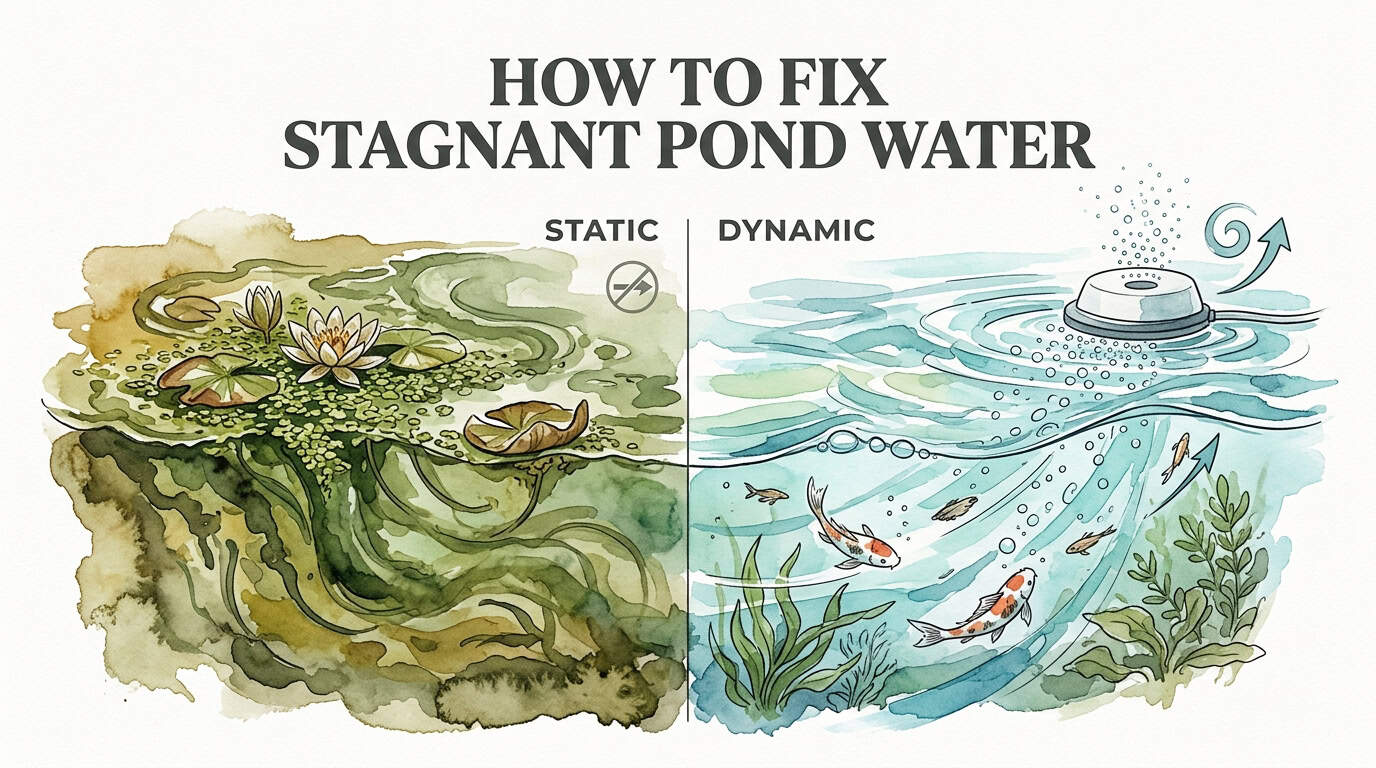
Algae loves a standing target; keep your water moving to keep the green away. Stagnancy is a breeding ground for string algae and mosquitoes. Introducing dynamic aeration increases dissolved oxygen levels which empowers beneficial bacteria to eat the muck that algae feeds on. A moving pond is a breathing pond.
Water management requires a shift from viewing a pond as a static decorative feature to understanding it as a biological reactor. Every cubic liter of water undergoes chemical and biological transformations based on temperature, light, and gas concentrations. Stagnation represents a failure of these processes, leading to anaerobic conditions and system collapse.
You must prioritize gas exchange at the surface and circulation throughout the water column. This article examines the mechanics of aeration, the biological necessity of oxygen, and the technical steps required to transform a stagnant environment into a high-performance ecosystem. Focused execution on these principles ensures long-term clarity and health.

How To Fix Stagnant Pond Water
Stagnant pond water occurs when there is a lack of mechanical or thermal energy to move the water column. This lack of movement leads to thermal stratification, where the water separates into distinct layers based on temperature and density. The upper layer, or epilimnion, remains warm and oxygen-rich, while the lower layer, the hypolimnion, becomes cold, dense, and depleted of oxygen.
This stratification prevents the natural recycling of nutrients. Organic matter such as leaves, fish waste, and grass clippings sink to the bottom. In a stagnant pond, the absence of oxygen at the floor prevents aerobic bacteria from decomposing this material. Instead, anaerobic bacteria take over, a process that is significantly slower and produces toxic byproducts like hydrogen sulfide and methane.
Fixing this issue requires the introduction of kinetic energy. You must break the surface tension to allow for atmospheric gas exchange and provide enough vertical lift to move bottom water to the surface. Systems that utilize diffused aeration or high-volume pumps achieve this by constantly turning the water over, ensuring that every drop eventually comes into contact with the atmosphere.
Real-world applications of these fixes range from small backyard koi ponds to massive industrial retention basins. In every case, the goal is the same: eliminate dead zones and maintain a consistent level of dissolved oxygen (DO) throughout the entire volume. High DO levels are the primary defense against the buildup of organic “muck” and the proliferation of opportunistic organisms like mosquitoes and filamentous algae.
The Mechanics of Gaseous Exchange
Aeration systems function based on the principles of Henry’s Law, which states that the amount of dissolved gas in a liquid is proportional to its partial pressure above the liquid. Oxygen enters the water at the interface between the air and the liquid. Increasing the surface area of this interface increases the rate of oxygen transfer.
Diffused aeration systems utilize a compressor located on the shore to push air through weighted tubing to a diffuser plate at the bottom of the pond. The diffuser breaks the air into thousands of tiny bubbles. As these bubbles rise, they create a “bubble curtain” that drags cold, oxygen-depleted water from the bottom up to the surface. This mechanical lifting is known as an airlift or inducer effect.
Surface agitators and fountains work on the opposite principle. They pull water from the upper layers and spray it into the air. Impact with the atmosphere allows for rapid gas exchange before the droplets return to the surface. While effective for decorative purposes, these systems often fail to address the deep-water stagnation found in ponds deeper than six feet.
Venturi injectors provide another method for gas introduction. These devices use the pressure differential created by water flowing through a constricted pipe to vacuum air into the stream. This creates a highly turbulent mixture of air and water that is then discharged back into the pond. High-velocity discharge helps circulate the water while simultaneously oxygenating it.
Benefits of High Dissolved Oxygen Levels
Maintaining high dissolved oxygen (DO) levels provides a direct boost to the efficiency of the nitrogen cycle. Aerobic bacteria, specifically Nitrosomonas and Nitrobacter, require oxygen to convert toxic ammonia into nitrite and then into relatively harmless nitrate. This process occurs significantly faster in oxygen-rich environments, preventing ammonia spikes that can stress or kill aquatic life.
Organic sludge reduction is another measurable benefit. Aerobic decomposition of organic matter is up to 20 times faster than anaerobic decomposition. Consistent aeration prevents the “muck” layer from thickening, which reduces the need for mechanical dredging or manual pond vacuuming. This reduction in organic load also limits the food source for string algae.
Mosquito control is a mechanical benefit of water movement. Mosquitoes require still water to lay their eggs and for the larvae to breathe through their siphons at the surface. Agitated water disrupts the surface tension, preventing egg-laying and drowning larvae. This biological control method eliminates the need for chemical pesticides in many pond environments.
Thermal stability is achieved through constant mixing. By eliminating stratification, the pond maintains a more uniform temperature. This reduces the risk of “turnover” events, which typically occur in the spring or fall when a sudden temperature change causes the deoxygenated bottom water to mix rapidly with the top water, often resulting in massive fish kills.
Challenges and Common Implementation Mistakes
Undersizing the aeration system is the most frequent error. Many pond owners select a compressor based on the surface acreage without considering the depth or the biological oxygen demand (BOD) of the system. A shallow, heavily stocked pond requires more air than a deep, clean pond of the same surface area because the BOD is higher and the bubble “hang time” is lower.
Improper diffuser placement leads to “dead zones.” Placing a diffuser in the center of a rectangular pond might leave the corners stagnant. You must analyze the shape of the pond and place diffusers in locations that maximize the circulation of the entire water mass. Using a single diffuser for a complex or irregular pond shape is rarely sufficient.
Neglecting seasonal adjustments can cause issues in specific climates. In winter, keeping an aerator running in a shallow pond can super-chill the water, potentially killing fish that rely on a slightly warmer “thermal refuge” at the bottom. Conversely, in extreme heat, oxygen solubility decreases, meaning the aerator must work harder to maintain the same DO levels as in cooler weather.
Mechanical failure often goes unnoticed until the pond shows signs of distress. Diaphragm compressors and rocking piston pumps have wear parts that require annual or biennial replacement. Clogged diffuser membranes increase backpressure on the system, which reduces efficiency and shortens the lifespan of the motor. Routine pressure gauge checks are mandatory for system health.
Limitations of Aeration Systems
Aeration is a management tool, not a total cure for poor pond design or excessive nutrient loading. If a pond receives massive amounts of nitrogen and phosphorus from lawn runoff or agricultural drainage, even the most powerful aeration system may not be able to prevent algae blooms. The influx of nutrients simply outpaces the bacteria’s ability to process them.
Environmental boundaries also exist regarding the size of the pond. For very large lakes, the cost of installing and powering a diffused aeration system can be prohibitive. In these cases, solar-powered circulators or large-scale wind-driven aerators are used, though they offer less consistent performance than grid-tied mechanical systems.
Sound and aesthetics can be a limiting factor in residential settings. While the diffusers are underwater and silent, the shoreline compressors produce a steady hum. Utilizing sound-dampening cabinets or burying the compressor in a ventilated vault is necessary for noise-sensitive areas. Failure to account for the physical footprint of the equipment can lead to installation friction.
Electricity requirements represent a long-term operational cost. Running a 1/2 HP compressor 24/7 can add significant amounts to a monthly utility bill. While energy-efficient models exist, the physics of moving air against water pressure requires a baseline amount of energy that cannot be bypassed. You must factor in these operational expenses when choosing a system.
Static Filtration vs. Dynamic Aeration
| Feature | Static Filtration (Standard Filter) | Dynamic Aeration (Diffused Air) |
|---|---|---|
| Primary Goal | Removal of suspended solids. | Gaseous exchange and circulation. |
| Oxygenation | Localized at the filter return. | System-wide throughout the water column. |
| Muck Reduction | Minimal impact on bottom sludge. | High impact through aerobic digestion. |
| Maintenance | Frequent cleaning of pads/media. | Annual compressor/diffuser service. |
| Energy Efficiency | High (pumping heavy water). | Moderate (pumping light air). |
Choosing between these systems depends on your specific goals. Static filtration is excellent for removing visible debris and clarifying the water for viewing fish. However, dynamic aeration is superior for overall ecosystem health and long-term nutrient management. Most high-performance systems utilize both to achieve a balance of clarity and biological stability.
Dynamic aeration is generally more cost-effective for larger volumes of water. Moving air is physically easier than moving water, meaning you can circulate a much larger area with a smaller motor when using diffused air. Static filters are best reserved for smaller, ornamental ponds where high-clarity water is the primary objective.
Practical Tips for Pond Aeration Success
Calculate your pond’s volume before purchasing equipment. Use the formula: Length x Width x Average Depth x 7.48 = Total Gallons. For irregular shapes, break the pond into sections. Knowing the total volume allows you to determine the necessary turnover rate. A standard goal is to turn the entire volume of the pond over at least once every 24 hours.
Select the right compressor type for your depth. Diaphragm compressors are energy-efficient and quiet but struggle with depths over 6 feet. Linear compressors provide high volumes of air at shallow depths. Rocking piston compressors are the industry standard for deep ponds, as they can push air against the high head pressure found at depths of 10 to 40 feet.
Monitor your system with a pressure gauge. A rise in pressure usually indicates a clogged diffuser or a kinked airline. A drop in pressure suggests a leak in the line or a failing compressor diaphragm. Keeping a log of the baseline operating pressure allows for early detection of mechanical issues before they lead to water quality degradation.
Use weighted airline for all underwater runs. Non-weighted tubing will float to the surface, creating an unsightly appearance and a hazard for boats or swimmers. Self-weighted tubing stays on the pond floor without the need for bricks or ties. This ensures that the air reaches the diffusers at the lowest point of the pond for maximum vertical lift.
Advanced Considerations: BOD and COD Management
Serious practitioners must understand Biological Oxygen Demand (BOD) and Chemical Oxygen Demand (COD). BOD represents the amount of oxygen required by microorganisms to break down organic matter. COD measures the oxygen required for the chemical oxidation of pollutants. In a stagnant pond, both BOD and COD are typically high, which rapidly depletes any available dissolved oxygen.
Sizing an aeration system involves calculating the oxygen transfer rate (OTR) of the equipment. The OTR is influenced by the water temperature, the salinity, and the initial DO level. Aerators are most efficient when the DO is low, as the concentration gradient between the air bubble and the water is at its steepest. As DO levels approach saturation, the rate of transfer slows down.
Redox potential, or ORP (Oxidation-Reduction Potential), is a secondary metric used to gauge pond health. A high ORP indicates an oxidizing environment where organic waste is being efficiently processed. A low or negative ORP indicates a reducing environment prone to stagnation and toxic gas buildup. Aeration directly increases ORP by providing the necessary oxygen for oxidation reactions.
Strategic placement of diffusers can create “cells” of circulation. In very large or long ponds, placing diffusers in a sequence can create a horizontal flow similar to a slow-moving river. This directional flow helps move debris toward a mechanical intake or skimmer, further improving water clarity and reducing the overall load on the biological system.
Example Scenarios: Small Pond vs. Large Pond
In a 5,000-gallon backyard koi pond with a depth of 4 feet, a small linear diaphragm compressor producing 2.0 CFM (Cubic Feet per Minute) is usually sufficient. A single 9-inch disc diffuser placed at the deepest point will provide enough circulation to prevent stagnation and support a high fish load. This setup is quiet and consumes less than 50 watts of power.
Consider a 1-acre farm pond with an average depth of 8 feet and a maximum depth of 15 feet. This system requires a 1/2 HP rocking piston compressor. Using three diffuser stations spread across the pond floor ensures total coverage. This system would move millions of gallons of water per day via the airlift effect, maintaining aerobic conditions even during the peak of summer heat.
Measurements for these systems are critical. For the 1-acre pond, the compressor might deliver 4.5 CFM at a pressure of 10 PSI. The energy cost would be roughly $30-$50 per month depending on local rates. The tradeoff is a clear, healthy pond that supports game fish and remains free of the “rotten egg” smell associated with stagnant, anaerobic water.
Comparing these two shows that while the technology is the same, the hardware must be matched to the environment. The small pond prioritizes silence and low power, while the large pond prioritizes high-pressure capability and massive water movement. Both successfully eliminate stagnancy by matching mechanical output to the pond’s physical requirements.
Final Thoughts
Achieving healthy pond water is a matter of managing the balance between nutrient input and oxygen availability. Stagnancy is the primary obstacle to this balance, as it isolates nutrients at the bottom and prevents the natural purification processes of the atmosphere. By installing a robust aeration system, you provide the infrastructure for a self-cleaning ecosystem.
Success requires an objective look at your pond’s dimensions, its biological load, and your maintenance capabilities. Choosing high-quality components and sizing them correctly will save time and money by reducing the need for chemical treatments and manual labor. A well-aerated pond is more resilient, more attractive, and far more productive than a still one.
Focus on the data: monitor your dissolved oxygen, check your system pressure, and observe the behavior of the water surface. Consistent movement is the sign of a healthy system. As you master the mechanics of aeration, you may find interest in more advanced topics like ozone injection or ultrasonic algae control, but always remember that oxygen is the foundation of aquatic life.
Amazon and the Amazon logo are trademarks of Amazon.com, Inc, or its affiliates.