

Pond Talk is an Amazon Associate. As an Amazon Associate we earn from qualifying purchases.
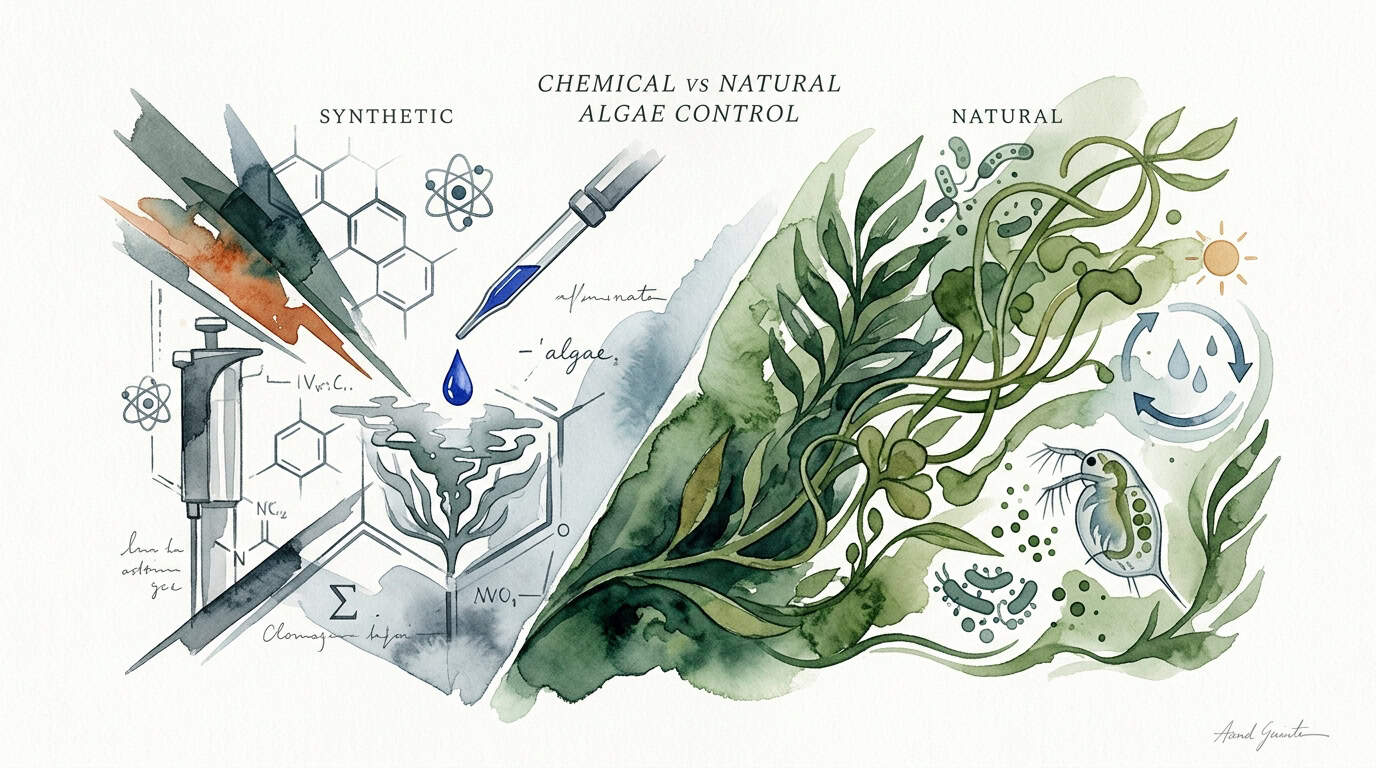
One treats the symptom with harsh toxins; the other treats the cause with biological enzymes. Quick-fix chemicals often cause oxygen crashes that harm your fish and beneficial bacteria. Natural barley straw slowly decomposes to release humic acids that prevent algae from ever taking hold. It is the slow, steady, and safe way to maintain a pristine ecosystem without the plastic bottles.
Maintaining a balanced aquatic environment requires an understanding of nutrient cycles and chemical interactions. Managing algae is not merely an aesthetic concern but a requirement for maintaining proper dissolved oxygen levels and stable pH parameters. When nitrogen and phosphorus levels exceed the processing capacity of the nitrogen cycle, opportunistic organisms like cyanobacteria and filamentous algae proliferate.
Traditional management relies on reactive measures that introduce synthetic biocides into the water column. These substances work by rupturing cell walls or inhibiting photosynthesis through heavy metal toxicity. Biological alternatives focus on competitive inhibition and secondary metabolite production. This guide analyzes the technical differences between these methodologies to assist in optimizing pond health and operational efficiency.

Chemical Vs Natural Algae Control
Chemical algae control refers to the application of synthetic or concentrated mineral-based substances designed to kill existing algal biomass. These products are generally classified as algaecides and often contain active ingredients such as copper sulfate, chelated copper, or sodium carbonate peroxyhydrate. Use of these chemicals results in a rapid “kill-off” period where the cellular structure of the algae is destroyed within hours or days.
Natural algae control, specifically the use of barley straw, is a proactive biological process. It does not function as a direct poison but rather as a preventative system. When barley straw is submerged in an aerobic environment, it begins a multi-stage decomposition process. This process releases specific organic compounds that inhibit the growth and reproduction of new algae cells.
In real-world applications, such as large-scale aquaculture or residential koi ponds, the choice between these methods depends on the urgency of the situation and the sensitivity of the resident biota. Synthetic chemicals are often deployed in emergency situations where an algae bloom threatens to deplete oxygen levels to lethal lows overnight. Natural methods are utilized for long-term stabilization, reducing the need for aggressive interventions by maintaining a steady baseline of inhibitory compounds.
The Lignin-Oxygen Reaction Loop
Barley straw functions through a complex series of chemical transitions. The primary mechanism involves the slow breakdown of lignin, a structural polymer found in the cell walls of the straw. For this process to be effective, three variables must be present: moisture, oxygen, and sunlight.
Initial submersion leads to the colonization of the straw by fungi and bacteria. As these microorganisms decompose the carbon structure, they release humic acids into the water. These acids are further oxidized in the presence of sunlight and dissolved oxygen to produce low concentrations of hydrogen peroxide (H2O2).
This localized production of hydrogen peroxide is the “active ingredient” in the barley straw effect. The concentrations of H2O2 produced are extremely low—usually in the parts per billion range. This concentration is insufficient to harm fish or advanced vascular plants but is high enough to interfere with the metabolic processes of unicellular algae. It effectively prevents the algae from replicating, leading to a gradual decline in the population.
Optimal performance requires high surface area and high water flow. Placing the straw in a mesh bag near a pump outlet or waterfall ensures that the released humic acids are distributed evenly throughout the pond and that the decomposing matter remains oxygenated. Anaerobic decomposition must be avoided, as it produces hydrogen sulfide and other toxins rather than the desired inhibitory compounds.
Chemical Algaecide Pathways and Risks
Synthetic algaecides operate through several distinct modes of action. Copper-based products are the most common. Copper ions (Cu2+) bind to the proteins and enzymes within the algae cells, disrupting the photosynthetic electron transport chain. While effective, copper is a heavy metal that does not degrade. It accumulates in the pond sediment, which can lead to long-term toxicity for benthic organisms and invertebrates like snails and shrimp.
Oxidizing agents, such as sodium carbonate peroxyhydrate, work by releasing a concentrated burst of active oxygen. This creates oxidative stress that shreds the cell membranes of the algae. The primary risk of this approach is the “oxygen crash.” When a large volume of algae dies simultaneously, the aerobic bacteria responsible for decomposing that dead organic matter consume massive amounts of dissolved oxygen.
If the oxygen demand of the bacteria exceeds the pond’s aeration capacity, fish kills become inevitable. Furthermore, the rapid release of nutrients (nitrates and phosphates) back into the water from the decaying algae often triggers a secondary bloom, creating a cycle of chemical dependence. This “rebound effect” is a significant mechanical inefficiency in synthetic pond management.
Benefits of Biological Inhibition
Using a biological approach offers several measurable advantages regarding ecosystem stability and long-term maintenance costs.
- System Stability: Because the inhibition is gradual, there is no sudden mass-die-off of organic material. This prevents the dangerous spikes in ammonia and drops in dissolved oxygen associated with chemical treatments.
- Non-Target Safety: The concentrations of hydrogen peroxide produced by barley are harmless to complex aquatic plants, fish, and beneficial nitrifying bacteria.
- Reduced Maintenance Frequency: Once a barley straw cycle is established, it provides continuous protection for several months. This contrasts with chemical treatments that require frequent dosing and monitoring.
- Cost-Effectiveness: Raw barley straw is significantly less expensive than formulated synthetic biocides when measured on an annual basis.
These benefits contribute to a more resilient bio-filter. The microbial colonies in the filter are not subjected to the fluctuating toxicity of algaecides, allowing for more consistent conversion of ammonia into nitrate.
Challenges and Deployment Pitfalls
Success with natural inhibitors requires precise application. A common mistake is using too much straw in an area with poor circulation. If the center of a barley bale becomes anaerobic, it will begin to rot rather than decompose aerobically. This produces foul odors and can lower the pH of the water to dangerous levels.
Timing is another critical factor. Because the decomposition process requires microbial colonization, there is a “lag time” of four to six weeks before the straw begins to release effective levels of humic acids. Applying straw to a pond that is already choked with heavy algae growth will not provide immediate results. It is a preventative measure, not a curative one.
Incorrect dosage also hampers efficiency. Typical calculations suggest using approximately 10 to 25 grams of straw per square meter of surface area. If the water is highly turbid or has a high nutrient load, the dosage may need to reach the higher end of that spectrum. Under-dosing results in H2O2 concentrations that are too diluted to inhibit cellular replication.
Limitations and Environmental Constraints
Environmental variables dictate the effectiveness of the barley straw reaction. Temperature is the primary constraint. Microbial activity significantly slows down in water temperatures below 10°C (50°F). In cold climates, the straw may remain dormant through the winter, only becoming active as the water warms in the spring.
Water chemistry also plays a role. High levels of suspended solids (turbidity) can block the sunlight required for the photo-oxidation of humic acids. In very “dirty” water, the chemical reaction chain is interrupted. Similarly, extremely high pH levels can alter the solubility of the organic compounds involved, potentially reducing their effectiveness.
In systems with massive, established blooms of filamentous “string” algae, barley straw may struggle to overcome the existing biomass. In these scenarios, manual removal of the algae is required to reduce the total nutrient load before the biological inhibitor can take effect.
Comparison of Methodology Performance
The following table compares the operational metrics of synthetic algaecides versus natural barley straw inhibition.
| Metric | Synthetic Algaecides | Barley Straw Method |
|---|---|---|
| Reaction Speed | Rapid (24–72 hours) | Slow (4–6 weeks for activation) |
| Duration of Effect | Short-lived (requires re-dosing) | Long-term (up to 6 months) |
| Impact on Dissolved Oxygen | High risk of depletion (crash) | Negligible/Stable |
| Environmental Residue | Heavy metals or salts accumulate | Biodegradable organic matter |
| Application Difficulty | Requires precise volumetric dosing | Simple placement in flow paths |
Practical Tips for Implementation
Optimizing natural algae control requires attention to placement and surface area. Use a loose mesh bag to hold the straw. This allows water to penetrate the center of the bundle and prevents the core from becoming anaerobic. If the straw is packed too tightly, the internal decomposition will fail to produce the necessary oxidative enzymes.
Placement should be in the upper 30 centimeters of the water column. Since the conversion of humic acids to hydrogen peroxide requires UV light, sinking the straw to the bottom of a deep pond significantly reduces its effectiveness. Secure the bags near the inflow of a filter or under a waterfall to maximize the oxygenation of the decomposing material.
Replace the straw every four to six months. In most temperate climates, a dual-deployment strategy works best: add a new bag of straw in early spring and another in mid-summer. Do not remove the old bag immediately when adding the new one. Overlapping the bags for one month ensures that the new straw is fully colonized by microbes before the old batch is removed, preventing a gap in protection.
Advanced Considerations: The Redfield Ratio
Serious practitioners should consider the underlying nutrient levels that drive algae growth. Algae proliferation is often governed by the Redfield Ratio—the atomic ratio of carbon, nitrogen, and phosphorus (106:16:1). If phosphorus is the limiting nutrient, even high levels of nitrogen will not cause a bloom.
Natural inhibitors work best when paired with nutrient export strategies. This include the use of mechanical filtration to remove solid waste and the cultivation of floating aquatic plants to compete for nitrates. Barley straw provides the chemical “gatekeeper,” but reducing the total nutrient load ensures the gatekeeper is not overwhelmed.
Monitoring the Nitrate (NO3) and Phosphate (PO4) levels using high-accuracy liquid test kits allows for data-driven adjustments. If phosphates exceed 0.05 mg/L, the biological pressure from algae will be extreme. In these cases, increasing the barley dosage or adding a phosphate-binding media like Lanthanum chloride or Granular Ferric Oxide (GFO) may be necessary to support the natural inhibition process.
Example Scenario: A 5,000-Gallon System
Consider a 5,000-gallon (approx. 19,000-liter) pond with a surface area of 400 square feet. A synthetic approach would involve dosing a liquid algaecide every two weeks during the summer. This requires careful calculation to avoid overdosing fish and consistent monitoring of the carbonate hardness (KH) to prevent pH swings.
A biological approach would utilize approximately 2 to 3 pounds of barley straw. This straw would be divided into three small mesh bags. One bag is placed in the skimmer basket, one near the waterfall return, and one in a high-flow stream section.
The straw is installed in March when water temperatures reach 10°C. By late April, the decomposition cycle is active. Throughout the summer, the pond remains clear despite high sunlight exposure. In July, a second set of bags is added alongside the originals. In August, the March bags are removed. This maintains a constant concentration of humic substances without any chemical spikes or oxygen fluctuations.
Final Thoughts
Shifting from synthetic chemicals to biological inhibitors represents a transition from reactive to proactive management. While algaecides offer the gratification of immediate results, they often compromise the long-term stability of the aquatic ecosystem. The reliance on heavy metals and oxidizers creates a fragile environment prone to oxygen crashes and nutrient rebounds.
Natural barley straw utilizes the pond’s own biological processes to maintain clarity. By facilitating the slow oxidation of lignin, the system generates a constant, low-level deterrent that prevents algae from colonizing the water column. This method preserves the health of beneficial bacteria and fish while reducing the chemical load on the environment.
Success with this approach requires patience and an understanding of the 4-to-6-week activation window. For those willing to plan ahead, the result is a self-regulating ecosystem that requires fewer interventions and lower operational costs. Experimenting with placement and dosage will allow any pond owner to fine-tune their system for maximum efficiency and clarity.
Amazon and the Amazon logo are trademarks of Amazon.com, Inc, or its affiliates.