

Pond Talk is an Amazon Associate. As an Amazon Associate we earn from qualifying purchases.
Is your pond on life support, or is it truly alive?
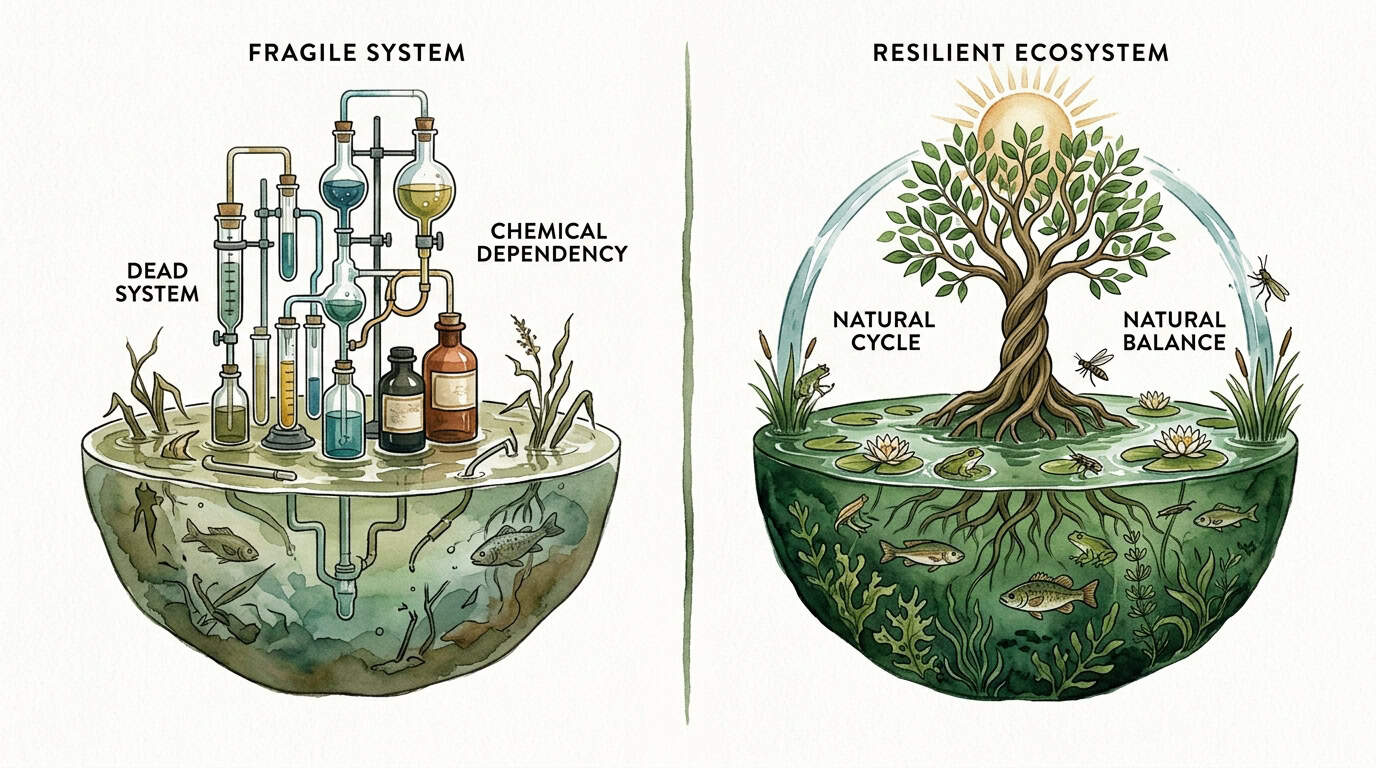
A fragile pond depends on you buying more stuff. A resilient pond depends on nature. Balancing your ‘biological load’ with snails and plants creates a system that can withstand a heatwave without turning into a swamp.
Many pond owners find themselves trapped in a cycle of constant intervention. They measure chemical levels daily and pour in expensive treatments to combat algae blooms or murky water. This approach treats the symptoms of an unbalanced ecosystem rather than the underlying cause.
The transition from a fragile system to a resilient one requires a shift in perspective. You must view the pond not as a static container of water, but as a living biological processor. This guide explores the mechanics of nutrient cycling and how to achieve a self-sustaining equilibrium.

Chemical Dependency In Ponds Vs Natural Balance
Chemical dependency occurs when a pond lacks the biological infrastructure to process its own waste. In these systems, external inputs like algaecides, clarifiers, and pH buffers are required to maintain a baseline level of water quality. This creates a “fragile system” where the failure of a single pump or a missed dose of chemicals can lead to rapid ecological collapse.
Natural balance relies on the nitrogen cycle and nutrient sequestration. In a balanced pond, fish waste (ammonia) is converted by beneficial bacteria into nitrites and then nitrates. Submerged and marginal plants then absorb these nitrates as fuel for growth. Snails act as the “clean-up crew,” breaking down solid organic matter and preventing the accumulation of sludge that would otherwise deplete dissolved oxygen levels.
The core difference lies in the direction of energy flow. Chemical systems require constant energy and financial investment to fight against natural processes. Resilient ecosystems harness natural processes to maintain stability, resulting in lower long-term maintenance costs and higher resistance to environmental stressors like temperature spikes or heavy rainfall.
How the Resilient Ecosystem Functions
Creating a resilient pond requires an understanding of the relationship between biological load and carrying capacity. The biological load represents the total amount of metabolic waste produced by fish, decomposing plant matter, and uneaten food. The carrying capacity is the pond’s ability to process that waste through filtration and plant uptake.
The Role of Gastropods in Waste Management
Snails serve as primary decomposers within the pond environment. They consume detritus, algae, and decaying plant leaves, converting large organic molecules into smaller particles. This mechanical breakdown increases the surface area available for heterotrophic bacteria to further decompose the material. Species like the Great Pond Snail or the Japanese Trapdoor Snail are particularly effective because they do not consume healthy plant tissue, focusing instead on the waste products that would otherwise rot and lower water quality.
Nutrient Sequestration through Macrophytes
Aquatic plants, or macrophytes, are the ultimate destination for nitrogen and phosphorus in a balanced pond. Floating plants like Water Lettuce or Frogbit have long, feathery roots that pull nutrients directly from the water column. Submerged plants, such as Anacharis or Hornwort, compete directly with algae for resources. By filling every ecological niche with desirable plants, you starve algae of the nutrients it needs to bloom. This is the foundation of a resilient system.
The Nitrogen Cycle and Bacterial Colonization
Bio-filtration is the engine of the pond. Nitrifying bacteria colonize every available surface, including the pond liner, rocks, and the roots of plants. These bacteria require high levels of dissolved oxygen to function efficiently. In a resilient pond, oxygen is supplied both through surface agitation and photosynthetic activity from submerged plants. This aerobic environment ensures that toxic ammonia is rapidly neutralized before it can harm aquatic life.
Benefits of a Resilient Biological System
Establishing a biologically balanced pond provides several measurable advantages over chemically maintained systems. These benefits range from fiscal efficiency to biological stability.
- Reduced Operating Costs: You eliminate the need for ongoing chemical purchases and reduce the electrical demand for high-powered mechanical filtration.
- Increased Environmental Resilience: A balanced pond maintains more stable pH and dissolved oxygen levels during heatwaves or power outages.
- Lower Maintenance Requirements: Once established, the system requires only occasional plant thinning and debris removal rather than intensive water testing and scrubbing.
- Enhanced Biodiversity: A natural approach supports a wider range of beneficial insects, amphibians, and micro-organisms that contribute to the overall health of the garden.
Predictability is perhaps the greatest benefit. In a resilient system, changes happen slowly. You can observe the growth of plants and the behavior of snails to gauge the health of the water, rather than relying solely on chemical test strips that only provide a snapshot in time.
Challenges and Common Mistakes
The most frequent error in pond management is overstocking. Every fish added to the system increases the biological load exponentially. Beginners often underestimate how much waste a growing fish produces, leading to a “crash” where the bacteria and plants cannot keep up with the ammonia production.
Inadequate plant coverage is another common pitfall. A resilient pond should have approximately 50% to 70% of its surface area covered by plants during the height of the growing season. Failure to provide this coverage allows sunlight to penetrate deep into the water, fueling aggressive algae growth and causing water temperatures to fluctuate wildly.
Patience is often lacking in the initial setup phase. It takes time for bacterial colonies to establish and for plants to transition from their nursery environment to the pond. Many owners panic during a minor initial algae bloom and reach for chemicals, which kills the beneficial bacteria and resets the entire biological clock.
Limitations of the Natural Approach
While a resilient pond is the goal, there are physical constraints to consider. Small containers or shallow ponds have less thermal mass, making them more susceptible to temperature extremes. In these cases, even the best biological balance may struggle to handle a 100-degree day without supplemental aeration.
High-waste species like Koi present a specific challenge. These fish are essentially “swimming pigs” that produce massive amounts of waste and often uproot or consume the very plants needed to filter the water. Maintaining a resilient Koi pond requires a much larger footprint for biological filtration, often involving a dedicated “bog filter” or a secondary pond filled solely with plants.
Geographic climate also plays a role. In areas with harsh winters, the biological activity slows down significantly. Plants go dormant, and bacteria become less active. The system must be designed to survive these dormant periods without a massive buildup of organic matter that could cause an “anoxic event” during the spring thaw.
Comparing Fragile vs. Resilient Ecosystems
| Feature | Fragile System (Chemical) | Resilient System (Biological) |
|---|---|---|
| Primary Filtration | UV Sterilizers & Pressurized Filters | Plants, Snails & Bio-films |
| Maintenance Frequency | Weekly (Chemical dosing/Backwashing) | Monthly (Pruning/Debris removal) |
| Algae Management | Algaecides (Chemical suppression) | Nutrient Competition (Natural starvation) |
| Reaction to Power Outage | High Risk (Rapid oxygen depletion) | Low/Medium Risk (Buffered by plants) |
| Long-term Cost | High (Recurring costs) | Low (Initial investment only) |
Practical Tips for Pond Optimization
Achieving balance requires active observation and minor adjustments. Start by measuring your pond’s volume accurately. Knowing the exact gallonage allows you to calculate the appropriate stocking levels for both fish and plants.
Select a variety of plant types. Use submerged “oxygenators” like Elodea to clean the water internally. Incorporate floating plants to block sunlight and cool the surface. Add marginal plants like Iris or Pickerelweed to the edges to provide structural diversity and bird habitat. This multi-layered approach ensures that nutrients are captured at every level of the water column.
Introduce snails early in the season. Snails are most effective when they have a head start on the algae. If you wait until the pond is already green, the snails will be overwhelmed. Adding 1-2 snails per square foot of surface area is a standard baseline for a healthy system.
Avoid overfeeding fish. Any food not consumed within two minutes becomes a pollutant. During the summer, fish can often find enough natural food (insect larvae and algae) in a balanced pond, allowing you to reduce supplemental feeding significantly.
Advanced Considerations: Redox and Dissolved Oxygen
Experienced practitioners monitor Oxidation-Reduction Potential (ORP) or “Redox.” This value measures the water’s ability to cleanse itself through oxidation. A high Redox potential indicates an oxygen-rich environment where organic waste is efficiently broken down. A drop in Redox often precedes an algae bloom or a disease outbreak, serving as an early warning system.
Dissolved Oxygen (DO) levels fluctuate throughout a 24-hour cycle. During the day, plants produce oxygen through photosynthesis, often reaching “supersaturation.” At night, the process reverses as plants and fish consume oxygen. A resilient system must have enough surface area or supplemental aeration to ensure that nighttime DO levels do not drop below 5 mg/L, which is the threshold for fish stress.
Carbonate Hardness (KH) acts as a buffer for pH. In ponds with heavy plant growth, the rapid uptake of CO2 during the day can cause pH levels to swing. Maintaining a KH of at least 100 ppm ensures that the water chemistry remains stable, protecting both the fish and the beneficial bacterial colonies.
Example Scenario: The 500-Gallon Transformation
Consider a 500-gallon pond that was previously managed with weekly chemical additions. The water was frequently green, and the fish were lethargic. The owner decided to shift toward a resilient ecosystem approach.
First, the owner reduced the fish population to five small goldfish, significantly lowering the ammonia input. Next, they added 20 bunches of Hornwort and 10 large Water Hyacinths. Finally, they introduced 50 Ramshorn snails to patrol the liner and rocks.
Within three weeks, the Water Hyacinths doubled in size, shading the water and absorbing nitrates. The snails consumed the existing string algae on the waterfall. By the end of the second month, the water was clear enough to see the bottom. Even during a week-long heatwave with temperatures exceeding 95 degrees, the pond remained stable without any chemical intervention. The system moved from “life support” to “resilient.”
Final Thoughts
A resilient pond is a partnership between the owner and the natural world. Moving away from chemical dependency requires trust in biological processes and a willingness to let the ecosystem find its own equilibrium. By focusing on the biological load and providing the right tools—specifically snails and a diversity of plants—you create a self-regulating environment.
This approach results in a pond that is not only more beautiful but also more robust. It requires less work and provides a more stable habitat for its inhabitants. Transitioning to a resilient system is a long-term investment in the health of your garden’s water feature.
Experimenting with different plant species and observing the cycles of your pond will deepen your understanding of aquatic ecology. As you master these principles, you will find that the most successful pond is the one where nature does most of the work for you.
Amazon and the Amazon logo are trademarks of Amazon.com, Inc, or its affiliates.