

Pond Talk is an Amazon Associate. As an Amazon Associate we earn from qualifying purchases.
Cities try to solve water problems with concrete; nature solves them with life. Our urban drainage systems are failing because they are designed to be dead. When weeds choke these channels, they flood. Instead of sending crews with heavy machinery and toxic sprays, cities are starting to use grass carp to keep the water moving. It’s a return to wild logic in an urban world.
Urban stormwater infrastructure represents a massive investment in hydraulic engineering. These systems, often termed Stormwater Control Measures (SCMs) or Best Management Practices (BMPs), are designed to mitigate peak flow and sequester pollutants. However, the accumulation of aquatic biomass within these systems frequently compromises their hydraulic efficiency. Mechanical and chemical interventions are the traditional methods for maintaining these conduits, but they carry high operational expenditures and potential ecological externalities.
Biological control using the triploid grass carp offers a technical alternative. This method leverages the high metabolic rate of a specific herbivorous fish to maintain channel capacity. It shifts the maintenance paradigm from periodic, high-impact events to continuous, low-impact biological processing. Understanding the mechanics of this system is essential for any water manager looking to optimize drainage performance.

Grass Carp For Urban Drainage Ponds
The grass carp (Ctenopharyngodon idella) is a macro-herbivore native to the large river systems of eastern Asia. Within the context of urban drainage, these fish are deployed as biological tools for the suppression of submerged aquatic vegetation (SAV). Unlike the common carp, which is a benthic feeder that increases turbidity through substrate disturbance, the grass carp possesses specialized pharyngeal teeth designed for shredding plant tissue.
In most jurisdictions, the use of these fish is strictly regulated to the triploid variety. Triploid grass carp are rendered sterile through the application of thermal or pressure shocks to fertilized eggs, which induces the retention of an extra set of chromosomes. This sterilization ensures that the fish cannot establish self-sustaining populations if they escape into open-river systems. Testing for triploidy is performed using a Coulter counter to measure the DNA content in red blood cells, ensuring 100% sterility in a given population.
Urban drainage ponds and canals present a unique environment for these fish. These systems often experience high nutrient loading from nitrogen and phosphorus runoff, which fuels the rapid growth of invasive species like Hydrilla verticillata and Najas guadalupensis. Left unchecked, this biomass can reduce the effective volume of a retention pond by over 30% and significantly increase the Manning’s roughness coefficient of a drainage canal, leading to upstream flooding during 10-year or 50-year storm events.
How It Works: Metabolism and Consumption Rates
The efficacy of grass carp as a maintenance tool is primarily a function of their metabolic rate. These fish are essentially biological biomass converters. Their digestive tract is relatively short, meaning they must consume large quantities of material to extract sufficient nutrients. The rate of consumption is closely tied to the age and size of the fish, as well as the ambient water temperature.
Juvenile specimens weighing less than 10 pounds (4.5 kg) exhibit the highest metabolic activity. These smaller fish have been documented to consume between 100% and 150% of their body weight in fresh plant material daily. In some high-temperature environments, consumption rates can peak at 300% of body weight. As the fish matures and surpasses 15 pounds (6.8 kg), the metabolic rate slows, and daily consumption typically drops to 25% or 30% of body weight. While older fish are less efficient per pound of biomass, their absolute consumption remains high due to their size, which can reach 60 to 100 pounds in ideal conditions.
Temperature is the primary driver of these rates. Optimal feeding occurs when water temperatures are between 78°F and 90°F (25°C to 32°C). When temperatures drop below 55°F (13°C), feeding activity is significantly reduced, and it ceases entirely as the fish enter a semi-dormant state in near-freezing conditions. This seasonality must be factored into maintenance schedules; biological control is most effective during the peak growing season for aquatic weeds.
Feeding is also selective. Grass carp exhibit a hierarchical preference for different plant species, which dictates the order in which vegetation is cleared from a system. Soft-tissued, submerged plants are the first to be targeted. The hierarchy generally follows this order:
- High Preference: Hydrilla, Southern Naiad, Muskgrass (Chara), and Duckweed.
- Moderate Preference: Pondweeds (Potamogeton spp.), Coontail, and Elodea.
- Low Preference: Eurasian Watermilfoil, Water Hyacinth (roots/leaves), and Alligatorweed.
- Avoided: Water Lilies, Cattails, and filamentous algae (once the fish reach adulthood).
Successful management requires matching the stocking density to the specific biomass and plant species present. If a pond is dominated by low-preference plants like lilies, stocking grass carp will result in the elimination of all other species, potentially creating a monoculture of the avoided plant.
Benefits: Economic and Technical Advantages
The transition from mechanical or chemical control to biological control is often driven by a cost-benefit analysis. Mechanical harvesting in urban canals is exceptionally resource-intensive. Mobilizing a harvester, transporting the biomass to a disposal site, and paying landfill tipping fees can cost between $2,000 and $4,000 per acre per cycle. Since vegetation regrows rapidly, multiple cycles are often required annually.
Chemical control via aquatic herbicides is cheaper, typically ranging from $200 to $600 per acre, but it involves recurring costs. Herbicides also introduce a pulse of decaying organic matter into the water column. This “die-off” event consumes dissolved oxygen (DO), which can lead to fish kills and the sudden release of sequestered phosphorus, fueling secondary algae blooms. Furthermore, some invasive species have begun to show resistance to common herbicides like fluridone.
Grass carp provide a continuous maintenance service for a lower total cost of ownership. The initial investment includes the purchase of the fish—typically $10 to $20 per specimen—and the installation of containment barriers. Over a 5-to-10-year lifespan, the cost per acre for biological control ranges from $20 to $250. This represents a 70% to 90% reduction in maintenance costs compared to mechanical options. Because the fish graze continuously, they prevent the massive biomass accumulation that leads to hydraulic failure, rather than reacting to it after it occurs.

Technical benefits also include the maintenance of water quality. By slowly processing biomass throughout the season, grass carp avoid the massive DO crashes associated with chemical treatments. They also maintain the “Living Canal” infrastructure, allowing for a more naturalized drainage system that supports other beneficial organisms and preserves the structural integrity of earthen embankments that might be damaged by heavy dredging machinery.
Challenges: Monitoring and Management Risks
Biological systems are inherently more complex to manage than mechanical ones. The primary challenge with grass carp is the lack of an “off switch.” Once stocked, the fish are difficult to remove. Overstocking can lead to the total eradication of all aquatic vegetation, which is often undesirable. Aquatic plants play a critical role in stabilizing sediments and sequestering nutrients. If 100% of the vegetation is removed, the pond may transition from a “clear water” state to a “turbid” state dominated by phytoplankton and algae blooms, as the nutrients previously locked in the weeds are now recycled through fish waste into the water column.
Nutrient loading is a significant technical consideration. While grass carp consume biomass, they do not remove the nitrogen and phosphorus from the system; they simply convert it into fecal matter. In a closed drainage pond with low turnover, this can lead to an accumulation of nutrients that may eventually require alum treatments or mechanical sediment removal. Managers must monitor the nutrient levels (Total Phosphorus and Total Nitrogen) to ensure the system does not exceed its carrying capacity.
Dissolved oxygen (DO) monitoring is also critical. While carp are hardy, their feeding rate is impacted by DO levels. Feeding is reduced by 45% when oxygen levels drop to 4 ppm and stops completely if levels fall below 2 ppm. In stagnant urban ponds during hot summer nights, DO can drop dangerously low, reducing the effectiveness of the fish and potentially causing mortality. Aeration systems are often recommended as a complementary technology in high-density stocking scenarios.
Limitations: Environmental and Regulatory Constraints
There are several scenarios where grass carp are not the ideal solution. High-flow environments present a major risk. Grass carp are riverine fish and have a natural instinct to swim into the current. During heavy storm events, if containment screens are not properly engineered, the fish will exit the pond and enter the broader watershed. This not only results in a loss of the maintenance investment but also poses a legal risk, as many states strictly forbid the release of even triploid fish into open waters.
Salinity is another hard limit. Grass carp can tolerate brackish water up to a point, but their feeding rate drops off sharply as salinity increases. Consumption stops at approximately 9 parts per thousand (ppt), and sustained levels higher than this will result in mortality. Consequently, drainage systems in coastal areas subject to tidal influence or storm surges are generally unsuitable for this method.
Regulatory hurdles vary by region. In the United States, states like Florida, Texas, and Virginia have robust permitting processes that require site inspections and the installation of approved barriers. Some northern states, such as Michigan and Minnesota, have much stricter regulations or outright bans due to concerns about the impact on native ecosystems and the potential for diploid “leakage” into the Great Lakes system. Always consult the state fisheries agency before initiating a stocking program.
Comparison: Maintenance Strategies
Selecting the correct maintenance strategy requires a comparison of efficiency, cost, and impact. The following table summarizes the metrics for the three primary control methods used in urban drainage systems.
| Factor | Mechanical Harvesting | Chemical Treatment | Triploid Grass Carp |
|---|---|---|---|
| Initial Cost | High (Equipment/Mobilization) | Low to Moderate | Moderate (Fish + Barriers) |
| Recurring Cost | Very High per cycle | Moderate per application | Negligible (Monitoring) |
| Speed of Results | Immediate | 7–14 Days | 6–12 Months |
| Nutrient Removal | Yes (Biomass Export) | No (In-situ decomposition) | No (Nutrient Cycling) |
| Lifespan | Temporary (Regrowth) | 3–6 Months | 5–10 Years |
| Hydraulic Impact | Potential Bank Erosion | None | None |
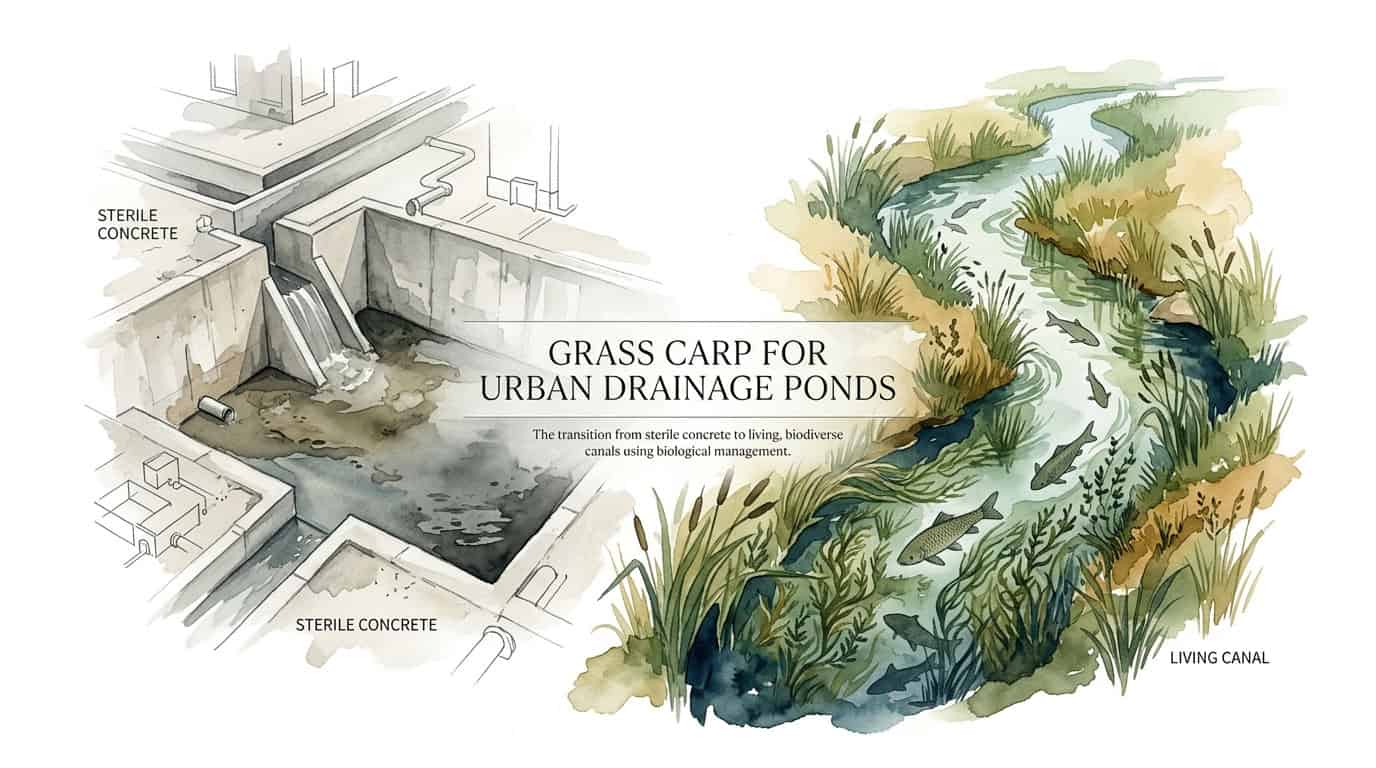
Mechanical harvesting is the only method that physically removes nitrogen and phosphorus from the watershed. However, its high cost often makes it the method of last resort. Chemical treatments are precise but episodic. Grass carp represent the STERILE CONCRETE vs LIVING CANAL debate by turning a drainage ditch into a functional ecosystem that manages its own maintenance through biology.
Practical Tips: Stocking and Implementation
Successful implementation of a grass carp program requires technical precision. The most common cause of failure is incorrect stocking density. Managers must first calculate the acreage of the water body and the percentage of weed coverage. The following stocking rates are generally recommended for standard urban ponds:
- Slight Infestation (<30% coverage): 2 to 5 fish per acre.
- Moderate Infestation (30%–60% coverage): 5 to 10 fish per acre.
- Heavy Infestation (>60% coverage): 15 to 20 fish per acre.
In cases of extreme biomass (e.g., a canal completely choked with Hydrilla), an integrated approach is most efficient. Use a targeted herbicide application to knock down the existing biomass by 50% to 70%. Wait for the indirect effects of the herbicide to dissipate, and then stock the carp at a lower density (5 fish per acre) to manage the regrowth. This prevents the need for high-density stocking, which can be difficult to manage once the weeds are gone.
Size at the time of stocking is equally important. In urban ponds that contain predators such as Largemouth Bass or Alligators, fingerlings will be quickly consumed. To ensure survival, fish should be at least 10 to 12 inches (25 to 30 cm) long before release. Stocking should ideally occur in early spring. This allows the fish to acclimate as water temperatures rise and gives them the opportunity to target tender, new plant sprouts before they reach peak summer biomass.
Advanced Considerations: Engineering the Barrier
Engineering a containment system is a non-negotiable step in urban drainage management. A standard mesh screen is rarely sufficient, as it will quickly clog with debris, leading to water backup and potential flooding. Professional designs often utilize a parallel-bar rack system. These grates should be constructed from galvanized steel or aluminum and positioned with vertical or horizontal bars.
The spacing between bars is determined by the size of the fish being contained. For 12-inch fish, a bar spacing of 1 to 1.5 inches is typical. However, hydraulic calculations must be performed to ensure that the head loss across the grate does not exceed the design capacity of the spillway or outfall. In systems with high debris loads (leaves, trash), a “swing-away” or “automated-cleaning” rack may be necessary to prevent blockages during peak storm events.
Long-term population dynamics also require attention. Because triploid fish cannot reproduce, the population will naturally decline due to mortality and age. Feeding efficiency typically drops after 7 to 8 years. A sustainable management plan includes supplemental stocking—adding 20% to 30% of the original population every 3 to 5 years—to maintain a consistent age structure and grazing pressure.
Example Scenario: Imperial Valley Canal Management
A technical example of this system can be found in the Imperial Irrigation District (IID) of California. In the late 1970s, the All-American Canal system was heavily infested with Hydrilla, which reduced water flow and blocked delivery pumps to over 500,000 acres of farmland. Mechanical and chemical trials proved either too expensive or incompatible with the multi-use nature of the water.
Beginning in 1985, the district introduced approximately 75,000 triploid grass carp into their lateral canals and reservoirs. By the late 1980s, Hydrilla was found in less than 5% of the formerly infested areas. The program utilized a specific stocking model based on metric tons of biomass and regular monitoring of fish movement. The IID success demonstrates that even in high-volume, high-value irrigation and drainage networks, biological control can provide a more efficient solution than industrial engineering alone. They maintain this balance today through a combination of periodic restocking and strictly engineered barrier systems at headworks and diversions.
Final Thoughts
Urban drainage maintenance is traditionally viewed as a battle against nature—a process of clearing, spraying, and dredging. The use of triploid grass carp redefines this relationship. It acknowledges that biological systems can perform maintenance tasks more continuously and cost-effectively than mechanical systems. For the water manager, this is not just an ecological choice but a mechanical optimization that reduces the total cost of ownership for public infrastructure.
Integrating these fish into a stormwater management plan requires a technical understanding of metabolism, plant hierarchy, and hydraulic engineering. While challenges such as nutrient cycling and containment exist, they are manageable with proper monitoring. By moving away from dead concrete channels and toward living, managed ecosystems, cities can solve their water problems with the same life-driven logic that has maintained natural watersheds for millennia.
Practitioners should begin by identifying target plant species and obtaining the necessary triploidy certifications from reputable hatcheries. Success is not measured by the speed of the results, but by the long-term stability and flow capacity of the drainage system. Experimenting with integrated management—combining biology with light chemical or mechanical interventions—often yields the most robust results for complex urban environments.
Amazon and the Amazon logo are trademarks of Amazon.com, Inc, or its affiliates.