

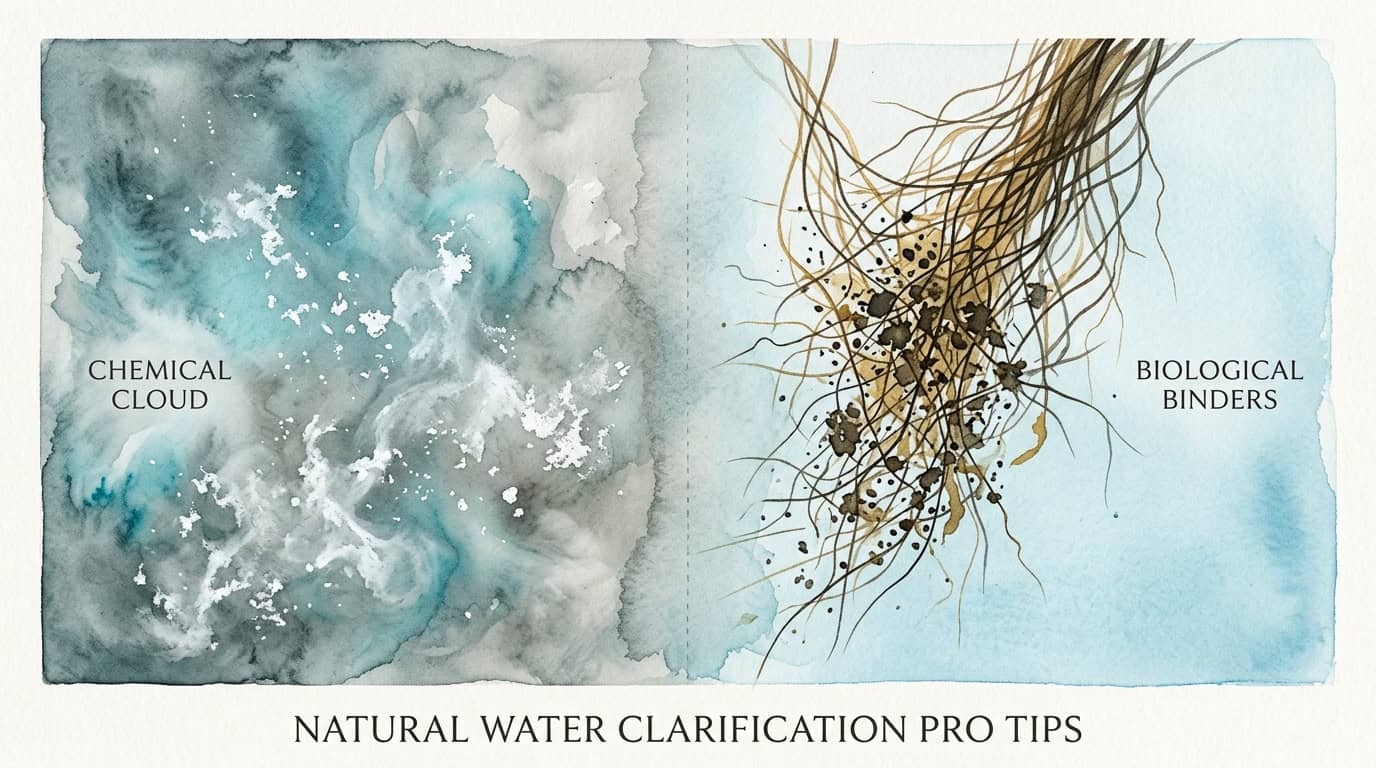
The cleanest water isn’t manufactured in a laboratory; it’s brewed in the mud using nature’s own chemistry. Chemical flocculants offer a 24-hour fix but leave behind aluminum and salts that harm your fish. Biological binders use natural enzymes to clump dirt and drop it to the floor where bacteria can eat it. Choose the solution that builds life instead of just hiding dirt.
Natural Water Clarification Pro Tips
Natural water clarification refers to the process of remediating turbidity and suspended solids using biological catalysts and organic polymers rather than synthetic metallic salts. In conventional pond management, water clarity is often treated as a visual problem, yet it is fundamentally a chemical and biological equilibrium issue. Suspended particulates, often negatively charged colloids, remain in suspension because their surface charges repel one another, preventing the formation of larger, heavier masses that can settle via gravity.
This approach exists to provide a sustainable, non-toxic alternative to aggressive industrial treatments. It is used in high-end koi ponds, commercial aquaculture, and ecological restoration projects where the preservation of the microbiome is critical. By utilizing enzymatic binders and concentrated bacterial strains, managers can achieve “gin-clear” water without the risk of heavy metal accumulation or drastic pH fluctuations associated with traditional aluminum sulfate (alum) applications.
Think of natural clarification as the difference between using a mechanical filter and an ecological sponge. While a mechanical filter traps what passes through it, a biological binder changes the physical properties of the water column itself. It forces microscopic debris to aggregate into “floc” that is heavy enough to sink or large enough to be captured by standard mechanical filtration systems. This method relies on the synergy between cationic biopolymers and heterotrophic bacteria to not only clear the water but also digest the resulting sediment.

How Biological Binding and Sedimentation Work
The process begins with the introduction of a biological binder, frequently a derivative of chitin such as chitosan, or a complex carbohydrate-based polymer. These molecules carry a high positive (cationic) charge. Because most suspended organic debris, silt, and clay particles in a pond carry a negative (anionic) charge, the binder acts as a molecular magnet. This phase is technically known as charge neutralization or coagulation.
Once the charges are neutralized, the repulsive forces between the particles vanish. The binder then facilitates “bridging,” where long molecular chains reach out and snag multiple particles, pulling them into a larger cluster known as a floc. This increase in mass follows Stokes’ Law, which dictates that the settling velocity of a particle increases as the square of its radius. By increasing the particle size, biological binders accelerate sedimentation by several orders of magnitude.
To implement this system effectively, follow these technical steps:
- Analyze Water Chemistry: Test for carbonate hardness (KH) and pH. Biological binders and the subsequent bacterial digestion perform optimally in water with a KH above 100 ppm and a stable pH between 7.2 and 8.0.
- Calculate Volume Metrics: Determine the exact gallonage or acre-feet of the system. Over-application of biological binders can lead to temporary “re-stabilization,” where particles become positively charged and begin repelling each other again, stalling the clarification process.
- Introduce the Binder: Apply the binder near an aeration source or a water return. High-energy mixing is required for the first 15–30 minutes to ensure the binder contacts as many suspended particles as possible.
- Monitor Dissolved Oxygen (DO): As particles settle and bacteria begin the digestion process, oxygen consumption increases. Maintain DO levels above 6.0 mg/L to prevent anaerobic pockets in the settling zone.
- Sustain the Microbiome: After the initial clearing, introduce heterotrophic bacteria strains (e.g., Bacillus subtilis) to colonize the new sediment layer and prevent the buildup of organic muck.
Advantages of Biological Systems Over Chemical Alternatives
The primary advantage of biological binders is their benign impact on the aquatic environment. Unlike aluminum sulfate or polyacrylamide, biological binders like chitosan are fully biodegradable. They do not leave behind residual heavy metals that can accumulate in the tissues of fish or lead to long-term neurotoxicity in sensitive species. This makes them the preferred choice for systems housing high-value livestock.
Nutrient sequestration is another critical benefit. Chemical flocculants often bind phosphorus temporarily, but they do nothing to address the organic load. Biological systems involve enzymes that begin the breakdown of proteins and lipids while the particles are still in suspension. This reduces the overall biochemical oxygen demand (BOD) of the pond over time, leading to more stable water quality parameters and fewer “crashes” during seasonal transitions.
Stability in water chemistry is significantly higher when using natural methods. Alum reacts with water to form sulfuric acid, which can rapidly deplete alkalinity and cause a lethal pH drop if the water is not properly buffered. Biological binders are typically pH-neutral or have a negligible effect on the carbonate system. This allows for repeated applications without the constant need for kalkwasser or baking soda adjustments to keep the water safe for inhabitants.

Challenges and Common Pitfalls
The most frequent error in natural clarification is lack of patience. Biological processes are governed by kinetics that are significantly slower than the purely ionic reactions of chemical salts. While alum might clear a pond in 4 to 6 hours, a biological binder combined with bacterial digestion may take 3 to 7 days to reach full transparency. Impatient managers often double-dose the system, which can lead to filter clogging or temporary oxygen depletion.
Temperature sensitivity is a major constraint for the biological component of the process. Most enzymes and beneficial bacteria see a sharp decline in metabolic activity when water temperatures fall below 50°F (10°C). Attempting to use a biological-heavy approach in mid-winter often yields poor results unless specialized psychrophilic (cold-water) bacterial strains are utilized. Failure to adjust the strategy based on seasonal metabolic rates is a common cause of system failure.
Mechanical filtration must be sized to handle the sudden influx of solids. When a biological binder works correctly, it creates a massive amount of “floc” that must go somewhere. If the system lacks a bottom drain or a pre-filter capable of handling high solids, this material will simply settle on the bottom and rot, potentially releasing ammonia or hydrogen sulfide. A successful clarification event often requires a backwash of the filtration system within 48 hours of treatment.
Limitations and Environmental Constraints
Biological binders are highly effective for organic turbidity—cloudiness caused by algae, fish waste, and decaying plants—but they struggle with certain types of inorganic colloidal clay. Extremely fine bentonite or montmorillonite clays may require a higher ionic strength than what standard biological binders provide. In these specific cases, a hybrid approach or a specific mineral-based natural clarifier may be necessary to achieve complete clarity.
Systems with extremely high flow-through rates or rapid turnover may not provide sufficient contact time for biological binders to work. If the water is replaced too quickly, the binder is flushed out before it can effectively aggregate the suspended solids. This makes natural clarification more challenging in high-volume stream-fed ponds compared to closed-loop recirculating systems where the chemistry can be precisely controlled.
High levels of existing salinity or heavy mineral content can interfere with the binding sites on biological polymers. In brackish water or systems with very high total dissolved solids (TDS), the binder’s cationic charges may be “shielded” by the surrounding ions, reducing its efficiency. Pre-treating for hardness or adjusting the dosage based on conductivity readings is often required in these environments to ensure the binder remains active.
Chemical Cloud vs. Biological Binders
Understanding the distinction between these two methodologies is essential for making an informed management decision. The following table compares the mechanical and chemical profiles of industrial flocculants versus biological binding systems.
| Factor | Chemical Flocculants (Alum/PAM) | Biological Binders (Chitosan/Enzymes) |
|---|---|---|
| Reaction Speed | High (1–6 hours) | Moderate (24–72 hours) |
| Residue Profile | Metallic salts, potential aluminum toxicity | Biodegradable biopolymers |
| Impact on pH | Can cause significant acidification | Neutral / Minimal impact |
| Maintenance Effort | High (Requires frequent pH monitoring) | Low (Self-digesting with bacteria) |
| Ecosystem Synergy | Inhibits microbial growth initially | Enhances nutrient cycling and bio-filtration |
Practical Tips for Immediate Application
Optimization of natural clarification starts with aeration. Because the biological component of this process is aerobic, increasing the surface agitation or adding a bottom-diffused aeration system can double the rate of clarification. High oxygen levels prevent the “floc” from going anaerobic once it hits the pond floor, ensuring that the bacteria can effectively consume the waste rather than letting it turn into foul-smelling sludge.
Dosing should be split into multiple applications. Rather than adding the entire calculated dose at once, apply 50% on day one and the remaining 50% on day three. This prevents “over-shooting” the ionic balance and allows the filtration system to keep up with the solids removal. This staged approach also minimizes the risk of a sudden oxygen sag that can occur if a massive amount of organic matter is dropped to the floor simultaneously.
Consider the use of a “sacrificial” filter media during the clarification process. Placing a fine polyester batting or a 50-micron felt pad in the mechanical pre-filter can capture the biological floc before it reaches the biological media. This keeps the primary filter clean and prevents the aggregated debris from clogging the sensitive surface area where nitrifying bacteria reside. Once the water is clear, simply remove and discard the spent media pad.
Advanced Considerations for Large Systems
Scaling biological clarification to large lakes or commercial reservoirs requires a deeper understanding of hydraulic retention times (HRT). In large bodies of water, the binder should be applied in the “littoral zones” where water is shallow and biological activity is naturally higher. This uses the natural wind-driven circulation to distribute the binder across the deeper benthic zones.
Monitoring the “Redox Potential” (ORP) provides a high-level metric for assessing the health of the clarification process. A rising ORP indicates that the organic load is being successfully oxidized and that the biological binders are reducing the BOD. If the ORP stays low despite clarification, it suggests that the debris is simply settling and not being digested, indicating a need for higher bacterial concentrations or better aeration.
Metabolic stimulants can be added to the biological binder to “prime” the indigenous bacteria. Adding trace minerals and specific amino acids along with the enzymes can trigger a faster response from the natural microbiome. This is particularly useful in “sterile” systems or new ponds where the bacterial colony is not yet robust enough to handle the sudden availability of concentrated organic matter.
Example Scenario: Remedying a Post-Storm Organic Bloom
Imagine a 5,000-gallon koi pond that has become “pea-soup” brown following a heavy rain event. The runoff has introduced both fine silt and high levels of dissolved organic carbon (DOC). A chemical approach using Alum would require precise titration to avoid killing the koi, and the resulting aluminum hydroxide sludge would need to be physically vacuumed out.
Using the biological approach, the manager first tests the KH, finding it at a safe 120 ppm. They apply a chitosan-based binder at a rate of 1 ounce per 1,000 gallons. Within 12 hours, the fine silt begins to clump. By the 24-hour mark, the water has shifted from brown to a hazy grey as the particles settle. At this point, the manager adds a concentrated blend of Bacillus and Pseudomonas bacteria.
By day three, the haziness is gone, and the water is transparent to a depth of four feet. The bottom-mounted aerator ensures the settled floc is being actively digested by the newly introduced bacteria. A quick backwash of the bead filter removes the heavier solids. The result is a system that is not only clear but has a more robust biological foundation than it did before the storm, with lower nitrate levels and a stable pH of 7.8.
Final Thoughts
Natural water clarification represents a shift from reactive chemical “fixing” to proactive biological management. By focusing on the underlying physics of particle suspension and the biology of organic digestion, pond owners can maintain pristine conditions without compromising the health of the aquatic ecosystem. This approach recognizes that the pond is a living system, where the most effective tools are those that enhance natural processes rather than overriding them with synthetic intervention.
Success in this field requires a technical mindset and an appreciation for the slower, more thorough pace of nature’s chemistry. While the initial results may take longer to manifest, the long-term benefits of reduced muck, stable water parameters, and healthier livestock are undeniable. As you move forward, continue to monitor your alkalinity and oxygen levels, as these are the fuel for the biological engine that keeps your water clear.
Experimentation with different bacterial strains and enzymatic concentrations will allow you to tune your system to its specific environmental variables. Whether you are managing a small backyard feature or a large-scale aquatic facility, the transition to biological binders is a step toward greater efficiency and environmental stewardship. The goal is not just clear water, but a thriving, self-sustaining world beneath the surface.