

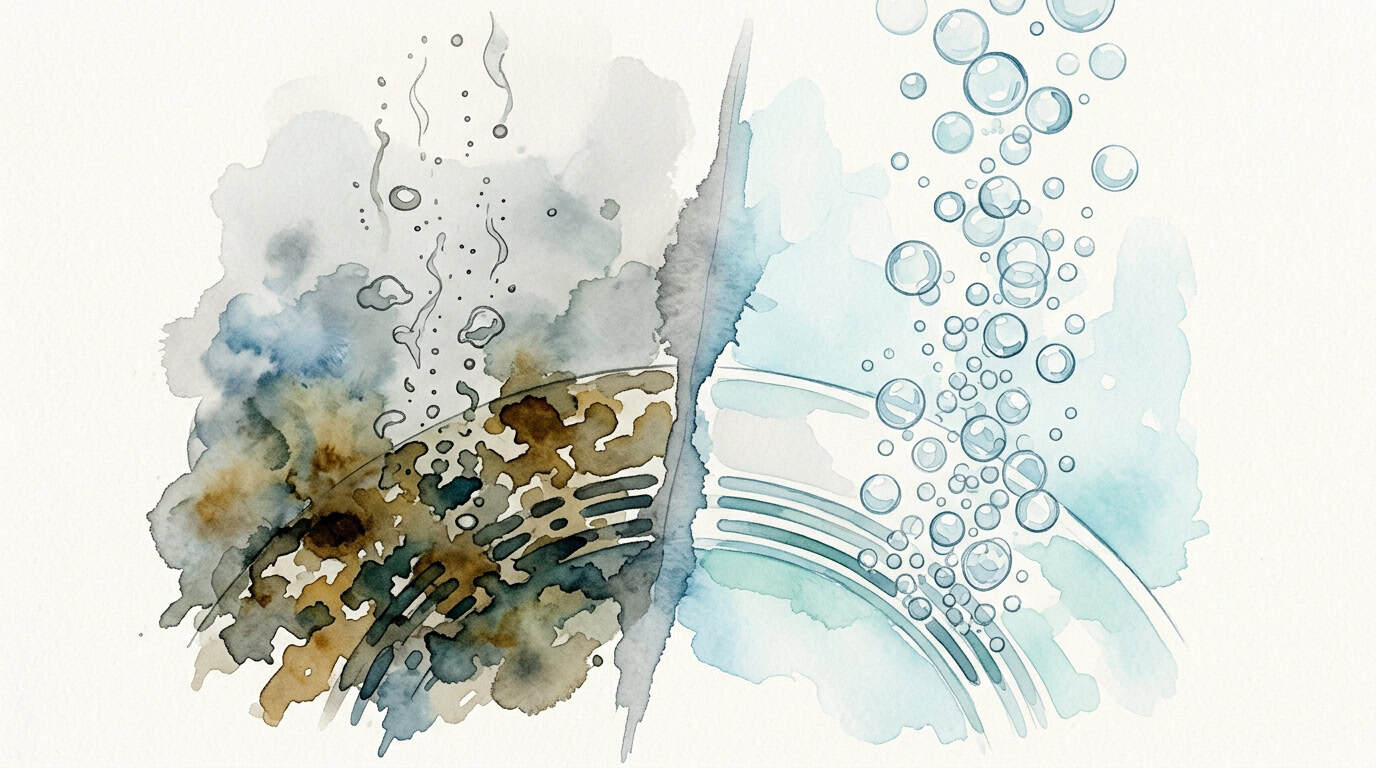
Big bubbles are a sign of failure. You want a ‘wall of mist’ for maximum oxygen. If your pond looks like it’s ‘burping’ instead of ‘boiling,’ your diffusers are likely clogged or failing. Large bubbles don’t transfer oxygen; micro-bubbles do. Here’s how to restore the flow.
Aeration efficiency is the single most critical variable in biological water treatment and pond management. When a diffuser system operates correctly, it produces a dense plume of fine bubbles that provide high interfacial surface area for gas exchange. As these bubbles rise, they transfer oxygen into the water column to support aerobic bacteria and aquatic life.
System performance inevitably degrades over time due to mechanical and biological factors. Clogging and fouling increase back-pressure on blowers, which leads to higher energy consumption and lower dissolved oxygen levels. Restoring this flow requires a technical understanding of why diffusers fail and how to optimize the aeration physics within your system.
Why Your Diffusers Aren’t Producing Enough Bubbles
Diffuser failure typically manifests as a shift from fine-pore diffusion to coarse-bubble “burping.” This transition is usually caused by two primary mechanisms: biofouling and mineral scaling. In real-world environments, these processes often occur simultaneously, creating a composite layer of obstruction that restricts airflow and reduces oxygen transfer efficiency.

Biofouling occurs when a layer of microbial biofilm attaches to the surface of the diffuser. These microorganisms produce Extracellular Polymeric Substances (EPS), a sticky matrix that traps debris and gradually seals the fine pores of the membrane or ceramic plate. This biological growth thrives in the oxygen-rich environment provided by the diffuser itself, making it a persistent challenge in wastewater and high-load aquaculture systems.
Mineral scaling is a chemical process, most commonly involving calcium carbonate (CaCO3) precipitation. When air is compressed and forced through a diffuser, local temperature and pH changes occur at the air-water interface. These shifts can cause dissolved minerals in the water to crystallize directly on or within the diffuser pores. Over time, these hard deposits narrow the orifice size, requiring higher pressure to maintain the same airflow.
Mechanical degradation also plays a role. In EPDM (Ethylene Propylene Diene Monomer) membranes, the loss of plasticizers over years of operation causes the material to lose elasticity. This “stiffening” prevents the slits from opening fully at standard operating pressures, resulting in uneven bubble distribution and localized “hot spots” of coarse bubbles where the material has eventually torn under stress.
How Aeration Physics Dictates Oxygen Transfer
The performance of an aeration system is measured by Standard Oxygen Transfer Efficiency (SOTE) and Standard Aeration Efficiency (SAE). SOTE represents the percentage of oxygen transferred from the air into the water at standard conditions, while SAE measures the amount of oxygen transferred per unit of energy consumed (typically kg O2/kWh).
Micro-bubbles, generally defined as being 1–3 mm in diameter, are superior for aeration because of two physical principles: surface area and rise velocity. A single 6 mm bubble has the same volume as eight 3 mm bubbles, but those eight smaller bubbles provide twice the total surface area for oxygen to cross the gas-liquid boundary. Furthermore, smaller bubbles rise more slowly due to lower buoyancy, increasing the contact time between the air and the water.
Restoring flow begins with monitoring the Dynamic Wet Pressure (DWP). DWP is the total pressure required to overcome the static head of the water column plus the resistance of the diffuser itself. As pores clog, the DWP increases. Monitoring this metric allows operators to identify fouling before the system reaches a point of “critical back-pressure,” where blowers may surge or overheat.

System optimization often involves “flexing” the membranes. By briefly increasing the airflow to the maximum rated capacity—a process called an air bump or air shock—the flexible membrane expands, potentially cracking and shedding mineral scales or biological mats. For rigid ceramic diffusers, this process is ineffective, and chemical intervention via acid dosing is typically required.
Benefits of High-Efficiency Micro-Bubble Aeration
Maintaining a clean, optimized diffuser system provides measurable operational advantages. The most immediate benefit is energy reduction. Because fine-pore diffusers have a higher SOTE, the blower can deliver less total air to achieve the target dissolved oxygen (DO) level. This reduces the electrical load and extends the service life of the blower components.
Process stability is another major advantage. In biological systems, consistent oxygen levels prevent the formation of anaerobic pockets, which can produce toxic gases like hydrogen sulfide. Optimized flow ensures a uniform “boiling” effect across the pond or tank surface, which indicates that oxygen is being distributed evenly throughout the entire volume of water.
Additional benefits include:
- Reduced Nutrient Loading: Higher oxygen levels support more efficient nitrification, helping to process ammonia and nitrites faster.
- Lower Maintenance Costs: Proactive cleaning prevents the permanent hardening of scales, which often necessitates expensive total membrane replacement.
- Improved Water Clarity: Optimized aeration promotes the healthy aerobic digestion of organic solids, reducing sludge buildup and turbidity.
Challenges and Common Mistakes in Diffuser Management
A common error is over-pressurizing the system to “force” air through clogged diffusers. While this might temporarily increase bubble volume, it significantly increases energy costs and risks damaging the blower. High back-pressure forces the blower to operate at the far left of its performance curve, leading to heat buildup and potential mechanical failure.
Another pitfall is the failure to distinguish between “mixing” and “aeration.” Operators sometimes see large, churning bubbles and assume the system is working well. In reality, large bubbles are excellent at moving water but terrible at transferring oxygen. If the goal is biological treatment, the “boiling” look of coarse bubbles is often a sign of massive energy waste and poor O2 transfer.
Mistakes also occur during the cleaning process. Using abrasive brushes or high-pressure washers too close to the membrane can permanently damage the precision slits. For EPDM membranes, using petroleum-based cleaners will cause the material to swell and fail. Always use soft-bristled brushes and approved cleaning agents like citric or muriatic acid at appropriate dilutions.
Limitations of Fine-Pore Diffusion Systems
Fine-pore diffusers are not universal solutions. In environments with extremely high solids concentrations or high levels of fats, oils, and grease (FOG), the rate of fouling may be so high that fine-pore diffusers become impractical. In these cases, coarse-bubble diffusers or mechanical surface aerators may be preferred despite their lower energy efficiency, as they are virtually immune to clogging.
Depth is another constraint. At shallow depths (less than 3 feet), the contact time for micro-bubbles is too short to achieve high SOTE. In shallow water, the energy required to compress the air often outweighs the oxygen transfer benefit. Conversely, at extreme depths, the back-pressure from the water column (static head) may exceed the capabilities of standard regenerative blowers, requiring more expensive positive displacement compressors.
Environmental conditions such as high water hardness (high calcium and magnesium levels) drastically reduce the intervals between cleanings. In such regions, an aeration system designed without an integrated acid-injection or cleaning port will face significant operational hurdles.
Comparison: Diffuser Types and Performance
Choosing the right hardware depends on the trade-off between initial cost, maintenance requirements, and energy efficiency. Below is a comparison of common diffuser technologies.
| Feature | EPDM Membrane | Ceramic Disc | Coarse Bubble |
|---|---|---|---|
| SOTE (%) | 20% – 40% | 25% – 45% | |
| Maintenance | Medium (Flexing) | High (Acid Wash) | Very Low |
| Lifespan | 5 – 7 Years | 10 – 15 Years | 15+ Years |
| Clog Resistance | Medium | Low | High |
| Initial Cost | Moderate | High | Low |
While ceramic diffusers offer the highest theoretical efficiency, they are prone to internal clogging and are more difficult to clean in-situ. EPDM is the industry standard for its balance of efficiency and the ability to be “flexed” to shed surface debris. Coarse bubble systems remain relevant only where mixing is the primary objective or where water quality is so poor that fine pores would clog instantly.
Practical Tips for Restoring and Maintaining Flow
To restore flow, start with a diagnostic pressure check. Compare your current system pressure (measured at the blower outlet) to the “clean” pressure recorded during installation. If the pressure has increased by 1.0–2.0 PSI at the same airflow, cleaning is mandatory.
Implement these best practices to maintain a “wall of mist”:
- Regular Flexing: Once a month, increase the airflow to the maximum rating for 15–30 minutes. This mechanical stretching helps keep the slits clear.
- Acid Injection: If you use ceramic or heavily scaled membranes, consider a permanent acid-injection system. Injecting a small amount of acetic or formic acid into the air line can dissolve mineral scales without removing the diffusers from the water.
- Blower Filter Maintenance: Clogged air intake filters on the blower reduce the mass of air delivered to the diffusers, which can look like a diffuser clog. Check filters every 3 months.
- Check for Leaks: Large bubbles surfacing near the shore or far from the diffusers usually indicate a pipe leak rather than a clogged head.
Advanced Considerations for Large-Scale Systems
For serious practitioners, monitoring the Alpha Factor ($\alpha$) is essential. The Alpha Factor is the ratio of oxygen transfer in process water versus clean water. In systems with high surfactants (soaps/chemicals), the $\alpha$ can drop significantly, meaning even a clean diffuser will underperform. Adjusting the diffuser density—adding more heads to reduce the air flux per head—can often improve the Alpha Factor and overall efficiency.
Consider the use of “Off-Gas Testing” for large municipal or industrial ponds. This involves capturing the air bubbles at the surface and analyzing the remaining oxygen content. This data provides an exact SOTE measurement in real-time, allowing operators to calculate the precise ROI of a cleaning cycle or a complete membrane replacement.
Thermal management is another advanced factor. Compressed air is hot. If the air temperature in the droplegs exceeds the rating of the EPDM (typically 180°F), the membranes will harden prematurely. Installing an air cooler or increasing the pipe diameter to reduce friction can extend the life of the diffusers by several years.
Example Scenario: The Cost of Clogged Chaos
Imagine a 1-acre industrial pond using four 12-inch disc diffusers powered by a 2 HP blower. When clean, the system operates at 4.0 PSI, delivering 25 CFM of air with an SOTE of 25%. The blower draws 1.5 kW of power.
After 18 months of neglect, the diffusers become scaled. To maintain the same oxygen level, the operator must increase the air volume, but the clogging has raised the back-pressure to 6.0 PSI. The blower is now working much harder, drawing 2.1 kW, and the SOTE has dropped to 12% because the bubbles have coalesced into larger “burps.”
The math is clear:

- Energy Increase: 0.6 kW additional draw. Over a year (8,760 hours), this equals 5,256 kWh of wasted electricity.
- Oxygen Loss: The system is transferring less than half the oxygen per cubic foot of air compared to the clean state.
- Result: At an electricity rate of $0.12/kWh, the operator is spending $630 extra per year in energy alone, not including the increased wear on the blower and the risk of a biological crash. A $100 acid-cleaning kit would have paid for itself in two months.
Final Thoughts
Effective aeration is a mechanical process that requires constant monitoring of pressure and bubble morphology. Transitioning from “Clogged Chaos” to “Optimized Flow” isn’t just about water aesthetics; it is about the fundamental efficiency of the biological engine in your pond. By focusing on micro-bubble production and managing back-pressure, you ensure that every watt of energy used by your blowers is translated into life-sustaining dissolved oxygen.
Regular maintenance, including mechanical flexing and chemical descaling, should be a non-negotiable part of your operational schedule. The goal is a consistent “wall of mist” that maximizes the interfacial surface area and contact time. Practitioners who master these technical details will see lower energy bills, cleaner water, and a more resilient aquatic ecosystem.
Experiment with your system’s “air bumps” and monitor your PSI monthly. These small adjustments are the difference between a failing, burping pond and a high-performance aeration system. If your current diffusers no longer respond to cleaning, it may be time to evaluate the latest high-efficiency membrane materials to restore your system’s competitive edge.