

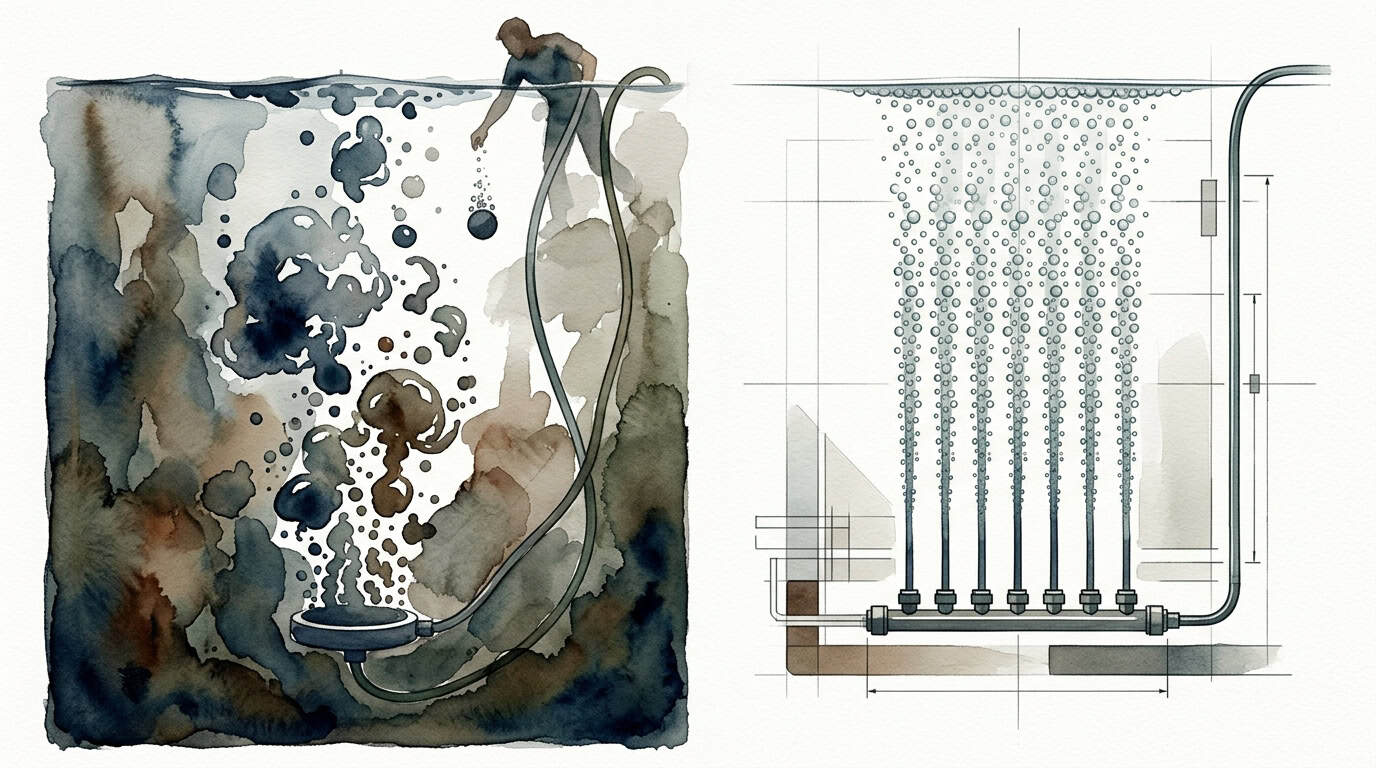
Your compressor is working too hard. Learn how physics determines your oxygen levels. Every foot of airline and every foot of depth is a battle against your compressor. Are you losing the fight? Learn how to calculate friction loss and depth pressure to get the bubbles you paid for.
Efficiency in pond and lake aeration is not a matter of horsepower alone. It is a calculation of total system backpressure. When a compressor is forced to push air against the weight of water and the resistance of narrow tubing, its output drops while its internal temperature rises. Understanding the mechanics of fluid dynamics as they apply to compressed air is the difference between a system that lasts ten years and one that fails in two.
This guide provides the technical framework required to evaluate and optimize aeration performance through the lens of physics. We will move beyond the simplified “gallons per minute” marketing and into the reality of pounds per square inch (PSI) and cubic feet per minute (CFM) at depth.
How Depth and Airline Length Affect Aeration Performance
Aeration performance is governed by the total resistance the compressor must overcome. This resistance is generally categorized into three distinct variables: hydrostatic pressure from water depth, friction loss from the delivery airline, and the mechanical resistance of the diffuser membrane itself.

Hydrostatic pressure is a constant derived from the weight of the water column. In freshwater environments, every 2.31 feet of depth adds exactly 1 PSI of backpressure to the system. If a diffuser is placed at a depth of 10 feet, the compressor is immediately fighting 4.33 PSI before a single bubble is produced. This is a non-negotiable physical limit.
Airline length introduces a second, more manageable variable known as friction loss. As air moves through a pipe, it interacts with the interior walls of the tubing. This interaction creates resistance that dissipates energy as heat and reduces the air’s velocity. The longer the run and the narrower the pipe, the higher the friction loss. For instance, pushing 2 CFM through 100 feet of 3/8-inch tubing can add nearly 0.5 PSI to the system, whereas upgrading to 1/2-inch tubing for the same run reduces that loss to approximately 0.14 PSI.
Total system pressure is the sum of these parts. A system operating at high total pressure forces the compressor to work at a less efficient point on its performance curve. This results in lower oxygen transfer, higher electrical consumption, and accelerated wear on mechanical components such as diaphragms, pistons, and seals.
How It Works: The Physics of Air Resistance
Calculating the backpressure of an aeration system requires a “bottom-up” approach. You must first determine the pressure at the diffuser and work back toward the compressor head. The primary equation for Total System Pressure (TSP) is:
TSP = (Depth / 2.31) + (Friction Loss per 100ft × (Total Length / 100)) + Diffuser Resistance
Friction loss is not linear relative to flow rate. If you double the airflow (CFM) through the same pipe, the friction loss increases exponentially. This is why a compressor that performs well with one diffuser might struggle significantly if a second diffuser is added to the same airline. The air velocity increases, the friction rises, and the compressor encounters a “wall” of resistance.

Compressor performance curves are the essential tool for this analysis. Every professional-grade compressor has a chart plotting CFM against PSI. As PSI rises, CFM falls. A rocking piston compressor might deliver 4.5 CFM at 0 PSI (free air), but only 3.1 CFM at 10 PSI. If your system design forces the pressure to 12 PSI through poor tubing choices, you may only be delivering 2.5 CFM. You are paying for the electricity to run a 4.5 CFM machine but only receiving roughly half of that output in the water.
Thermal dynamics also play a role. When air is compressed, it generates heat. If that air cannot move freely due to high backpressure, the heat stays trapped at the compressor head. High operating temperatures cause the lubrication in the bearings to break down and the rubber components in the valves to become brittle. Sizing the airline correctly ensures that air moves at a velocity that allows for adequate heat dissipation.
Benefits of Strategic Pressure Management
Optimizing for lower backpressure provides immediate mechanical and financial advantages. The most significant benefit is the extension of the compressor’s mean time between failures (MTBF). Compressors operating at or near their maximum rated PSI generate excessive heat, which is the primary killer of electric motors and compression chambers. Reducing system pressure by just 2 or 3 PSI can extend the life of a rocking piston or diaphragm by several years.
Energy efficiency is the second major benefit. While most aeration compressors are fixed-speed, the “load” on the motor changes based on the pressure it must maintain. A compressor fighting high backpressure will draw more amperage than one operating at a lower PSI. Over a year of 24/7 operation, the cost difference is measurable.
Oxygen transfer efficiency (OTE) also improves when the compressor is allowed to operate in its “sweet spot.” Higher CFM delivery means more water is moved per hour. In a stratified pond, the goal is to move the entire volume of the bottom water (the hypolimnion) to the surface twice per day. If backpressure is cutting your CFM in half, you are only achieving half the necessary turnover, leaving the bottom of the pond in a state of hypoxia despite the compressor running constantly.
Challenges and Common Mistakes
The most frequent error in DIY and even some professional installations is the use of undersized airlines. Many installers reach for 3/8-inch weighted tubing because it is easier to handle and lower in cost. However, for any run exceeding 100 feet at flow rates above 2 CFM, 3/8-inch tubing creates a significant bottleneck.
Another common mistake is ignoring the cumulative effect of fittings. Every elbow, tee, and check valve adds a small amount of resistance. While a single 90-degree elbow might only add the equivalent of a few feet of pipe, a manifold with six sharp turns can contribute significantly to the total PSI. Engineers prefer “sweeping” turns or larger diameter manifolds to keep air moving smoothly.
Failure to account for diffuser fouling is also a hidden trap. Over time, calcium deposits and biological growth (biofilm) can clog the pores of a membrane diffuser. This increases the “cracking pressure” required to push air through the membrane. If a system is already designed at the limit of the compressor’s PSI range, a small amount of fouling can push the system into an overload state, causing the internal thermal switch to trip or the motor to burn out.
Limitations of Aeration Physics
Physics imposes hard limits on what a compressor can achieve regardless of its quality. No matter how large your airline is, you cannot change the fact that water depth creates pressure. This means that at a certain depth—typically around 40 to 50 feet—standard rocking piston compressors reach their limit. Beyond these depths, specialized rotary vane or high-pressure screw compressors are required, but these are often prohibitively expensive for most private pond owners.
Atmospheric pressure and elevation also create limitations. At higher altitudes, the air is thinner. This means the compressor has less “mass” to work with at the intake, leading to a natural reduction in delivered CFM compared to sea-level ratings. If you are installing a system in the mountains, you must derate the manufacturer’s performance specs by approximately 3% for every 1,000 feet of elevation.
Environmental temperature provides the final constraint. In the peak of summer, ambient air is already hot. A compressor that runs at its limit will struggle to stay within its safe operating temperature when the intake air is 90 degrees Fahrenheit. This is why ventilation in the compressor cabinet is just as important as the plumbing in the pond.
Strategic Engineering vs Manual Placement
There is a distinct difference between “Manual Placement” and “Strategic Engineering.” Manual placement involves dropping a diffuser where it seems most convenient, often close to the shore to save on airline costs. Strategic engineering uses data to determine the most efficient location based on the pond’s bathymetry (depth profile).
| Factor | Manual Placement | Strategic Engineering |
|---|---|---|
| Airline Sizing | Standard 3/8″ or 1/2″ used regardless of length. | Diameter calculated based on CFM and distance to minimize PSI drop. |
| Placement Depth | Placed in the deepest hole (often creates excessive backpressure). | Placed at the optimal depth to balance OTE and compressor load. |
| Manifold Design | Standard fittings; multiple lines from one small port. | Balanced manifolds to ensure equal CFM to all diffusers. |
| System Longevity | Lower; compressor often operates at high heat/PSI. | Higher; compressor operates within the efficient 40-60% range. |
Strategic engineering may require a higher upfront investment in larger tubing and a more powerful compressor, but the total cost of ownership is lower because of the reduced maintenance and energy savings.
Practical Tips and Best Practices
If you are designing or troubleshooting a system, start by installing a pressure gauge at the compressor head. This is the only way to know exactly what the “battle” looks like. A reading that is higher than the calculated depth pressure indicates a restriction in the airline or a clogged diffuser.
When running long distances from the power source to the pond, it is almost always more efficient to run air than to run electricity. Voltage drop in long extension cords can damage motors. Conversely, you can run 1,000 feet of 1-inch PVC pipe (which has almost zero friction loss for aeration flow rates) and place the compressor right at the power source. This keeps the expensive mechanical components in a controlled environment while delivering air to the water.
Use weighted airline for the portion of the run that is underwater, but use rigid PVC or PE pipe for the trenching on land. Weighted tubing is expensive and has slightly more friction than smooth-wall PVC. By transitioning to weighted tubing only at the water’s edge, you save money and improve efficiency.
Best Practices Checklist:
- Always use a pressure relief valve set to 1-2 PSI above your operating pressure.
- Size your main header pipe one size larger than your individual diffuser lines.
- Install the compressor in a shaded, well-ventilated enclosure.
- Keep a log of your baseline PSI to identify when diffusers begin to clog.
Advanced Considerations: Adiabatic Compression and Heat
For high-end practitioners, the concept of adiabatic compression is vital. When air is compressed rapidly, as it is in a piston chamber, the temperature rise is not just due to friction; it is a thermodynamic property. This “heat of compression” can reach temperatures exceeding 200 degrees Fahrenheit at the discharge port.
If the airline is too small, this heat cannot dissipate. This leads to a phenomenon where the plastic of the airline can actually soften and burst near the compressor. Using a “heat sink” or a short section of high-temperature copper or braided steel hose immediately following the compressor can help dissipate this initial thermal spike before the air enters the plastic airline.
Furthermore, consider the moisture content of the air. Hot air holds more water vapor. As that air cools in the underwater airline, the water condenses. In cold climates, this condensation can freeze, creating an “ice plug” that completely blocks the line. Strategic engineering accounts for this by installing moisture traps at the lowest point of the land-based airline before it enters the water.
Real-World Scenario: The 15ft vs 25ft Comparison
To illustrate the impact of these principles, consider a 1/2 HP rocking piston compressor. This unit is rated for 3.5 CFM at 5 PSI but only 2.2 CFM at 15 PSI.

In Scenario A, the diffuser is placed at 15 feet. The depth pressure is 6.5 PSI. Using 1/2-inch tubing for a 200-foot run adds 0.3 PSI. The diffuser adds 0.2 PSI. Total pressure: 7.0 PSI. The compressor delivers approximately 3.2 CFM. The system is efficient and the motor runs cool.
In Scenario B, the same diffuser is placed in a 25-foot hole. The depth pressure is 10.8 PSI. The installer used 3/8-inch tubing for the same 200-foot run, adding 1.2 PSI. Total pressure: 12.2 PSI. The compressor output drops to 2.5 CFM. More importantly, the compressor is now operating at the upper limit of its heat rating.
The difference of 10 feet of depth and a smaller tube diameter resulted in a 22% loss in oxygen delivery and likely halved the lifespan of the compressor.
Final Thoughts
Physics is the final arbiter of your aeration system’s success. You cannot “out-horsepower” a poorly designed airline or an overly deep placement without paying a steep price in equipment failure and energy waste. By calculating your total system backpressure and matching it to the compressor’s performance curve, you move from guesswork to strategic management.
The goal is to provide the highest volume of air at the lowest possible pressure. This balance ensures that your pond receives the oxygen it needs while your compressor operates in a state of mechanical ease. Whether you are managing a small koi pond or a multi-acre lake, the mathematics of depth and friction remain the same.
Take the time to measure your runs, choose the correct diameters, and monitor your PSI. These small adjustments in the design phase pay dividends for years in the form of clear water and a reliable system. Apply what you have learned here, and you will no longer be losing the battle against physics.