

Pond Talk is an Amazon Associate. As an Amazon Associate we earn from qualifying purchases.
A ‘pretty’ plant layout could be suffocating your fish when the ice forms—here is how the pros map their ponds. Stop just ‘dropping’ plants into your pond. Professional pond managers use strategic grid layouts to ensure oxygen reaches every corner, even under a foot of ice. It’s the difference between a spring awakening and a spring cleanup.
Mapping a pond for winter survival requires shifting focus from aesthetics to gas-exchange efficiency. When the surface seals with ice, the biological and chemical demands of the pond do not stop; they merely change their metabolic rate. Managing these rates through precise plant placement and biomass control is the only way to ensure consistent dissolved oxygen levels throughout the winter months.
This guide explores the technical methodologies used to prevent winterkill by optimizing oxygen production and minimizing biochemical oxygen demand. Readers will learn how to transition from decorative planting to functional oxygen grids.

Professional Winter Pond Oxygenation Tips
Professional winter pond management centers on maintaining dissolved oxygen (DO) levels above critical thresholds. While many game fish can survive at 2 parts per million (ppm), they become physiologically stressed when DO falls below 5 ppm. Maintaining these levels under ice requires a balance between oxygen production and the consumption caused by respiration and decomposition.
The physics of cold water provides a natural advantage: cold water has a higher saturation point for oxygen than warm water. However, without a path for atmospheric diffusion or active photosynthesis, this reservoir depletes over time. Professional managers use “venting” and “gridding” to ensure that the gases produced by organic decay—such as methane and hydrogen sulfide—can escape while oxygen is replenished.
Strategic plant placement serves as a biological engine. By utilizing specific hardy species in a calculated layout, managers can leverage the 70–90% of a pond’s oxygen that is typically generated through photosynthesis. This approach reduces the reliance on mechanical aerators, which can sometimes “super-cool” the water if not positioned correctly.
How the Oxygen Grid System Works
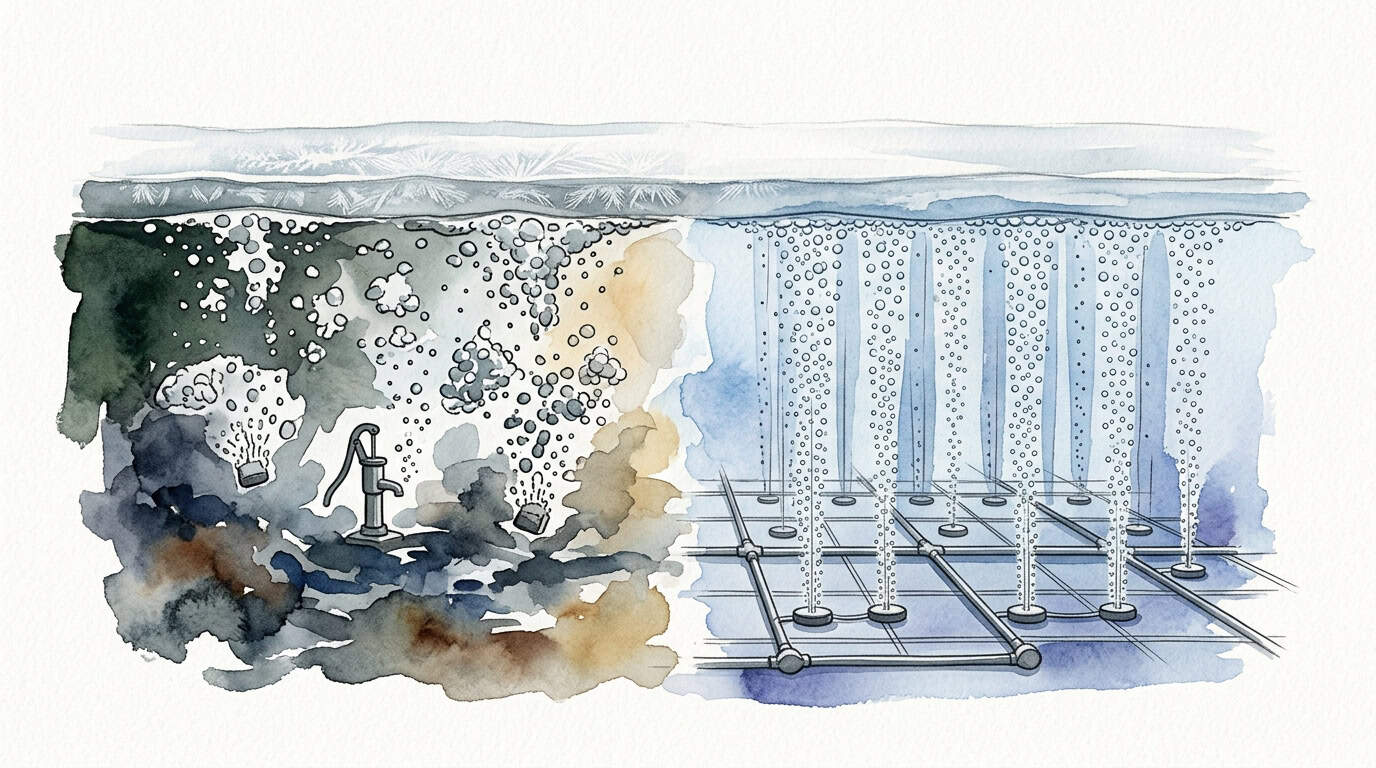
The Oxygen Grid system replaces the traditional “random clump” planting method with a geometric distribution of submerged vegetation. This method is based on the principle of maximizing the “ventilation radius” of each plant cluster.
To implement this, first calculate the total pond volume and surface area. Professional standards suggest that for every 1,000 gallons of water, a specific biomass of oxygenating plants is required. These plants should not be placed in a single mass, which creates “dead zones” in the center where water circulation is restricted and decomposition rates are higher.
Instead, plants like Hornwort (Ceratophyllum demersum) or Vallisneria are placed in a grid pattern. This spacing allows for slow under-ice convection currents to move oxygenated water throughout the entire water column. The grid should be densest near the “shelf” areas (12–24 inches deep) where light penetration is highest, but it must also extend toward the deeper thermal refuge where fish congregate.
Benefits of Strategic Grid Layouts
One primary advantage of a grid layout is the reduction of concentrated Biochemical Oxygen Demand (BOD). When plants are clumped together, the interior of the clump often dies off due to lack of light or nutrient competition. This concentrated mass of decaying matter consumes oxygen rapidly, creating a localized anoxic zone.
Grid layouts ensure that each plant has access to available light and nutrients, which keeps the vegetation healthy and actively producing oxygen even in low-light conditions. This distribution also aids in the stabilization of the pond’s pH levels. Since photosynthesis consumes carbon dioxide, a well-distributed plant grid prevents the localized acidic spikes that occur when CO2 builds up in stagnant areas.
Furthermore, a strategic layout facilitates easier maintenance. Managers can quickly identify areas of overgrowth or die-back, allowing for targeted pruning before the ice sets in. This proactive biomass management is essential for reducing the total organic load that the pond must process during the dormant season.
Challenges and Common Mistakes
The most frequent error in winter pond preparation is the failure to prune “marginal” or “emergent” plants before the first freeze. When lilies, rushes, and lotuses die back, their foliage falls into the water and begins to rot. In a sealed system, this decomposition consumes the very oxygen the fish need to survive the winter.
Another common mistake is neglecting snow cover. While ice is often translucent enough to allow for some photosynthesis, even a few inches of snow can block up to 99% of incoming light. Without light, plants stop producing oxygen and begin to consume it through respiration. This shift can turn a biological asset into a liability in less than 48 hours.

Improper placement of mechanical aerators also poses a risk. If an aerator is placed at the very bottom of the pond’s deepest point, it can disrupt the “thermal layer” (inverse stratification). This forces 39°F water to the surface where it cools further, potentially lowering the temperature of the entire pond to dangerous levels for the fish.
Limitations of Biological Oxygenation
Biological oxygenation is not a silver bullet for every environment. In extremely shallow ponds—those under three feet deep—the volume of water is often insufficient to act as an oxygen reservoir. In these cases, even a perfectly mapped oxygen grid may not produce enough DO to offset the respiration of a large fish load.
Environmental factors like “ice transmissivity” also play a role. If the ice forms as “white ice” (opaque) rather than “black ice” (clear), light penetration is significantly hampered regardless of the plant layout. In regions with prolonged, heavy snow and consistently sub-zero temperatures, biological systems must be supplemented with mechanical de-icers or aerators.
The specific species of fish also dictate the limits. High-metabolism species or those with low hypoxia tolerance require much higher DO levels. A plant grid that supports a small population of goldfish may fail to sustain a large population of koi, which have much higher metabolic demands even in a state of torpor.
Comparison: Random Clumps vs. Oxygen Grids
The following table compares the two primary methods of plant distribution in terms of winter efficiency and maintenance requirements.
| Feature | Random Clumps | Oxygen Grids |
|---|---|---|
| Oxygen Distribution | Localized; prone to dead zones. | Uniform; promotes convection. |
| Decomposition Risk | High; interior die-off is common. | Low; optimized for health. |
| Light Utilization | Inefficient; plants shade each other. | Maximized for each individual plant. |
| Gas Exchange | Restricted by biomass density. | High; allows for better gas flow. |
| Maintenance | Difficult to prune effectively. | Systematic and predictable. |
Practical Best Practices for Pond Managers
To maximize the effectiveness of a winter oxygen grid, several best practices should be followed during the late autumn transition. Start by selecting hardy, submerged species. Hornwort is a top recommendation for cold climates because it remains active at low temperatures and does not require a root system, allowing it to be anchored or moved easily within the grid.
Pruning is the next critical step. Remove all dead or dying foliage from marginal plants. For submerged plants, thin the clusters so that water can flow through them. A good rule of thumb is the “hand-width” rule: you should be able to pass your hand between the branches of an oxygenating plant without snagging.
Maintain at least 1–2% of the pond’s surface as open water. This can be achieved with a small floating de-icer or a shallow-depth bubbler. This “vent” allows toxic gases to escape, which is just as important as getting oxygen in. If snow accumulates, clear at least 30% of the pond’s surface area to allow sunlight to reach the submerged grids.
Advanced Considerations for Large Systems
Serious practitioners managing larger ponds (over 5,000 gallons) should consider the fluid dynamics of their system. Under ice, water moves very slowly, driven primarily by temperature differentials. Mapping your oxygen grid to align with these natural flow paths can significantly improve the SOTR (Standard Oxygen Transfer Rate) of the biological system.
Monitoring equipment is another advanced investment. Handheld Dissolved Oxygen meters allow for precise tracking of the DO profile. By measuring oxygen at different depths and locations, managers can identify if a particular grid section is failing or if a “thermal squeeze” is occurring—where the bottom water is too low in oxygen and the top water is too cold.
Digital sensors that provide real-time data to a smartphone can alert a manager to a “bloom crash” or a sudden drop in DO before a fish kill occurs. This data-driven approach allows for tactical interventions, such as emergency aeration or targeted snow removal, based on empirical evidence rather than guesswork.
Examples of Grid Mapping
Consider a 2,000-gallon pond with a surface area of 200 square feet and a maximum depth of 4 feet. A “pretty” layout might have placed two large pots of lilies in the center and a massive bank of Anacharis in one corner. This creates two problems: the lilies die and rot, and the Anacharis becomes a dense, oxygen-consuming mat in the dark.
A professional grid map for this same pond would look different. After removing the lilies, the manager would distribute 20 bunches of Hornwort in a 4×5 grid, spaced roughly 3 feet apart. Each bunch is anchored at a depth of 18–24 inches.
By spreading the biomass, the manager ensures that no single area has a high oxygen demand. If a bubbler is used, it is placed in a shallow area (about 12 inches deep) near one edge of the grid. This setup creates a circular flow of oxygenated water that reaches the deep end where the fish are resting, without freezing the entire water column.
Final Thoughts
Successful winter pond management is a mechanical and biological challenge. Shifting from an aesthetic mindset to a technical, grid-based approach ensures that the pond remains a healthy, balanced ecosystem even when it is hidden under ice. By understanding the relationship between biomass, light penetration, and gas exchange, you can prevent the devastating losses associated with winterkill.
The transition to oxygen grids requires more planning than simply dropping plants into the water, but the results are measurable. Consistency in dissolved oxygen levels leads to healthier fish, clearer spring water, and a significantly reduced workload when the ice finally thaws.
Practitioners are encouraged to start with a site survey and a clear map of their pond’s depths. Applying these professional gridding techniques is the most effective way to guarantee a successful spring awakening for your aquatic environment.
Amazon and the Amazon logo are trademarks of Amazon.com, Inc, or its affiliates.