

Pond Talk is an Amazon Associate. As an Amazon Associate we earn from qualifying purchases.
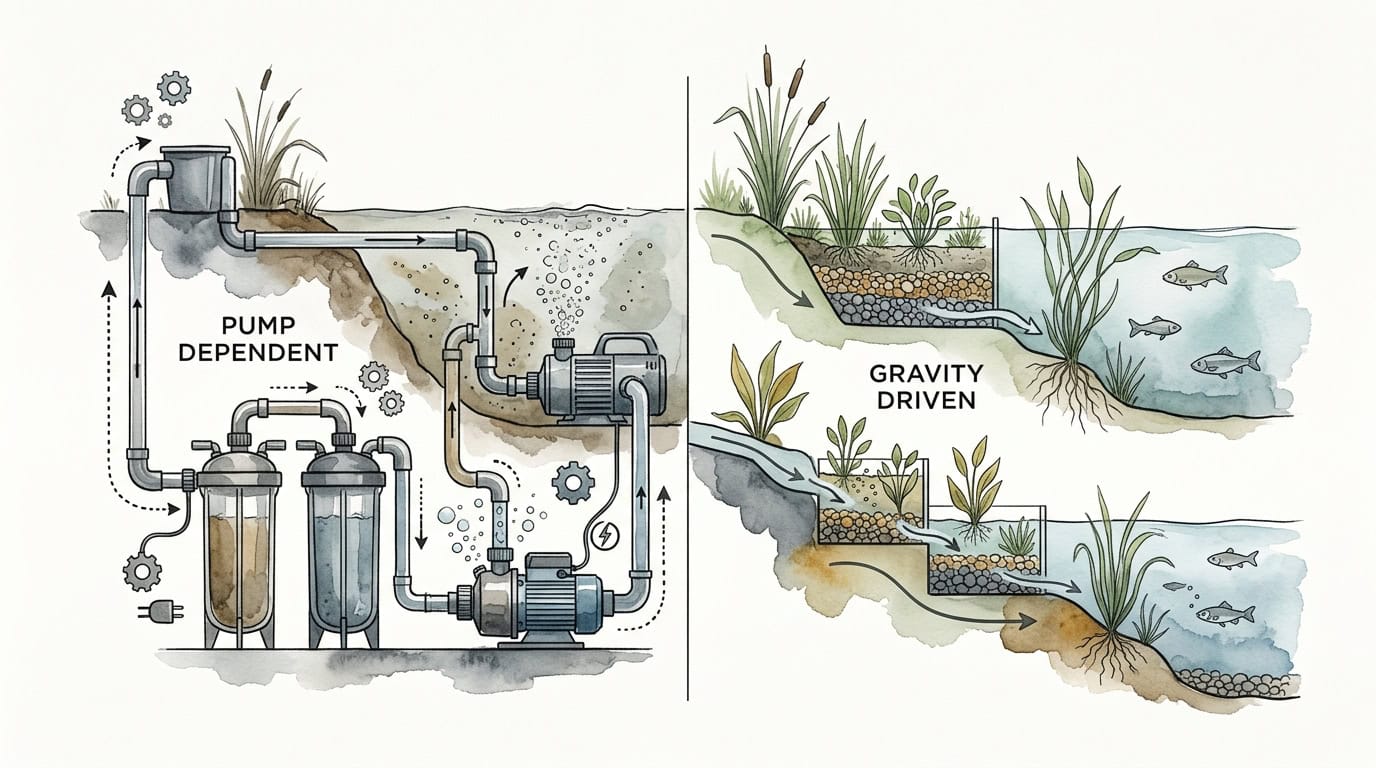
When the pump clogs, the pond dies—unless you use the force of gravity. Most pond owners are slaves to their pumps. If the intake clogs in the spring, the oxygen drops. A dynamic gravity-fed system uses elevation to keep water moving and oxygenated with far less mechanical risk.
In a traditional pump-fed setup, a submersible pump sits in the pond and pushes water through a filter. In a gravity-fed system, the physics are inverted. The filtration equipment is installed in a pit, at a level equal to the pond surface. Water flows naturally from the pond into the filters, and the pump is only used at the end of the line to return clean water.
This technical shift changes everything about how a pond functions. It moves the mechanical burden away from the water’s interior and places it into a controlled, accessible environment.

Passive Pond Filtration Methods
Passive pond filtration relies on physical laws rather than high-pressure mechanical force. The most common application is seen in dedicated Koi ponds and Recirculating Aquaculture Systems (RAS). These systems prioritize the removal of solid waste before it can dissolve and compromise water chemistry.
The primary method involves a bottom drain connected to a 4-inch PVC line. This line leads to a settlement chamber or a mechanical separator. Because the water moves slowly through these large-diameter pipes, heavy solids like fish waste and decaying plant matter remain intact. In a pump-fed system, these solids would be macerated by the pump impeller, turning them into a “fine” suspension that is significantly harder to filter.
Real-world examples of passive filtration include:
- Settlement Tanks: Large chambers where water velocity drops, allowing solids to sink to the bottom.
- Radial Flow Settlers (RFS): Advanced chambers that force water through a central baffle, achieving up to 80% efficiency in solids removal.
- Sieve Filters: Stainless steel mesh screens that use the “Coanda effect” to strip solids from the water column as it passes over a weir.
How the Gravity-Fed System Operates
The operational principle is based on the “connected vessels” theory. When two bodies of water are connected by a pipe, they seek an identical surface level. In a pond, the filter chambers are buried so that their top edges are a few inches above the pond’s maximum water level.
When the system is idle, the water level in the filter pit is exactly the same as the pond. When the return pump—located at the final stage of the filter—is activated, it draws water out and pushes it back into the pond. This creates a slight drop in the water level within the filter chambers.
Gravity immediately attempts to equalize this difference. It pushes water from the pond, through the bottom drain, and into the first filter chamber. This creates a continuous, low-pressure loop. The speed of this flow is determined by the “draw-down,” which is the difference in height between the pond surface and the water level in the first filter chamber.
Benefits of Gravity-Driven Architecture
Switching to a gravity-driven system provides several measurable technical advantages. The most significant is the protection of the pump itself. Since the pump is located at the end of the filtration sequence, it only handles “polished” water. This prevents debris from clogging the impeller, extending the mechanical life of the unit and reducing the frequency of teardown maintenance.
Solids management is another critical advantage. By keeping waste particles whole, the system can remove them in the first stage of filtration. This prevents the release of dissolved organic carbons (DOCs) that lead to yellow water and algae blooms.
Energy efficiency metrics also improve. Because the system does not require the pump to “suck” water through a restrictive intake screen or push it up a significant vertical head height before filtration, you can use high-flow, low-wattage external pumps. These pumps often move more water per watt than their submersible counterparts.
Challenges and Common Installation Errors
The most common mistake in gravity-fed design is improper pipe sizing. Many installers attempt to use 2-inch or 3-inch pipes for the main feed. At standard pond flow rates (3,000 to 5,000 GPH), a 2-inch pipe creates too much friction. The resulting “head loss” means the water cannot flow fast enough to keep up with the pump, causing the filter chambers to run dry.
Another challenge is the “filter pit” requirement. The filtration system must be installed at a precise depth. If the filter is too high, it won’t fill; if it is too low, the pond will overflow the filter edges. This requires careful excavation and a level concrete base to prevent shifting over time.

Finally, airlocks are a frequent issue. If the plumbing from the pond to the filter has a high point (an “up-and-over” loop), air will trap at the peak. This breaks the siphon or significantly restricts the flow. All gravity lines must have a continuous upward slope toward the filter or be perfectly horizontal to allow air to escape.
Limitations of Gravity-Fed Systems
Gravity-fed systems are not universally applicable. Site topography is the primary constraint. If the pond is built on a steep slope where the filtration cannot be buried at the correct elevation, a gravity system becomes logistically impossible or requires expensive retaining walls.
The footprint is also a consideration. Passive filtration components like settlement tanks or vortex chambers are physically large. They require more space than compact, pressurized bead filters. For small urban gardens with limited square footage, the space required for a filter pit may be prohibitive.
Lastly, the initial capital expenditure is higher. You must account for the cost of bottom drains, large-bore 4-inch PVC, and the labor for deep excavation. While the operational costs are lower, the upfront investment can be double that of a basic pump-fed system.
Technical Comparison: Gravity vs. Pump-Fed
| Feature | Gravity-Fed (Passive) | Pump-Fed (Mechanical) |
|---|---|---|
| Waste Handling | Maintains whole solids for easy removal. | Macerates solids into fine particles. |
| Energy Efficiency | High; minimal friction and head loss. | Lower; pump must overcome intake resistance. |
| Maintenance | Periodic flushing of valves/drains. | Frequent cleaning of pump cages and pads. |
| Installation Complexity | High; requires pit and precise leveling. | Low; plug-and-play. |
| Reliability | Safe; cannot easily empty the pond if a pipe breaks. | Risky; can pump the pond dry if a hose slips. |
Practical Best Practices for Setup
To optimize a gravity-fed system, use aerated bottom drains. An aerated drain includes an air diffuser on the top dome. As air bubbles rise, they create a vertical current that pulls debris from the pond floor toward the drain intake. Studies suggest aerated drains are approximately 30% more effective at capturing solids than non-aerated versions.
Install a “V-ball” or “Knife” valve on every incoming line. This allows you to isolate the filter pit for maintenance without draining the pond. It also enables “purging”—the process of opening a valve quickly to let a rush of water clear any heavy sediment settled in the 4-inch lines.
Ensure the return lines use Tangential Pond Returns (TPRs). By placing the return pipes at an angle and near the bottom of the pond wall, you create a circular “spinning” motion in the water. This vortex effect pushes debris toward the center drain, making the pond self-cleaning.
Advanced Considerations: The Radial Flow Settler
For those seeking maximum efficiency, the Radial Flow Settler (RFS) is superior to the traditional vortex chamber. In a vortex, water enters at a tangent and spins. In an RFS, water enters through a central vertical pipe, hits a baffle, and is forced to flow outward and upward.
Because the cross-sectional area increases as the water moves away from the center, the velocity drops sharply. This allows even light, neutrally buoyant particles to settle. Data from aquaculture trials shows that an RFS can remove 77% of total suspended solids (TSS), compared to only 37% for standard swirl separators. Implementing an RFS as your first stage significantly reduces the load on your biological media.
Example Scenario: A 5,000-Gallon Design
Consider a 5,000-gallon koi pond measuring 12′ x 15′ x 4′. A high-efficiency gravity design would include:
- Bottom Drain: One 4-inch aerated bottom drain placed at the deepest point.
- Plumbing: 4-inch Schedule 40 PVC running to the filter pit.
- Mechanical Stage: A 250-gallon Radial Flow Settler or a 300-micron Sieve filter.
- Biological Stage: A Moving Bed Biofilm Reactor (MBBR) using K1 or similar media.
- Return Pump: An external pump rated for 4,500 GPH at 5 feet of head, consuming roughly 150-200 watts.
In this setup, the turnover rate is once every 66 minutes. Because the solids are removed passively, the biological media stays clean, preventing “channeling” and ensuring the bacteria have maximum surface area for nitrification.
Final Thoughts
Dynamic gravity-fed systems represent the pinnacle of pond engineering for those prioritizing water quality and long-term stability. By removing the pump from the front of the sequence, you eliminate the primary cause of system failure and biological overload. The reliance on hydraulic gradient and Stokes’ Law for solids removal ensures that the water chemistry remains stable even as the fish population grows.
While the installation requires more rigorous planning and excavation, the reduction in weekly maintenance and the increase in equipment longevity provide a clear return on investment. Professionals and serious hobbyists who transition to gravity-driven architecture rarely return to pump-fed configurations.
Experimenting with different settlement geometries, such as the RFS, or integrating airlifts for even higher energy savings can further refine the system. Focus on the physics of water movement, and the biology of the pond will follow.
Amazon and the Amazon logo are trademarks of Amazon.com, Inc, or its affiliates.