

Pond Talk is an Amazon Associate. As an Amazon Associate we earn from qualifying purchases.
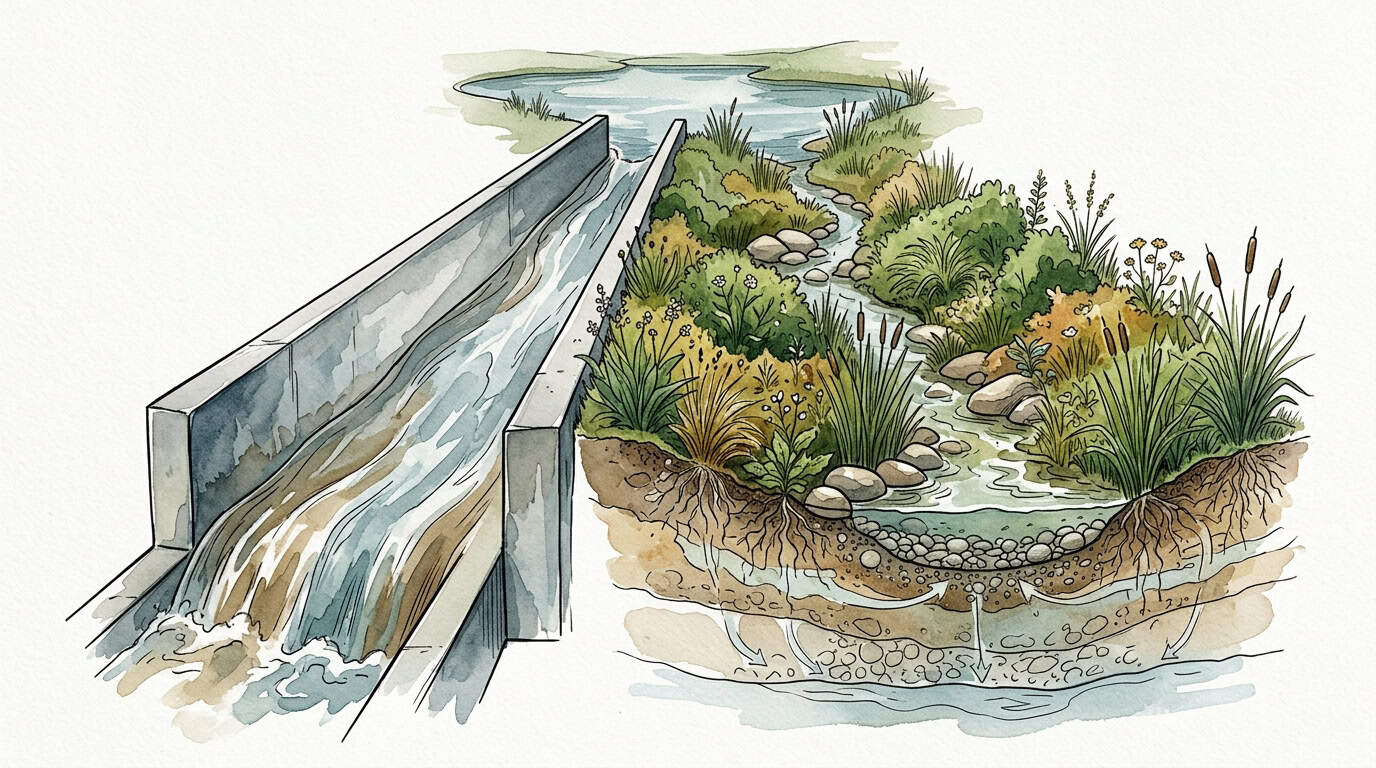
Is your pond edge a highway for pollution, or a filter for the spring rains? When the spring rains hit, a concrete lip sends every drop of lawn chemical and silt straight into your water. A wild, integrated bio-swale doesn’t just look better—it acts as a biological kidney, cleaning the water before it ever touches your pond.
Effective pond management requires a transition from mere water containment to active hydrological processing. While a standard drainage ditch simply moves water from point A to point B, a bio-swale utilizes mechanical, chemical, and biological mechanisms to improve water quality during transit. This article examines the technical specifications and optimization strategies for implementing natural spring pond runoff solutions.
Natural Spring Pond Runoff Solutions
Natural spring pond runoff solutions are engineered vegetated systems designed to capture, treat, and attenuate stormwater. Unlike traditional gray infrastructure, these systems prioritize hydraulic residence time (HRT) to facilitate the settling of total suspended solids (TSS) and the uptake of dissolved nutrients. In pond environments, these solutions serve as the primary defense against the “first flush” effect, where the initial period of a rainstorm carries the highest concentration of pollutants.

These systems are utilized in residential, agricultural, and industrial contexts to manage non-point source pollution. In a pond setting, a bio-swale typically replaces a standard concrete or turf-grass channel. It consists of a shallow, sloped trough filled with specialized filter media and planted with specific native vegetation. The primary function is to transform high-velocity, turbulent flow into slow, laminar sheet flow.
The fundamental objective of these solutions is to mitigate nutrient loading—specifically nitrogen and phosphorus—which are the primary drivers of eutrophication and harmful algal blooms. By integrating these “biological kidneys” into the landscape, pond owners can reduce reliance on chemical additives and mechanical aeration by addressing water quality issues at the source.
How It Works: The Mechanics of Bio-Filtration
The operation of a bio-swale is governed by three primary mechanisms: physical sedimentation, chemical adsorption, and biological uptake. Each mechanism relies on specific design parameters to function at peak efficiency.
Physical sedimentation occurs when the velocity of the runoff is reduced below the threshold required to keep particles in suspension. In a well-designed swale, the vegetation provides hydraulic roughness, increasing the Manning’s roughness coefficient (n). As water slows to a target velocity of less than 1.0 foot per second, heavier particles like silt and sand drop out of the water column.
Chemical adsorption takes place within the soil matrix or filter media. Many bio-swales utilize an engineered soil mix consisting of 60-80% sand and 20-40% organic compost or sandy loam. This media provides a high surface area for dissolved pollutants, such as heavy metals (lead, copper, zinc) and certain phosphorus compounds, to bind to soil particles.
Biological uptake is the most complex phase, involving the rhizosphere—the area of soil surrounding plant roots. Native wetland plants and their associated microbial colonies actively metabolize nitrogen and phosphorus. Microorganisms in the soil convert organic nitrogen into forms that plants can use, effectively sequestering these nutrients into plant biomass.
Benefits of Integrated Bio-Swales
Implementing a wild bio-swale over a conventional concrete spillway provides quantifiable improvements in water chemistry and hydraulic stability. Data from performance studies indicate significant pollutant mass removal rates when these systems are correctly specified.
Total suspended solids (TSS) reduction is often the most visible benefit. Enhanced vegetated swales can achieve TSS removal rates between 70% and 80%. This prevents the gradual shallowing of the pond due to siltation and reduces the turbidity that can stress aquatic life.
Nutrient sequestration is a critical metric for long-term pond health. Studies show that bio-swales can remove approximately 35% to 50% of total phosphorus and 40% to 60% of total nitrogen from runoff. This reduction is vital during the spring months when fertilizer runoff from surrounding lawns is at its peak.
Thermal regulation is an often-overlooked advantage. Concrete and asphalt surfaces absorb solar radiation, heating the runoff before it enters the pond. This “thermal shock” can lower dissolved oxygen levels and kill sensitive fish species. A vegetated swale provides shade and utilizes evapotranspiration to cool the water as it traverses the channel.
Challenges and Common Pitfalls
The most frequent cause of bio-swale failure is hydraulic overload. If the contributing drainage area is too large for the swale’s capacity, high-velocity flows will cause channelization. Once a channel forms, water bypasses the vegetation and filter media, leading to erosion and zero filtration efficiency.

Soil compaction is another significant failure point. If heavy machinery is used during installation without subsequent soil tilling, the infiltration rate (the rate at which water moves through the soil) will be severely compromised. Effective swales require an infiltration rate of at least 1.0 inch per hour to prevent prolonged standing water, which can lead to anaerobic conditions and mosquito breeding.
Vegetation selection errors often lead to system collapse. Using non-native or ornamental species that cannot survive the “wet-dry” cycle typical of runoff zones results in bare patches. Bare soil in a swale is a source of sediment rather than a filter for it. Furthermore, the introduction of invasive species like Phragmites can quickly clog a swale, requiring expensive mechanical removal.
Limitations and Environmental Constraints
Bio-swales are not universal solutions and have specific environmental boundaries. Slope is the primary constraint. These systems function best on longitudinal slopes between 1% and 2%. While they can be adapted for slopes up to 5% with the use of check dams, anything steeper risks erosive velocities that exceed the stability of the vegetation.
Space requirements can also be a limitation. To achieve a target hydraulic residence time (HRT) of 10 minutes, a swale must have a minimum length relative to the flow velocity. On smaller properties, there may not be enough linear distance to install an effective system without significant meandering, which increases construction complexity.
Maintenance capacity must be considered before installation. Unlike a concrete pipe, a bio-swale is a living system. It requires periodic sediment removal from the forebay, invasive species monitoring, and seasonal pruning. If a property owner is looking for a “zero-maintenance” solution, a natural bio-swale may not be the appropriate choice.
Comparative Analysis: Concrete vs. Wild Bio-Swale
The choice between traditional hardscaping and natural filtration systems involves trade-offs in cost, efficiency, and ecological impact. The following table compares a standard concrete spillway with an engineered wild bio-swale.
| Metric | Concrete Spillway | Wild Bio-Swale |
|---|---|---|
| Pollutant Filtration | 0% (Direct conveyance) | 70-80% TSS removal |
| Nutrient Uptake | None | High (N and P sequestration) |
| Flow Velocity | High (Erosive) | Low (Attenuated) |
| Thermal Impact | Heats runoff | Cools runoff |
| Initial Cost | Moderate to High | Low to Moderate |
| Maintenance Type | Structural repair | Biological management |
While concrete spillways offer high structural durability, they fail to provide any water quality benefits. In contrast, bio-swales provide a high return on investment through reduced pond maintenance costs and improved ecosystem health.
Practical Tips for Implementation
Successful swale design begins with accurate grading. The cross-section should ideally be trapezoidal or parabolic with a bottom width between 2 and 8 feet. Avoid “V-shaped” ditches, as they concentrate flow in the center and increase the risk of erosion.
Incorporate a “forebay” or sediment trap at the inlet. This is a small, easy-to-clean basin where the heaviest sediments can settle before entering the main body of the swale. Cleaning a forebay once a year is significantly easier than dredging an entire pond.
Use check dams for slopes exceeding 2%. These small berms, constructed from stone or timber, act as mini-weirs. They create a “stair-step” effect that slows the water and encourages infiltration. Ensure that the center of the check dam is lower than the outer edges to keep water centered in the channel.
Select native species with deep, fibrous root systems. Excellent candidates for most temperate climates include Carex stricta (Tussock Sedge), Juncus effusus (Soft Rush), and Iris versicolor (Blue Flag Iris). These plants are adapted to periodic inundation followed by dry periods and provide the necessary root surface area for microbial colonization.
Advanced Considerations: Calculating Water Quality Volume (WQv)
Serious practitioners should design swales based on the Water Quality Volume (WQv), which represents the amount of runoff generated by the “first flush” of a storm. A common standard is to design for the first 1.0 to 1.5 inches of rainfall.
Manning’s equation is the standard for calculating flow velocity: V = (1.49/n) * R^(2/3) * S^(1/2). In this equation, V is velocity, n is the roughness coefficient (use 0.20 to 0.24 for thick vegetation), R is the hydraulic radius, and S is the slope. Maintaining V below 1.0 fps is mandatory for effective sediment capture.
The Hydraulic Residence Time (HRT) is the final check on design efficiency. HRT is calculated by dividing the length of the swale by the velocity. A target HRT of 10 minutes (600 seconds) is the industry benchmark for ensuring adequate contact time between the water and the bio-filtration elements. If your site is too short to reach 10 minutes, increase the bottom width or add meandering curves to lengthen the flow path.
Scenario: The 1-Acre Watershed
Consider a pond receiving runoff from a 1-acre residential watershed. During a 1-inch rain event, this area generates approximately 3,630 cubic feet of water. If this water is funneled through a 50-foot concrete pipe, it enters the pond in minutes, carrying all accumulated pollutants.
If the same water is routed through a 100-foot bio-swale with a 4-foot bottom width and 3:1 side slopes, the hydraulics change completely. With a Manning’s n of 0.24 and a 1.5% slope, the water velocity drops to roughly 0.15 fps. The resulting residence time exceeds the 10-minute target, allowing for nearly 80% of the sediment to settle and significant nutrient uptake by the rhizosphere. This single change can prevent pounds of nitrogen from reaching the pond over a single spring season.
Final Thoughts
Transitioning from traditional drainage to natural spring pond runoff solutions is a shift toward mechanical and biological optimization. By treating the pond edge as a functional component of the filtration system rather than a simple border, you drastically reduce the chemical and physical stress on the aquatic environment.
The integration of bio-swales requires careful attention to hydraulic principles—specifically velocity control and residence time. When these engineering requirements are met, the resulting “biological kidney” provides a self-sustaining, efficient method for maintaining water clarity and health.
Applying these principles allows for a pond that is not just a destination for water, but a destination for clean water. Experiment with native planting densities and soil amendments to fine-tune your system for the specific nutrient profile of your local watershed.
Amazon and the Amazon logo are trademarks of Amazon.com, Inc, or its affiliates.