

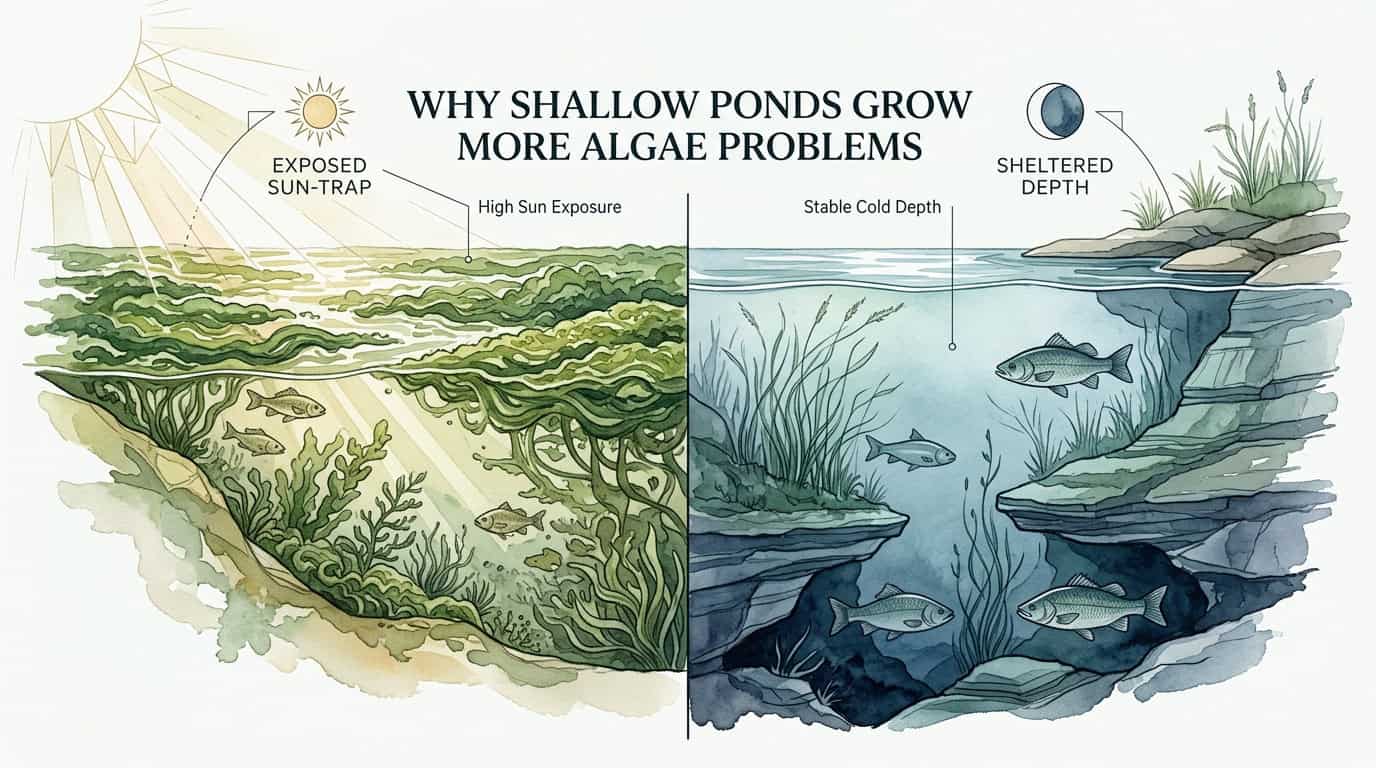
Shallow water is an incubator for pond slime. If your pond is under 6 feet deep, you are fighting an uphill battle against sunlight. Here is why depth matters and how to fix shallow-water blooms.
The fundamental relationship between water depth and biological productivity is governed by light penetration and thermal stability. In aquatic ecosystems, shallow environments maximize the ratio of surface area to total water volume. This physical configuration results in rapid solar gain and high light availability across the entire benthic zone.
Understanding these mechanics is essential for pond managers seeking to minimize filamentous algae and maintain water quality. This article analyzes the technical reasons why shallow systems fail and provides engineering-based solutions for depth-related issues.
Why Shallow Ponds Grow More Algae Problems
A shallow pond is defined as any water body where sunlight reaches the bottom across a majority of its surface area. This state allows for the growth of benthic organisms, particularly filamentous algae, which anchor to the substrate before floating to the surface.

Light penetration is the primary driver of this growth. In water bodies with a depth of three feet or less, the entire column exists within the euphotic zone. This zone is the layer of water where light intensity is sufficient for photosynthesis to exceed respiration.
Thermal fluctuations also occur more rapidly in shallow systems. Water has a high specific heat capacity, but a low total volume in a shallow pond means it lacks thermal inertia. As the water temperature rises, its ability to hold dissolved oxygen (DO) decreases. This creates an environment where metabolic rates of algae accelerate while the system’s capacity to support aerobic decomposition diminishes.
Nutrient availability is the final component. In shallow ponds, wind-driven mixing frequently disturbs the sediment-water interface. This disturbance brings sequestered phosphorus and nitrogen into the water column, fueling rapid planktonic and filamentous blooms. These factors combine to create a self-sustaining cycle of eutrophication.
How Depth Influences Light and Heat Dynamics
The physics of light attenuation in water follows the Beer-Lambert Law, which states that light intensity decreases exponentially with depth. In deep ponds, the lower layers receive insufficient Photosynthetically Active Radiation (PAR) to support plant growth.
Thermal stratification is a secondary mechanical benefit of depth. When a pond exceeds 8 to 10 feet, it typically separates into three distinct layers:
- Epilimnion: The warm, oxygen-rich surface layer.
- Metalimnion (Thermocline): The transition zone where temperature drops rapidly.
- Hypolimnion: The cold, dense bottom layer.
In a stratified system, the hypolimnion remains isolated from the atmosphere. While this can lead to anoxia at the bottom, it also traps nutrients in the cold, dark depths where they cannot fuel surface-level algae. Shallow ponds lack this stratification, meaning the entire water column remains warm and nutrient-rich throughout the peak growing season.

Temperature regulation via depth acts as a buffer. Deep water resists the rapid heating observed in the upper 24 inches of a pond. Lower average temperatures reduce the metabolic demand for oxygen and slow the reproductive cycles of most common pond slime species.
Benefits of Increasing Pond Depth
Restoring or increasing pond depth provides measurable improvements in water chemistry and biological stability. The primary advantage is the reduction of the photic zone relative to the total volume.
Deep water bodies maintain higher dissolved oxygen stability. Because colder water holds more oxygen than warm water, a larger volume of deep, cool water provides a reservoir of DO that can prevent fish kills during sudden weather changes or bloom die-offs.
Increased depth also limits the growth of invasive submersed macrophytes and filamentous algae. By creating a dark benthic zone, you eliminate the starting point for mat-forming algae species like Spirogyra or Pithophora. These species require sunlight at the bottom to begin their life cycle.
Deeper ponds provide superior habitat for beneficial bacteria. Aerobic bacteria are more efficient at breaking down organic muck than anaerobic varieties. A well-aerated deep pond supports these bacteria across a larger surface area of the substrate, leading to faster nutrient processing and reduced “muck” accumulation.
Challenges and Common Mistakes in Shallow Systems
Managing a shallow pond often leads to repetitive and ineffective treatments. A common mistake is the over-reliance on chemical algaecides. While copper sulfate or peroxygen-based products kill existing blooms, they do not address the underlying cause: light and heat.
Another frequent error is the design of “saucer” shaped ponds. Many decorative or old farm ponds have shallow, gradual slopes (e.g., 5:1 or 10:1). These wide littoral zones create massive “sun-traps” where water temperatures soar and sunlight hits every square inch of the pond floor.
Improper aeration placement is also a technical failure. In shallow water, surface fountains offer aesthetic value but provide minimal vertical mixing. Sub-surface diffusers are more effective, but if the water is too shallow (under 4 feet), the “bubble plume” does not have enough rise time to move significant volumes of water, resulting in poor oxygen transfer efficiency.
Finally, ignoring the “internal loading” of nutrients is a critical oversight. In shallow ponds, years of accumulated organic matter (leaves, grass, fish waste) form a layer of muck that continuously releases phosphorus. Without addressing this sediment or the depth, water treatments will offer only temporary relief.
Limitations of Deepening Existing Ponds
Deepening a pond is not always feasible due to structural or environmental constraints. Dredging is a high-cost intervention, often ranging from $15,000 to over $75,000 depending on the volume of material and disposal requirements.
Geological factors may limit depth. If a pond is located above a high groundwater table or on top of a thin clay liner, digging deeper could puncture the seal and lead to water loss. Structural integrity of the banks must also be considered; steepening a slope too much can cause bank failure and erosion.
Local regulations and permits frequently govern dredging activities. Removing sediment often requires environmental impact assessments to ensure that the process does not release heavy metals or pollutants into downstream waterways. These administrative hurdles can extend project timelines significantly.
Safety is a practical boundary. Deep ponds (over 10 feet) may pose higher risks for recreational use, especially in residential or HOA settings. Management must balance the biological benefits of depth with the liability and safety requirements of the specific location.
Comparison: Shallow Sun-Trap vs. Managed Depth
The following table compares the operational metrics of a shallow pond (3-4 feet) versus a deep pond (8-10 feet) under identical nutrient loading conditions.
| Parameter | Shallow Sun-Trap (3-4 ft) | Managed Depth (8-10+ ft) |
|---|---|---|
| Light Penetration | 100% to bottom (Benthic growth) | <20% at bottom (Limits algae) |
| Thermal Stability | Low (High diurnal fluctuation) | High (Resists rapid heating) |
| Dissolved Oxygen | Volatile (Drops at night) | Stable (Cold water reservoir) |
| Nutrient Cycling | Rapid internal loading | Sequestered in hypolimnion |
| Algae Type | Filamentous mats & Planktonic | Primarily Planktonic (at surface) |
| Management Cost | High (Frequent chemical use) | Low (Preventative focus) |
Practical Tips for Managing Shallow Water
If deepening the pond via dredging is not an immediate option, several technical adjustments can mitigate the “shallow water effect.” These methods focus on light attenuation and nutrient immobilization.
Implement Pond Dyes Early: Professional-grade pond dyes (blue or black) function as a filter for PAR. By adding dye in early spring, you reduce the light reaching the bottom, effectively “tricking” the pond into behaving like a deeper system. This prevents the germination of filamentous algae spores.
Steepen Bank Slopes: During maintenance, aim for a 3:1 slope. For every three feet of distance from the shore, the pond should drop one foot in depth. This reduces the surface area of the littoral zone and limits the space available for weed and algae growth.
Use Phosphorus Binders: Products containing lanthanum-modified clay or aluminum sulfate (alum) can bind with reactive phosphorus in the water and sediment. This makes the nutrients unavailable for algae. In shallow ponds, this is critical because wind mixing otherwise keeps nutrients in constant circulation.
Optimize Aeration: Use sub-surface aeration with fine-bubble diffusers. In shallow water, you may need more diffusers spaced closer together to compensate for the lack of vertical lift. The goal is to maintain an aerobic state at the sediment-water interface to prevent the release of phosphorus.
Advanced Considerations for Pond Professionals
For serious practitioners, managing shallow water requires an understanding of the redox potential (Eh) at the sediment layer. In anoxic conditions (low oxygen), the chemical bond between iron and phosphorus breaks, releasing a massive surge of nutrients into the water. This is why shallow ponds often “explode” with algae after a period of calm, hot weather.

Consider the “Secchi Disk” depth as a management metric. If your Secchi depth (clarity) is greater than your actual pond depth, you will have a bottom-up algae problem. The target for a healthy managed pond is to have a Secchi depth that is roughly 50-70% of the maximum pond depth.
Hydraulic dredging is an advanced alternative to traditional mechanical dredging. It uses a floating pump to suction muck without draining the pond. This is less disruptive to the ecosystem and can be targeted to the deepest areas where muck accumulation is highest, effectively restoring depth where it matters most.
Scaling considerations also apply to biological treatments. In shallow water, the dosage of beneficial bacteria must be higher because the “turnover” rate of organic matter is accelerated by the higher water temperatures. Monitoring the Carbon-to-Nitrogen (C:N) ratio in the sediment can help in fine-tuning these bacterial applications.
Example Scenario: Depth and Algae Suppression
Consider two ponds of identical surface area (1 acre). Pond A has an average depth of 3 feet, while Pond B has an average depth of 8 feet.
Pond A contains approximately 977,000 gallons of water. Due to its shallow profile, sunlight hits the entire substrate. On a 90°F day, Pond A’s temperature can rise by 5°F or more in a single afternoon. This thermal gain triggers a massive growth spurt in *Spirogyra*, which uses the high light levels at the 3-foot bottom to photosynthesize rapidly. Within two weeks, the pond is 80% covered in surface mats.
Pond B contains approximately 2.6 million gallons of water. The upper 3 feet heat up, but the remaining 5 feet of water stay significantly cooler. Light intensity at the 8-foot bottom is less than 5% of surface levels. *Spirogyra* cannot establish itself on the floor. While some planktonic algae may bloom in the upper layer, the total biomass is 70% lower than in Pond A because the “growth engine” at the bottom has been deactivated by the lack of light.
Final Thoughts
Depth is the most effective long-term regulator of pond health. While shallow water naturally facilitates high biological productivity, it also leads to the instability and “slime” outbreaks that plague most pond owners. By understanding the physics of light attenuation and the thermodynamics of water, you can move away from reactive chemical treatments and toward proactive structural management.
Focusing on increasing depth, whether through physical dredging or optical manipulation with dyes, provides the most significant return on investment for water quality. A deeper pond is a more resilient pond, capable of buffering against nutrient spikes and temperature swings.
For those managing shallow systems, the path forward involves a combination of slope stabilization, nutrient binding, and strategic aeration. Applying these technical principles will allow you to break the cycle of seasonal algae blooms and maintain a balanced, clear aquatic environment.