

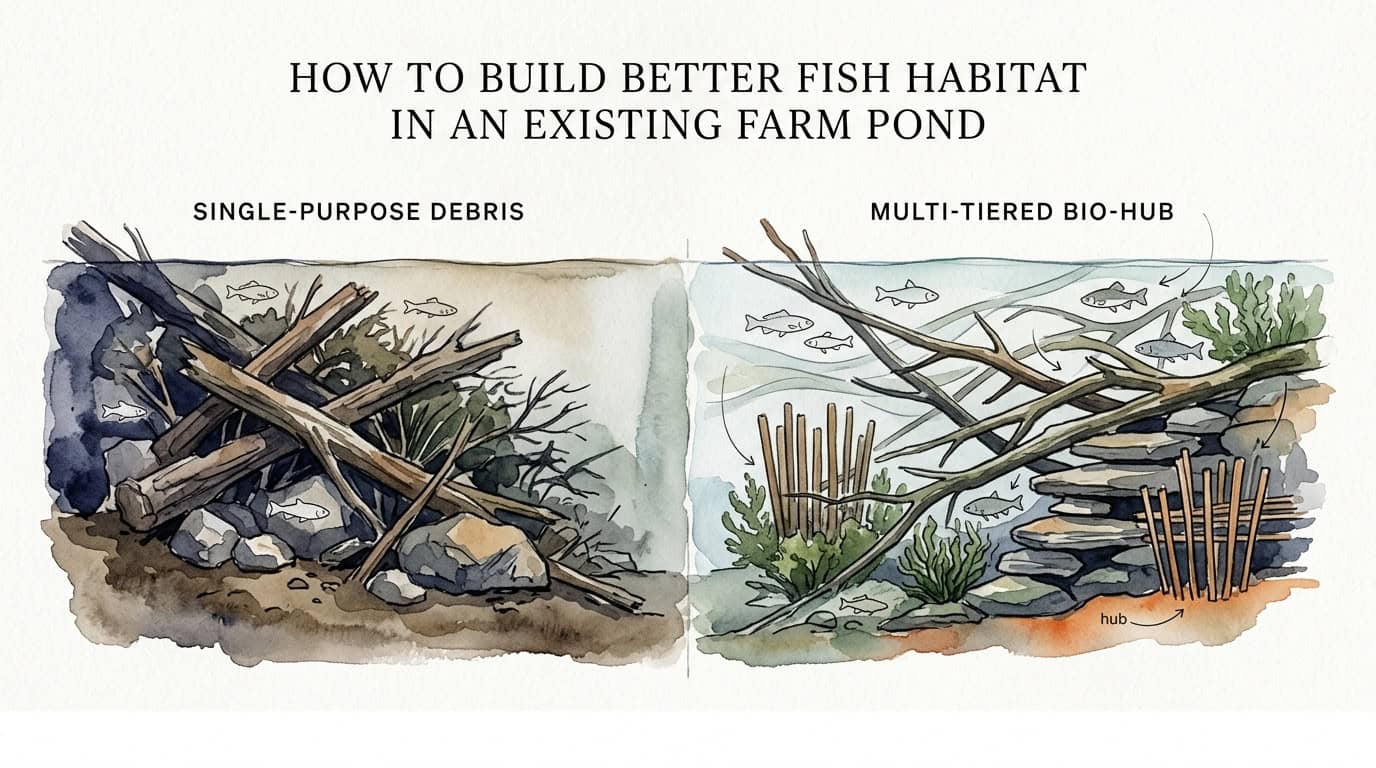
Is your pond a desert? Most owners throw in trash; experts build ecosystems. A single block isn’t a habitat. If you want a thriving fishery, you need multi-use structures that support every stage of the life cycle. Here is how to build them.
To build better fish habitat in an existing farm pond, you must create a strategic network of structures that provide spawning sites, nursery cover, and ambush zones. Effective designs utilize durable materials like PVC, gravel, and stone to maximize surface area for periphyton and create specific interstitial spaces. By varying depth placement across the pond’s littoral and profundal zones, you optimize thermal refuge and oxygen access for diverse fish populations throughout the year.
How to Build Better Fish Habitat in an Existing Farm Pond
In fisheries science, habitat refers to the physical and biological environment where fish live, including spawning grounds, nursery areas, and food supply zones. Most aging farm ponds suffer from habitat degradation as original timber rots and sedimentation fills in structural voids. Building better habitat is the process of restoring these complexities to increase the pond’s carrying capacity—the total weight of fish a pond can support.
Structural complexity is not just about “attracting” fish for easier angling; it is about “recruitment,” or the number of young fish that survive to adulthood. Without adequate cover, small forage fish are consumed too quickly by predators, leading to a stunted population and a collapse in the food chain. A high-quality habitat system utilizes approximately 25% to 30% of the pond’s bottom surface area to create a “fish city” that supports multiple life stages simultaneously.

How It Works: The Mechanical and Biological Process
Effective habitat construction relies on mechanical placement and biological colonization. Once a structure is submerged, it undergoes a predictable succession:
1. **Biofilm Colonization:** Within days, submerged surfaces are coated in periphyton—a mixture of algae, bacteria, and microbes. This forms the base of the pond’s food web.
2. **Macroinvertebrate Attraction:** Insects, snails, and crawfish colonize the structure to feed on the periphyton.
3. **Forage Refuge:** Small fish (bluegill, fathead minnows) occupy the “interstitial spaces”—the gaps within the structure—to hide from predators.
4. **Predator Positioning:** Larger fish (largemouth bass, crappie) take up “ambush points” on the perimeter of the structure to feed on the gathered forage.
To achieve this, you must apply a layered approach across three primary depth zones:
1. The Littoral Zone (2–6 Feet)
This shallow area is primarily for spawning and nursery cover. Spawning beds should be constructed using 4 to 6 inches of pea gravel placed in framed boxes (approx. 3×3 feet) or plastic wading pools to prevent the gravel from sinking into the muck. For bluegill and bass, these beds should be located in areas that receive ample sunlight and remain covered by water even during summer drawdown.
2. The Mid-Depth Zone (6–12 Feet)
This zone serves as the primary hunting ground for predators. Structures here should be taller and more complex. “Honey hole” trees—vertical structures made of PVC or hardwood—should provide at least 15,000 square inches of surface area for periphyton growth. These units should be spaced far enough apart for a boat to pass between them but grouped close enough to form a cohesive “reef.”
3. The Profundal/Refuge Zone (12+ Feet)
Deep-water structures provide thermal refuge. In summer, fish move deep to escape heat; in winter, they seek the densest, most stable temperatures. However, because ponds often stratify, creating a thermocline (a layer where temperature and oxygen drop rapidly), structures placed too deep may sit in “dead water” without oxygen. Aeration systems are often required to make deep-water habitat viable.

Benefits of Engineered Habitat
Building engineered or highly structured habitat offers measurable mechanical advantages over simply dumping brush:
* **Longevity:** While natural brush like Christmas trees decay within 3 to 8 years, PVC and stone structures are virtually indestructible, maintaining their structural integrity for decades.
* **Specific Surface Area (SSA):** Engineered structures are designed to maximize the area available for biofilm. More biofilm equals more food, which leads to faster fish growth rates.
* **Snag Resistance:** Modern artificial habitats are often designed with flexible limbs or smooth surfaces to prevent fishing lures from getting permanently hung up.
* **Precision Recruitment:** By controlling the size of the interstitial spaces (the “holes” in the habitat), you can specifically protect target sizes of fish, such as 1-inch to 3-inch bluegill, ensuring they reach reproductive age.
Challenges and Common Mistakes
The most frequent error in habitat development is the “Single-Purpose Debris” approach—throwing a few random tires or blocks into the water without a spatial plan.
* **Structural Homogeneity:** Using only one type of material (e.g., only rock piles) limits species diversity. A balanced pond needs rocks for crawfish, dense brush/PVC for minnows, and tall timber for bass.
* **Hypoxia Placement:** Placing large structures in the deepest part of the pond without checking for thermal stratification. If the water lacks dissolved oxygen (DO) below 10 feet, any habitat placed there is useless for fish for several months of the year.
* **Over-structuring:** While 25–30% coverage is optimal, exceeding 40% can hinder predator efficiency. If small fish have too many places to hide, the bass cannot eat enough to grow, resulting in a pond full of small, stunted bass and overpopulated forage.
* **Buoyancy Failures:** Wood and certain plastics will float or move during heavy rain events. Every structure must be ballasted with concrete or heavy stone to ensure it remains on the GPS-marked coordinate.
Limitations and Environmental Constraints
Not every pond is a candidate for all types of habitat. You must account for the following constraints:
* **Sedimentation Rates:** In ponds with high runoff from tilled fields, structures with small interstitial spaces will quickly fill with silt, rendering them useless for small fish refuge.
* **Water Chemistry:** Highly acidic ponds may inhibit the growth of the periphyton necessary to kickstart the habitat’s food chain.
* **Pond Age:** In very new ponds, the lack of organic matter means habitat will take longer to “prime.” In very old ponds, muck depth might be so significant that structures sink and disappear unless placed on a wide base or liner.
* **Species Specifics:** Structures designed for crappie (vertical and thin) differ significantly from those for catfish (cavity-based like pipes or hollow logs). You must match the build to the intended resident.
Comparison: Single-Purpose Debris vs. Multi-Tiered Bio-Hub
The following table compares traditional “trash” habitat with engineered, multi-functional structures.
| Feature | Single-Purpose Debris (e.g., Tires, Pallets) | Multi-Tiered Bio-Hub (Engineered PVC/Stone) |
|---|---|---|
| Lifespan | 3–10 Years (Variable) | 30+ Years |
| Surface Area (SSA) | Low; Smooth surfaces limit growth | High; Engineered for maximum biofilm |
| Lure Snag Rate | High; Rough edges and rot | Low; Flexible limbs or smooth transitions |
| Maintenance | Frequent replacement required | Near zero after installation |
| Biological Impact | Primarily attraction; limited recruitment | High recruitment; supports full life cycle |
Practical Tips for Implementation
* **Calculate Ballast:** For PVC structures, use a ratio of 3:1 ballast-to-structure weight. A 5-gallon bucket filled with concrete is usually sufficient to hold a large PVC “tree” in place against current and wind.
* **Use the 20% Rule:** Aim for at least 20% of your pond’s shoreline to be structured. This is the minimum threshold required to see a statistically significant increase in fish population density.
* **GPS Marking:** Always mark your habitat locations on a digital map. As the pond settles and water levels change, finding your “hotspots” visually becomes impossible.
* **Vary Interstitial Space:** When building rock piles, use a mix of “D50” (average diameter) sizes. Use 3-to-6-inch stones for crayfish and 12-to-18-inch boulders for larger predator ambush points.
Advanced Considerations: The Hydrodynamic Factor
Serious practitioners should consider how water moves around the structure. In ponds with a significant through-flow (creek-fed), habitat should be placed on the “leeward” side of points or in eddies where fish can hold without expending excessive energy.
Furthermore, monitoring the Dissolved Oxygen (DO) levels at different depths using a digital meter can help you fine-tune placement. If you find your thermocline is at 8 feet, you should avoid placing the bulk of your structure below that line unless you install a bottom-diffused aeration system to break the stratification.
Scenario: Renovating a 1-Acre Farm Pond
Consider a typical 1-acre pond that is 10 years old with no standing timber. To optimize this fishery:
1. **Shoreline (2–4 ft):** Install 10 gravel spawning boxes and 5 “shrub” style PVC units for nursery cover.
2. **Transitional Slope (5–8 ft):** Construct 4 large rock piles (using roughly 2 tons of mixed limestone) along the dam and two primary points.
3. **Deep Flats (9–12 ft):** Place 6 large PVC “trees” ballasted in concrete buckets. Group these in sets of three to create two distinct “fishing reefs.”
4. **The Result:** This configuration provides approximately 12,000 square feet of “influenced” area, covering roughly 25% of the pond and providing shelter for an estimated 2,000–3,000 additional forage fish per year.
Final Thoughts
Building better fish habitat is a mechanical solution to a biological problem. By moving away from random debris and toward engineered, multi-tiered systems, you transition from being a casual pond owner to an active fisheries manager. The goal is a balanced ecosystem where every structure serves a specific purpose—protecting the young, feeding the growing, and harboring the giants.
Success in pond management is measured by the stability of the food chain and the health of the predators. Durable, high-surface-area structures are the most efficient way to achieve that stability. As you apply these techniques, remember that habitat is a network; the more connected your “fish cities” are, the more resilient your fishery will become.
Frequently Asked Questions About How to Build Better Fish Habitat in an Existing Farm Pond
What is the most durable material for building pond habitat?
Polyvinyl chloride (PVC) and high-density polyethylene (HDPE) are considered the most durable materials for artificial pond habitat. Unlike natural timber or brush piles, which can decay and lose their structural complexity in as little as 3 to 5 years, plastics are inert and do not break down in water. Furthermore, concrete and large natural stones (such as limestone or granite) provide permanent structure for benthic organisms like crawfish and aquatic insects. Using these materials ensures that the structural volume of the habitat remains constant for decades, providing a reliable refuge for fish without the need for frequent replacement.
How much of my pond should be covered with habitat structures?
Fisheries biologists generally recommend that 20% to 30% of a pond’s bottom surface area should contain some form of habitat or structure. This coverage provides a sufficient balance between refuge for forage fish and open hunting lanes for predators. If habitat coverage is too low (less than 10%), forage fish are easily over-predated, leading to a collapse in the food chain. Conversely, if habitat exceeds 40%, predators like largemouth bass cannot effectively hunt, which often results in a stunted population of small, skinny predators and overpopulated, slow-growing forage fish.
At what depth should I place my fish habitat structures?
Habitat should be distributed across multiple depths to accommodate seasonal movements and different life stages. Shallow areas (2 to 6 feet) are critical for spawning and nursery refuge for fry. Mid-depths (6 to 12 feet) are primary hunting zones for predators and should contain the bulk of your “attractor” structures. Deep-water areas (over 12 feet) serve as thermal refuge during summer and winter extremes. However, you must be cautious of the thermocline; in many ponds, water below a certain depth may lack oxygen (hypoxia) during the summer, making any habitat placed there unusable unless the pond is aerated.
Can I use old tires or wooden pallets as fish habitat?
While old tires and wooden pallets were once common “DIY” habitat solutions, they are now generally discouraged by modern fisheries managers. Tires can trap sediment and, in some cases, leach trace chemicals or trap small fish in ways that lead to mortality. Wooden pallets, particularly if they are made of softwoods or are chemically treated, decay rapidly and may release harmful resins or wood preservatives into the water. Furthermore, decaying wood consumes dissolved oxygen, which can stress fish in smaller ponds. Engineered PVC structures or natural, untreated hardwoods and stone are safer and more effective long-term alternatives.
How do spawning beds differ from nursery cover?
Spawning beds are specifically designed to facilitate the reproduction of species like bass and bluegill. They typically consist of firm, clean substrate like pea gravel or sand, often placed in shallow, sunny water (18 to 36 inches deep) where parent fish can fan the eggs to keep them oxygenated. Nursery cover, on the other hand, is much denser and designed to protect the resulting fry from predation. This usually consists of “bushy” structures with very small interstitial spaces (the gaps between limbs) that allow tiny fish to enter while keeping larger predators out. A successful pond requires both: beds to produce the fish and nursery cover to ensure they survive the first few months of life.