

Is your pond filling in faster than you think? Measure the rate of muck buildup before it is too late. Muck accumulation is inevitable, but its speed is up to you. Here is how to measure and slow the process.
Pond muck typically accumulates at an average rate of 1 to 5 inches per year, depending on nutrient loading and oxygen levels. In nutrient-rich eutrophic systems, organic deposition can exceed 1 inch annually, while oligotrophic or well-aerated ponds may see less than 0.25 inches. This rate is determined by the balance between organic matter input and the speed of microbial decomposition at the benthic interface.
How Fast Does Pond Muck Actually Accumulate?
Pond muck, technically referred to as benthic sediment or sapropel, is a collection of organic and inorganic materials that settle at the bottom of a water body. In most temperate freshwater ponds, the standard accumulation rate is approximately 1 inch per year. However, this figure is a broad average and can fluctuate significantly based on environmental variables.
In high-productivity environments, such as those receiving significant agricultural runoff or treated wastewater, the rate can accelerate to 0.5 inches per month during peak growing seasons. Conversely, a new pond with a limited watershed and minimal shoreline vegetation might accumulate only a few millimeters of inorganic silt over several years. The accumulation becomes a critical issue when the volume of new organic matter exceeds the pond’s biological capacity to decompose it.

The physical composition of muck is primarily divided into two categories: allochthonous and autochthonous material. Allochthonous material originates from outside the pond, such as wind-blown leaves, grass clippings, and eroded soil. Autochthonous material is generated within the pond itself, including dead algae, aquatic plants, and fish waste. Understanding the ratio between these two helps determine the most effective mechanical or biological intervention.
Mechanics of Sedimentation and Deposition
The process of muck formation begins with the settling of suspended solids. When the velocity of water decreases—either as it enters the pond or as wind-driven currents subside—particles lose the kinetic energy required to remain in suspension. Heavier inorganic particles like sand and silt settle first near the inflow areas, while lighter organic particles are distributed across the entire benthic floor.
Organic deposition is a recursive cycle. During the spring and summer, high nutrient levels (nitrogen and phosphorus) fuel the growth of algae and macrophytes. When these organisms complete their life cycle, they die and sink. In a healthy system, aerobic bacteria utilize dissolved oxygen to oxidize this carbon-based waste. If the input rate of organic matter is higher than the oxidation rate, the material compacts and forms the characteristic black, foul-smelling sludge known as sapropel.
Temperature also plays a pivotal role in deposition mechanics. Microbial activity doubles for every 10-degree Celsius increase in water temperature up to a certain threshold. However, warmer water holds less dissolved oxygen. This paradox often leads to a scenario where decomposition is most needed during the summer, but the lack of oxygen forces the system into a slow, anaerobic state, causing muck to pile up rapidly.
Measuring Pond Muck: Technical Methods
To accurately quantify the rate of accumulation, pond managers must establish a baseline and perform periodic measurements. Estimating muck depth is essential for calculating the necessary dosage of biological treatments or determining the volume of material for mechanical dredging.
The Sludge Probe Method
A sludge probe, or “muck stick,” is a graduated pole equipped with a check valve or a sensitive tip that can distinguish between the soft muck layer and the original hard bottom. The operator lowers the probe until it makes initial contact with the “flocculant” layer—the very top of the muck. This depth is recorded. The probe is then pushed through the muck until it hits the firm clay or rock base of the pond. The difference between these two measurements is the muck thickness at that specific coordinate.

Bathymetric Mapping
For larger systems, manual probing is inefficient. Bathymetric mapping uses sonar technology and GPS to create a three-dimensional model of the pond bottom. High-frequency sonar can detect the top of the soft sediment, while low-frequency pulses penetrate the muck to reflect off the original bottom. By overlaying these two data sets, software can calculate the total volume of muck across the entire acreage. This method provides an objective metric for “Static Accumulation,” showing exactly how many cubic yards of material are present.
The Secchi Disk Comparison
While a Secchi disk primarily measures water clarity, it serves as a secondary indicator of muck accumulation potential. Consistently low Secchi readings (less than 24 inches) suggest high levels of suspended solids and planktonic algae. This high turbidity correlates with a high deposition rate, as the suspended matter will eventually settle. Monitoring clarity over several seasons allows managers to predict spikes in muck buildup before they manifest on the pond floor.
Benefits of Maintaining Low Accumulation Rates
Reducing the speed of muck buildup provides measurable mechanical and biological advantages to the pond ecosystem. A shallower muck layer correlates directly with higher dissolved oxygen levels and better water quality.
- Extended Lifespan of the Water Body: Reducing accumulation by 50% can double the interval between expensive dredging operations, saving thousands of dollars in capital expenditure.
- Nutrient Sequestration: Muck acts as a “nutrient sink.” By limiting its accumulation, you prevent the internal recycling of phosphorus, which is the primary driver of harmful algal blooms.
- Mechanical Efficiency: In industrial or irrigation ponds, low muck levels prevent the clogging of intake pipes and reduce wear on pump impellers caused by abrasive silt.
- Habitat Stability: Many fish species require a hard substrate for spawning. Keeping muck levels low ensures that nesting sites remain viable and are not smothered by anaerobic sludge.
Challenges and Common Pitfalls in Muck Management
One of the most frequent errors in managing muck is treating the symptoms rather than the rate of deposition. Using algaecides to kill blooms provides temporary clarity but adds a massive load of dead organic matter to the bottom, essentially “feeding” the muck layer.
Another challenge is the “Compaction Trap.” New muck is often 90% water and very loose. Over time, the weight of new material compresses the lower layers. A manager might see the muck depth stay the same for a year and assume accumulation has stopped, when in reality, the density has increased. This means the total mass of organic waste is still rising, even if the vertical depth appears stable.
Environmental factors like watershed ratio also present a challenge. A small pond with a massive drainage area (high watershed-to-surface-area ratio) will always struggle with muck, as every rain event washes in a fresh load of sediment. Without a sediment forebay or a vegetated buffer strip, mechanical accumulation will always outpace biological decomposition.
Limitations of Biological Remediation
While biological treatments like muck-eating bacteria and enzymes are effective, they have hard physical limits. These microbes require specific environmental parameters to function. If the water pH is below 6.0 or above 8.5, or if dissolved oxygen is below 2.0 mg/L, the bacteria will go dormant.
Furthermore, biological treatments only target the organic component of muck. If your pond is filling with sand, clay, or road silt from runoff, no amount of bacteria will remove it. In these cases, the only solution is mechanical dredging. Managers must perform a “Loss on Ignition” (LOI) test on a muck sample to determine the percentage of organic vs. inorganic material before investing in biological programs.
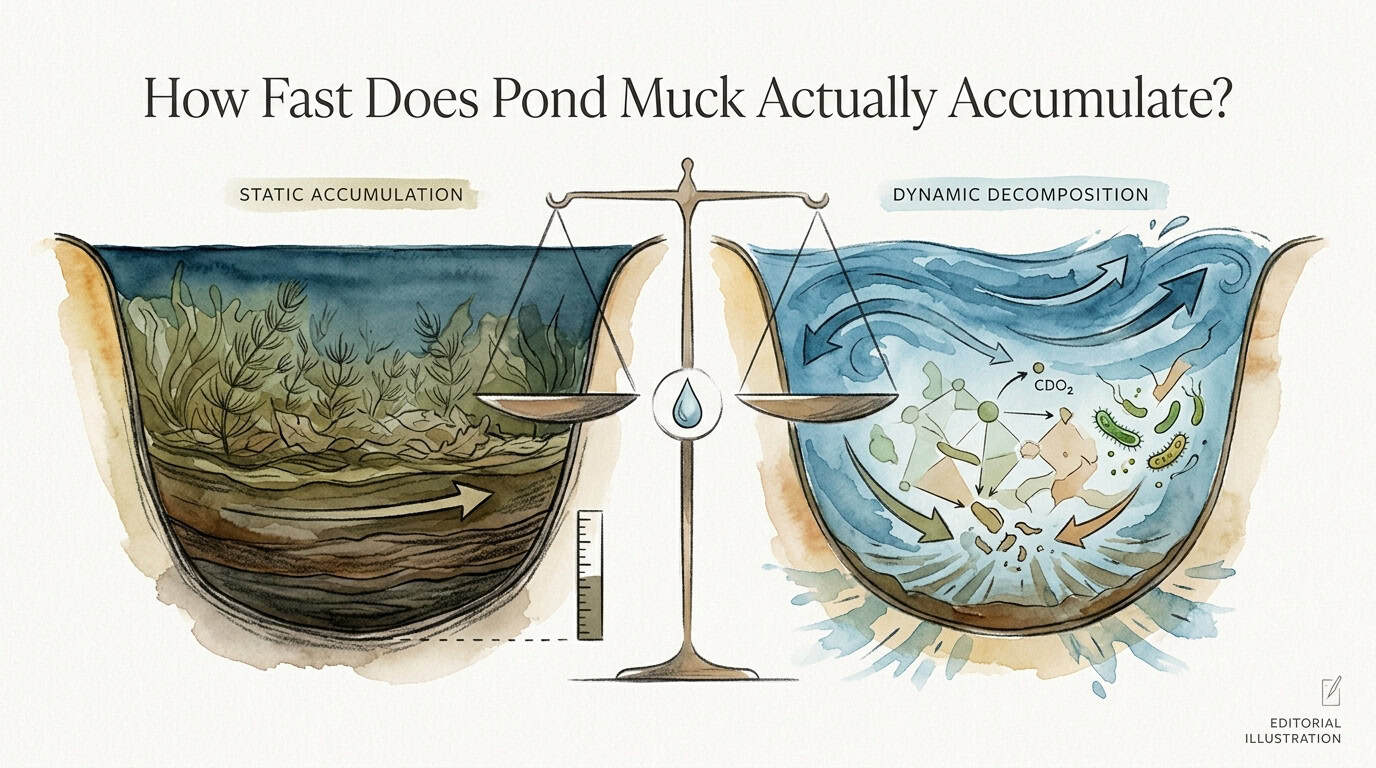
Static Accumulation vs. Dynamic Decomposition
The actual depth of muck at any given time is the result of a mathematical relationship: **Current Muck = Total Deposition – Total Decomposition**.
| Factor | Static Accumulation (The Input) | Dynamic Decomposition (The Output) |
|---|---|---|
| Primary Driver | Leaf litter, runoff, dead algae | Aerobic bacteria, dissolved oxygen |
| Effect of Temperature | High growth in summer increases load | High temp increases metabolic rate |
| Management Focus | Buffer strips, nutrient reduction | Aeration, microbial augmentation |
| Measurement Tool | Sediment traps, Secchi disk | Muck probe, DO meter |
Focusing only on “Static Accumulation” results in a reactive management style where you simply wait for the pond to fill up. Focusing on “Dynamic Decomposition” allows for a proactive approach where you optimize the system’s ability to “burn off” the waste as it arrives.
Practical Tips for Optimizing Muck Reduction
To maintain the lowest possible accumulation rate, implement these technical adjustments to your pond management strategy:
- Install Bottom-Diffused Aeration: Unlike fountains, bottom aerators move oxygen-depleted water from the pond floor to the surface. This maintains an aerobic environment at the muck-water interface, which is the most critical zone for decomposition.
- Establish a 10-Foot No-Mow Buffer: Allowing native grasses to grow around the perimeter acts as a mechanical filter, trapping grass clippings and leaves before they enter the water.
- Apply Phosphorus Binders: Products like lanthanum-modified clay or aluminum sulfate can lock phosphorus in the sediment, preventing it from fueling the algae growth that eventually becomes muck.
- Use Targeted Microbial Pellets: Pellets that sink directly into the muck layer are more effective than liquid bacteria, as they deliver the microbes exactly where the organic concentration is highest.
Advanced Considerations: The Eutrophication Trap
In older ponds, a phenomenon known as “Internal Loading” occurs. Once the muck layer reaches a certain thickness, it becomes anoxic (void of oxygen). In these conditions, chemical bonds that hold phosphorus to the sediment break down, releasing large amounts of nutrients back into the water column.
This creates a self-sustaining cycle of muck production. Even if you stop all external nutrient runoff, the pond will continue to produce massive amounts of algae and muck using its own internal reserves. For serious practitioners, the goal is to intervene before the pond hits this tipping point. If the pond is already in a state of internal loading, aggressive aeration and chemical nutrient inactivation are required to reset the system.
Example Scenario: 1-Acre Suburban Pond
Consider a 1-acre pond located in a suburban area with several deciduous trees nearby. Without intervention, this pond might receive approximately 2,000 pounds of dry weight organic matter per year from leaves and grass. Combined with an estimated 1,500 pounds of dead algae, the total organic load is 3,500 pounds annually.
If the pond is stagnant and anaerobic, the decomposition rate might only be 500 pounds per year. This leaves a net accumulation of 3,000 pounds. Over a 1-acre surface, this translates to roughly 0.75 inches of new muck depth every year. After 10 years, the pond has lost nearly 8 inches of depth, representing over 1,000 cubic yards of material.
By installing a diffused aeration system, the decomposition rate could be increased to 3,000 pounds per year. In this optimized state, the net accumulation drops to 500 pounds, or approximately 0.12 inches per year. This shift extends the time between dredging from 15 years to nearly 90 years.
Final Thoughts
Understanding the rate of pond muck accumulation is a requirement for long-term water body health. The data shows that while some accumulation is inevitable, the speed of the process is highly variable and heavily influenced by management choices. By measuring muck depth accurately and regularly, you can move from guesswork to precision management.
The transition from an anaerobic, high-accumulation state to an aerobic, high-decomposition state is the most efficient way to maintain pond volume. Focus on reducing inputs through buffers and increasing outputs through aeration and microbial support. This dual-pronged approach ensures that the pond remains a functional asset rather than a liability.
The most successful pond managers are those who treat their water body as a mechanical system requiring constant optimization. Apply these metrics to your own pond, and you will be able to predict and control its future with scientific accuracy.
Frequently Asked Questions About How Fast Does Pond Muck Actually Accumulate?
How can I tell if my pond muck is accumulating too fast?
The most immediate indicator is a noticeable loss of depth in the swimming or dock areas. If you find that you are hitting “soft bottom” sooner each year, the accumulation rate is likely exceeding one inch. Other technical signs include the frequent release of gas bubbles (methane) from the bottom when disturbed and a persistent rotten-egg smell. If clarity has decreased and you see an increase in floating organic debris, your pond is likely in a high-accumulation phase where decomposition cannot keep up with input.

Does dredging completely stop muck from accumulating again?
Dredging is a mechanical reset, not a permanent cure. It removes the existing “Static Accumulation,” but it does nothing to address the “Dynamic Decomposition” or the input sources. Unless you change the watershed management or add aeration, the muck will begin to accumulate at the same rate—or even faster—immediately after the project is completed. Think of dredging as a surgery; it removes the problem, but lifestyle changes are required to prevent the problem from returning.
Can fish waste significantly contribute to the muck layer?
In most natural ponds, fish waste is a minor component compared to leaf litter and dead algae. However, in heavily stocked or overfed koi ponds and aquaculture systems, fish waste becomes a primary driver of muck. High-protein fish food is rich in phosphorus and nitrogen. When fish consume this food, they excrete a large percentage of those nutrients, which then fuels massive algal growth. This dual impact—direct waste and indirect algae growth—can double the standard accumulation rate.
Will adding more plants to the pond reduce muck accumulation?
This depends entirely on the type of plants. Submerged weeds and floating plants eventually die and contribute directly to the muck layer. However, emergent plants along the shoreline, such as cattails or bulrushes, can help if they are managed correctly. They trap incoming sediment from the watershed. The key is to harvest the dead plant material in the fall before it falls into the water. If left unharvested, large amounts of shoreline vegetation will actually accelerate the filling-in process of the pond.
How does water depth affect the speed of muck buildup?
Deep water (over 8-10 feet) often accumulates muck faster than shallow water because it is prone to thermal stratification. In the summer, the bottom layer of a deep pond becomes isolated from the atmosphere and loses all its oxygen. This halts aerobic decomposition, allowing muck to pile up in an anaerobic state. Shallow ponds are more likely to stay mixed by the wind, keeping oxygen at the bottom and allowing for faster decomposition. Paradoxically, while deep ponds have more “room” for muck, they are often less efficient at breaking it down naturally.