

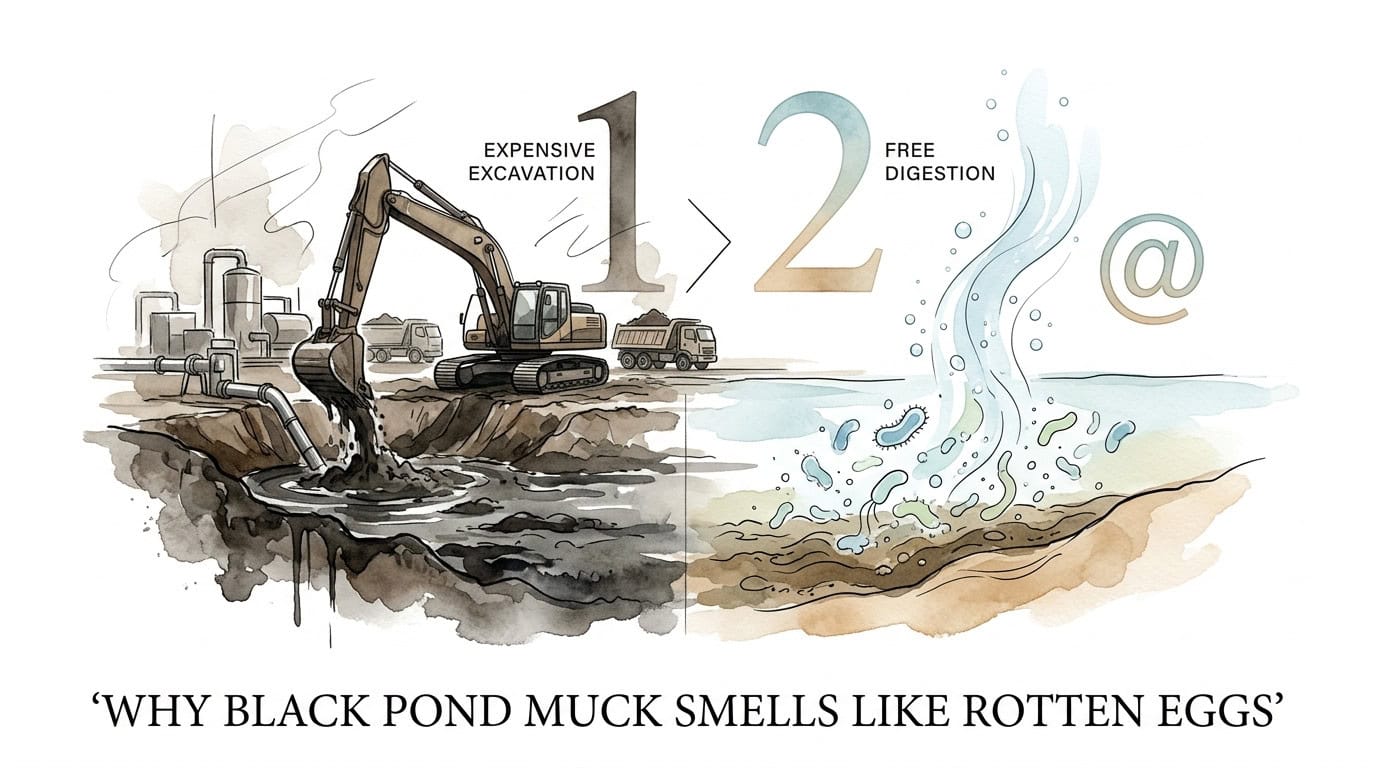
You do not always need a dredge to get rid of the smell. Let nature do the heavy lifting. That rotten egg smell is the result of anaerobic decay. Flip the script and use biological management to clean it up.
Black pond muck smells like rotten eggs because of hydrogen sulfide gas produced during anaerobic decomposition. When dissolved oxygen levels at the pond bottom reach zero, specialized bacteria break down organic matter using sulfates instead of oxygen. This chemical reaction releases hydrogen sulfide as a byproduct. The black color indicates the presence of metal sulfides, confirming a highly reduced, oxygen-depleted environment within the benthic sediment layer.
Why Black Pond Muck Smells Like Rotten Eggs
The presence of black, malodorous muck in a pond or lake is a definitive indicator of an anoxic benthic environment. This substance, scientifically referred to as sapropel, forms when the rate of organic matter accumulation exceeds the rate of aerobic decomposition. In a healthy aquatic system, aerobic bacteria use dissolved oxygen to break down organic debris into carbon dioxide and water. However, as organic loading from leaf litter, fish waste, and dead algae increases, the biological oxygen demand (BOD) often surpasses the available oxygen supply.
Once the dissolved oxygen (DO) concentrations at the sediment-water interface fall below 1.5–2.0 mg/L, aerobic metabolism ceases. The system then transitions into anaerobic decay. This shift causes the oxidation-reduction potential (Redox or ORP) to drop significantly. When ORP reaches levels between -100 mV and -200 mV, sulfate-reducing bacteria (SRB) become the dominant metabolic drivers. These microorganisms, such as those in the genus Desulfovibrio, use sulfate (SO4 2-) as an electron acceptor to process organic carbon.

The primary byproduct of this anaerobic pathway is hydrogen sulfide (H2S), a colorless and highly toxic gas characterized by its distinct “rotten egg” odor. The black pigmentation associated with this muck is primarily due to the reaction of hydrogen sulfide with dissolved iron or other metals in the sediment. This reaction forms ferrous sulfide (FeS), a black precipitate that coats organic particles. This process effectively traps nutrients and toxins in a highly reduced state until physical disturbance or turnover releases them into the water column.
The Biochemistry of Anaerobic Muck Formation
Understanding the mechanics of muck accumulation requires an analysis of the metabolic pathways utilized by aquatic microorganisms. In an aerobic environment, the decomposition of glucose (a proxy for organic matter) follows a highly efficient pathway. The chemical equation C6H12O6 + 6O2 ? 6CO2 + 6H2O + Energy illustrates this high-yield process. Aerobic bacteria can recycle nutrients rapidly, preventing the “snowball effect” of sediment buildup.
When oxygen is depleted, the microbial community shifts to less efficient electron acceptors. The sequence of reduction usually follows a specific order based on the energy yield: nitrate reduction (denitrification), manganese reduction, iron reduction, and finally sulfate reduction. Sulfate reduction is particularly prevalent in ponds because sulfate is naturally abundant in many water sources and runoff.
Specialized anaerobic bacteria strip oxygen atoms from the sulfate molecule to oxidize organic carbon. This metabolic process yields much less energy than aerobic respiration, resulting in a decomposition rate that is significantly slower. Because the rate of decay is so low, organic matter “piles up” faster than it can be processed. The accumulation of hydrogen sulfide within these layers creates a hostile environment for most benthic macro-invertebrates, such as dragonfly larvae or snails, which would otherwise assist in the mechanical breakdown of debris.
Benefits of Biological Muck Digestion
Biological management focuses on reversing the conditions that lead to H2S production. Instead of the high-cost physical removal of sediment, this approach optimizes the pond’s internal capacity for self-cleaning. Implementing a strategic biological digestion program offers measurable advantages in terms of ecosystem stability and operational efficiency.
Restoring dissolved oxygen to the benthic zone is the primary objective. Increasing DO levels facilitates the shift back to aerobic metabolism. Aerobic bacteria decompose organic matter up to 10 to 20 times faster than anaerobic species. Data from case studies involving probiotic sediment treatments shows that biological “bio-dredging” can reduce organic muck depth by an average of 6.6 inches over a single 5-to-7-month treatment season.

Biological digestion also mitigates the risk of internal nutrient loading. Anaerobic muck acts as a reservoir for phosphorus and nitrogen. When the sediment is anoxic, phosphorus is released from its bond with iron and enters the water column, fueling harmful algal blooms (HABs). Maintaining an oxidative state at the sediment-water interface keeps phosphorus “locked” in the soil, improving overall water clarity and reducing the need for chemical algaecides.
Challenges and Common Pitfalls
The transition from an anaerobic to an aerobic state is not without technical risks. One of the most frequent errors in pond management is the sudden, aggressive aeration of a severely degraded system. If a large volume of stagnant, H2S-rich water is rapidly mixed with the rest of the pond, it can lead to a “turnover” event.
A turnover event causes a massive influx of hydrogen sulfide and ammonia into the upper water layers. Hydrogen sulfide is a potent metabolic poison that inhibits the electron transport chain in fish, leading to rapid mortality even at concentrations as low as 0.037 ppm. Furthermore, the sudden oxidation of accumulated sulfides can create an “oxygen debt,” where the chemical demand for oxygen exceeds the capacity of the aeration system to provide it. This leads to a secondary fish kill caused by hypoxia.
Another common pitfall involves the use of improper microbial strains. Not all “pond bacteria” are designed for muck digestion. Many retail products contain facultative anaerobes that are effective at clearing water clarity but lack the specialized enzymes (cellulase and ligninase) required to break down the complex structural polymers found in leaf litter and woody debris. Selecting a product without technical specifications regarding microbial counts or enzymatic activity often results in negligible sediment reduction.
Limitations of Biological Remediation
Biological digestion is highly effective for organic sediment, but it is not a universal solution for all types of pond buildup. Practitioners must distinguish between organic muck and inorganic silt. Inorganic materials, such as sand, clay, and gravel transported via stormwater runoff or construction activity, cannot be decomposed by bacteria.
If a pond’s depth has been reduced primarily by mineral sedimentation, biological treatments will not restore the original basin capacity. A simple “smell and squeeze” test can help determine the viability of biological management. Organic muck is typically black, slimy, and has a strong odor. Inorganic sediment is usually brown or gray, gritty to the touch, and lacks the sulfurous smell of anaerobic decay.
Environmental factors also impose constraints. Microbial activity is highly temperature-dependent. Decomposition rates drop significantly once water temperatures fall below 50°F (10°C). In colder climates, the window for effective biological muck digestion is limited to the late spring, summer, and early autumn months. Attempting to accelerate digestion during the winter is generally an inefficient use of resources.
Expensive Excavation vs Free Digestion
Choosing between mechanical dredging and biological digestion requires a comparison of cost, efficiency, and long-term impact. Mechanical dredging is often viewed as a “reset button,” but it carries significant logistical and financial burdens.
| Factor | Mechanical Excavation (Dredging) | Biological Digestion (Bio-Dredging) |
|---|---|---|
| Average Cost | $30,000 to $100,000+ per acre | $1,500 to $4,000 per acre per year |
| Disruption | High (Heavy equipment, basin drainage) | Low (Non-invasive, pond remains in use) |
| Material Removal | Removes organic and inorganic material | Reduces organic matter only |
| Permitting | Complex (Environmental impact studies) | Minimal (General water quality maintenance) |
| Long-term Success | High, but muck will return if inputs remain | Moderate, requires consistent maintenance |
While mechanical dredging offers immediate results, it does not address the underlying nutrient loading or the metabolic state of the pond. Without a change in management strategy, the “black muck” and its associated odors often return within a few years of excavation.
Practical Tips and Best Practices
Implementing a successful muck reduction strategy requires a data-driven approach. Monitoring specific water quality parameters ensures the environment is optimized for aerobic decomposition.
- Monitor Redox Potential (ORP): Use an ORP meter to track the health of the sediment-water interface. A reading above +100 mV indicates an oxidative environment where aerobic digestion can thrive. Readings below -100 mV suggest active H2S production.
- Saturate the Benthic Zone: Standard fountains often fail to aerate the bottom layers due to thermal stratification. Use a bottom-diffused aeration system that places diffusers at the deepest points of the pond to ensure oxygen reaches the muck layer directly.
- Apply Probiotics Strategically: Use pelletized or tablet-based microbial treatments. Unlike liquid bacteria that stay in the water column, weighted pellets sink into the muck, delivering the microbes and essential bio-stimulants directly to the target zone.
- Manage Nutrient Inputs: Limit the amount of “fuel” entering the system. Create vegetative buffers around the pond to trap grass clippings and runoff before they reach the water.
Advanced Considerations: The Role of pH and Iron
For serious practitioners, the solubility and toxicity of hydrogen sulfide are critical factors influenced by water chemistry. Hydrogen sulfide exists in a pH-dependent equilibrium: H2S (gas) ? HS- (bisulfide ion) ? S2- (sulfide ion). At a neutral pH of 7.0, approximately 50% of the total sulfide exists in the toxic, gaseous H2S form. If the pH drops below 6.0, nearly 90% becomes H2S, significantly increasing the odor and the risk of toxicity to aquatic life.
Maintaining alkalinity and a stable pH is therefore essential during a muck digestion program. High alkalinity acts as a buffer against the organic acids produced during the initial stages of decomposition. Furthermore, the presence of iron (Fe) can be leveraged to mitigate H2S issues. Adding iron-based compounds to the pond can facilitate the formation of ferrous sulfide within the muck, “trapping” the sulfur in a solid form and preventing it from volatilizing into the atmosphere as a gas.
Example Scenario: Calculating Oxygen Demand
Consider a 1-acre pond with a 12-inch layer of organic muck. If the muck is 80% water and 20% organic solids, the pond contains approximately 8,712 cubic feet of wet muck. Assuming a density of 65 lbs per cubic foot, this equates to roughly 566,280 lbs of material.
If 113,000 lbs of this is dry organic matter, the biochemical oxygen demand (BOD) for total decomposition would be astronomical. However, biological digestion targets the most volatile organic components first. To reduce this muck layer by 3 inches in a single season, an aeration system must deliver enough oxygen to satisfy both the respiration of the added bacteria and the chemical oxidation of existing sulfides. A typical system might need to provide 2.5 to 3.0 lbs of oxygen for every pound of organic matter processed. This highlights why high-efficiency diffusers are superior to simple surface agitation in deep-muck scenarios.
Final Thoughts
The “rotten egg” smell emanating from black pond muck is a clear signal of environmental stress and metabolic inefficiency. It marks a system that has moved from a state of healthy production to one of stagnant decay. Understanding that this process is driven by specific chemical and biological triggers allows for a more sophisticated management approach.
Addressing the root cause—anoxia and sulfate reduction—is far more effective than temporary chemical masks or the destructive force of a dredge. By restoring dissolved oxygen and introducing specialized microbial communities, a pond owner can transform a waste zone into an active biological reactor.
Successful restoration requires patience and consistency. Biological systems do not fail overnight, and they do not recover overnight. However, the long-term benefits of a balanced, aerobic ecosystem far outweigh the temporary convenience of mechanical removal.
Frequently Asked Questions About Why Black Pond Muck Smells Like Rotten Eggs
Is the rotten egg smell from my pond dangerous?
Hydrogen sulfide (H2S), the gas responsible for the rotten egg smell, is highly toxic to aquatic life and can be hazardous to humans in high concentrations. In an open-air pond setting, the gas usually dissipates quickly enough that it does not pose a direct threat to people standing nearby. However, it is a potent metabolic poison for fish and invertebrates. Even low concentrations can interfere with their ability to process oxygen, leading to stress or death. If you smell H2S, it is a sign that the pond’s ecosystem is in a dangerous anaerobic state that requires immediate attention, particularly if you maintain a fish population.
Can I just use chemicals to get rid of the black muck and smell?
Chemical treatments like algaecides or clarifies might provide temporary relief from odors or water cloudiness, but they do not remove the underlying muck. In fact, aggressive chemical use can worsen the problem by killing off beneficial bacteria and creating a sudden influx of dead organic matter (algae), which adds to the muck layer and fuels more anaerobic decay. To truly eliminate the smell and the black “sludge,” you must either physically remove it or use biological methods like aeration and probiotic bacteria to digest the organic matter naturally. Chemicals often act as a bandage rather than a cure.
Why is the muck specifically black and not just brown?
The black color is a chemical indicator of a highly reduced, oxygen-free environment. When bacteria break down organic matter without oxygen, they produce hydrogen sulfide gas. This gas reacts with dissolved iron in the water and sediment to form ferrous sulfide (FeS). Ferrous sulfide is a black precipitate that coats the organic particles in the muck, giving it a characteristic “ink-black” appearance. If the muck were well-oxygenated, the iron would oxidize into a brown or reddish “rust” color (ferric iron). Therefore, the black color is visible proof that your pond bottom is currently in an anaerobic state.

How long does it take for biological treatments to remove pond muck?
Biological muck digestion is a gradual process that depends on water temperature, oxygen levels, and the type of organic matter present. Under optimal conditions—with water temperatures above 60°F and a high-quality aeration system—you can expect to see a reduction of 1 to 2 inches of organic muck per month. Most practitioners plan for a 5-to-7-month treatment season to achieve significant results. While this is slower than mechanical dredging, it is a continuous process that prevents the muck from returning, provided the biological balance is maintained. Consistency in aeration and microbial applications is key to success.
Will adding a fountain stop the rotten egg smell?
A standard surface fountain is often insufficient for stopping the rotten egg smell because it only aerates the top few feet of water. The hydrogen sulfide gas is produced at the very bottom of the pond in the benthic zone. To stop the smell, you must deliver oxygen to the sediment-water interface where the anaerobic bacteria are active. A bottom-diffused aeration system, which uses a compressor on shore to pump air to diffusers placed on the pond floor, is much more effective. This type of system “lifts” the cold, gas-rich water from the bottom to the surface, where gases can escape and oxygen can be absorbed.