

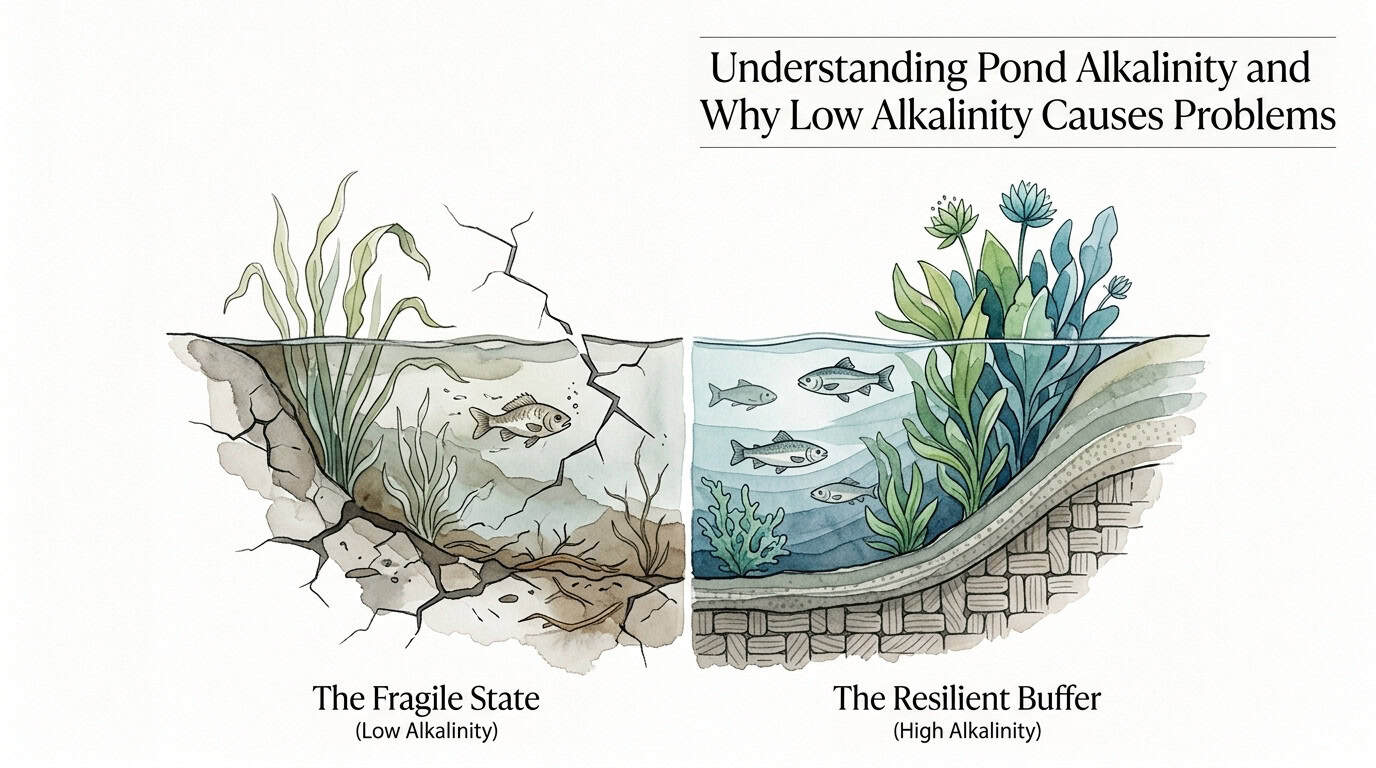
Understanding Pond Alkalinity and Why Low Alkalinity Causes Problems
Pond alkalinity, often measured as Carbonate Hardness or KH, functions as the water’s chemical buffering system, neutralizing acids to prevent rapid fluctuations in pH. Low alkalinity is problematic because it leaves the pond susceptible to sudden “pH crashes” that can lead to acute fish mortality and the cessation of biological filtration. Maintaining adequate alkalinity—typically above 100 ppm for ornamental ponds—ensures a stable environment for both aquatic life and the nitrifying bacteria responsible for processing toxic waste.
Alkalinity is the ‘insurance policy’ for your water chemistry; without it, your fish are at risk. Low alkalinity makes your pond vulnerable to ‘pH crashes.’ Discover how to build a chemical buffer that keeps your water stable regardless of weather.
Achieving a stable aquatic environment requires more than just monitoring temperature and dissolved oxygen. Precise control over the chemical equilibrium of the water column is essential for long-term system health. Alkalinity represents the backbone of this stability, acting as a mechanical damper against the acidic byproducts of biological activity and environmental inputs.
This guide examines the technical mechanics of the bicarbonate buffer system. It explains the stoichiometric relationship between metabolic processes and chemical consumption, providing the data necessary to optimize water quality. Understanding these principles allows a practitioner to transition from reactive maintenance to proactive chemical management.

Understanding Pond Alkalinity and Why Low Alkalinity Causes Problems
Alkalinity is defined as the quantitative capacity of an aqueous solution to neutralize an acid. In the context of pond management, it is primarily composed of bicarbonate (HCO3-) and carbonate (CO3 2-) ions. These ions represent the “Carbonate Hardness” (KH) of the water. While pH measures the current concentration of hydrogen ions, alkalinity measures the reservoir of bases available to absorb those hydrogen ions before they can alter the pH.
Low alkalinity creates a state of chemical fragility. In systems where the KH is below 50 ppm (parts per million) or approximately 3 dKH (German degrees of hardness), the water lacks sufficient buffering capacity. Under these conditions, small additions of acid—such as those from rain, metabolic waste, or the nitrification process—can cause the pH to plummet rapidly. This event, known as a pH crash, often results in the immediate failure of the pond’s biological filter and severe physiological stress or death for the fish.
Real-world applications of alkalinity management are found in intensive aquaculture and high-end koi keeping. In these environments, the high density of livestock leads to rapid accumulation of organic acids. Without a robust chemical buffer, the system would reach toxic levels of acidity within hours. Proper alkalinity management provides the mechanical stability needed to support these high-performance biological systems.
How the Bicarbonate Buffer System Works
The stabilization of pH in a pond is governed by the equilibrium between carbon dioxide (CO2), carbonic acid (H2CO3), bicarbonate (HCO3-), and carbonate (CO3 2-). This chemical sequence is often referred to as the carbonate-bicarbonate equilibrium. When an acid is introduced into the water, it releases hydrogen ions (H+). The bicarbonate ions in the water react with these hydrogen ions to form carbonic acid, which then dissociates into water and CO2. This reaction “mops up” the excess acidity, keeping the pH stable.
Nitrifying bacteria, specifically Nitrosomonas and Nitrobacter, are heavily dependent on this system. These autotrophic organisms use inorganic carbon (carbonates) as their primary food source to build cell structures. As they oxidize ammonia into nitrite and then nitrate, they release hydrogen ions into the water. This process is inherently acid-producing. Data indicates that for every 1.0 mg of ammonia oxidized, approximately 7.14 mg of alkalinity is consumed. In a pond with high ammonia production and low KH, the biological filter will literally consume its own buffer until the pH drops so low that the bacteria can no longer function.
To maintain this system, a practitioner must ensure that the rate of alkalinity addition or replenishment meets or exceeds the rate of consumption. Testing KH levels weekly is the standard protocol for identifying downward trends before they reach critical thresholds. If the KH falls below 80–100 ppm, proactive adjustment is required to prevent a stalling of the nitrogen cycle.

Benefits of Maintaining High Alkalinity
Consistent alkalinity levels above 100 ppm provide several measurable advantages for pond performance. The most immediate benefit is the elimination of daily pH swings. During the day, algae and aquatic plants perform photosynthesis, removing CO2 from the water and causing the pH to rise. At night, they respire, adding CO2 back and causing the pH to fall. High alkalinity dampens these oscillations, keeping the pH within a narrow, healthy range for fish and invertebrates.
Optimized biological filtration is another primary benefit. Nitrifying bacteria perform most efficiently at a pH between 7.5 and 8.5. Because the nitrification process is acid-producing, high alkalinity ensures that the local environment within the filter media remains within this optimal range. This leads to faster ammonia processing times and increased carrying capacity for the pond. Systems with stable, high KH levels are significantly more resilient to sudden spikes in waste production, such as those occurring after heavy feeding or spawning events.
Furthermore, high alkalinity improves the overall productivity of the pond’s ecosystem. It makes essential nutrients, such as phosphorus, more available for beneficial plankton growth while stabilizing the toxicity levels of various heavy metals. In recreational ponds, this supports a healthier food web, leading to better growth rates for fish populations. For the ornamental hobbyist, stable water chemistry translates to more vibrant fish colors and reduced susceptibility to opportunistic pathogens.
Challenges and Common Mistakes in Alkalinity Management
A frequent error among beginners is the confusion between General Hardness (GH) and Carbonate Hardness (KH). While GH measures calcium and magnesium ions, KH measures the buffering carbonates. It is entirely possible to have “hard” water (high GH) that has almost no buffering capacity (low KH). Treating a pond based on GH readings alone can lead to a false sense of security, leaving the system vulnerable to a pH crash despite having high mineral content.
Another common pitfall is the attempt to “chase” a specific pH number using liquid acids or “pH Down” products. These chemicals aggressively consume alkalinity. If a practitioner adds acid to lower a pH of 8.2 without realizing the alkalinity is also high, the buffer will simply neutralize the acid, and the pH will bounce back. Repeatedly adding acid in this scenario eventually depletes the entire KH reservoir. Once the buffer is gone, the next dose of acid will cause the pH to drop uncontrollably, often resulting in a total system collapse.
Neglecting the impact of source water is also a significant challenge. Municipal water supplies and well water vary greatly in their chemical composition. Some areas have naturally “soft” water with KH levels below 20 ppm. If a pond owner performs large water changes using this source without testing and adjusting the alkalinity, they may inadvertently dilute their pond’s buffer to dangerous levels. Always test the replacement water to determine the required dosage of buffering agents.
Limitations and Environmental Constraints
While high alkalinity is generally beneficial, it is not without practical boundaries. One significant limitation is the relationship between pH, alkalinity, and ammonia toxicity. In water with high alkalinity, the pH tends to settle at a higher equilibrium, often around 8.2 to 8.4. At higher pH levels, a larger percentage of total ammonia exists in its “un-ionized” form (NH3), which is highly toxic to fish. In a system where the biological filter has failed, high alkalinity can actually accelerate ammonia poisoning by keeping the pH elevated.
Environmental factors such as heavy rainfall can also overwhelm a pond’s buffering capacity. Rainwater is naturally acidic (pH 5.0–5.6) and contains zero alkalinity. In a small pond, a significant rain event can dilute the existing carbonates and introduce enough hydrogen ions to cause a rapid decline in KH. Systems located in regions with frequent heavy storms require more frequent monitoring and higher baseline alkalinity levels to account for this environmental “washout.”
Additionally, the use of certain medications or water treatments can be limited by alkalinity levels. Some copper-based algaecides and parasite treatments become significantly more toxic to fish in low-alkalinity water. Conversely, very high alkalinity can cause certain beneficial treatments to precipitate out of solution, rendering them ineffective. Practitioners must always verify that their water chemistry is compatible with any chemical interventions they plan to implement.
Comparing KH (The Resilient Buffer) vs. GH (The Mineral State)
Understanding the distinction between Carbonate Hardness and General Hardness is vital for precise mechanical control of the pond environment. The following table highlights the primary differences between these two parameters.
| Feature | Carbonate Hardness (KH) | General Hardness (GH) |
|---|---|---|
| Primary Ions | Bicarbonates (HCO3-), Carbonates (CO3 2-) | Calcium (Ca2+), Magnesium (Mg2+) |
| Primary Function | pH Buffering / Acid Neutralization | Osmoregulation / Mineral Supply |
| Consumed By | Nitrification, Organic Acids, CO2 | Biological Uptake (Snail Shells, Fish Bone) |
| Effect on pH | Stabilizes and usually raises pH | Little to no direct effect on pH |
| Minimum Threshold | 100 ppm (Recommended for Koi) | 100–200 ppm (Species Dependent) |
Practical Tips for Managing Pond Alkalinity
Maintaining optimal alkalinity requires a consistent testing and dosing regimen. For most ornamental ponds, the use of sodium bicarbonate (common baking soda) is the most efficient and cost-effective method for raising KH. Sodium bicarbonate is highly soluble and safely raises alkalinity without causing the extreme pH spikes associated with stronger bases like soda ash or lime.
- Test Weekly: Use a drop-based titration kit rather than test strips for better accuracy. Aim for a target of 100–200 ppm (6–11 dKH).
- Calculate Your Dose: To raise the alkalinity of 1,000 gallons of water by approximately 17.8 ppm (1 dKH), add roughly 125 grams (about 4.4 ounces) of sodium bicarbonate.
- Dose Gradually: Do not attempt to raise the KH by more than 20 ppm (approx. 1 dKH) per 24-hour period. Sudden changes in water chemistry can stress the fish’s osmoregulatory systems.
- Dissolve Before Adding: Mix the powder in a bucket of pond water before distributing it evenly around the pond surface or into the filter returns.
- Monitor pH: While sodium bicarbonate is a gentle buffer, it will naturally pull the pH toward an equilibrium of about 8.2. Ensure your fish are acclimated to this range.
For large-scale earthen ponds, agricultural limestone (calcium carbonate) is often preferred. While it dissolves much slower than sodium bicarbonate, it provides a long-term, self-regulating buffer. The limestone only dissolves when the water becomes slightly acidic, providing an automated defense against pH drops.
Advanced Considerations for High-Load Systems
In high-performance koi ponds or intensive aquaculture raceways, the rate of alkalinity consumption is a critical metric for system design. Because nitrification destroys 7.14 mg of alkalinity for every mg of ammonia oxidized, a system processing 100 grams of ammonia per day will deplete 714 grams of calcium carbonate equivalent every 24 hours. This consumption must be accounted for in the daily maintenance routine.
Practitioners should also consider the “Residual Alkalinity” required for bacterial health. Research suggests that nitrifying bacteria begin to lose efficiency when the KH drops below 50 mg/L. To ensure the bio-filter operates at peak capacity, a residual alkalinity of at least 80–100 mg/L should be maintained at all times, even at the point of maximum daily consumption (usually just before the next scheduled dose or water change).
Scaling these operations requires automated dosing systems in many cases. Using a peristaltic pump to deliver a saturated sodium bicarbonate solution throughout the day can maintain a perfectly flat KH and pH profile. This level of mechanical optimization minimizes stress on the livestock and maximizes the growth potential of the system.
Example Scenario: Correcting Low Alkalinity
Consider a 2,500-gallon koi pond that has been experiencing unexplained lethargy in the fish. A water test reveals the following parameters: Ammonia 0.25 ppm, Nitrite 0 ppm, pH 6.8, and KH 35 ppm. The low KH indicates that the buffer is nearly exhausted, and the declining pH is causing the nitrifying bacteria to stall, leading to the ammonia spike.
The goal is to raise the KH to a safer level of 125 ppm. This requires an increase of 90 ppm. Using the standard metric that 125 grams of sodium bicarbonate raises 1,000 gallons by 17.8 ppm, we calculate the total requirement. For 2,500 gallons, one “unit” (1 dKH) increase requires 312.5 grams. To reach the 90 ppm (5 dKH) increase, the pond needs approximately 1,562 grams of sodium bicarbonate.
To avoid shocking the fish, the practitioner should divide this dose over five days, adding roughly 312 grams per day. After the first dose, the pH will likely stabilize near 7.2–7.5, and the nitrifying bacteria will resume activity. By the fifth day, the pond will have a resilient chemical buffer and a fully functional biological filter.
Final Thoughts
Alkalinity is not merely a secondary water parameter; it is the fundamental framework upon which all other pond chemistry relies. By maintaining a robust bicarbonate buffer, a pond owner can ensure that metabolic processes and environmental changes do not lead to catastrophic system failure. The data-driven approach to KH management—calculating consumption rates and maintaining consistent residuals—is what separates successful long-term aquatic systems from those plagued by chronic instability.
The transition from a “fragile state” to a “resilient buffer” is achieved through regular monitoring and precise chemical adjustment. While the mechanics of the carbonate-bicarbonate equilibrium may seem complex, the practical application is straightforward: keep the KH high enough to absorb the acids produced by your pond’s life. This simple act of mechanical optimization provides the highest level of protection for your aquatic investment.

Focusing on these technical metrics allows for a deeper understanding of the aquatic environment. Practitioners are encouraged to experiment with dosing schedules and monitor the specific consumption rates of their individual systems. Mastery of alkalinity is the most effective way to guarantee the biological efficiency and physical health of any pond.
Frequently Asked Questions About Understanding Pond Alkalinity and Why Low Alkalinity Causes Problems
What is the difference between pH and alkalinity in a pond?
pH measures the concentration of hydrogen ions in the water, indicating how acidic or basic the water is at a specific moment. Alkalinity, or KH, measures the total concentration of bases (primarily bicarbonates and carbonates) that can neutralize acids. While pH tells you the current state of the water, alkalinity tells you how well the water can resist future changes in pH. High alkalinity acts as a buffer, preventing the pH from moving up or down rapidly. Without sufficient alkalinity, the pH can crash suddenly, even if it initially seems stable.
Why does the alkalinity in my pond decrease over time?
Alkalinity is continuously consumed by biological and chemical processes within the pond. The primary driver of KH depletion is the nitrification process, where beneficial bacteria convert toxic ammonia into nitrate. This chemical reaction releases hydrogen ions, which are neutralized by the bicarbonate buffer, consuming it in the process. Additionally, organic acids produced by decaying leaves, fish waste, and uneaten food further deplete the alkalinity. Environmental factors like acid rain can also neutralize the buffer. Because these processes are ongoing, alkalinity must be regularly tested and replenished.
Can I use baking soda to increase my pond’s alkalinity?
Sodium bicarbonate, commonly known as baking soda, is one of the most effective and safest ways to increase pond alkalinity. It is highly soluble and provides a direct source of bicarbonate ions for the buffer system. Unlike stronger chemicals, baking soda has a self-limiting effect on pH; it will naturally stabilize the water at a pH of around 8.2, making it very difficult to “over-alkalize” the pond to dangerous levels. It is an ideal tool for both emergency corrections and routine maintenance in ornamental ponds and koi systems.
How much alkalinity is needed to prevent a pH crash?
To ensure total system stability, most experts recommend maintaining a minimum alkalinity level of 100 ppm (approximately 5.6 dKH). For ponds with high fish loads or intensive feeding schedules, levels as high as 200 ppm (11 dKH) are often preferred. When alkalinity falls below 50 ppm, the risk of a sudden pH crash increases significantly. At these low levels, there is very little “buffer” left to neutralize the acids produced during the night or during a heavy rainstorm, which can lead to a rapid and lethal drop in pH within a matter of hours.
Does high alkalinity make ammonia more toxic to fish?
Alkalinity itself does not make ammonia toxic, but it does influence the pH, which is the primary factor in ammonia toxicity. High alkalinity tends to pull the pond’s pH toward a range of 8.0 to 8.4. In this higher pH range, a larger portion of total ammonia is converted into its un-ionized form (NH3), which is much more toxic to fish than ionized ammonium (NH4+). Therefore, while high alkalinity is essential for pH stability, it is equally important to ensure that the pond’s biological filter is healthy and efficiently removing ammonia from the system.