

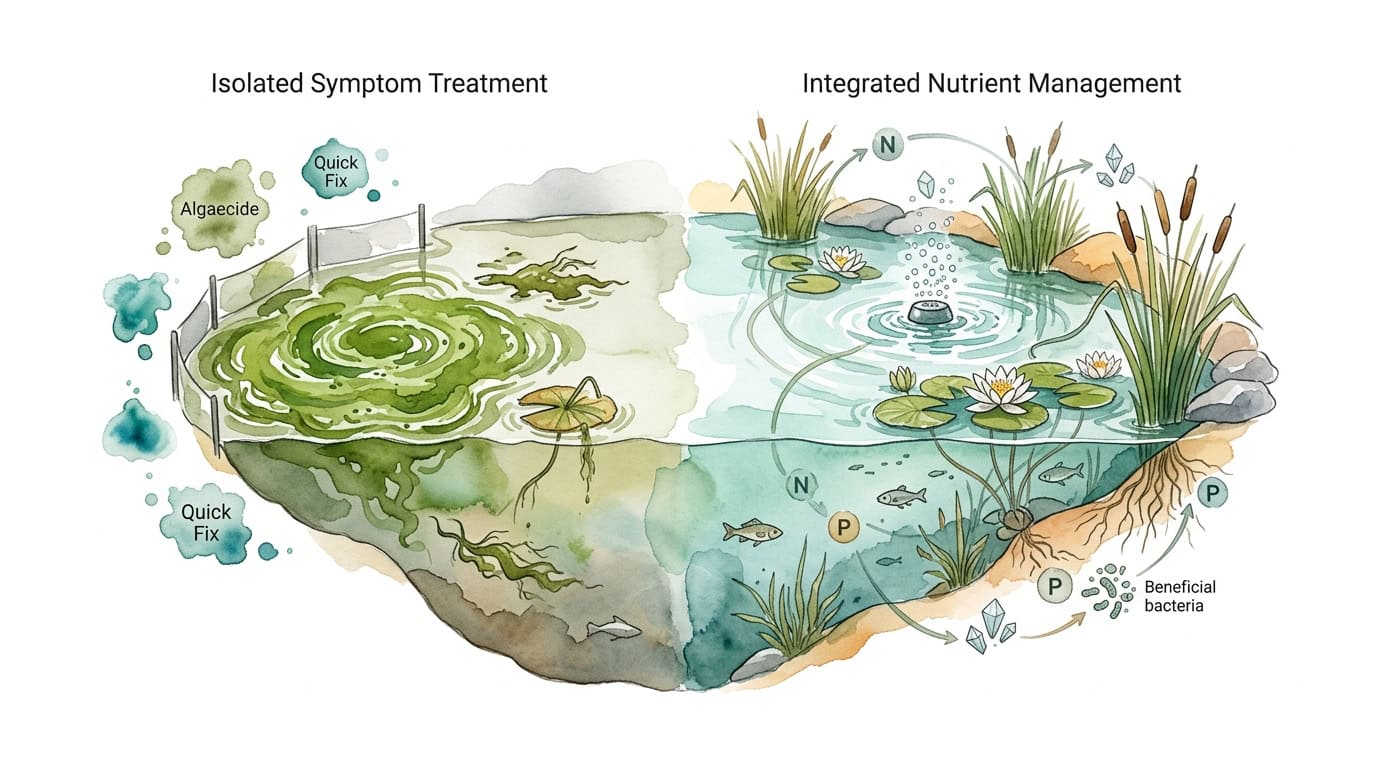
Algae isn’t the problem—it’s the messenger. Are you listening? Treating algae as an isolated problem is like taking aspirin for a broken leg. You have to look at the integrated system of nutrients feeding the bloom. Fix the source, and the algae disappears.
Successful pond management requires a transition from reactive chemical applications to proactive nutrient sequestration. Most property owners view a green surface as a disease to be cured with algaecides. In reality, algae is a biological response to high concentrations of dissolved nitrogen and phosphorus. This article analyzes the mechanical and biochemical frameworks required to stabilize an aquatic ecosystem by managing the underlying nutrient load.
The Real Cause Of Most Pond Algae Problems
Excessive algae growth is fundamentally a mass balance issue. Ponds act as catchments for organic and inorganic materials, leading to a state of eutrophication. This process occurs when nutrient inputs exceed the system’s capacity for natural processing or export.
Phosphorus is the primary limiting nutrient in most freshwater systems. Technical data suggests that a single pound of phosphorus can support the growth of up to 500 pounds of wet algae. Nitrogen, while also critical, is often more abundant due to atmospheric exchange and runoff. When these two elements reach specific threshold concentrations—typically above 0.03 mg/L for total phosphorus—algae blooms become inevitable.

Nutrient loading originates from two primary vectors: external and internal. External loading includes surface runoff containing fertilizers, animal waste, and decaying organic debris. Internal loading refers to the release of nutrients from bottom sediments. Over years, organic matter settles at the pond bottom, forming a layer of “muck.” As this material decomposes under low-oxygen conditions, it releases phosphorus and ammonia back into the water column, creating a self-perpetuating cycle of algae growth.
Mechanisms of Nutrient Cycling and Sequestration
Biological and chemical processes dictate the availability of nutrients for algae uptake. Managing these cycles requires an understanding of redox potential and microbial metabolism.
The Nitrogen Cycle
Effective nitrogen management relies on a two-step bacterial process known as nitrification. Aerobic bacteria, specifically Nitrosomonas and Nitrobacter, convert toxic ammonia (NH3) into nitrite (NO2) and then into nitrate (NO3). Nitrate is a more stable form of nitrogen that can be utilized by beneficial aquatic plants or further converted into nitrogen gas (N2) through denitrification in anaerobic zones. Without sufficient dissolved oxygen, this cycle halts at the ammonia stage, which is highly toxic to fish and readily consumed by certain algae species.
Phosphorus Binding and Locking
Phosphorus does not have a gaseous phase in the natural cycle, meaning it must be physically sequestered or removed. In a well-oxygenated pond, phosphorus often binds to iron and settles into the sediment. However, if the pond bottom becomes anoxic (lacks oxygen), the chemical bond between iron and phosphorus breaks, releasing the nutrient back into the water. This is known as internal loading. Chemical binders like lanthanum-modified clay or aluminum sulfate (alum) can be used to create permanent, oxygen-independent bonds with phosphorus, locking it in the sediment.
Technical Benefits of Integrated Nutrient Management
Shifting to a nutrient-centric model provides measurable improvements in water quality and system stability. This approach moves away from the “boom and bust” cycle associated with repeated chemical treatments.
Data indicates that reducing total phosphorus concentrations below 0.02 mg/L significantly inhibits the formation of filamentous algae and harmful cyanobacteria blooms. By starving the algae of its primary fuel source, the need for copper-based algaecides is reduced by 70% to 90% over a three-year period.

Maintaining high dissolved oxygen levels (above 5 mg/L) throughout the water column supports a robust community of beneficial aerobic bacteria. These microbes outcompete algae for available nutrients. Furthermore, a stabilized nutrient profile prevents the rapid dissolved oxygen crashes that often follow the mass die-off of an algae bloom, protecting fish populations from hypoxia.
Mechanical and Biological Failure Points
Systems often fail because of a mismatch between the nutrient load and the remediation capacity. Common errors in pond management stem from under-engineered solutions or biological inactivity.
Insufficient Dissolved Oxygen (DO)
Aeration systems are frequently undersized. If the biological oxygen demand (BOD) of the decaying muck exceeds the oxygen transfer rate of the aerator, the pond remains in a state of chronic stress. Many managers fail to account for sediment oxygen demand (SOD), which can account for over 50% of the total oxygen consumption in a mature pond. Without enough oxygen at the sediment-water interface, phosphorus release continues unabated.
Inadequate Microbial Density
Biological additives often underperform because the initial inoculation density is too low. Effective muck reduction requires high concentrations of Colony Forming Units (CFU). Many retail-grade products contain low-activity spores or high ratios of inert fillers. For aggressive nutrient sequestration, professional-grade formulations with counts exceeding 3 billion CFU per gram are required. Additionally, bacteria require specific environmental conditions—including a pH between 6.5 and 8.5 and temperatures above 55°F—to reach peak metabolic efficiency.
Environmental and Operational Limitations
Integrated nutrient management is not a universal solution and faces specific technical constraints depending on the water body’s characteristics.
Very shallow ponds (less than 4 feet deep) present a challenge for bottom-up aeration. In these environments, the air bubbles do not have enough “hang time” in the water column to transfer significant amounts of oxygen. Furthermore, shallow water is subject to rapid temperature fluctuations, which can stress bacterial colonies and cause sudden shifts in nutrient solubility.
Ponds with high levels of inorganic silt or heavy metal contamination cannot be remediated through biological means alone. Bacteria digest organic matter like leaves and fish waste but have no effect on sand, clay, or mineral sediments. In these cases, mechanical dredging may be the only viable method for restoring depth and removing the internal nutrient reservoir.
Technical Comparison: Treatment Methodologies
The following table compares the efficiency and impact of standard symptom-based treatments versus integrated nutrient management strategies.
| Metric | Algaecide Treatment | Nutrient Sequestration |
|---|---|---|
| Primary Target | Living Algae Cells | Phosphorus & Nitrogen |
| Duration of Effect | 7–14 Days | Seasonal to Permanent |
| Impact on Muck | Increases (via die-off) | Decreases (via digestion) |
| Oxygen Demand | Increases significantly | Decreases over time |
| Long-term Cost | High (Recurring) | Low (Maintenance) |
Practical Optimization Strategies
Achieving peak system performance requires precise calibration of mechanical and biological inputs.
Aeration Sizing and Placement
Calculate the required CFM (Cubic Feet per Minute) based on the total water volume and the anticipated BOD. For most residential ponds, a turnover rate of 1.5 to 2.0 times per 24 hours is the target. Diffusers should be placed at the deepest points of the pond to maximize the volume of water moved through the air-lift effect. If the pond has an irregular shape, multiple diffusers are necessary to eliminate “dead zones” where nutrients can accumulate.
Probiotic Dosing Schedules
Initial “shock” doses of beneficial bacteria are required to establish a dominant colony. This should be followed by maintenance doses every two weeks during the growing season. Using water-soluble pouches ensures even distribution. For ponds with heavy muck, specialized “sludge-eating” pellets are more effective as they sink directly into the organic layer, delivering the bacteria to the highest concentration of fuel.
Advanced Sediment Remediation and Capping
In hyper-eutrophic systems, biological management may be insufficient to handle the volume of legacy phosphorus stored in the sediment. Advanced chemical capping provides a high-efficiency alternative.
Lanthanum-modified bentonite is a specialized clay that binds with phosphate ions to form rhabdophane, a highly stable, insoluble mineral. Unlike aluminum sulfate, lanthanum remains effective across a wide pH range (5.0 to 9.0) and does not pose the same toxicity risks to fish in low-alkalinity water. Applying these binders creates a “chemical blanket” over the sediment, preventing any internal loading regardless of oxygen levels. This is a critical strategy for deep ponds where maintaining total bottom-to-top oxygenation is mechanically difficult or cost-prohibitive.
Case Study: Quantitative Impact of Sequestration
Consider a 1-acre pond with an average depth of 6 feet and a total phosphorus concentration of 0.15 mg/L. This pond experienced bi-weekly blooms requiring copper sulfate treatments.
The management plan involved the installation of a 1/2 HP sub-surface aeration system providing 2.5 CFM and a monthly application of 3 billion CFU/g beneficial bacteria. Over a six-month period, the total phosphorus concentration dropped to 0.04 mg/L. The organic muck depth was reduced by an average of 1.5 inches through biological digestion. By the second season, algaecide requirements were eliminated entirely, and water clarity (measured by Secchi disk) increased from 14 inches to 42 inches.
Final Thoughts
Integrated nutrient management represents the most technically sound approach to long-term pond health. By focusing on the chemical and biological drivers of algae growth rather than the algae itself, managers can create resilient ecosystems that require less intervention.
Success is a function of data-driven decisions. Testing water for nitrogen and phosphorus levels, sizing aeration equipment based on volume, and selecting high-density microbial cultures are the cornerstones of this methodology.
Implementing these systems requires patience, as biological colonization and nutrient sequestering take time to show visible results. However, the result is a stable, clear, and healthy water body that functions as a balanced system rather than a constant maintenance burden. Encouraging the natural cycles of the pond is always more efficient than fighting against them.