

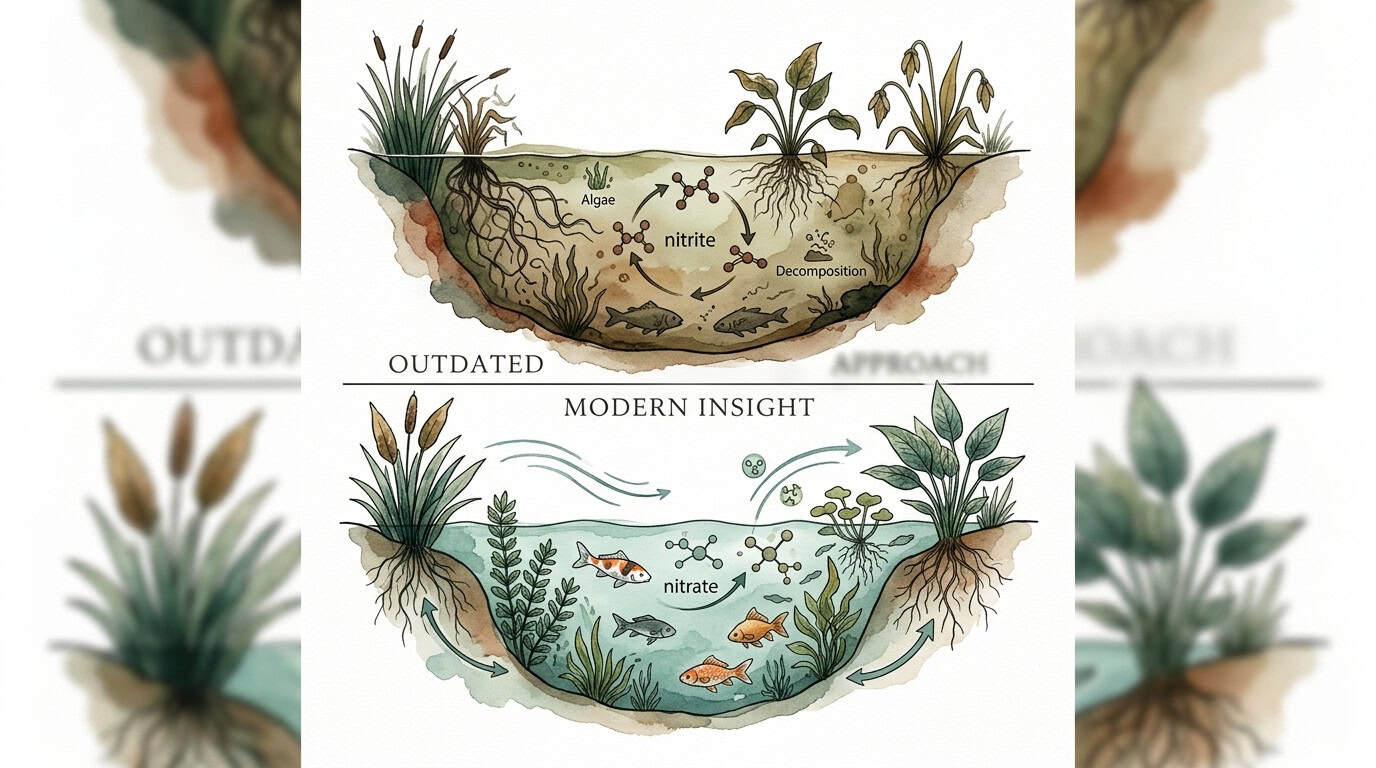
Treating all nitrogen the same is a recipe for disaster; know the difference between the poison and the fertilizer. Do you know which stage of the nitrogen cycle is harming your fish? Learn why Nitrite is a critical emergency while Nitrate is a management task.
Nitrite is an intermediate, highly toxic byproduct of ammonia oxidation that causes acute respiratory failure in fish by preventing oxygen transport in the blood. In contrast, nitrate is the relatively stable end product of the nitrogen cycle, functioning as a plant fertilizer that only becomes harmful at chronically high concentrations. Understanding this distinction allows pond owners to prioritize immediate emergency intervention for nitrite while utilizing long-term nutrient export strategies for nitrate management.
Nitrite vs Nitrate in Ponds: Why the Difference Matters
In a closed pond ecosystem, the nitrogen cycle is a multi-step biochemical process driven by chemolithoautotrophic bacteria. The primary distinction between nitrite (NO2-) and nitrate (NO3-) lies in their oxidation state and biological impact. Nitrite represents the middle stage of the cycle, where ammonia has been oxidized but not yet rendered safe. It is a potent physiological stressor that actively interferes with a fish’s internal chemistry.
Nitrate is the final inorganic stage of the nitrogen cycle. While it is significantly less toxic than its precursor, it serves as the primary driver for eutrophication and algal blooms. In professional pond management, nitrite is viewed as a systemic toxin requiring immediate neutralization, whereas nitrate is treated as a metabolic load that necessitates regular dilution or biological uptake.

The Mechanics of Nitrification: How Nitrogen Transitions
The conversion of nitrogenous waste occurs through a process called nitrification. This is an aerobic, two-step reaction performed by specific bacterial colonies residing in the biological filter and on pond surfaces.
First, ammonia-oxidizing bacteria, primarily Nitrosomonas, convert total ammonia nitrogen (TAN) into nitrite. This reaction requires substantial dissolved oxygen. Specifically, the oxidation of 1 gram of ammonia requires approximately 4.57 grams of oxygen.
The second step is the oxidation of nitrite into nitrate, performed by nitrite-oxidizing bacteria such as Nitrobacter or Nitrospira. This phase is often the “bottleneck” of the nitrogen cycle. Nitrobacter colonies grow slower than Nitrosomonas and are more sensitive to environmental shifts, such as temperature drops or pH fluctuations. When the population of Nitrobacter cannot keep pace with Nitrosomonas, a “nitrite spike” occurs.
Benefits of Differentiated Monitoring
Accurate tracking of both compounds provides a technical roadmap for pond health. Monitoring nitrite allows for the detection of “New Pond Syndrome” or biofilter failure before mass mortality occurs. Because nitrite is an acute toxin, even trace amounts (0.25 ppm) indicate that the second stage of the biofilter is underperforming or overwhelmed.
Monitoring nitrate, conversely, serves as an efficiency metric for nutrient export. Since nitrate accumulates over time, its concentration reveals whether the pond’s plant load and water change schedule are sufficient to balance the biological input from fish feed. High nitrate levels often precede pathogenic outbreaks, as chronic exposure to nitrate concentrations above 50–100 ppm can suppress the immune systems of sensitive species like high-grade Koi.
Challenges and Common Pitfalls
One of the most frequent errors in pond management is assuming that clear water equates to safe water. Nitrite is colorless and odorless; a pond can appear pristine while containing lethal concentrations. Another common pitfall is the “Nitrite Lag.” After a pond is first set up or after a filter is cleaned too aggressively, ammonia levels may drop to zero, leading the owner to believe the cycle is complete. However, the Nitrobacter colony often takes an additional 2–4 weeks to establish, leaving the pond in a high-nitrite state during that window.

Furthermore, many practitioners fail to account for the impact of organic carbon on nitrification. High levels of Dissolved Organic Carbon (DOC) can encourage the growth of heterotrophic bacteria. These bacteria grow significantly faster than nitrifying bacteria and can outcompete them for space and oxygen on the filter media, leading to sudden spikes in both nitrite and ammonia.
Limitations of Biological Filtration
Biological filtration is not a universal solution for nitrogen management. Nitrifying bacteria are highly temperature-dependent. Their metabolic rate drops significantly below 55°F (12.8°C). In many temperate climates, the Nitrosomonas activity may resume in the spring before Nitrobacter activity, leading to a seasonal nitrite spike known as “Spring Vibe.”
Additionally, nitrification is an acidifying process. For every gram of ammonia oxidized, approximately 7.14 grams of alkalinity (as CaCO3) is consumed. If the pond’s Carbonate Hardness (KH) is low, the pH can crash, which in turn halts the nitrification process entirely. This creates a feedback loop where the filter fails, and toxic nitrogen levels rise rapidly.
Nitrite vs Nitrate: Technical Comparison
| Feature | Nitrite (NO2-) | Nitrate (NO3-) |
|---|---|---|
| Toxicity Level | Acute (High) | Chronic (Low) |
| Primary Danger | Methemoglobinemia (Brown Blood) | Immune suppression / Algae |
| Target Range | 0.0 ppm | < 20-40 ppm |
| Removal Method | Bio-oxidation / Salt (Mitigation) | Water changes / Plants |
| Chemical Role | Intermediate waste product | End-stage plant nutrient |
Practical Tips and Best Practices
Managing nitrite requires a two-pronged approach: emergency mitigation and long-term stabilization. If nitrite is detected, the immediate application of pond salt (Sodium Chloride) is the standard technical response. Chloride ions (Cl-) compete with nitrite ions for the same active transport sites in the fish’s gills. Maintaining a chloride-to-nitrite ratio of at least 10:1 effectively prevents nitrite from entering the bloodstream, neutralizing the threat even while the biofilter recovers.
For nitrate management, the focus shifts to nutrient export. Mechanical filtration must be optimized to remove solid waste before it breaks down into dissolved nitrogen. Frequent, small water changes (10–15% weekly) are more effective at maintaining stable nitrate levels than infrequent, large changes. Additionally, the use of bog filters or “veggie filters” can provide enough phytoremediation to keep nitrates near zero by utilizing the nitrogen for plant tissue growth.
Advanced Considerations: Denitrification and DOCs
Serious practitioners should look beyond the aerobic nitrogen cycle toward anaerobic denitrification. In deep substrate layers or specialized “anoxic” filter systems, different bacteria can convert nitrate back into nitrogen gas (N2), which then safely off-gasses into the atmosphere. This is the only way to achieve a “closed-loop” nitrogen cycle that does not rely solely on water changes.
Furthermore, the relationship between Total Dissolved Solids (TDS) and nitrification efficiency is critical. As ponds age, “old pond syndrome” can set in, where the accumulation of various ions and organic compounds inhibits bacterial efficiency. Monitoring the “Redox Potential” (ORP) of the pond can provide an advanced metric for the water’s oxidative capacity, giving a more complete picture of how effectively the system can process nitrite into nitrate.
Scenario: Emergency Nitrite Remediation
Consider a 2,000-gallon pond experiencing a filter failure where nitrite has risen to 2.0 ppm. At this concentration, sensitive fish will begin gasping at the surface due to Methemoglobinemia (suffocation despite high oxygen).
The technical response:
1. Stop all feeding immediately to halt the production of new ammonia.
2. Increase aeration to saturation to assist the recovering biofilter.
3. Dose the pond with salt to reach a concentration of 0.1% to 0.15% (1 to 1.5 lbs of salt per 100 gallons). This provides a massive excess of chloride ions to block nitrite uptake.
4. Perform 25% water changes daily until the Nitrobacter population recovers and nitrite levels return to 0.0 ppm.
Final Thoughts
Mastering the difference between nitrite and nitrate is the hallmark of a professional pond keeper. While nitrite is a metabolic poison that demands immediate chemical and biological intervention, nitrate is a management metric that dictates the long-term maintenance schedule and stocking density of the pond.
A balanced pond requires a robust biofilter to handle the nitrite and a consistent export strategy to handle the nitrate. By focusing on the specific chemical needs of the nitrifying bacteria—oxygen, alkalinity, and surface area—and the competitive inhibition of chloride, you can maintain an environment that is both stable and safe for high-value aquatic life.
Frequently Asked Questions About Nitrite vs Nitrate in Ponds: Why the Difference Matters
How quickly can nitrite kill fish in a pond?
The speed of mortality depends on the concentration and the species’ sensitivity, but levels above 1.0 ppm can cause death within 24 to 48 hours. Nitrite enters the gills and oxidizes iron in the hemoglobin, forming methemoglobin. This “Brown Blood Disease” makes the blood unable to transport oxygen. Consequently, fish may suffocate in as little as a few hours if levels are extremely high (e.g., 5.0+ ppm), even if the water is highly aerated. Immediate action, such as adding salt to block nitrite uptake, is required the moment nitrite is detected.
Can I have zero nitrate in a pond?
While difficult to achieve in heavily stocked fish ponds, it is possible and ideal. Zero nitrate indicates that your nutrient export (plants, algae, and water changes) exactly matches or exceeds the rate of nitrogen production. In many cases, a heavily planted “bog filter” or “anoxic filter” can keep nitrate levels at non-detectable levels. However, for most hobbyists, a reading of 5–10 ppm is considered excellent, and anything under 40 ppm is generally safe for the long-term health of common pond fish like Koi and Goldfish.
Does a high pH make nitrite more toxic?
Unlike ammonia, which becomes significantly more toxic as pH increases, nitrite toxicity is actually slightly more pronounced at lower pH levels. In acidic water, a portion of the nitrite can convert into nitrous acid (HNO2), which can diffuse more easily into the fish’s tissues. However, the most critical factor for nitrite toxicity is not the pH, but the chloride concentration. Regardless of the pH, maintaining a proper salt level is the most effective way to neutralize the immediate threat of nitrite poisoning.
When should I worry about nitrate levels?
Nitrate should become a concern when it consistently exceeds 50–80 ppm. While not acutely lethal, chronic exposure to high nitrates causes physiological stress, stunts growth, and inhibits the immune system, making fish more susceptible to bacterial infections like “Ulcer Disease.” High nitrates also serve as a fuel source for nuisance algae. If your nitrates are climbing steadily, it is a signal that your fish load is too high, you are overfeeding, or your water change frequency is insufficient for the volume of the pond.
Why is my nitrite high but my ammonia is zero?
This situation, often called a “Nitrite Spike,” occurs because the bacteria that process ammonia (Nitrosomonas) and the bacteria that process nitrite (Nitrobacter/Nitrospira) are different species with different growth rates. Nitrosomonas typically colonize a filter faster. If the ammonia is zero but nitrite is high, it means the first half of your nitrogen cycle is working, but the second half hasn’t caught up yet. This is common in new ponds (week 3 or 4 of cycling) or after using medications that have partially damaged the biofilter’s bacterial colonies.
Here are some other pond articles you might be interested in...:
