

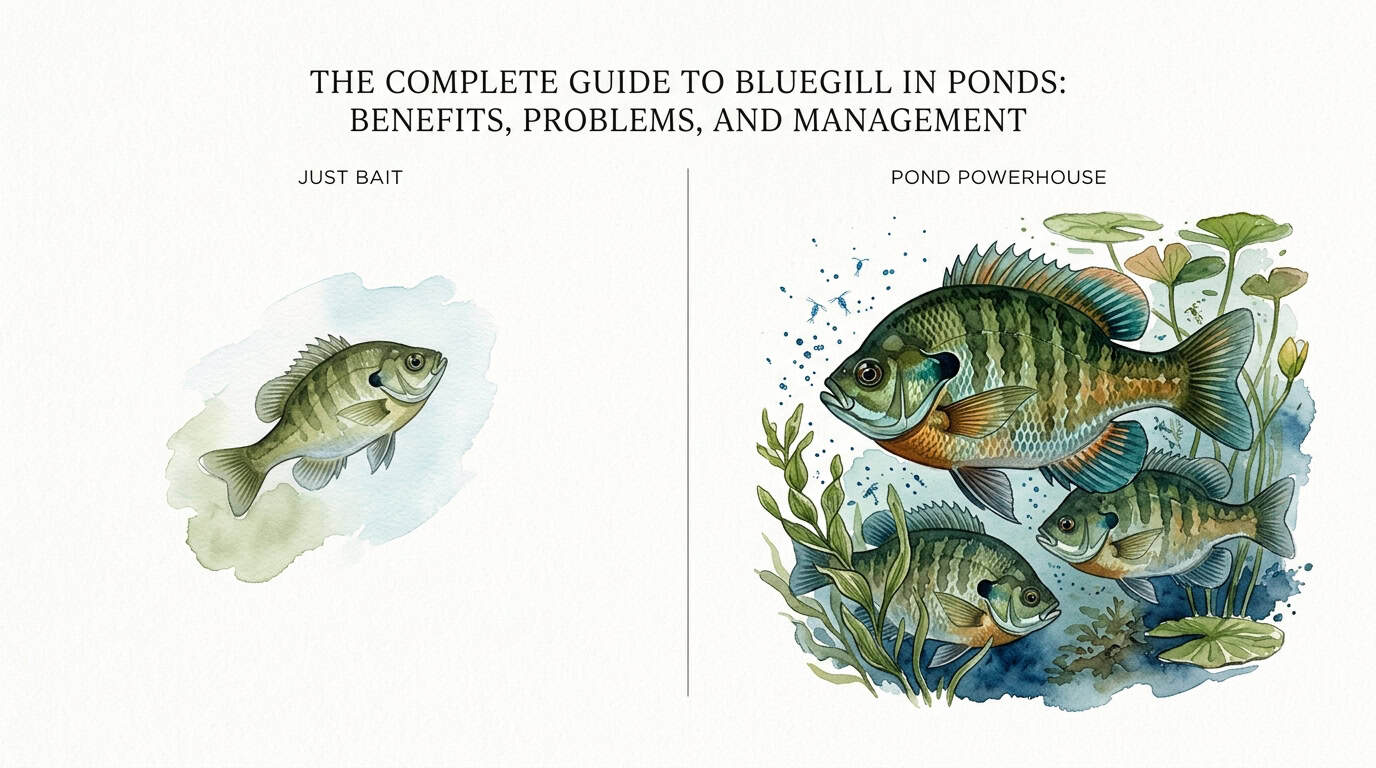
Are you wasting the potential of the most versatile fish in your pond? Most pond owners treat bluegill as a secondary thought. In reality, they are the engine of your pond’s health and your family’s freezer. Here is how to manage them for maximum return.
The Complete Guide To Bluegill In Ponds: Benefits, Problems, And Management
Bluegill (Lepomis macrochirus) represent the primary trophic link between primary productivity and apex predators in North American freshwater impoundments. In a managed ecosystem, these fish function as biological converters, transforming zooplankton, insects, and supplemental protein into high-density biomass. This biomass serves two functions: it supports the growth of largemouth bass and provides a sustainable protein harvest for human consumption.
The species belongs to the sunfish family, Centrarchidae. It is characterized by a deep, compressed body shape, a small mouth, and a distinct dark spot on the posterior edge of the operculum (gill cover). Their evolutionary success in pond environments stems from their high reproductive plasticity and broad dietary range. Without bluegill, most pond systems fail to achieve the caloric density required to grow trophy-class predators.
Effective management requires moving beyond the “Just Bait” mentality. Viewing bluegill as a Pond Powerhouse necessitates a technical understanding of their population dynamics, metabolic requirements, and recruitment cycles. Proper management ensures that the pond remains in biological balance, preventing the common pitfall of “stunting” where thousands of small fish consume resources without reaching harvestable size.

Biological Mechanics: How Bluegill Populations Function
The primary driver of bluegill success is their reproductive frequency. Unlike many freshwater species that spawn once annually, bluegill are multiple-spawners. Spawning activity generally commences when surface water temperatures reach 68°F to 70°F and can continue through late summer, often concluding when temperatures drop below 80°F in the fall.
Males construct saucer-shaped nests in colonies, typically in shallow water with firm substrates like gravel or sand. A single female can produce between 10,000 and 60,000 eggs per spawn, depending on her size and physical condition. Because bluegill can spawn every 21 to 28 days during the peak season, a single acre of water can produce millions of fry in a single year.
This high recruitment rate is a mechanical necessity for supporting largemouth bass. It takes approximately 10 pounds of bluegill for a largemouth bass to gain 1 pound of body weight. Therefore, a pond designed to produce 50 pounds of bass gain per year must successfully recruit and maintain 500 pounds of bluegill biomass. Management strategies must focus on ensuring this biomass is distributed across various size classes to satisfy both predator needs and harvest goals.
The Advantages of a Bluegill-Centric System
Bluegill provide a level of ecological stability that few other species can match. Their ability to utilize various niches—from eating mosquito larvae in the shallows to consuming zooplankton in open water—makes them highly efficient at nutrient cycling. This efficiency translates into several measurable benefits for the pond owner.
One primary advantage is the consistent forage availability. Because bluegill spawn in “bouts” throughout the summer, they provide a multi-modal size distribution of prey. This ensures that bass of all sizes, from 2-inch fingerlings to 10-pound trophies, have access to appropriately sized calories at all times. This constant availability reduces predator stress and minimizes the risk of bass cannibalism.
Recreational and harvest value is another significant benefit. Bluegill are among the most efficient converters of supplemental pelleted feed. In systems utilizing high-quality floating rations (32% to 40% protein), bluegill can achieve a feed conversion ratio (FCR) of nearly 2:1. This means for every 2 pounds of feed provided, the system gains 1 pound of fish. This makes them an ideal species for sustainable “backyard” protein production.

Challenges: The Mechanics of Stunting and Competitive Exclusion
The most frequent failure in bluegill management is the development of a stunted population. Stunting is a density-dependent process where the population exceeds the carrying capacity of the available food resources. When this occurs, individual growth rates decelerate or stop entirely, resulting in a pond filled with 3-inch to 5-inch fish that never reach “hand-sized” dimensions.
Stunting is often caused by a lack of predatory pressure or excessive habitat complexity. If aquatic vegetation covers more than 20% to 30% of the pond’s surface area, small bluegill can effectively hide from largemouth bass. This high survival rate leads to intra-specific competition for food. As thousands of small fish compete for the same limited zooplankton and insects, none of them receive enough energy for somatic growth beyond basic maintenance metabolism.
Another challenge is competitive exclusion by “trash” species like green sunfish or bullhead catfish. These species often compete for the same nesting sites and food sources as bluegill but offer lower forage value to predators due to their body shape or slower reproductive cycles. Maintaining a pure bluegill-to-bass ratio is critical for high-efficiency energy transfer within the pond.
Environmental Limitations and Technical Constraints
Bluegill are hardy, but they are subject to specific environmental thresholds that limit their performance. Dissolved oxygen (DO) is the most critical metric. While they can survive briefly at DO levels as low as 3.0 mg/L, optimal growth and metabolic efficiency occur at levels above 5.0 mg/L. Sustained low oxygen leads to reduced feeding activity and increased susceptibility to bacterial infections.
Water chemistry also plays a role in bluegill health. They thrive in water with a pH between 6.5 and 8.5. In ponds with low alkalinity (less than 20 ppm), primary productivity is often limited, which reduces the natural food base. Liming is frequently required in these environments to buffer pH and unlock nutrients like phosphorus, which are essential for the phytoplankton blooms that feed young bluegill.
Thermal limits must also be considered. While the Northern subspecies is highly cold-tolerant, the Coppernose subspecies may experience stress or mortality in regions where water temperatures remain near freezing for extended periods. Pond owners in northern latitudes must select the correct genetic strain to ensure over-winter survival and spring reproductive success.
Comparison: Northern vs. Coppernose Subspecies
Choosing the correct strain of bluegill is a mechanical decision based on geography and management intensity. The two primary subspecies utilized in pond management are the Northern Bluegill (Lepomis macrochirus macrochirus) and the Coppernose Bluegill (L. m. purpurescens).
| Feature | Northern Bluegill | Coppernose Bluegill |
|---|---|---|
| Native Range | Mississippi River Basin / Midwest | Southeastern US / Florida |
| Cold Tolerance | High (Survives ice cover) | Moderate (Susceptible to winterkill) |
| Growth Potential | Standard (0.25 – 0.5 lb/yr) | Enhanced (Up to 0.75 lb/yr) |
| Feeding Behavior | Opportunistic | Highly aggressive on pellets |
| Spawning Window | Shorter (Late Spring/Early Summer) | Extended (Spring through Fall) |
For most southern and transitional zone ponds, Coppernose bluegill are the superior choice due to their extended spawning window and faster growth rates. However, in regions where ponds freeze over, the Northern strain is the only viable option to prevent total population collapse during severe winters.
Practical Tips for Bluegill Management
Successful management hinges on data collection and proactive intervention. Pond owners should implement a “Catch and Record” system to monitor the size distribution of the population. If more than 80% of the bluegill caught are under 6 inches, the system is likely trending toward a stunted state.
One of the most effective tools for boosting bluegill production is the installation of mechanical feeders. Providing a high-protein floating pellet allows the fish to bypass the limitations of the natural food chain. Feed should be administered in multiple short bursts (5-10 seconds) throughout the day rather than one large feeding. This prevents waste and ensures that smaller, less aggressive fish also have access to the nutrients.
Maintaining the predator-prey balance is equally critical. In a standard 1-acre pond, a common stocking ratio is 1,000 bluegill to 100 largemouth bass. If the goal is to produce large bluegill, the pond should actually be “bass-heavy.” Keeping a high density of small bass (10 to 12 inches) ensures that bluegill recruitment is strictly controlled. When fewer bluegill survive, the ones that remain have access to more food and grow to trophy sizes.
Advanced Considerations: PSD and Relative Weight Analysis
Serious practitioners use specific indices to quantify pond health. The Proportional Size Distribution (PSD) is a mathematical tool used to assess the size structure of a fish population. For bluegill, the formula is: (Number of fish ≥ 6 inches / Number of fish ≥ 3 inches) x 100. A balanced pond typically maintains a bluegill PSD between 20 and 40.
Relative Weight (Wr) is another vital metric for evaluating the nutritional status of the population. It compares the actual weight of a captured fish to a “standard” weight for a fish of that length. A Wr of 100 indicates the fish is in the 75th percentile of health. If your bluegill consistently show a Wr below 85, it indicates a forage deficit or a water quality issue that is suppressing metabolic efficiency.
Managing for “Trophy” bluegill requires a selective culling protocol. Large male bluegill are the guardians of the nesting colonies. If these “bull” males are harvested, smaller, “sneaker” males will take over the nesting sites. Sneaker males put their energy into reproduction rather than growth, which can lead to a long-term decline in the average size of the fish in your pond. Protecting large males and harvesting medium-sized females is a more effective strategy for maintaining size quality.
Scenario Analysis: The 1-Acre Managed System
Consider a 1-acre pond in a temperate climate with a goal of producing both 2-pound largemouth bass and 0.75-pound bluegill. To achieve this, the owner stocks 1,000 Coppernose bluegill and 100 redear sunfish (to control snails and parasites) in the fall. In the following spring, 50-75 largemouth bass are added.
The owner installs two mechanical feeders, each dispensing 2 pounds of 40% protein feed per day during the growing season. This supplemental input adds approximately 300 pounds of fish biomass per year that the natural system would not otherwise support. To maintain balance, the owner implements a harvest quota of 150-200 intermediate-sized bluegill annually.
By the third year, the pond reaches carrying capacity. Sampling shows a bluegill PSD of 35 and an average Wr of 98. The bass are growing at a rate of 1.2 pounds per year, and the bluegill have established multiple nesting colonies that provide a consistent “conveyor belt” of forage. This system is mechanically optimized for maximum output and ecological stability.
Final Thoughts
Bluegill management is not a passive endeavor. It requires a fundamental understanding of how energy moves through a pond system and the discipline to monitor and adjust population densities. By treating bluegill as the primary engine of the pond rather than a secondary species, you ensure a healthy, productive environment that meets both recreational and harvest goals.
Focusing on metrics like Relative Weight and Proportional Size Distribution allows you to make informed decisions about stocking, feeding, and harvesting. Whether your goal is to grow the largest bass possible or to fill your freezer with sustainable protein, the path to success begins with the careful management of the bluegill population.
Apply these technical principles consistently, and your pond will transition from a simple water feature into a high-performance biological system. Experiment with different feeding rates and harvest quotas to find the optimal balance for your specific watershed and climate. Strong management today creates a legacy of quality fishing for years to come.
