

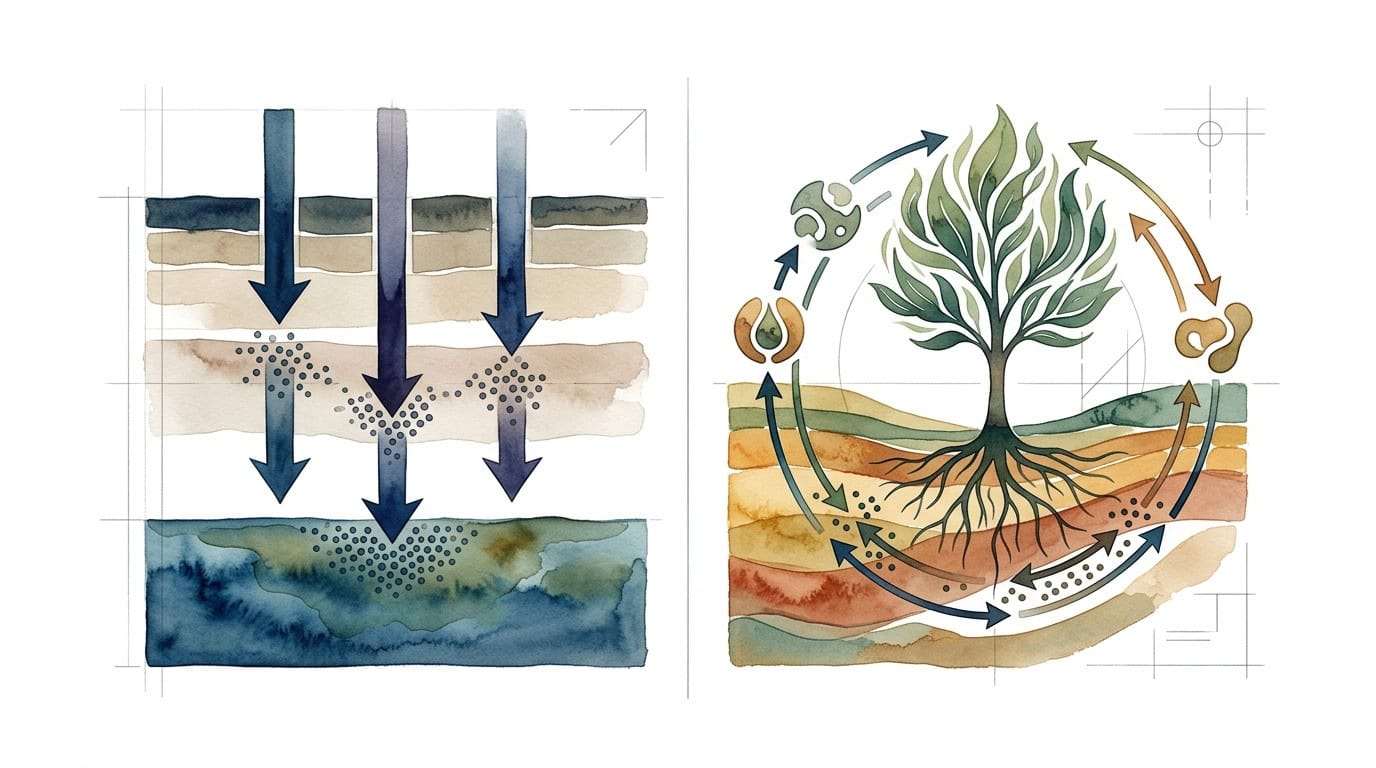
Nitrates don’t have to be pollution; they can be plant food. Nitrate spikes in the Midwest aren’t just an environmental issue—they are a design flaw. When we treat the landscape as a static surface for chemical inputs, the excess has nowhere to go but our drinking water. Creating dynamic, living systems that cycle nutrients through biology allows us to protect our health and our soil. Here is the path from toxic runoff to clean abundance.
The Midwest’s challenge of high nitrates in the water is a systemic contamination crisis where nitrogen-based fertilizers and manure from intensive agriculture leach into groundwater and surface water. Concentrations frequently exceed the federal 10 mg/L safety limit, particularly across Iowa, Wisconsin, and Illinois. This failure forces municipal utilities to spend millions on treatment while exposing residents to health risks like colorectal cancer and blue baby syndrome.
The Midwest’s Challenge Of High Nitrates In The Water
Agricultural productivity in the Midwestern United States relies heavily on nitrogen inputs. However, the efficiency of nitrogen uptake by crops is remarkably low, often ranging between 40% and 60%. This discrepancy creates a massive surplus of nitrogen that remains in the soil profile. Because nitrate (NO3-) is a highly mobile anion, it does not bind to soil particles. Heavy precipitation events, particularly the “spring flush” observed in 2025, transport this excess nitrogen into local waterways and underlying aquifers.
The geographic scope of the problem is concentrated in the “Corn Belt.” Iowa, for instance, reported 36 nitrate-related drinking water violations across 13 public water systems in 2025 alone. Central Iowa Water Works faced record-high nitrate levels in the Raccoon and Des Moines Rivers, leading to the region’s first-ever mandatory lawn watering ban. These events demonstrate that the nitrate challenge is not a future threat but a current operational reality for Midwestern infrastructure.

Health risks associated with high nitrate levels are well-documented. Concentrations above the 10 mg/L Maximum Contaminant Level (MCL) can cause methemoglobinemia, or “blue baby syndrome,” which impairs the blood’s ability to carry oxygen in infants. Newer longitudinal studies suggest that chronic exposure to levels as low as 5 mg/L may correlate with increased risks of colorectal cancer, thyroid disease, and neural tube defects. For many small Midwestern towns, the cost of remediating these health risks is becoming unsustainable.
Mechanisms of Contamination: Static Leaching vs. Dynamic Cycling
Understanding why nitrates move through the landscape requires a focus on soil physics and hydraulic connectivity. Static leaching occurs when nitrogen is applied to a landscape that lacks the biological complexity to process it. In this scenario, gravity and water movement become the primary drivers. Nitrates move vertically through the soil profile into groundwater or horizontally through subsurface drainage tiles directly into streams.
Dynamic cycling offers a biological alternative to this linear loss. This process utilizes soil microbes and perennial root systems to keep nitrogen within the “living” part of the soil. Denitrification, a microbially mediated process, converts nitrate into inert nitrogen gas (N2) before it can escape the field. This transition requires specific anaerobic conditions and a carbon source, elements that are often missing in high-input, low-diversity monoculture systems.
The design of modern agricultural drainage significantly exacerbates leaching. Subsurface tiling acts as a high-speed highway for nitrate-laden water, bypassing the natural filtration of riparian zones. Remediation efforts must focus on intercepting this flow and reintroducing the biological components necessary for nutrient sequestration and gas conversion.
Technical Solutions: Engineering Denitrification at the Edge-of-Field
Engineering interventions can effectively reduce nitrate loads before they reach public water supplies. Woodchip bioreactors represent one of the most efficient technical solutions. These systems consist of a buried trench filled with woodchips through which tile drainage water is diverted. Carbon in the woodchips provides the energy source for denitrifying bacteria, which then convert nitrate into nitrogen gas. Data indicates these systems can achieve nitrate reduction rates between 15% and 60%.
Saturated buffers provide another scalable alternative. This practice involves diverting tile water into the soil profile of a vegetated riparian buffer. The water moves laterally through the soil toward the stream, allowing plants and microbes to process the nutrients. On average, saturated buffers remove approximately 46% of the nitrogen load. These systems are particularly cost-effective, with installation and maintenance costs ranging from $1.20 to $9.20 per kilogram of nitrogen removed.

Strategic wetland restoration offers the highest potential for mass removal. Wetlands act as natural sinks, slowing water velocity and providing the anaerobic environments necessary for large-scale denitrification. Performance metrics for restored wetlands show nitrate reduction efficiencies between 40% and 90%. While wetlands require more land than bioreactors, their long-term stability and ecological benefits make them a cornerstone of state-level nutrient reduction strategies.
Measurable Benefits of Biological Remediation
Implementation of biological filtration systems provides immediate economic relief to municipal water utilities. Des Moines Water Works, for example, spends between $14,000 and $16,000 daily to operate its nitrate removal facility during peak runoff periods. Reducing the concentration of nitrates in source water decreases the frequency and duration of these treatment cycles. This shift translates to lower utility bills for residents and extended life cycles for expensive reverse osmosis and ion exchange equipment.
Groundwater protection is another critical advantage. Over two-thirds of Wisconsinites rely on groundwater for drinking water. Protecting these aquifers through dynamic cycling prevents the long-term “legacy nitrogen” accumulation that can take decades to flush out of deep well systems. For private well owners, who are often responsible for their own testing and filtration, these watershed-scale improvements are the only viable path toward safe tap water.
Soil health and agricultural resilience also improve when nitrogen is managed as a resource rather than a waste product. Cover crops and perennial buffers increase soil organic matter, improving water infiltration and reducing the need for synthetic inputs. This creates a feedback loop where the land becomes better at holding both water and nutrients, mitigating the severity of both floods and droughts.
Challenges and Technical Limitations
Site suitability remains a significant barrier to the widespread adoption of edge-of-field practices. Bioreactors and saturated buffers require specific topographic profiles and tile configurations to function correctly. If the land is too flat, or if the stream banks are too steep, the hydraulic head necessary to move water through the treatment system may be insufficient. Professional engineering assessments are required for every installation to prevent system failure.
Maintenance of biological systems requires long-term commitment. Woodchips in a bioreactor typically need replacement every 10 to 15 years as the carbon source is depleted. If the system is not managed, it can become a source of dissolved phosphorus or other unintended byproducts. Furthermore, the effectiveness of these systems is temperature-dependent; microbial activity slows significantly during the cold Midwestern winters, which often coincide with high-flow drainage periods.
Economic constraints often prevent smaller communities from taking proactive measures. While federal programs like the Conservation Reserve Enhancement Program (CREP) provide funding, the administrative burden and initial capital costs can be prohibitive for small towns and individual farmers. Without centralized coordination and sustained funding, the patchwork of voluntary conservation efforts is unlikely to meet the massive scale of the Midwest’s nitrate challenge.
Comparative Analysis of Mitigation Practices
| Practice | Nitrate Reduction Efficiency | Cost per kg N Removed | Maintenance Requirement | Land Area Needed |
|---|---|---|---|---|
| Woodchip Bioreactor | 15% – 60% | $2.10 – $3.50 | Medium (Replace media) | Very Low |
| Saturated Buffer | 40% – 50% | $1.20 – $2.90 | Low (Mowing/Thinning) | Low (Riparian strip) |
| Restored Wetland | 40% – 90% | $3.00 – $9.00 | Very Low | High |
| Cover Crops | 20% – 50% | Variable (Operational) | High (Annual planting) | None (In-field) |
Practical Tips for Implementation
Start with a comprehensive tile mapping and water quality baseline. Identifying the exact location of drainage outlets and measuring the baseline nitrate concentration (in mg/L as N) allows for precise sizing of treatment systems. Monitoring should ideally occur during the spring flush when concentrations are typically at their peak. Knowing the flow rate and concentration is the only way to calculate the total mass load being discharged.
Prioritize “in-field” practices before investing in “edge-of-field” structures. Reducing the total nitrogen application through 4R Nutrient Stewardship (Right Source, Right Rate, Right Time, Right Place) lowers the pressure on downstream remediation. Cover crops like cereal rye can scavenge residual nitrogen during the winter months, preventing it from leaching into the tile lines in the first place. These practices complement each other to create a multi-tiered defense against runoff.
Engage with local watershed coordinators and NRCS offices. These agencies provide technical expertise and access to cost-share programs that can cover up to 90% of installation costs in some Midwestern states. Collaborative projects that aggregate multiple tile lines into a single large-scale bioreactor or wetland are often more efficient and easier to maintain than individual, field-specific solutions.
Advanced Considerations in Nutrient Management
Optimizing the retention time within a bioreactor is critical for maximum denitrification. If water moves too quickly through the woodchips, the bacteria do not have enough time to process the nitrate. Conversely, if the water sits for too long, the system may enter a “sulfate-reducing” state, producing hydrogen sulfide and other unwanted compounds. Installing automated control structures with sensors allows for real-time adjustment of water levels to maintain ideal residence times.
Integrating perennial crops into the rotation can fundamentally shift the nitrogen balance. Crops like Kernza or switchgrass have deep, permanent root systems that can capture nitrates from deep in the soil profile that annual corn or soy cannot reach. These “living cover” systems move the landscape toward dynamic cycling and away from the inherent leakage of annual cropping cycles. Advanced practitioners are beginning to explore these “working lands” solutions as a way to generate income while protecting water quality.
Climate change is increasing the frequency of high-intensity rainfall events, which complicates traditional drainage management. Designing treatment systems to handle higher peak flows is essential to prevent bypass flow where untreated water overflows the system and enters the stream directly. Future-proofing nitrate mitigation requires oversized buffers and more resilient wetland designs that can accommodate increased hydraulic variability.
Example Scenario: Municipal Water Protection
A small city in Wisconsin with a population of 5,000 relies on three municipal wells. Testing indicates that Well No. 2 has reached a nitrate level of 12 mg/L, exceeding the EPA limit. The city faces two choices: drill a deeper well into a confined aquifer at a cost of $2.5 million, or implement a watershed protection plan. By partnering with upstream farmers to install three 10-acre wetlands and 20 woodchip bioreactors, the city can potentially reduce the nitrate load by 60% over five years.
Initial analysis shows that the watershed approach costs approximately $800,000 when leveraged with state grants. This strategy not only brings Well No. 2 back into compliance but also protects the other two wells from future contamination. The city also avoids the $200,000 annual operating cost of a specialized ion exchange treatment plant. This scenario demonstrates that investing in landscape-scale nutrient cycling is often more economically sound than end-of-pipe industrial treatment.
Final Thoughts
The Midwest’s challenge of high nitrates in the water is a solvable design problem. By shifting from a static model of nutrient disposal to a dynamic model of biological cycling, we can restore the safety of our drinking water. The technology to intercept and treat agricultural runoff exists today, but its implementation requires a concerted effort across technical, legislative, and economic sectors.
Practitioners must focus on a systems-approach that combines in-field management with robust edge-of-field filtration. This strategy reduces the burden on municipal utilities and ensures that clean water remains a foundational resource for the region’s health and economy. Moving forward, the goal is to treat every acre of the Midwest not just as a production unit, but as a living filter for the water we drink.
Frequently Asked Questions About The Midwest’s Challenge Of High Nitrates In The Water
Why is the 10 mg/L nitrate limit so important for drinking water?
The EPA established the 10 mg/L Maximum Contaminant Level (MCL) primarily to prevent methemoglobinemia, commonly known as “blue baby syndrome.” This condition occurs when nitrate is converted to nitrite in an infant’s body, which then binds to hemoglobin and prevents the blood from carrying oxygen. Without treatment, this can be fatal. Beyond this acute risk, emerging research from the National Cancer Institute and other health organizations suggests that long-term exposure to nitrates even below the 10 mg/L limit—specifically at levels above 5 mg/L—is linked to chronic health issues, including colorectal cancer and thyroid disorders. Maintaining water below this threshold is a critical safety requirement for all public water systems.
How does agricultural drainage tiling contribute to the nitrate problem?
Subsurface drainage tiling is designed to remove excess water from the root zone to allow for early planting and better crop growth. However, this infrastructure creates a direct conduit for dissolved nitrates to exit the field. Instead of water slowly percolating through the soil—where microbes and plants could naturally process the nutrients—tiling captures the water and discharges it directly into ditches and streams. This bypasses the natural filtration capacity of the landscape. In the Midwest, where millions of acres are tiled, this creates a massive aggregate load of nitrogen that arrives in rivers simultaneously during the “spring flush,” overwhelming the natural processing capacity of the ecosystem.
What is the most effective way for a private well owner to remove nitrates?
Private well owners are responsible for their own water safety, and traditional carbon filters or boiling the water will not remove nitrates. In fact, boiling water increases nitrate concentrations by evaporating the water and leaving the minerals behind. The most effective home treatment options are reverse osmosis (RO) systems, ion exchange units, or distillation. RO systems are common and effective, using a semi-permeable membrane to strip nitrates from the water. However, these systems require regular maintenance and produce wastewater. For residents in high-nitrate areas, regular testing at least once a year is mandatory to ensure that filtration systems are functioning correctly and that nitrate levels remain below the 10 mg/L threshold.

Can cover crops alone solve the Midwest’s nitrate challenge?
Cover crops like cereal rye or clover are highly effective at sequestering residual nitrogen after the main harvest, often reducing nitrate leaching by 20% to 50%. While they are a vital part of the solution, they are rarely sufficient on their own to bring watershed-level nitrate concentrations below the safety limit. This is because their effectiveness depends heavily on weather conditions and the timing of the spring thaw. To achieve the 40% to 45% reduction goals set by states like Iowa and Minnesota, cover crops must be combined with edge-of-field practices like bioreactors or wetlands. A multi-tiered strategy that addresses both in-field application and edge-of-field discharge is necessary to manage the total volume of nitrogen moving through the system.
Who pays for the treatment of nitrates in Midwestern municipal water?
Currently, the financial burden of nitrate removal falls primarily on the water utility customers and local taxpayers. When a city like Des Moines or Chippewa Falls must run specialized treatment equipment or drill deeper wells, those costs are passed down through increased utility rates. This creates an economic disparity, as smaller, lower-income communities often have a smaller customer base to absorb the multi-million dollar costs of treatment infrastructure. While some state and federal grants are available for conservation practices on farms, there is currently no federal “polluter pays” mechanism that requires agricultural operations to fund the cleanup of the nitrogen runoff they produce. This remains a central point of debate in Midwestern environmental policy.