

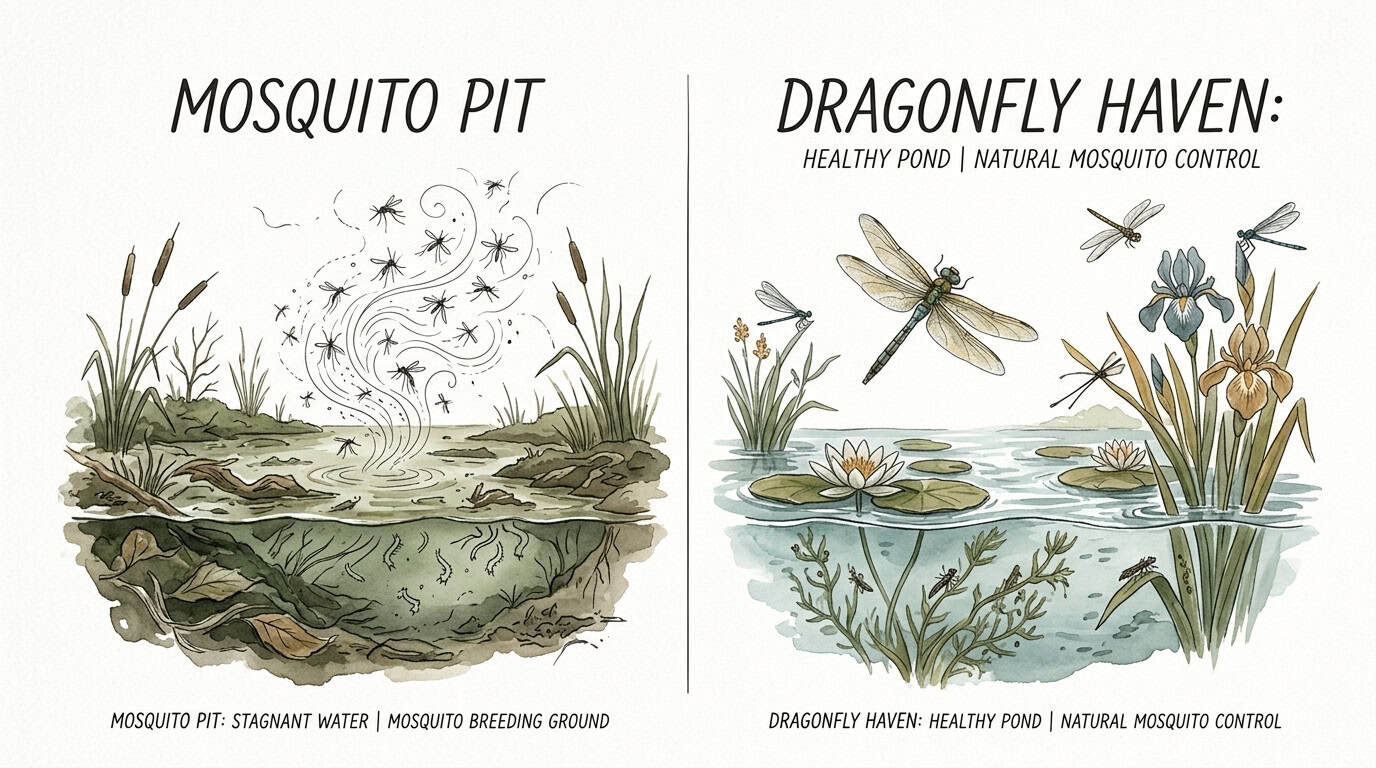
Is your backyard water feature a breeding ground for pests or a high-performance predator nursery? Most homeowners see a backyard pond as a mosquito liability, but that’s only because the ecosystem is broken. When you transition from a ‘static puddle’ to a ‘living system,’ you invite the fighter jets of the insect world: Dragonflies. A single dragonfly can consume hundreds of mosquitoes a day, turning your ‘nuisance’ into the most effective pest-control asset on your property.
Natural mosquito control for backyard ponds is achieved by optimizing ecological predator-prey dynamics and mechanical surface tension disruption to eliminate larvae before maturation. Successful management requires maintaining high dissolved oxygen levels, introducing biological agents like Bacillus thuringiensis israelensis (BTi), and establishing a diverse population of aquatic predators. This integrated approach ensures the pond functions as a biological trap rather than a breeding site, maintaining zero-larvae counts through natural attrition and mechanical interference.
Natural Mosquito Control For Backyard Ponds
Natural mosquito control is the practice of managing a pond’s ecosystem to prevent the successful development of mosquito larvae (*Culicidae*) without the use of synthetic neurotoxins or broad-spectrum pesticides. This method relies on the fundamental biological requirements of mosquitoes: they require stagnant, nutrient-rich water with minimal surface disturbance to complete their life cycle. By altering these specific environmental variables, a pond owner can effectively “engineer out” the mosquito population.
In real-world applications, this system is used in residential landscape design, organic farming irrigation ponds, and public park water features. The core objective is to move away from a “Mosquito Pit”—a low-oxygen, high-nutrient environment—and toward a “Dragonfly Haven”—a high-velocity, oxygenated system that supports complex food webs. The logic is simple: if the water is moving and the predators are present, the survival rate of mosquito larvae drops to near zero.

This concept is grounded in the “Trophic Cascade” theory, where top-down pressure from predators (fish, dragonflies, backswimmers) controls the population of lower-level organisms. When a pond is biologically balanced, mosquitoes that attempt to lay eggs are met with a gauntlet of mechanical and biological defenses. The pond ceases to be a liability and instead becomes a biological “sink” that actively reduces the mosquito population in the surrounding area.
How It Works: The Mechanics of Larval Suppression
Natural control functions through three primary vectors: physical disruption, biological predation, and targeted bacterial interference. Each vector targets a specific stage of the mosquito life cycle, primarily the egg and larval stages where the organisms are most vulnerable.
Mechanical surface tension disruption is the first line of defense. Mosquito larvae (wrigglers) and pupae (tumblers) must hang from the water surface to breathe through specialized siphons. If the water surface is in constant motion, larvae cannot maintain their position to exchange gases, leading to drowning or exhaustion. High-volume pumps and aeration systems create a “breaking surface” that prevents adult mosquitoes from landing to deposit eggs and prevents larvae from breathing.
Biological predation introduces specialized organisms that consume mosquito larvae as their primary caloric source. The most common technical choice is the introduction of *Gambusia affinis*, commonly known as the Mosquitofish. These fish are surface feeders with high metabolic rates, capable of consuming their own body weight in larvae daily. Additionally, macroinvertebrates like dragonfly nymphs act as subsurface hunters, patrolling the benthic zones and vegetation for any larvae that escape surface-level predators.
Targeted bacterial interference utilizes *Bacillus thuringiensis israelensis* (BTi), a naturally occurring soil bacterium. BTi produces crystalline toxins that, when ingested by mosquito larvae, destroy their digestive tract. This method is highly specific; the toxins are only activated by the alkaline gut pH of larvae from the *Diptera* order (mosquitoes, blackflies, and fungus gnats). This ensures that honeybees, butterflies, and fish remain unaffected while the target population is neutralized.
Benefits of Ecological Pest Management
The transition to natural control offers measurable performance advantages over chemical treatments. One primary benefit is the reduction of chemical resistance. Mosquito populations frequently develop resistance to synthetic pyrethroids and organophosphates through rapid generation cycles. Biological controls like predation and BTi do not trigger the same resistance pathways, ensuring long-term efficacy.

Cost efficiency is another significant factor. While the initial setup of a high-performance filtration and aeration system requires capital investment, the operational costs are limited to electricity and occasional biological supplements. This contrasts with the recurring expense of professional chemical spraying or the purchase of synthetic larvicides. A well-designed system becomes self-sustaining as predator populations stabilize and reproduce.
Environmental safety and biodiversity are critical metrics for many pond owners. Natural control methods protect the health of the broader ecosystem. Synthetic pesticides often have “non-target” effects, killing beneficial insects like bees and butterflies or accumulating in the tissues of birds and amphibians. An ecological approach increases the pond’s biodiversity, which in turn makes the system more resilient to other pests, such as aphids or midges.
Challenges and Technical Pitfalls
Failure in natural mosquito control usually stems from a breakdown in system parameters. One common mistake is the “Over-Planting Paradox.” While aquatic plants are necessary for filtration, excessive surface coverage (such as duckweed or thick lily pads) creates “dead zones” of stagnant water. These pockets are inaccessible to fish and protected from wind or pump-driven surface agitation, providing a perfect refuge for larvae to mature.
Low Dissolved Oxygen (DO) levels represent another significant failure point. If a pond becomes hypoxic due to high organic decay or poor aeration, mosquito predators will die off or become lethally stressed. Mosquito larvae, however, breathe atmospheric air and are highly tolerant of low-oxygen environments. A pond with low DO effectively removes the predators while leaving the pests untouched. Regular monitoring of oxygen levels is essential for maintaining the biological “firing squad.”
Improper stocking density is a frequent error in biological control. Introducing too few fish into a large volume of water allows larvae to find “niche refugia” where they can complete their life cycle. Conversely, overstocking leads to high ammonia levels and stunted fish growth, which reduces their predatory efficiency. Achieving the correct “Predator-to-Volume” ratio is necessary for consistent suppression.
Limitations and Environmental Constraints
Natural mosquito control is highly effective but has specific operational boundaries. In very small containers or “micro-ponds” (under 10 gallons), establishing a stable predator-prey cycle is difficult. These small volumes are prone to rapid temperature fluctuations and total evaporation, which can wipe out fish and macroinvertebrates. In these scenarios, mechanical agitation or frequent BTi application is required as biological stability is unattainable.
Environmental shading also dictates the limits of natural control. Ponds located in deep shade may not support the necessary algae and plant growth to feed the base of the food web, leading to a collapse of the predator population. Furthermore, dragonflies require sunlight to regulate their body temperature and hunt effectively. A pond in a zero-sunlight environment will lack the “air defense” provided by adult dragonflies, shifting the entire burden of control onto subsurface fish.
In regions with extreme seasonal shifts, biological control faces “re-entry” challenges. In areas with hard freezes, many predators may not survive the winter. This creates a “protection gap” in the early spring when mosquitoes emerge but predator populations have not yet rebounded. Pond owners in these climates must plan for seasonal restocking or utilize winter-hardy species like fathead minnows to maintain year-round suppression.
Comparison: System Efficiency and Maintenance
Understanding the difference between a neglected water feature and a managed ecosystem is vital for successful pest management. The following table compares the metrics of a high-risk pond versus a high-performance natural control system.
| Feature | Mosquito Pit (High Risk) | Dragonfly Haven (Optimized) |
|---|---|---|
| Water Movement | Static / Stagnant | High turnover (1.5x volume per hour) |
| Dissolved Oxygen | Low ( | High (> 6 mg/L) |
| Predator Presence | Absent or Minimal | Multi-tier (Fish, Nymphs, Backswimmers) |
| Surface Condition | Biofilm / Algae mats | Agitated / Clear |
| Larval Mortality Rate | Low ( | High (> 99%) |
The Mosquito Pit operates as an open system with no resistance to colonization. The Dragonfly Haven operates as a closed-loop predatory trap. The primary difference lies in the energy input; the optimized system uses mechanical energy (pumps) and biological energy (predators) to maintain a state of high entropy for the mosquito population.
Practical Tips for System Optimization
To maximize the efficiency of your natural control system, implement the following technical adjustments. First, ensure your pump is rated for at least one full volume turnover per hour. For a 1,000-gallon pond, the pump should move 1,000 to 1,500 gallons per hour. This ensures that no part of the pond remains static for long enough for larvae to reach the pupal stage.
Strategic planting is essential for predator habitat. Use submerged oxygenating plants like *Anacharis* or *Hornwort*. These plants provide the complex structure required for dragonfly nymphs to hide and ambush larvae. Avoid “carpeting” the surface; maintain at least 40% open water to allow fish to access the edges where mosquitoes are most likely to congregate.
Regularly “pulse” the system with BTi “dunks” or granules during peak mosquito season (typically when overnight temperatures remain above 50°F). While predators do the bulk of the work, BTi acts as a fail-safe for any larvae that hatch in inaccessible crevices or overflow areas. Use BTi every 30 days to maintain a lethal concentration in the water column.
Advanced Considerations: The Trophic Web
Serious practitioners should look beyond simple fish stocking and focus on the nitrogen cycle and phosphate management. High levels of nitrates and phosphates fuel “filamentous algae” (string algae). While some algae is healthy, thick mats of string algae provide a physical barrier that prevents fish from reaching mosquito larvae. By using a UV clarifier and beneficial bacteria supplements, you can reduce the nutrient load, thinning the algae and increasing the “hunting window” for your predators.
Consider the “oviposition attraction” strategy. Some practitioners purposefully keep a small, separate container of water treated with BTi nearby. This acts as a “decoy” site. Adult mosquitoes are attracted to the stagnant water and lay their eggs there. The BTi kills the larvae immediately, effectively removing those genetics from the local pool. This “Trap and Kill” method can significantly reduce the pressure on your primary pond.
Monitor the pH and alkalinity of your water. BTi performance is highest in slightly alkaline conditions, but predatory fish efficiency can drop if pH swings too wildly. Aim for a stable pH between 7.2 and 7.8. This range supports both the biological health of your fish and the technical efficacy of the bacterial toxins used for supplemental control.
Example: 1,200-Gallon Pond Optimization Scenario
Consider a standard 1,200-gallon backyard pond experiencing a mosquito outbreak. The baseline state includes a low-flow 300 GPH pump, significant duckweed coverage, and no fish. Larval counts are measured at 15–20 per square foot of surface area.
Step one involves mechanical upgrading. Replacing the 300 GPH pump with a 1,800 GPH model equipped with a venturi aerator increases surface agitation and dissolved oxygen. This immediately disrupts the breathing cycle of the existing larvae. Step two is the manual removal of 60% of the duckweed to open the water surface.
Step three is the biological introduction. Stocking 50 *Gambusia affinis* and 200 fathead minnows provides immediate subsurface pressure. Within 48 hours of these changes, larval counts typically drop by 80%. Finally, adding two BTi dunks into the filter skimmer ensures that any larvae trapped in the filtration media are neutralized. Within one week, the larval count reaches zero, and the pond transitions from a mosquito source to a predator nursery.
Final Thoughts
Natural mosquito control is not a matter of luck; it is a matter of environmental engineering. By focusing on surface tension, dissolved oxygen, and predatory biodiversity, any pond owner can eliminate the need for chemical intervention. The goal is to move from a “static puddle” mindset to a “living system” mindset, where every component of the pond serves a functional purpose in the suppression of pests.

The most successful systems are those that embrace the complexity of nature. A pond with moving water, healthy fish, and active dragonflies is more than a landscape feature—it is a high-performance biological filter for your property. By optimizing these parameters, you create an environment where mosquitoes simply cannot survive, allowing you to enjoy your backyard without the constant threat of bites or disease.
Experiment with different plant species and monitor your water parameters closely. As you dial in the balance of your pond, you will find that the “mosquito problem” disappears naturally, replaced by a thriving ecosystem that works for you. The transition from a liability to an asset is a technical journey worth taking for any serious pond enthusiast.
Frequently Asked Questions About Natural Mosquito Control For Backyard Ponds
How many fish do I need to control mosquitoes in my pond?
The stocking density for mosquito control depends on the fish species and pond volume. For the highly efficient *Gambusia affinis* (Mosquitofish), a general rule is 2 to 5 fish per 10 square feet of surface area. In larger ponds, a mix of species is often more effective. You might stock 50-100 fathead minnows or small goldfish per 1,000 gallons. The goal is to have enough fish to patrol the entire perimeter of the pond, as mosquitoes typically lay eggs near the edges and among plants. If you see any larvae surviving for more than 24 hours, your predator density is likely too low for the current nutrient load.
Will BTi dunks harm the other wildlife in my pond?
No, *Bacillus thuringiensis israelensis* (BTi) is highly selective and considered one of the safest biological controls available. It specifically targets the larval stages of the suborder *Nematocera*, which includes mosquitoes, blackflies, and fungus gnats. The toxin is only activated in the highly alkaline environment of these specific insects’ digestive tracts. It has been extensively tested and shown no adverse effects on fish, amphibians, turtles, honeybees, butterflies, or mammals. This specificity makes it an ideal “fail-safe” for natural ponds where you want to protect biodiversity while targeting pests.
Can dragonflies really control a mosquito population on their own?
Dragonflies are incredibly efficient predators, often referred to as “mosquito hawks,” but they are most effective as part of a multi-tiered defense. Adult dragonflies have a 95% success rate when hunting, and a single dragonfly can consume hundreds of mosquitoes daily. However, their larval stage (nymphs) also lives underwater for months or even years, where they voraciously eat mosquito larvae. To rely on dragonflies, your pond must provide “perching” plants for adults and “submerged” plants for nymphs. While they are powerful allies, combining them with fish and surface agitation ensures 24/7 protection across all stages of the mosquito life cycle.
Why do I still have mosquitoes if I have a waterfall?
A waterfall provides excellent aeration and movement, but it may not be enough if the pond has “dead zones.” Mosquitoes only need a small pocket of still water to breed. If your pond has thick blankets of algae, dense clusters of lily pads, or corners where the current doesn’t reach, mosquitoes will exploit those areas. Furthermore, if your waterfall only runs during the day, mosquitoes can lay eggs at night when the water is still. For total control, ensure that your pump provides a turnover rate that moves water through every square inch of the pond, or use supplemental BTi in areas where the current is naturally blocked.
Do certain pond plants attract mosquitoes?
Plants themselves do not attract mosquitoes, but their growth patterns can create breeding habitats. Floating plants like duckweed, water hyacinth, or dense lily pads can create a “shelter” from fish and wind. When these plants cover too much of the surface, they act as a physical barrier that prevents predators from reaching larvae. To prevent this, keep plant coverage to roughly 50-60% of the pond surface and prune back any decaying vegetation. Decaying organic matter provides the bacteria and nutrients that mosquito larvae feed on, so maintaining a clean, well-trimmed pond is a key technical step in mosquito suppression.