

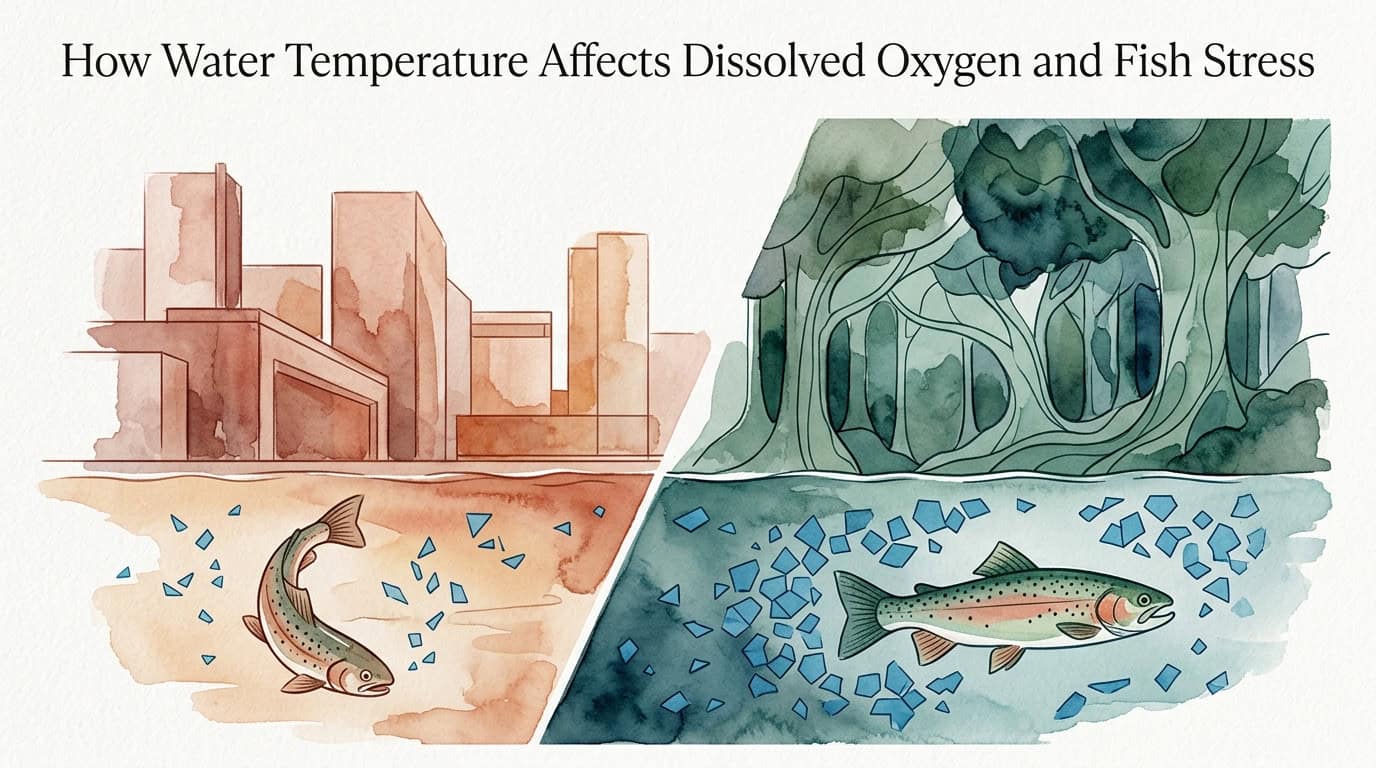
Hot water is thin water. If you can’t keep it cool, your fish can’t breathe. As water warms up, its ability to hold oxygen drops. Is your pond designed to stay cool during the summer heat?
Water temperature directly determines the maximum concentration of dissolved oxygen (DO) through the principles of gas solubility; as temperatures rise, the kinetic energy of water molecules increases, forcing oxygen molecules out of solution. Simultaneously, fish experience an accelerated metabolic rate, typically doubling their oxygen demand for every 18°F (10°C) increase in temperature. This creates a physiological “squeeze” where environmental supply falls while biological demand surges, leading to acute respiratory stress and potential homeostatic failure.
How Water Temperature Affects Dissolved Oxygen and Fish Stress
The relationship between water temperature and dissolved oxygen is governed by Henry’s Law, which states that the amount of dissolved gas in a liquid is proportional to its partial pressure above the liquid. In practical pond management, this means that cold water is denser and more efficient at trapping gas molecules than warm water. For example, fresh water at 32°F (0°C) can hold approximately 14.6 mg/L of oxygen at saturation. By the time that same water reaches 86°F (30°C), its holding capacity drops to roughly 7.6 mg/L.
Fish are ectothermic organisms, meaning their internal body temperature is regulated by the surrounding environment. Every chemical reaction within their bodies—from digestion to cellular repair—speeds up as the water warms. This is quantified by the Q10 temperature coefficient, which for most teleost fish is between 2.0 and 3.0. This coefficient indicates that a fish at 80°F requires significantly more oxygen to perform basic life functions than it does at 60°F. When these two curves—decreasing oxygen supply and increasing oxygen demand—intersect, the result is a critical oxygen deficit.

This phenomenon exists in every aquatic ecosystem but is most dangerous in closed systems like backyard ponds or intensive aquaculture facilities. In these environments, there is no “deep water refuge” where fish can escape to cooler, oxygen-rich layers. Understanding this mechanical and biological interplay is essential for maintaining a stable ecosystem during seasonal peaks.
The Mechanics of Thermal-Oxygen Dynamics
Managing a pond through a heatwave requires a technical understanding of how oxygen enters and leaves the system. Oxygen enters the water through two primary pathways: atmospheric diffusion and photosynthesis. It leaves the system through respiration (fish and plants) and the decomposition of organic matter by aerobic bacteria.
Atmospheric diffusion is the physical transfer of oxygen at the air-water interface. The rate of this transfer is determined by the “deficit,” which is the difference between the actual DO level and the saturation point. Because warm water has a lower saturation point, the “room” available for new oxygen to enter is reduced. This makes mechanical intervention, such as aeration, less efficient as temperatures rise.
Photosynthesis provides a significant oxygen boost during daylight hours as algae and submerged plants release O2 as a byproduct of energy production. However, this process reverses at night. During the “nocturnal respiration” phase, plants consume oxygen and release carbon dioxide. In a warm pond with heavy algae loads, the DO levels can crash to lethal levels just before dawn, as the warm water cannot store enough of the daytime surplus to last through the night.
Biochemical Oxygen Demand (BOD) also spikes in warm water. Bacteria responsible for breaking down fish waste and fallen leaves operate at higher rates in the heat. These microorganisms compete directly with your fish for the limited oxygen supply. If a pond has a high load of organic “muck” at the bottom, the bacterial respiration alone can deplete the oxygen in the lower water columns within hours of a temperature spike.
Advantages of Proactive Thermal Management
Maintaining lower water temperatures or high aeration rates provides measurable stability to the aquatic environment. A cooler pond ensures that the water remains “thick” with oxygen, providing a safety buffer during power outages or equipment failures. When DO levels are kept near saturation, fish maintain stronger immune systems and better growth rates.

Mechanical efficiency is a primary benefit of keeping water cool. Aeration systems, such as diffused air or surface splashers, do not have to work as hard to maintain life-sustaining levels in 70°F water as they do in 85°F water. Lower temperatures also slow down the metabolic rate of pathogens and parasites. Many common pond diseases, such as Ichthyophthirius multifiliis, have life cycles that accelerate in warm water, meaning a cooler pond naturally limits the spread of infection.
Efficient thermal management also protects the “Standard Aeration Efficiency” (SAE) of your equipment. SAE is a metric used to measure how many pounds of oxygen an aerator can transfer per horsepower-hour. As the water temperature increases and the DO saturation point drops, the SAE of any given motor decreases because the physical “push” required to force oxygen into the water becomes less effective.
Common Mistakes in High-Temperature Scenarios
A frequent error is overfeeding during summer months. Because fish appear more active in warm water, many keepers increase their feeding frequency. This is a mistake. Digestion is a high-energy process that requires significant oxygen. Feeding fish when water temperatures are above their optimal range forces their metabolism to work even harder, potentially pushing them into respiratory distress.
Another pitfall is the reliance on “fountain” style aerators for deep ponds. While fountains move surface water, they often fail to circulate the deeper, cooler layers. This leads to thermal stratification, where a layer of hot, oxygen-rich water sits on top of a layer of cooler, oxygen-depleted water. If a sudden storm or wind event causes these layers to mix—a process known as “turnover”—the resulting average DO level can be low enough to kill the entire fish population instantly.
Many people also forget to account for the impact of altitude. At higher elevations, atmospheric pressure is lower, which further reduces the solubility of oxygen. A pond at 5,000 feet above sea level will hold significantly less oxygen at 80°F than a pond at sea level. Managers in high-altitude regions must over-engineer their aeration systems to compensate for this combined physical limitation.
Limitations of Atmospheric Cooling
Environmental constraints often limit how much a manager can do to control temperature. In shallow ponds (less than 3 feet deep), the water temperature will track the ambient air temperature almost exactly. There is not enough thermal mass to resist the daily heating cycle. In these cases, no amount of shading can keep the water significantly cooler than the air.
Evaporative cooling is the most effective natural method for lowering water temperature, but it is limited by humidity. In arid climates, high-power aeration can drop water temperatures by several degrees through evaporation. However, in humid environments, the air is already saturated with moisture, which prevents evaporation and traps heat within the water.
In these situations, the only solution is to increase the volume of water or the depth of the pond. A deeper pond provides a “thermal sink” that stays cooler longer, giving fish a vertical space to retreat to during the hottest part of the day. Without sufficient depth or volume, the system remains entirely at the mercy of the weather.
The Urban Heat Trap vs. The Wild Canopy
The environment surrounding a pond significantly influences its thermal profile. The “Urban Heat Trap” refers to the phenomenon where concrete, asphalt, and stone surfaces absorb solar radiation during the day and radiate it back at night. Ponds located near patios or driveways act as “heat sinks,” absorbing this secondary radiation.
Conversely, the “Wild Canopy” approach utilizes natural shading and evapotranspiration to regulate temperature. Trees and floating plants reflect sunlight and release moisture, which cools the immediate microclimate.
| Factor | The Urban Heat Trap | The Wild Canopy |
|---|---|---|
| Thermal Mass | High (Concrete/Stone) | Low (Soil/Vegetation) |
| Nighttime Cooling | Slow (Radiant heat) | Rapid (Atmospheric exchange) |
| Average Water Temp | 3–5°F higher | Baseline |
| Oxygen Stability | Volatile | High |
Practical Best Practices for Summer Maintenance
Deploying diffused aeration systems at the deepest point of the pond is the most effective mechanical strategy. Unlike surface aerators, bottom diffusers pull the coldest water from the floor and move it to the surface. This eliminates thermal stratification and ensures the entire water column is oxygenated.
Monitoring DO levels with a digital meter rather than relying on visual cues is critical. By the time fish are seen “piping” (gasping) at the surface, they are already in the advanced stages of respiratory acidosis. Aim to maintain DO levels above 5.0 mg/L at all times. If levels drop below 3.0 mg/L, immediate intervention with supplemental aeration or water changes is required.
Strategic shading can also reduce the solar load. Using floating plants like lilies or lotuses to cover 40-60% of the pond surface blocks direct sunlight from penetrating the water. If plants are not an option, temporary shade sails can be installed over the pond during the peak summer months to reduce the thermal gain from UV radiation.
Advanced Considerations: The Role of Total Dissolved Solids (TDS)
Serious practitioners must also consider the role of salinity and Total Dissolved Solids (TDS) in oxygen solubility. Salt is often used in ponds to support fish health or treat parasites. However, salt further reduces the water’s ability to hold oxygen. In warm water, this effect is compounded.
If you are maintaining a high-salinity environment for therapeutic reasons, you must increase your aeration capacity by 10-15% to compensate for the displaced gas capacity. Similarly, high TDS levels—caused by accumulated minerals or organic waste—make the water “heavier” and less efficient at gas exchange. Regular partial water changes using cooler, fresh water can help lower TDS and improve the “breathing” capacity of the pond.
Understanding the “Oxygen Transfer Rate” (OTR) is another advanced step. The OTR is not a fixed number; it varies based on the gradient between the water’s current DO and its saturation point. In a warm pond that is already 80% saturated, it is very difficult to add more oxygen. In a depleted pond, the transfer rate is much higher. Using this knowledge, managers can time their heaviest aeration for the late night and early morning hours when the “oxygen gap” is largest.
Scenario: The Heatwave Response
Consider a 2,000-gallon pond with a temperature of 82°F. At this temperature, the 100% saturation point is approximately 7.9 mg/L. During the day, high algae activity might push the DO to 10 mg/L (supersaturation). However, as soon as the sun sets, the plants and fish begin to consume that oxygen.
If the manager continues to feed the fish and the pond has 12 inches of organic muck at the bottom, the BOD will be extreme. By 3:00 AM, the DO could drop to 2.5 mg/L. The fish, already dealing with a metabolism running at 200% of its normal rate due to the heat, will begin to experience tissue damage and immunosuppression.
In this scenario, the correct action is to cease all feeding, increase mechanical aeration to maximum, and perform a 10% water change with cooler water to break the thermal cycle. This reduces the metabolic demand on the fish while physically adding “thicker” water to the system.
Final Thoughts
The intersection of water temperature and dissolved oxygen represents the single most important physical limit in pond management. When the mercury rises, the environment undergoes a fundamental shift that reduces the supply of life-sustaining gas while simultaneously forcing fish to consume it faster. This “thin water” effect is a predictable mechanical reality that requires proactive design and operational adjustments.

Successful long-term management relies on recognizing that aeration is not just about bubbles; it is about managing a gas-liquid equilibrium that is constantly shifting. By prioritizing depth, shading, and high-efficiency diffused aeration, you can bypass the “urban hot tub” effect and provide your fish with the stable, oxygen-rich environment they require.
Experiment with different aeration timings and monitor your thermal trends. The more data you gather about your specific pond’s behavior during a heatwave, the better equipped you will be to optimize its mechanical performance and ensure the health of its inhabitants.
Frequently Asked Questions About How Water Temperature Affects Dissolved Oxygen and Fish Stress
At what temperature does dissolved oxygen become dangerous for fish?
The danger threshold is not a single temperature but rather the point where the decreasing saturation level meets the increasing metabolic demand of the specific fish species. For most temperate species like Koi or Goldfish, stress begins to manifest as water temperatures exceed 80°F (27°C). At this point, the water’s oxygen-carrying capacity is roughly 25-30% lower than at 60°F, while the fish’s oxygen requirement has doubled. If DO levels drop below 3.0 to 4.0 mg/L in these warm conditions, acute respiratory distress and mortality can occur rapidly.
Why do fish seem to eat more in warm water if it is stressful for them?
Fish are ectotherms, meaning their metabolism is slave to the ambient temperature. As water warms, their internal enzymes and chemical processes speed up, leading to increased hunger and activity. However, this is a physiological trap. While they feel the urge to eat, the process of digesting food—known as Specific Dynamic Action—requires a massive surge in oxygen consumption. In oxygen-thin warm water, the energy required for digestion can exceed the available supply, leading to metabolic exhaustion or death. This is why experts recommend reduced feeding during extreme heat.
Can I just add cold water to the pond to fix a low oxygen crisis?
Adding cold water can help, but it must be done with caution. Cold water is physically denser and holds more oxygen, but a sudden, massive temperature swing can cause “thermal shock,” which is just as lethal as low oxygen. A better approach is to perform small, frequent water changes of 10-15% using dechlorinated water. This gradually lowers the temperature and introduces oxygen without shocking the fish’s system. Always ensure the new water is aerated or splashed into the pond to maximize gas exchange during the process.
How does nocturnal respiration contribute to fish stress in the summer?
During the day, plants and algae produce oxygen via photosynthesis, often leading to “supersaturation.” However, at night, these same organisms switch to respiration, consuming oxygen and releasing CO2. In warm water, the pond cannot store enough of the daytime oxygen surplus to compensate for this nighttime drain. As a result, oxygen levels reach their lowest point in the early hours of the morning (usually between 2:00 AM and 6:00 AM). This is the “critical window” where fish stress is highest and where most summer fish kills occur.
Is a fountain or a bottom diffuser better for oxygenating warm water?
For warm-weather management, a bottom diffuser is significantly superior. Fountains primarily aerate the surface and provide aesthetic value, but they rarely circulate the deeper, cooler water. This leads to thermal stratification, where the bottom of the pond becomes an anaerobic (oxygen-free) “dead zone.” A bottom diffuser uses a compressor to push air through a membrane at the pond’s floor, creating a column of bubbles that pulls the cool bottom water to the surface. This ensures the entire water volume is mixed and oxygenated, preventing dangerous turnovers.