

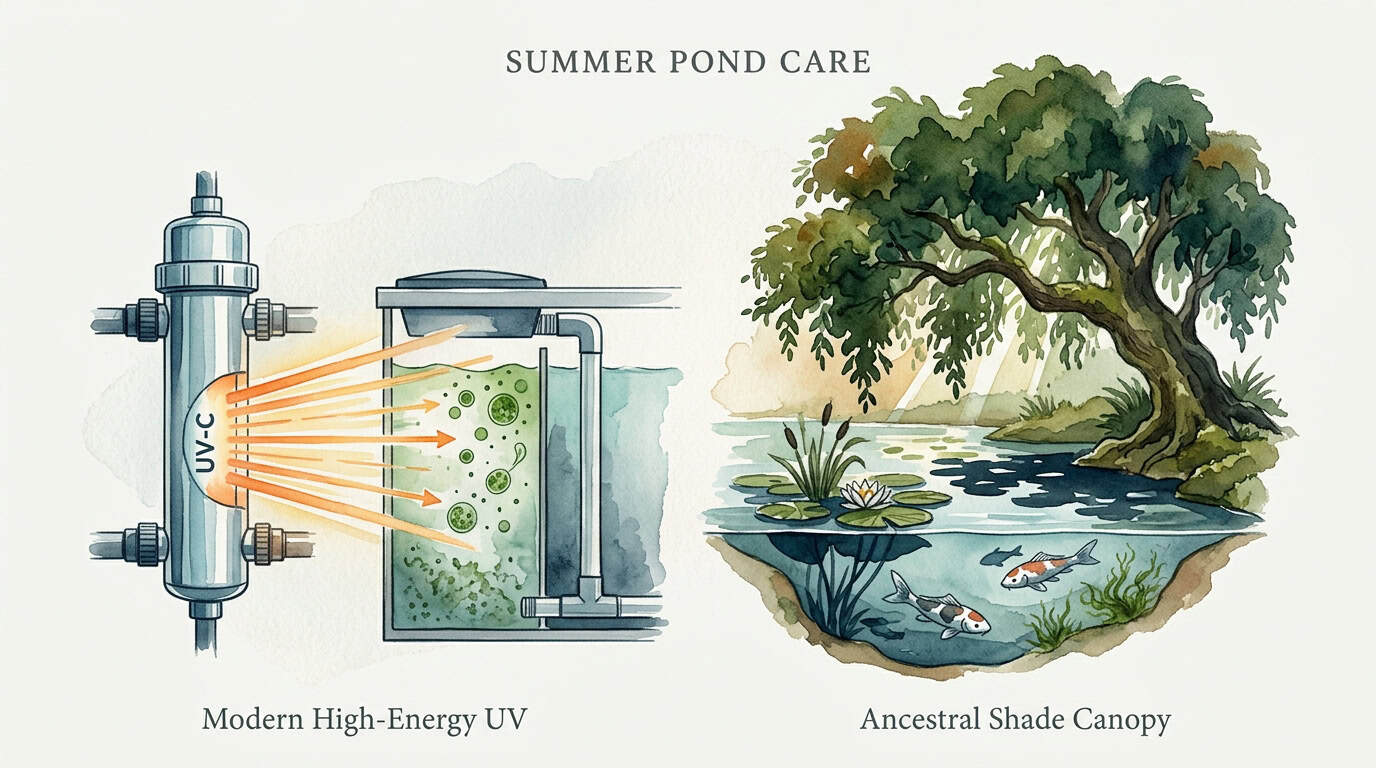
Ancient ponds didn’t have UV lights, yet they stayed clear—here is why. Nature has its own cooling system. Discover how to use ancestral planting wisdom to shield your fish from summer heat and starve out algae before it starts.
The maintenance of an artificial pond during peak summer months requires an understanding of thermodynamics, gas solubility, and nutrient kinetics. Unlike modern high-energy UV systems that rely on short-wave radiation to neutralize single-cell organisms, ancestral ecosystems utilized biological competition and physical shading to maintain equilibrium. This technical guide outlines the mechanical and biological strategies necessary to optimize pond performance under high thermal loads.
Summer Pond Care: Preventing Algae And Fish Stress
Summer pond care is a systematic approach to managing the biological and chemical variables that fluctuate as ambient temperatures rise. This process focuses on three primary objectives: maximizing dissolved oxygen, limiting solar-driven photosynthesis in non-target organisms, and managing the metabolic waste of aquatic livestock.
In a closed pond system, high solar irradiance increases water temperature, which inversely impacts the water’s ability to hold dissolved oxygen (DO) [1.1.1]. As temperatures exceed 25°C, the saturation point of oxygen drops significantly, while the metabolic rate of fish increases. This creates a physiological “squeeze” where demand for oxygen outstrips supply. Concurrently, high light levels and accumulated nutrients (nitrogen and phosphorus) facilitate rapid algal blooms, which can further deplete oxygen during nocturnal respiration cycles [1.3.6, 1.1.8].

The Thermodynamics of Dissolved Oxygen and Temperature
The solubility of oxygen in water is a function of partial pressure and temperature. According to Henry’s Law, the amount of dissolved gas is proportional to its partial pressure in the gas phase. However, as water temperature increases, the kinetic energy of the water molecules increases, allowing dissolved oxygen molecules to escape into the atmosphere more easily.
Oxygen Solubility Metrics
The following data illustrates the decline in oxygen saturation at 760 mm Hg (standard sea level pressure) as temperature increases [1.1.1, 1.1.3]:
| Temperature (°C) | Oxygen Solubility (mg/L) | Biological Impact |
|---|---|---|
| 10.0 | 11.29 | Optimal for most cold-water species. |
| 20.0 | 9.09 | Standard operating range. |
| 25.0 | 8.26 | Beginning of thermal stress for sensitive species. |
| 30.0 | 7.56 | Critical threshold; high aeration required. |
Fish such as koi and goldfish are poikilothermic, meaning their internal body temperature is dictated by the environment. For every 10°C increase in water temperature, their metabolic rate approximately doubles (the Q10 coefficient). This surge in metabolism necessitates higher oxygen consumption at the exact moment the water is least capable of providing it. Failure to manage this delta results in respiratory distress, immune suppression, and potential mortality [1.1.8, 1.4.1].
The Mechanics of Shading: Evapotranspiration and Light Attenuation
Shading is not merely the prevention of light; it is a mechanism for thermal regulation. Strategic placement of a Modern High-Energy UV vs Ancestral Shade Canopy reveals that while UV systems clear water of suspended algae, they do nothing to lower the water temperature. Natural shade, however, utilizes the physics of evapotranspiration to actively cool the environment.
Evapotranspiration as a Cooling Heat Sink
Aquatic plants such as water lilies (*Nymphaeaceae*) and floating heart (*Nymphoides*) perform transpiration, where water is absorbed by roots and released as vapor through leaf stomata [1.5.2, 1.5.5]. This phase change from liquid to gas requires latent heat, which is extracted from the leaf surface and the surrounding air, creating a localized cooling effect. Large-leafed plants provide a physical barrier against infrared (IR) radiation, preventing the pond substrate from acting as a thermal mass that retains heat long after sunset [1.5.4, 1.4.6].
Light Attenuation and Algal Inhibition
Algae are photosynthetic opportunists. When light intensity exceeds the saturation point of higher plants, or when higher plants are absent, algae utilize the excess photons to drive rapid cell division [1.3.4, 1.3.8]. Implementing a 40% to 60% surface coverage using floating or lily-like plants limits the “photic zone”—the depth to which enough light penetrates for photosynthesis to occur [1.4.5]. By reducing the available light for submerged algae, the pond manager effectively creates a light-limited environment where algal growth rates are suppressed despite high nutrient availability [1.3.3].

Nutrient Loading and Competitive Inhibition by Macrophytes
Nitrogen (N) and Phosphorus (P) are the primary drivers of pond eutrophication. In a summer environment, high feeding rates and rapid decomposition of organic matter lead to elevated levels of ammonia (NH3) and nitrate (NO3) [1.2.4].
Uptake Rates of Common Aquatic Plants
Macrophytes (higher plants) outcompete algae for these nutrients by developing extensive root systems that draw nutrients directly from the water column or substrate [1.2.2]. Research on Floating Treatment Wetlands (FTWs) has identified specific species with high nutrient sequestration capabilities:
- Juncus effusus (Soft Rush): Capable of fixing approximately 13.5 g/m² of nitrogen annually [1.2.2].
- Agrostis alba (Redtop): Demonstrates a nitrogen fixation rate of 13.2 g/m² and phosphorus fixation of 3.77 g/m² [1.2.2].
- Lemna spp. (Duckweed): One of the most efficient nutrient scrubbers, though its rapid growth requires frequent mechanical harvesting to permanently remove the nutrients from the system [1.2.4, 1.2.3].
Higher plants sequester nutrients into complex biomass (stems and leaves), whereas algae cycle nutrients rapidly through short life cycles. By fostering a high biomass of desirable plants, the pond manager “locks” the nitrogen and phosphorus into a form that can be physically removed through pruning [1.2.3, 1.2.8].
Benefits of Natural Biological Systems
Integrating an ancestral shade canopy and biological filtration provides several measurable advantages over purely mechanical or chemical interventions:
- Thermal Stability: Shaded ponds experience lower diurnal temperature swings, reducing the stress on the fish’s metabolic and immune systems [1.4.1, 1.4.4].
- Ammonia Toxicity Mitigation: Ammonia exists in two forms: ionized (NH4+) and un-ionized (NH3). The un-ionized form is highly toxic to fish. The ratio of NH3 to NH4+ is heavily dependent on temperature and pH. Higher temperatures shift the equilibrium toward the toxic NH3 form. Cooling the water through shading directly reduces the toxicity of any present ammonia [1.4.5].
- Enhanced Biodiversity: Natural planting provides a substrate for periphyton and zooplankton, which serve as secondary biological filters and natural food sources for fish [1.2.7].
- Reduced Operational Costs: While a UV clarifier requires electrical input and annual bulb replacement, a well-balanced plant canopy is self-sustaining and provides additional benefits like vitamin D synthesis and predator protection [1.4.5, 1.4.2].
Challenges and Common Mistakes
One frequent error in summer pond management is the over-reliance on chemical algaecides. While these products provide a rapid “kill,” the resulting mass of dead algae decomposes simultaneously. This decomposition consumes massive amounts of dissolved oxygen and releases the sequestered nutrients back into the water column, often triggering an even larger bloom within days [1.2.3, 1.3.2].
Another mistake is the failure to adjust feeding schedules. Fish metabolism increases in heat, but the biological filter’s capacity to process the resulting ammonia may lag behind. Overfeeding in temperatures above 28°C can lead to sudden ammonia spikes that the nitrifying bacteria cannot immediately oxidize [1.6.2, 1.6.4].
Limitations of Natural Methods
Natural shade and planting systems have realistic constraints. In extremely small or shallow water features, the thermal mass is so low that even 100% shading may not prevent the water from reaching ambient air temperatures. Furthermore, in areas with high wind speeds, the cooling effect of evapotranspiration may be negated by the rapid removal of the cooled air layer above the pond surface [1.5.7].
Biological systems also have a “ramp-up” period. Unlike a UV light, which can clear water in 48 hours, a plant-based system requires weeks for the root systems to establish and for the bacterial colonies to reach a population density capable of handling high summer nutrient loads [1.6.6].
Practical Implementation: Best Practices
Optimizing a pond for summer requires a multi-faceted approach to biological and mechanical management.
- Target 50% Coverage: Use a combination of water lilies for surface shade and marginal plants for nutrient uptake. This ratio balances the need for light-limited algae control with the fish’s need for some UV exposure [1.4.5].
- Increase Gas Exchange: Supplement natural oxygenation with mechanical aeration. Use air stones or waterfalls to break the surface tension, as this increases the surface-area-to-volume ratio for gas diffusion [1.6.3].
- Mechanical Pre-Filtration: Ensure that your skimmer or intake filter is clear of organic debris. Leaves and grass clippings that enter the pond in summer decompose quickly, adding to the nutrient load and oxygen demand [1.6.3, 1.6.5].
- Harvest Biomass: Regularly prune and remove yellowing leaves from aquatic plants. If the plant material stays in the pond to rot, the nutrients it absorbed are released back into the water, defeating the purpose of the biological filter [1.2.2, 1.2.3].
Advanced Considerations: The pH-Ammonia Relationship
Experienced practitioners must monitor the relationship between pH and ammonia during summer months. During the day, submerged plants and algae perform photosynthesis, which consumes carbon dioxide (CO2). The removal of CO2, which acts as a weak acid in water, causes the pH to rise.
As the pH increases, a larger percentage of total ammonia is converted into the toxic un-ionized (NH3) form. For example, at a pH of 7.0 and 20°C, the toxic fraction is roughly 0.4%. At a pH of 8.5 and 28°C, the toxic fraction increases to approximately 15%. This 37-fold increase in toxicity highlights why temperature control via shading and pH stability via proper buffering are critical for the survival of large koi during heatwaves [1.4.5].
Example Scenario: Calculating Nutrient Removal
Consider a 4,000-liter pond with an surface area of 10 m². If 20% of the surface is dedicated to a floating treatment wetland (2 m²) using *Juncus effusus*, the system can theoretically remove approximately 27 grams of nitrogen per year based on a removal rate of 13.5 g/m²/year [1.2.2].
If the pond manager feeds 50 grams of high-protein koi food daily, and that food is 7% nitrogen, the pond receives 3.5 grams of nitrogen per day. This simple calculation shows that while plants are effective, they must be part of a larger ecosystem strategy including water changes and mechanical filtration to handle the full load of an intensively stocked fish pond.
Final Thoughts
Maintaining a clear and healthy pond during the summer is an exercise in ecological balance. By prioritizing the thermodynamics of shading and the nutrient kinetics of aquatic plants, the pond manager can create a system that is resilient to high temperatures and resistant to algal dominance.
Success lies in understanding that modern tools like UV clarifiers and mechanical filters work best when they support, rather than replace, the natural cycles of a healthy ecosystem. Implementing ancestral planting wisdom not only reduces the chemical and electrical burden of pond maintenance but also provides a more stable and humane environment for aquatic life. Experimenting with different species and monitoring oxygen and nitrogen levels will provide the data necessary to fine-tune any specific water feature for peak summer performance.