

Pond Talk is an Amazon Associate. As an Amazon Associate we earn from qualifying purchases.
Optimizing Duckweed: Technical Strategies for Biomass Management
Duckweed is only a ‘weed’ if you don’t know how to move it. Don’t let your pond suffocate under its own success. Turn that rapid growth into a cycle. Harvesting 20% of your duckweed every week keeps the water oxygenated and the nutrient flow dynamic. It’s not a problem; it’s a crop.
Managing aquatic plants requires a shift from eradication to utilization. Small floating macrophytes like duckweed represent some of the fastest-growing biomass on the planet. Proper management transforms a potential environmental hazard into a high-protein resource for livestock, aquaculture, or compost.
This article provides a technical framework for maintaining duckweed systems. It focuses on the mechanics of growth, the physics of gas exchange, and the logistics of harvesting. Practitioners will find data-driven methods to optimize pond health and yield.

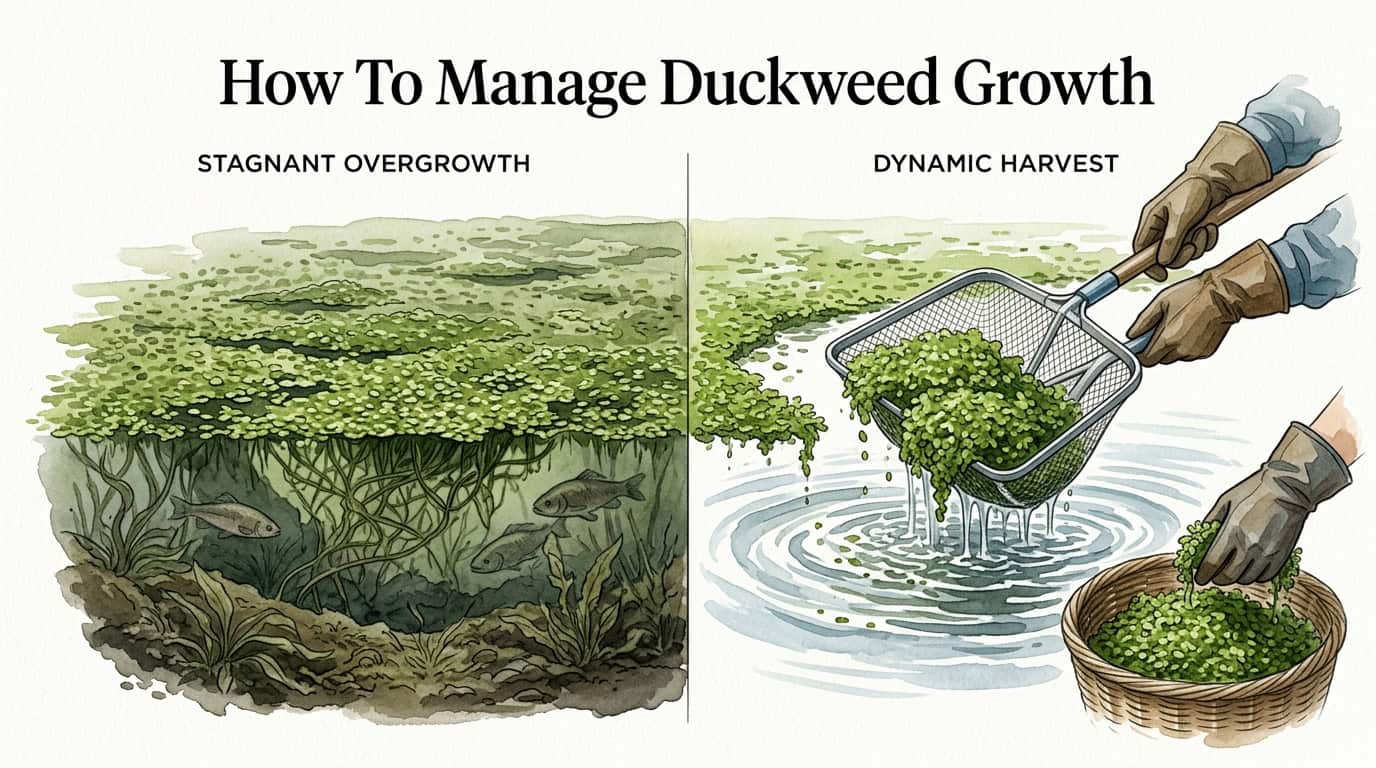
How To Manage Duckweed Growth
Duckweed refers to several genera of floating aquatic plants in the family Lemnaceae. These plants lack traditional leaf and stem structures, consisting instead of a simple frond. They float on the surface of still or slow-moving water, drawing nutrients directly from the water column through shortened roots or the underside of the frond.
Management involves controlling the surface area coverage to prevent biological system failure. Duckweed excels at sequestering nitrogen and phosphorus, making it an ideal tool for bioremediation. However, an unmanaged mat creates an airtight seal over the water surface.
A thick, stagnant mat prevents atmospheric oxygen from dissolving into the water. This leads to anaerobic conditions, which can cause mass mortality in fish and beneficial aerobic bacteria. Effective management maintains a balance between maximum biomass production and sufficient open surface area for gas exchange.
Systems utilizing duckweed are common in wastewater treatment, small-scale aquaculture, and sustainable agriculture. In these contexts, the plant acts as a biological filter. It converts dissolved nutrients into harvestable green tissue, effectively “mining” the water for fertilizer components.
Mechanical Harvesting Processes and Systems
Harvesting is the primary control mechanism for duckweed density. A systematic approach ensures that the population remains in the exponential growth phase. This phase occurs when the plants have enough space to double their biomass every 16 to 48 hours depending on temperature and nutrient availability.
The 20% weekly harvest rule is a baseline for temperate climates. Removing approximately one-fifth of the total surface cover every seven days creates internal gaps. These gaps allow the remaining fronds to expand without overcrowding, which would otherwise trigger a growth slowdown due to physical competition.
Tools for harvesting vary by scale. Small ponds utilize skimming nets or floating booms to aggregate the plants. Large-scale operations employ mechanical harvesters or automated skimming systems that utilize water current to funnel the duckweed into a collection point.
Water movement plays a critical role in management. Strategic use of aerators or small pumps creates “clear zones” where duckweed cannot settle. Directing the flow toward a harvest corner reduces the labor required to gather the biomass. It also ensures that a portion of the pond remains open to the atmosphere at all times.
Surface Area Metrics
Maintaining a specific percentage of open water is vital. Most practitioners aim for 70% to 80% surface coverage. Exceeding 90% coverage drastically increases the risk of pond inversion or thermal stratification issues. Regular thinning maintains the “dynamic harvest” state, where nutrient uptake is at its peak.
Benefits of Managed Duckweed Systems
Active management yields significant environmental and economic returns. The most measurable benefit is nutrient removal. Managed duckweed can remove up to 90% of nitrogen and 80% of phosphorus from contaminated or enriched water sources.
Protein production is another primary advantage. Duckweed contains 25% to 45% protein on a dry-matter basis, depending on the nitrogen concentration in the water. This protein profile includes essential amino acids like lysine and methionine, which are often limited in other plant-based feeds.
Evaporation reduction is a mechanical benefit of a duckweed cover. The floating mat acts as a physical barrier and a thermal insulator. It reduces water loss from the pond surface and stabilizes water temperatures during peak summer months. This protects sensitive aquatic organisms from rapid thermal fluctuations.
Algae suppression occurs through light competition. Because duckweed occupies the surface, it blocks the solar radiation required for the growth of submerged filamentous algae and phytoplankton. Managed duckweed systems typically have much higher water clarity beneath the mat than unmanaged ponds.
Challenges and Common Mistakes
Over-harvesting is a frequent error made by beginners. Removing too much biomass at once can collapse the population, especially if the water has high nutrient levels. Without enough duckweed to absorb the nutrients, a sudden algae bloom may occur, which then competes with the remaining duckweed for carbon dioxide.
Ignoring the “doubling time” leads to logistical failure. Duckweed growth is logarithmic. If a manager misses a harvest cycle, the mat can double in thickness or area in less than two days. This rapid expansion can catch a practitioner off guard, leading to a sudden drop in dissolved oxygen levels.
Poor aeration in deep ponds is another technical hurdle. While duckweed is great for surface management, the water column underneath requires circulation. Stagnant water under a duckweed mat can become stratified, with cold, anoxic water trapped at the bottom. Integrating a bottom-up aeration system solves this issue.
Contamination by invasive species or pests can disrupt the cycle. Certain species of aphids and water moths feed exclusively on duckweed fronds. Identifying these pests early is essential. Introducing biological controls, such as specific fish species that eat duckweed-feeding insects, maintains the health of the crop.
Limitations and Environmental Constraints
Temperature is the most significant limiting factor for duckweed growth. Most species thrive between 20°C and 30°C. Once temperatures drop below 10°C, growth slows significantly, and many species produce turions—sinkable seeds—to overwinter at the bottom of the pond. Duckweed systems are less effective in high-latitude winters without supplemental heating.
Salinity levels also restrict the use of duckweed. Lemnaceae are freshwater plants and generally cannot tolerate salinity levels above 4 parts per thousand (ppt). Systems designed for brackish or marine environments must use alternative aquatic plants like sea lettuce or various seaweeds.
Heavy metal accumulation is a double-edged sword. While duckweed is excellent at cleaning water, it bioaccumulates toxins like lead, cadmium, and arsenic. If the water source is contaminated with industrial runoff, the harvested biomass is unsafe for use as animal feed. Practitioners must test their water source before integrating duckweed into a food cycle.
Phosphate levels can also become a bottleneck. While nitrogen is often abundant, a lack of phosphorus will stunt duckweed growth regardless of how much nitrogen is present. Maintaining a balanced N:P ratio is necessary for high-density biomass production.
Dynamic Harvest vs. Stagnant Overgrowth
Understanding the difference between a managed system and a neglected pond is crucial for success. The following table compares the metrics of Dynamic Harvest against those of Stagnant Overgrowth.
| Metric | Dynamic Harvest (Managed) | Stagnant Overgrowth (Neglected) |
|---|---|---|
| Surface Coverage | 70% – 85% | 95% – 100% |
| Dissolved Oxygen | 4.0 – 7.0 mg/L | 0.5 – 2.0 mg/L |
| Biomass Quality | High (High Protein, Low Fiber) | Low (High Fiber, Decaying Matter) |
| Nutrient Removal Rate | Maximum (Logarithmic Growth) | Minimal (Maintenance Phase) |
| Water Clarity | High (Suppressed Algae) | Low (High Organic Loading) |
Practical Tips for Pond Optimization
Monitoring the color of the fronds provides an immediate visual diagnostic. Bright green, thick fronds indicate high nitrogen levels and healthy growth. Yellowing (chlorosis) usually indicates a nutrient deficiency, often nitrogen or iron. Adding a chelated iron supplement can often restart a stalled system.
Wind management is a technical necessity for large ponds. Because duckweed floats, even a light breeze will push the entire crop to one side. This causes overcrowding and rot on the windward side while leaving the leeward side exposed to algae growth. Installing floating baffles or windbreaks keeps the mat distributed evenly across the surface.
Drying the harvest is the best way to store the biomass. Fresh duckweed is roughly 92% to 94% water. Using a mechanical press to squeeze out excess moisture, followed by solar drying on a rack, creates a shelf-stable meal. This meal can be mixed with traditional grains to reduce feed costs for poultry or fish.
- Use a 1mm mesh net for small-scale harvesting to capture all frond sizes.
- Install a perimeter boom to keep duckweed away from pump intakes and overflows.
- Test water pH regularly; duckweed prefers a range between 6.5 and 7.5.
- Avoid harvesting during the heat of the day to reduce stress on the remaining population.
Advanced Considerations for Scaling Operations
Automated harvesting systems represent the next step for serious practitioners. These systems use sensors to detect surface coverage. Once the mat reaches a specific density, a conveyor system activates to skim the surface and deposit the biomass into a processing area. This reduces labor costs and ensures the 20% harvest rule is met precisely.
Integration with recirculating aquaculture systems (RAS) offers the highest efficiency. In this setup, water from fish tanks, which is high in ammonia, flows through a duckweed raceway. The duckweed cleans the water, which is then pumped back to the fish. The harvested duckweed is processed into pellets and fed back to the fish, creating a closed-loop nutrient cycle.
Carbon dioxide supplementation can further accelerate growth. Just like land plants, duckweed uses CO2 for photosynthesis. In greenhouses or enclosed systems, increasing the ambient CO2 concentration can boost biomass production by up to 30%. This is particularly useful in cold climates where growth rates are naturally slower.
Genetic selection of species is also an advanced tactic. Lemna minor is hardy and widespread, but Wolffia arrhiza (the smallest flowering plant) has a higher protein-to-fiber ratio. Professional growers often use a polyculture of two or three species to ensure system resilience against pests and seasonal changes.
Example Scenario: The 1,000 Gallon Managed System
Consider a 1,000-gallon pond with a surface area of 100 square feet. In a dynamic harvest scenario, the practitioner maintains 80 square feet of duckweed coverage. This setup produces approximately 2 to 4 pounds of wet biomass per day during the peak growing season.
Harvesting 15 to 25 pounds of wet duckweed per week keeps the system healthy. This volume of biomass, when dried, yields about 1.5 to 2 pounds of high-protein feed. Over a four-month season, this single small pond can produce nearly 30 pounds of supplemental feed while keeping the water clean and oxygenated.
Failure to harvest in this scenario would result in a 100% cover within four days. Within a week, the bottom-most layer of duckweed would begin to die from lack of light. The resulting decomposition would consume the remaining dissolved oxygen, potentially killing any fish in the system and creating a foul odor.
Final Thoughts
The transition from viewing duckweed as a nuisance to recognizing it as a crop is essential for modern aquatic management. It requires a commitment to regular harvesting and an understanding of the relationship between surface cover and water chemistry. A well-managed pond is a high-performance engine of biomass production.
Implementing the technical strategies outlined here ensures that the system remains stable and productive. By maintaining the 20% weekly harvest and monitoring nutrient levels, practitioners can maximize the benefits of this remarkable plant. Efficiency is found in movement, not in stagnation.
Those who master the art of moving duckweed will find themselves with a sustainable source of nutrients and a cleaner environment. Experiment with these methods on a small scale before expanding. The data will soon show that managed duckweed is one of the most efficient tools in the agricultural toolkit.
Amazon and the Amazon logo are trademarks of Amazon.com, Inc, or its affiliates.