

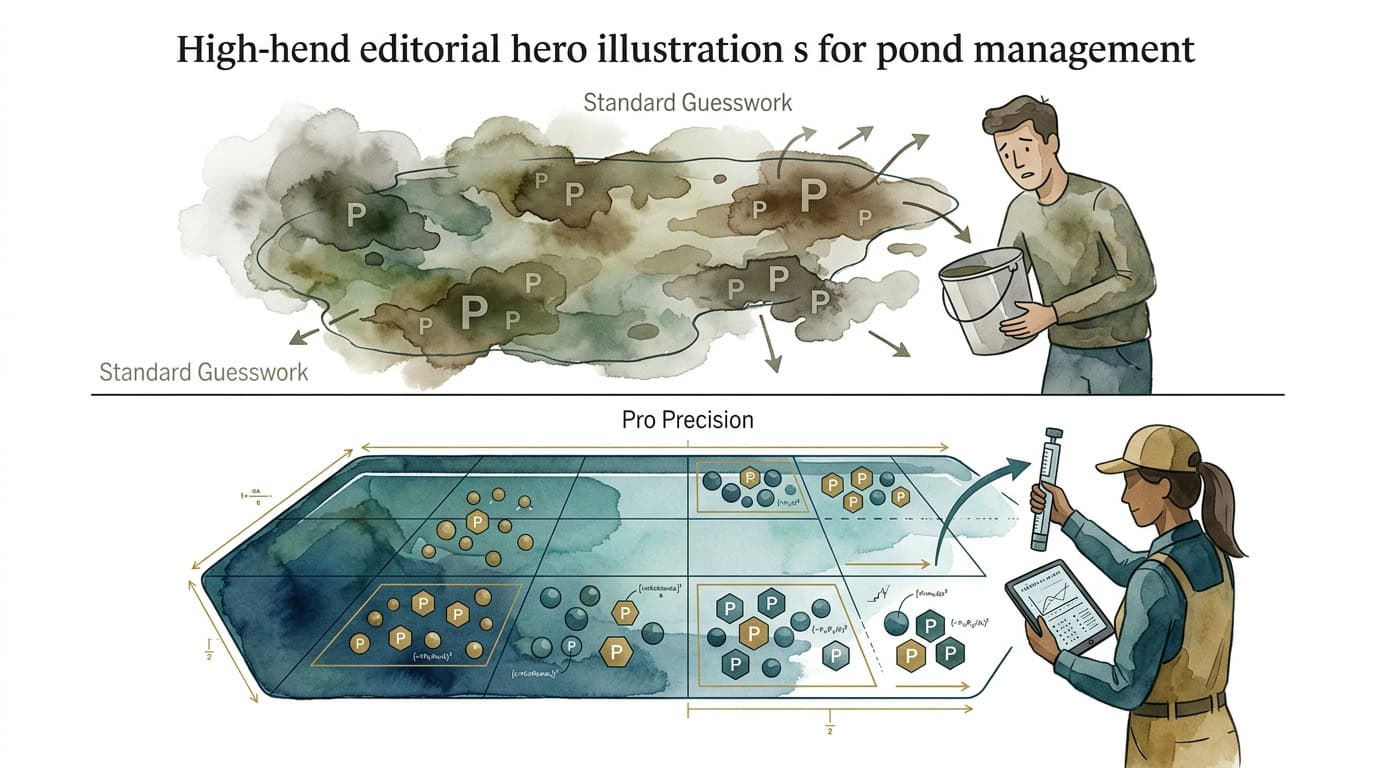
Too little does nothing; too much wastes money. Get the math right. Stop guessing and start measuring. We break down the simple formulas to calculate your pond volume and the exact amount of binding agent needed to drop your phosphorus levels.
Managing a pond ecosystem requires a transition from aesthetic observation to mechanical precision. Phosphorus serves as the primary limiting nutrient for cyanobacteria and filamentous algae. When concentrations exceed critical thresholds—often as low as 0.03 mg/L—the risk of eutrophication increases exponentially. Addressing this surplus through chemical sequestration requires an exact understanding of the water body’s volumetric capacity and the stoichiometric requirements of the chosen binding agent.
Relying on “bucket-math” or visual estimations of surface area leads to treatment failure or chemical toxicity. Effective nutrient inactivation demands a data-driven approach. This article outlines the engineering principles and chemical formulas necessary to achieve targeted phosphorus reduction while maintaining water quality stability.
How to Calculate Phosphorus Reduction for Your Pond Size
Phosphorus reduction is the process of chemically sequestering soluble reactive phosphorus (SRP) into an inert, solid form. This process removes the nutrient from the biological cycle, effectively “starving” algae populations. Calculating the required dose begins with a fundamental understanding of the pond’s physical dimensions and current nutrient load.

In real-world aquatic management, phosphorus exists in two primary compartments: the water column and the benthic sediment. The water column load represents the immediate bioavailable nutrient pool. The sediment load, or “internal load,” represents the long-term reservoir that can be released during periods of anoxia or pH fluctuation. To calculate the total reduction required, a manager must determine the total mass of phosphorus in grams or kilograms across these compartments.
Calculating the volume of the water body is the first mechanical step. Surface area alone is insufficient because phosphorus concentrations are measured in milligrams per liter (mg/L). Without an accurate average depth measurement, the total volume—and thus the total mass of phosphorus—remains unknown. For example, a one-acre pond that is three feet deep contains significantly less phosphorus than a one-acre pond that is ten feet deep, even if the laboratory results show identical mg/L concentrations.
Determining Surface Area
Standard geometric formulas provide the most reliable estimates for surface area. For rectangular ponds, multiply the length by the width. For circular ponds, the formula is 3.14 multiplied by the radius squared. Most natural ponds are irregular; these require dividing the surface into smaller geometric shapes, calculating each area individually, and summing the results. Modern mapping software or aerial photography can also provide precise acreage data.
Calculating Total Volume in Acre-Feet
Acre-feet is the standard unit for large-scale water treatment. One acre-foot is the volume of water required to cover one acre of land to a depth of one foot. To find this value, multiply the surface area in acres by the average depth in feet. If a pond covers 2.5 acres and has an average depth of 6 feet, the volume is 15 acre-feet. This figure is critical because 1 acre-foot equals 325,851 gallons or approximately 1,233 cubic meters.
Mechanical Systems and Chemical Mechanisms
Sequestration relies on the ionic attraction between a cationic binding agent and the anionic phosphate molecule. The two most common agents are Aluminum Sulfate (Alum) and Lanthanum-Modified Clay (LMC). Each operates through distinct chemical pathways that dictate the dosing math.
The Alum Precipitation Mechanism
Aluminum sulfate reacts with water to form an aluminum hydroxide floc. This “floc” acts as a physical and chemical filter. As it settles through the water column, it adsorbs phosphate ions, forming aluminum phosphate (AlPO4). This compound is highly insoluble within a pH range of 5.5 to 8.5. The process is a combination of direct precipitation and physical entrapment within the settling flocculant.

The math for Alum is complex because the reaction consumes alkalinity. Every 1.0 mg/L of Alum added consumes approximately 0.5 mg/L of alkalinity (as CaCO3). If the pond lacks sufficient buffering capacity, the pH will crash, leading to acute fish toxicity. Professional applicators often use a 2:1 ratio of Alum to Sodium Aluminate to buffer the reaction and maintain a neutral pH.
The Lanthanum-Modified Clay Mechanism
Lanthanum-modified clay, often marketed under trade names like Phoslock, uses a 1:1 molar ratio of Lanthanum to Phosphate. Unlike Alum, this agent does not form a voluminous floc and does not significantly impact pH or alkalinity in most water chemistries. The Lanthanum is embedded within a bentonite clay matrix. When it contacts phosphate, it forms Rhabdophane, a naturally occurring and highly stable mineral.
Dosing for LMC is generally calculated at a 100:1 weight ratio. This means 100 units of the product are required to sequester 1 unit of phosphorus. While the chemical cost per pound is higher than Alum, the lack of a pH buffer requirement and the stability of the bond across a wider pH range (4 to 11) make it a preferred option for many sensitive environments.
Benefits of Targeted Nutrient Inactivation
Precision dosing ensures that the phosphorus levels drop below the “bloom threshold” without over-applying chemicals. Maintaining phosphorus at or below 0.02 mg/L typically prevents the formation of harmful cyanobacteria blooms. This targeted approach provides several measurable advantages.
Stability of the benthic layer is a primary benefit. Once phosphorus is bound into AlPO4 or Rhabdophane, it becomes part of the permanent sediment. It is no longer susceptible to “internal loading,” where phosphorus is released from the mud back into the water during summer months when oxygen levels at the bottom are low. This creates a “reset” for the pond, moving it from a eutrophic state to an oligotrophic or mesotrophic state.
Improved water clarity is an immediate observable benefit. The settling floc from Alum treatments clears suspended solids and colloidal clays, significantly increasing the Secchi disk depth. Increased light penetration allows for the growth of beneficial submersed macrophytes, which further stabilize the ecosystem by competing with algae for any remaining nutrients.
Challenges and Common Computational Errors
The most frequent error in phosphorus reduction is the underestimation of the sediment load. In many mature ponds, the mass of phosphorus in the top 5 to 10 centimeters of sediment is three to ten times greater than the mass in the water column. If a treatment only addresses the water column, the sediment will quickly “re-charge” the water with phosphorus through benthic efflux, rendering the treatment ineffective within weeks.
Failure to account for alkalinity is the most dangerous mistake when using Alum. A pond with low alkalinity (less than 50 mg/L) cannot absorb the acid produced by the Alum reaction. This results in a rapid pH drop that can cause immediate fish kills. Measuring total alkalinity is a mandatory prerequisite for any Alum-based phosphorus reduction strategy.
Inaccurate depth sounding also leads to significant errors. Ponds are rarely uniform in depth. Taking only a single depth measurement at the center usually results in an overestimation of volume. A grid-based sounding approach—taking measurements at multiple points across the pond and averaging them—is necessary for a precise volumetric calculation.
Limitations and Environmental Constraints
Binding agents are not a permanent solution for ponds with high external loading. If a pond receives constant nutrient-rich runoff from fertilized lawns, agricultural fields, or septic systems, the sequestered phosphorus will eventually be buried under new layers of nutrient-heavy sediment. In these cases, the “longevity” of the treatment is limited by the rate of new phosphorus entry.
High flushing rates also limit the effectiveness of binding agents. If the pond’s residence time is short—meaning the water is replaced every few days by a stream or spring—the chemical agent may be washed out before it has time to react with the phosphorus or settle to the bottom. Binding agents work best in “closed” or “slow-exchange” systems where the agent can remain in contact with the water column for several hours.
Extreme pH environments can also pose limitations. While Lanthanum-modified clay is stable up to pH 11, Alum-bound phosphorus can become soluble again if the pH rises above 9.0 or falls below 5.0. In ponds with intense afternoon photosynthesis, pH levels can naturally spike, potentially re-releasing phosphorus if Alum was the sole sequestering agent used.
Dosing Comparison: Alum vs. Lanthanum-Modified Clay
Choosing between agents depends on water chemistry, budget, and safety requirements. The following table compares the two primary methods based on technical metrics.
| Factor | Aluminum Sulfate (Alum) | Lanthanum-Modified Clay (LMC) |
|---|---|---|
| Dosing Ratio | ~3.5:1 (Al:P Molar) | 100:1 (Product:P Weight) |
| pH Sensitivity | High (Requires buffering) | Low (Stable pH 4-11) |
| Alkalinity Impact | Consumes 0.5 mg/L per mg/L Alum | Negligible |
| Floc Formation | Heavy, visible flocculation | Minimal, fine clay settles |
| Application Complexity | High (Dual-pump for buffering) | Moderate (Slurry application) |
Best Practices for Accurate Phosphorus Management
Conducting a “Jar Test” is the most effective way to verify dosing math before full-scale application. A jar test involves taking a sample of pond water and adding incremental doses of the binding agent to observe clarity changes and measure pH shifts. This empirical data confirms the theoretical calculations and identifies potential chemistry issues that a spreadsheet might miss.
Utilizing a Secchi disk throughout the treatment process provides a real-time metric of success. Measure the transparency of the water before, during, and after application. A successful phosphorus reduction should be accompanied by a steady increase in the depth at which the disk remains visible. If clarity does not improve, it indicates the phosphorus is tied up in organic matter or the dose was insufficient to overcome the current nutrient load.
Monitoring dissolved oxygen (DO) levels is also critical, especially in deep ponds. Phosphorus binding agents do not remove organic “muck.” If the bottom remains anoxic, the microbial breakdown of organic matter will continue to release phosphorus. Aeration systems often complement binding agent treatments by maintaining an aerobic interface at the sediment-water boundary, which helps the binding agent remain effective.
Advanced Considerations: Sediment Core Analysis
Serious practitioners often invest in sediment core analysis to calculate the “Potentially Releasable Phosphorus” (PRP). This involves taking a vertical sample of the pond bottom and performing a sequential extraction in a laboratory. The extraction identifies different fractions of phosphorus: loosely bound, iron-bound, aluminum-bound, and organic-bound.
Iron-bound phosphorus is the most dangerous for pond health. Under anoxic conditions (low oxygen), iron loses its grip on phosphorus, allowing it to flood into the water column. Knowing the exact mass of iron-bound phosphorus in the top 10 centimeters of sediment allows for a “sediment reset” dose. This dose is specifically calculated to place enough binding agent on the bottom to intercept every milligram of phosphorus as it is released from the iron, providing years of control rather than months.
Mass balance modeling is another advanced tool. This involves calculating the annual “inflow” of phosphorus from the watershed versus the “outflow” through the pond’s discharge. If the inflow is significantly higher than the capacity of the binding agent to sequester it, the manager must shift focus toward watershed management, such as installing vegetative buffers or sediment forebays, to protect the chemical investment made in the pond itself.
Practical Example: A 1-Acre Pond Calculation
Consider a 1-acre pond with an average depth of 5 feet. The total volume is 5 acre-feet. A laboratory test shows the Total Phosphorus (TP) in the water column is 0.15 mg/L, which is well above the desired target of 0.02 mg/L. To reduce the phosphorus by 0.13 mg/L, we must calculate the mass of phosphorus in the water.

Total Water Mass: 5 acre-feet × 325,851 gallons/acre-foot × 3.785 liters/gallon = 6,168,220 liters.
Mass of Phosphorus to remove: 6,168,220 liters × 0.13 mg/L = 801,868 mg, or approximately 0.8 kg of Phosphorus.
If using Lanthanum-Modified Clay (100:1 ratio), the calculation is:
0.8 kg Phosphorus × 100 = 80 kg of LMC product.
However, if we also want to address the “internal load” from the sediment (estimated at 50 kg/hectare for a typical eutrophic pond), we would need to add significantly more product—often up to 1 ton for a full “reset” application.
If using Alum for water column stripping at a standard rate of 10 mg/L as Al:
10 mg/L Al × 6,168,220 liters = 61,682,200 mg Al, or 61.7 kg of Aluminum.
Since dry Alum is approximately 9% Aluminum by weight:
61.7 kg / 0.09 = 685 kg (approx. 1,510 lbs) of Alum product.
The manager must then verify that the pond’s alkalinity can handle the 5 mg/L drop in alkalinity that this 10 mg/L Alum dose will cause.
Final Thoughts
Achieving a clear, healthy pond requires moving beyond guesswork and embracing the chemistry of nutrient management. Phosphorus reduction is a volumetric challenge; success depends entirely on the accuracy of your initial measurements. Calculating acre-feet, measuring alkalinity, and understanding the stoichiometric requirements of your binding agent are the foundations of professional pond care.
Effective treatment sequestering phosphorus into the sediment provides a long-term solution to algae problems, provided the external loading is managed. Whether you choose the rapid flocculation of Alum or the high-stability bonding of Lanthanum-modified clay, the math remains the most important tool in your arsenal. Practitioners are encouraged to start with thorough water testing and site surveys to ensure every pound of chemical applied translates into a measurable improvement in water quality.