

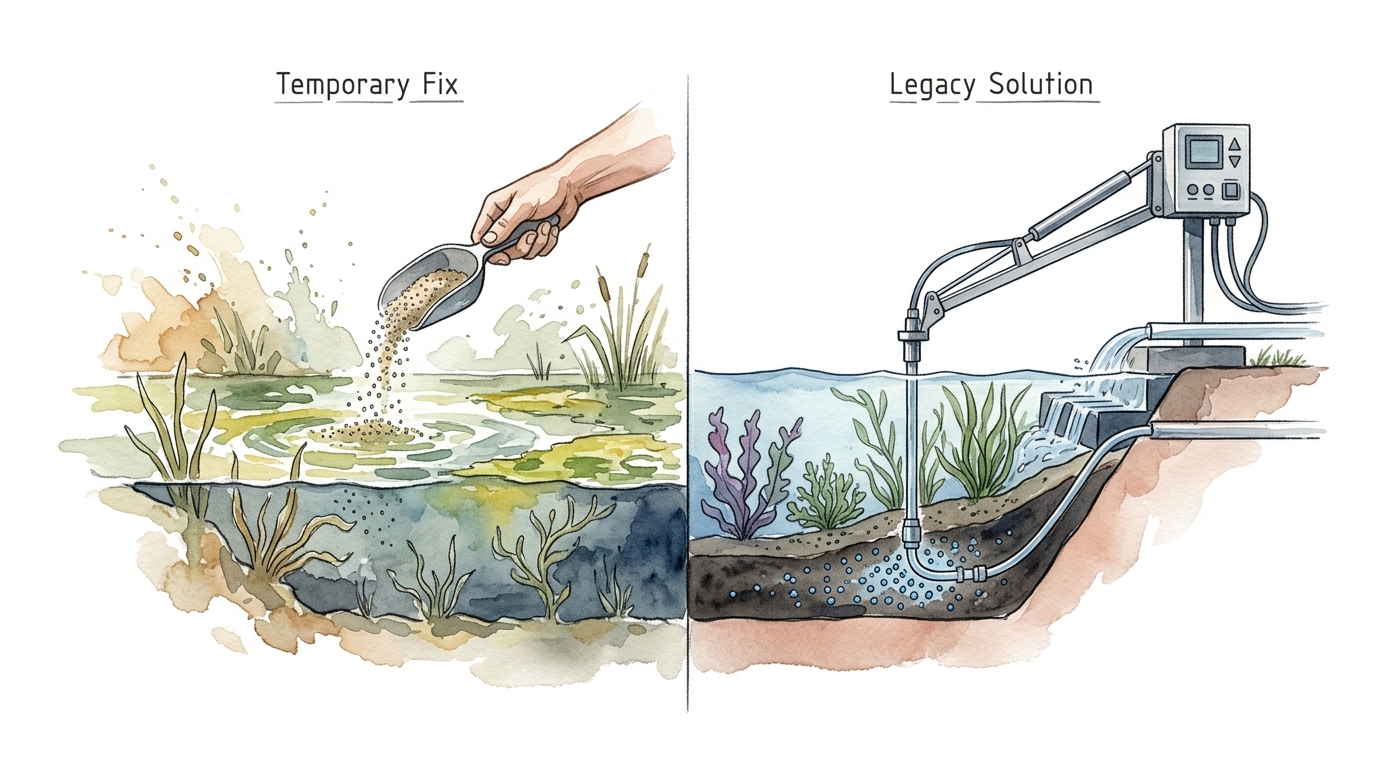
Stop treating the symptom. Start locking the source. Chemical treatments are a treadmill. Phosphorus binders create a legacy of clear water by removing the food source permanently.
The primary driver of pond degradation is nutrient enrichment, specifically orthophosphates. Most pond owners rely on algaecides to kill blooms, yet these treatments release the phosphorus back into the water as the organic matter decays. This cycle ensures the next bloom is already scheduled. Phosphorus binders interrupt this loop by converting dissolved phosphorus into an insoluble mineral form.
Understanding the mechanics of nutrient sequestration is the difference between a high-maintenance pond and a self-sustaining ecosystem. This guide examines the chemical and mechanical processes required to achieve permanent nutrient inactivation.
Best Phosphorus Binders for Ponds (Compared by Results, Not Marketing)
Phosphorus binders are chemical agents designed to react with phosphate ions to form stable, non-reactive compounds. These products are categorized by their active metal ions: Aluminum, Lanthanum, or Iron.
Aluminum Sulfate (Alum)
Aluminum sulfate is the industry standard for large-scale water clarification and nutrient removal. It works by forming an aluminum hydroxide floc that traps suspended particles and reacts with dissolved phosphorus to form aluminum phosphate (AlPO4). Alum is highly efficient, often achieving over 90% phosphorus removal when dosed correctly. It is the most cost-effective solution for deep lakes with high alkalinity.
Lanthanum-Modified Bentonite (Phoslock)
Lanthanum-modified clay represents a more modern approach. Lanthanum ions are embedded into the structure of bentonite clay. When applied, the lanthanum reacts with phosphate to form Rhabdophane (LaPO4), a mineral that is insoluble across a massive pH range (4 to 11). This binder is ideal for shallow ponds or environments with low alkalinity where alum might pose a toxicity risk.
Ferric Salts (Ferric Chloride and Ferric Sulfate)
Iron-based binders are commonly used in wastewater treatment. They form iron-phosphorus complexes that are stable under aerobic conditions. However, in many pond environments, the sediment becomes anoxic (oxygen-depleted). Under these conditions, iron-bound phosphorus can become soluble again, releasing the nutrients back into the water column. Ferric salts are best used in systems with high dissolved oxygen or mechanical aeration.
How Phosphorus Sequestration Works
The process of binding phosphorus is a chemical reaction, not a biological one. It involves three distinct phases: precipitation, adsorption, and sedimentation.
Chemical Precipitation
When a metal salt like alum is introduced to the water, it dissociates into its ionic components. The free metal ions (Al3+ or La3+) seek out negatively charged phosphate ions (PO4 3-). They bond together to form a solid precipitate. This reaction occurs at the molecular level, effectively “locking” the phosphorus into a mineral state that algae cannot consume.
Adsorption and Flocculation
As the metal ions react with water, they also form hydroxides. These hydroxides create a “floc”—a sticky, snowflake-like structure. As this floc settles through the water column, it acts like a microscopic net. It adsorbs additional phosphate ions and traps organic particulates, leading to a dramatic increase in water clarity within hours of application.
Sediment Capping
Once the binder reaches the bottom, it forms a thin layer over the sediment. This is known as a sediment cap. This layer continues to work by intercepting phosphorus that is released from the bottom muck through natural decay. This “active” capping is what creates the legacy effect of clear water, as it prevents internal loading from fueling new algae growth.
Practical Benefits of Permanent Sequestration
Removing the food source is objectively superior to killing the consumer. Phosphorus binders offer several measurable advantages over traditional chemical treatments.
Interruption of the Algae Cycle
Algaecides like copper sulfate are effective at killing existing blooms but do nothing to address the underlying cause. Binders remove the reactive phosphorus (the “fuel”) from the water. Without this fuel, algae populations remain at low, manageable levels, reducing the need for toxic algaecides.
Improved Water Clarity and UV Penetration
The flocculation process removes suspended solids and tannins. Clearer water allows for better light penetration, which encourages the growth of beneficial submerged aquatic vegetation. These plants then compete for any remaining nutrients, further stabilizing the ecosystem.
Long-Term Cost Efficiency
While the initial cost of a phosphorus binder like Phoslock or Alum is higher than a gallon of algaecide, the frequency of application is much lower. A single, high-dose sequestration treatment can keep phosphorus levels low for several seasons, whereas algaecides often require bi-weekly applications during the peak of summer.
Challenges and Common Mistakes
Applying phosphorus binders requires technical precision. Errors in dosing or site assessment can lead to treatment failure or ecological harm.

Alkalinity Depletion and pH Shock
Aluminum sulfate is acidic. For every 1 mg/L of alum added, approximately 0.5 mg/L of calcium carbonate alkalinity is consumed. If a pond has low alkalinity, the pH can drop rapidly, leading to fish kills. Practitioners must always measure total alkalinity and use buffered alum or supplemental lime if the levels are below 50 mg/L.
Under-Dosing Based on Water Volume Only
A frequent error is calculating the dose based only on the water column phosphorus. In many ponds, the “internal load” (the phosphorus stored in the sediment) is 10 to 100 times higher than what is in the water. To achieve a legacy solution, the dose must account for both the water column and the mobile phosphorus in the top 2-5 cm of the sediment.
Ignoring External Loading
No binder can last forever if the pond is receiving a constant stream of nutrient-rich runoff from fertilized lawns or agricultural fields. Binders solve the internal loading problem, but external sources must be managed with buffer strips or bioswales to protect the investment.
Limitations and Environmental Constraints
Phosphorus binders are highly effective, but they are not universal solutions for every water body.
High Turbulence and Resuspension
In very shallow ponds with high wind fetch or heavy boat traffic, the sediment cap can be physically disturbed. If the binder layer is mixed too deeply into the muck, its ability to intercept phosphorus from the sediment-water interface is diminished. In these scenarios, heavier binders or repeated low-dose “maintenance” treatments are more effective.
Humic Acid Interference
Dissolved organic carbon (DOC) and humic substances can coat the binding sites of lanthanum or aluminum ions. This competition reduces the binding efficiency. In “tea-colored” ponds with high organic loading, the dosage must be adjusted upward to account for this interference.
Temperature Sensitivity
Chemical reactions generally slow down in cold water. While binders can be applied in winter, the formation of a robust floc is often more efficient when water temperatures are above 50°F (10°C).
Comparison: Temporary Fix vs. Legacy Solution
The following table compares the two primary strategies for managing pond nutrients and algae.
| Feature | Algaecides (Temporary Fix) | Phosphorus Binders (Legacy Solution) |
|---|---|---|
| Primary Action | Kills algae cells via toxicity | Inactivates nutrients via bonding |
| Longevity | Days to Weeks | Months to Years |
| Effect on Phosphorus | Increases dissolved P (post-decay) | Permanently removes dissolved P |
| Risk Factor | Oxygen depletion from rapid decay | pH shifts (Alum) or high cost (Phoslock) |
| Cost Structure | Low initial, high recurring | High initial, low recurring |
Practical Tips and Best Practices
Successful nutrient sequestration requires a data-driven approach. Follow these technical guidelines for optimal results.
- Perform a Jar Test: Before a full-scale application, mix different concentrations of the binder with pond water in clear jars. Observe the floc formation and settling rate to determine the optimal dosage.
- Measure Total Phosphorus (TP) and Orthophosphate (SRP): SRP is the “free” phosphorus available for algae. TP includes organic forms. Base your calculations on the total phosphorus to ensure a complete “lock.”
- Monitor Alkalinity: If using Alum, ensure alkalinity is at least 100 mg/L. If it is lower, use a 2:1 ratio of Alum to Sodium Aluminate to maintain a neutral pH.
- Apply Evenly: Use a spray boat or sub-surface injection system. Dumping the product in one spot will result in poor coverage and an ineffective sediment cap.
Advanced Considerations: Stoichiometry and Molar Ratios
Serious practitioners calculate dosages using molar ratios rather than “pounds per acre.” For Aluminum, the theoretical stoichiometric ratio is 1:1 (one mole of Aluminum to one mole of Phosphorus). However, in real-world pond conditions, ratios of 2:1 up to 10:1 are often required.
This is because aluminum ions also react with hydroxides and carbonates in the water. Lanthanum-modified clay generally requires a 100:1 ratio by weight (100 kg of Phoslock to remove 1 kg of Phosphorus) due to the lanthanum being only a fraction of the total clay weight. Understanding these ratios allows for precise cost-estimation and avoids the risk of under-treating.
Scenario: Restoring a 1-Acre Eutrophic Pond
Consider a 1-acre pond with an average depth of 5 feet (5 acre-feet of water) and a total phosphorus concentration of 150 µg/L. The goal is to reduce this to below 20 µg/L to prevent blue-green algae blooms.
First, calculate the mass of phosphorus in the water column. In this pond, there are approximately 2 lbs of dissolved phosphorus. To address the water column alone using Alum, a dose of roughly 100-200 lbs might suffice.
However, the sediment likely contains an additional 50-100 lbs of “mobile” phosphorus ready to release. To create a legacy solution, the practitioner would apply approximately 1,500 to 2,000 lbs of Alum (or an equivalent amount of Phoslock) to ensure the sediment is capped. This heavy initial dose prevents the “treadmill” effect and ensures the pond stays clear for several years.
Final Thoughts
Relying on algaecides to manage a pond is a reactive strategy that ignores the laws of chemistry. By focusing on phosphorus, you are addressing the root cause of the problem. Phosphorus binders provide a mechanical and chemical solution that effectively “starves” the algae out of existence.
Whether you choose the cost-efficiency of Alum or the stability of Lanthanum-modified clay, the objective remains the same: permanent nutrient inactivation. Moving away from temporary chemical fixes toward legacy nutrient management is the only way to achieve long-term water quality.
Take the time to test your water chemistry and calculate your nutrient load. The data will guide you toward the right binder and the right dose, turning a struggling pond into a clear, healthy asset.