

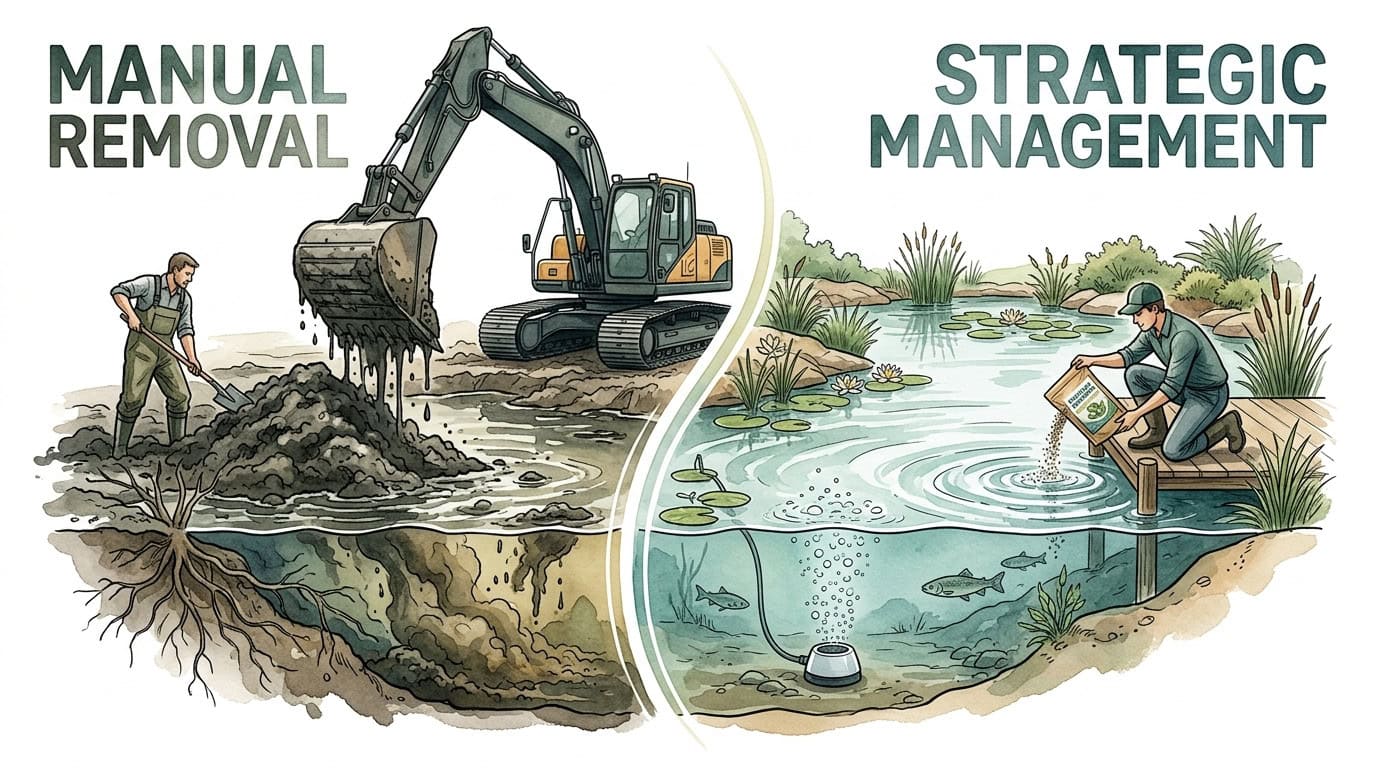
Before you spend thousands on a dredge, see if biological management can save your pond. Dredging is the ‘nuclear option.’ Learn how to diagnose if your pond needs a machine or just a better strategy.
Determining whether a pond requires dredging or management depends on sediment composition and depth loss. If the bottom consists of organic “muck” (decomposed leaves and waste) and depth loss is under 25%, biological management through aeration and microbes can often restore the basin. However, if the sediment is inorganic silt or sand, or if the pond has lost more than 30% of its original volume, mechanical dredging is usually the only viable solution to restore structural integrity.
Waterbodies are dynamic systems that naturally accumulate material over time. This process, known as succession, eventually transforms a pond into a wetland and then dry land. Managing this process requires a clear understanding of what is filling the basin. Identifying the tipping point between routine maintenance and major mechanical intervention is critical for long-term fiscal and environmental planning. Many property managers mistakenly assume any depth loss requires a dredge, but technical data often reveals a biological solution is more efficient for specific types of accumulation.
How to Tell Whether Your Pond Needs Dredging or Just Better Management
The distinction between needing a dredge and needing management lies in the ratio of organic to inorganic material at the bottom. Dredging is the physical removal of sediment using heavy machinery, while management focuses on optimizing the ecosystem’s ability to process organic waste. Understanding which category your pond falls into requires a baseline assessment of the benthic layer.

Organic muck is essentially “fuel” for the pond’s ecosystem. It consists of fish waste, decaying aquatic plants, and leaf litter. When a pond has high dissolved oxygen levels, aerobic bacteria consume this material. If the pond becomes anaerobic, this process slows to a crawl, and muck accumulates. Biological management aims to restart this “digestion” process. In contrast, inorganic sediment includes sand, clay, and silt washed in from construction sites or road runoff. No amount of bacteria or aeration will “digest” a pile of sand. If sand is the primary culprit for depth loss, mechanical extraction is the only option.
Real-world indicators of a management-ready pond include high clarity water that still has a soft, “pillowy” bottom or seasonal algae blooms. These indicate high nutrient levels stored in the muck that can be remediated biologically. Indicators of a pond requiring a dredge include visible sand bars at inlets, structural damage to shorelines, or water that remains murky even after weeks of calm weather. In these cases, the sheer volume of inorganic material has overwhelmed the pond’s capacity.
Measuring the Benthic Layer: Technical Assessment Methods
Accurate diagnosis starts with data collection. Visual inspections from the shore are insufficient for calculating sediment volume or composition. Professional pond managers use several tools to quantify the exact state of the pond bottom. These measurements provide the metrics needed to decide between a \$2,000 microbial program and a \$50,000 dredging contract.
The “Sludge Judge” is the industry standard for small to medium ponds. This transparent plastic pipe is lowered to the bottom to capture a vertical core of the water column and sediment. When pulled up, a check valve holds the sample, allowing the operator to see the exact thickness of the muck layer versus the clear water above. A 10-foot pond with 3 feet of muck is a prime candidate for biological management if the muck is dark and loose. If the pipe hits a hard stop at 4 feet, you are likely dealing with compacted silt or clay that requires a machine.
Probing with a graduated rod is another essential technique. By pushing a rod through the soft muck until it hits the “original” firm bottom (usually clay or a liner), you can map the sediment distribution. Mapping multiple points across a grid allows you to calculate the total cubic yardage of material. If the majority of the accumulation is concentrated at the inlets, it suggests a siltation issue from the watershed. If the accumulation is uniform across the bottom, it is more likely organic “internal loading” that may respond to better management.
Advanced practitioners may use bathymetric sonar mapping. This technology uses high-frequency sound waves to create a 3D model of the pond bottom. Modern sonar can often distinguish between the soft “fluff” of organic muck and the hard return of a sandy or rocky bottom. Comparing these maps to “as-built” drawings from when the pond was first dug provides a definitive percentage of volume loss. This data is vital for meeting municipal stormwater requirements, which often mandate dredging once 10% to 25% of storage capacity is lost.

The Efficiency of Biological vs. Mechanical Remediation
Mechanical dredging provides an immediate “reset” of the pond environment. Whether using a long-reach excavator (mechanical dredging) or a suction pump (hydraulic dredging), the physical removal of material restores depth in days. This approach is highly effective for removing legacy phosphorus—nutrients trapped in the sediment that fuel algae. However, dredging is invasive. It disrupts the local ecosystem, often requires heavy equipment access that destroys turf, and involves the logistical nightmare of disposing of thousands of pounds of wet sludge.
Biological management offers a “slow-motion” dredge. By installing a sub-surface aeration system, you increase dissolved oxygen at the sediment-water interface. This shift from anaerobic to aerobic conditions allows native and supplemented bacteria to decompose organic matter. High-quality probiotic treatments can reduce organic muck by 4 to 10 inches per year in optimal conditions. While this takes longer than a machine, the costs are significantly lower, and the process creates no turbidity or disposal issues.
Strategic management also includes nutrient binding. Products like lanthanum-modified clay or alum can “lock” phosphorus into the sediment, making it unavailable for algae growth. This often improves water clarity faster than dredging. When combined with microbial treatments, these management strategies address the root cause of the problem—nutrient overload—rather than just the symptom of sediment buildup.
Identifying Failed Management and Structural Overload
Management has its limits. A common mistake is attempting to use microbes to fix a pond that has a “structural” sediment problem. If a watershed is contributing 200 cubic yards of silt annually due to upstream construction, a biological program will never keep pace. In these scenarios, the pond is acting as a sediment trap. The physical capacity of the basin is the primary concern, and mechanical removal is the only way to restore the required flood storage volume.
Another indicator of failed management is the “black water” effect. This occurs when the sediment is so high in organic load and so deep that the oxygen demand (BOD) exceeds what an aeration system can provide. If you have been aerating for two seasons and haven’t seen a measurable increase in depth or a decrease in foul odors, the system is likely undersized or the muck is too compacted for biological remediation. At this point, the cost of increasing the management intensity often exceeds the long-term ROI of a single, decisive dredge.
Chemical contamination also limits management options. In some urban or industrial ponds, the sediment may contain heavy metals or hydrocarbons. Microbes cannot “digest” lead or mercury. If a sediment analysis reveals high levels of toxins, dredging becomes a remediation necessity rather than a cosmetic choice. Furthermore, specialized disposal in lined landfills may be required, which drastically increases the project’s complexity and cost.
Limitations of Biological Remediations
Biological management is not a universal cure. Its success depends entirely on water chemistry and environmental conditions. Microbes are living organisms; they require specific temperature ranges and pH levels to function. In cold climates, biological muck reduction effectively stops during winter months, limiting the active remediation window to perhaps five or six months per year. This makes biological management a poor choice for ponds that need immediate depth restoration for navigation or flood control.
Inorganic materials present a hard boundary for management. Sand, silt, and clay are the products of geological erosion. No biological enzyme can break down silica or alumina. If your sediment probe comes back with a “gritty” texture or if your Sludge Judge shows light-colored, dense material, management strategies should focus on preventing *new* inputs rather than trying to remove what is already there. In these cases, spending money on “muck-eating” bacteria is a waste of resources.
High flow-through rates also negate the effects of biological management. If a pond has a high volume of water constantly moving through it—such as an inline pond on a stream—added bacteria and nutrients will be washed out before they can settle and work on the benthic layer. These “high-energy” systems almost always require mechanical intervention because the biological residence time is too short for meaningful remediation.
Cost, Complexity, and Maintenance Comparison
Financial planning for pond restoration requires comparing the immediate capital expenditure of dredging against the ongoing operational costs of management. Dredging is often the most expensive single maintenance item a property owner will ever face. Management, while cheaper upfront, requires a long-term commitment to be effective.
| Factor | Mechanical Dredging | Biological Management |
|---|---|---|
| Initial Cost | \$20,000 – \$150,000+ | \$1,500 – \$5,000 |
| Cost Per Cubic Yard | \$25 – \$65 | \$5 – \$15 (Equivalent) |
| Time to Result | Days to Weeks | 1 – 3 Seasons |
| Ecological Impact | High (Disruptive) | Low (Restorative) |
| Longevity | 15 – 25 Years | Continuous (Ongoing) |
| Permitting Requirements | Extensive (USACE, State) | Minimal to None |
Dredging costs are heavily influenced by disposal. If the removed material can be spread on-site as topsoil, costs remain manageable. If the material is wet and must be hauled to a landfill, trucking fees can double the project’s price. Management costs are primarily driven by electricity for aeration and the annual cost of microbial inputs. For many HOAs and golf courses, the ability to spread management costs over a 10-year budget is more attractive than a massive one-time special assessment for dredging.
Protocols for Strategic Pond Maintenance
If your assessment suggests that management is still viable, success depends on a multi-pronged strategy. Simply throwing a few bags of bacteria into a pond rarely produces results. You must create an environment where those bacteria can thrive. This starts with dissolved oxygen. Aim for at least 3-5 mg/L of oxygen at the bottom of the pond. Without this, the microbes will go dormant or die, and the muck will continue to accumulate.
Reducing external inputs is the second pillar of management. If you don’t stop the flow of new sediment, you are essentially trying to bail out a boat with a hole in it. Establish vegetative “buffer strips” around the pond perimeter. These tall grasses and native plants act as a filter, trapping grass clippings, leaves, and soil before they enter the water. For ponds with major inlet issues, installing a “sediment forebay”—a smaller, easily accessible pool at the inlet—can catch inorganic silt before it reaches the main body of the pond, making future mechanical removal much cheaper.
Consistency is the third pillar. Biological management is a marathon. Microbial treatments should be applied every 2 to 4 weeks during the growing season. Periodic monitoring with a Sludge Judge every spring and fall will allow you to track progress. If you see a steady reduction in muck depth over two years, your management strategy is working. If the depth remains stagnant despite your efforts, it may be time to transition to a dredging plan.
Advanced Considerations for Large-Scale Systems
For larger lakes or industrial lagoons, “bio-dredging” can be scaled up using specialized delivery systems. Automated dosing pumps can provide a continuous stream of enzymes and bacteria, maintaining a high population density that is more effective than manual “tossing.” In large systems, the aeration layout must be mathematically modeled to ensure there are no “dead zones” where muck can continue to accumulate undisturbed.
Consider the role of the nitrogen-to-phosphorus (N:P) ratio. High phosphorus levels often favor the growth of cyanobacteria (blue-green algae), which contribute significantly to organic muck when they die. By using phosphorus-binding agents as part of your management, you shift the competitive balance in the water column. This reduces the total organic “load” being added to the bottom each year, effectively speeding up the work of your muck-eating bacteria.
In cases where dredging is unavoidable, technology like “Geobags” can bridge the gap between mechanical and biological approaches. These massive geotextile bags allow water to drain out while trapping sediment. The resulting “cake” can be left to dry and eventually used as nutrient-rich soil. This reduces the volume of material that needs to be hauled away, potentially saving thousands in transportation costs.
Examples of Management Success and Failure
Scenario A involves a 0.5-acre pond at a residential complex. The pond had lost 2 feet of depth over 15 years, and residents complained of a “rotten egg” smell. Probing revealed the sediment was entirely soft, black organic muck. Instead of a \$25,000 dredge, the HOA installed a \$3,000 aeration system and implemented a \$1,200 annual microbial program. Within two years, the muck layer was reduced by 14 inches, the odor disappeared, and the water clarity improved from 12 inches to 4 feet. The management strategy saved the community over \$20,000.
Scenario B involves a stormwater pond in a new commercial development. After a heavy storm season, the pond lost 40% of its volume. A Sludge Judge sample showed 3 feet of light-brown, sandy silt. The property manager attempted to use muck-digesting pellets for a full season with zero change in depth. Because the material was inorganic silt from upstream construction, no biological process could remove it. The manager eventually had to hire a mechanical dredger at a cost of \$45,000. In this case, the money spent on management was entirely wasted because the diagnostic step was skipped.
Final Thoughts
Deciding between dredging and management requires a technical approach rooted in data. By measuring the depth, composition, and source of your pond’s sediment, you can avoid the “nuclear option” of dredging when a biological solution is more appropriate. Always prioritize a Sludge Judge assessment before signing a major contract.

Effective management is a proactive commitment to ecosystem health. It involves balancing the oxygen levels, limiting the nutrient influx, and supporting the natural microbial processes that keep a pond from filling in. While it requires patience and consistency, the financial and ecological rewards are substantial.
If your pond has reached the point where mechanical removal is necessary, view it as a foundational investment. Once the basin is reset, implementing a robust management plan will ensure that you don’t have to repeat the expensive dredging process for another twenty to thirty years. The key is to manage the pond’s future as diligently as you remediate its past.
Frequently Asked Questions About How to Tell Whether Your Pond Needs Dredging or Just Better Management
What is the most reliable way to tell if my pond needs a dredge?
The most reliable method is a combination of depth probing and sediment sampling using a tool like a Sludge Judge. You must determine the percentage of volume loss compared to the pond’s original “as-built” design. If the pond has lost more than 25-30% of its total volume, mechanical dredging is often required to restore its functional capacity for stormwater management or fish habitat. Additionally, if the sediment consists of inorganic materials like sand or silt, biological management will not work, making a dredge the only technical option for removal.
Can biological management really remove deep muck?
Biological management can significantly reduce organic muck, but it is a gradual process. High-quality microbial treatments and proper aeration can reduce organic sediment by an average of 6 to 10 inches per year. This works by providing aerobic bacteria with the oxygen and enzymes they need to consume the organic matter. However, this only works on “muck” (leaves, waste, dead plants). If the “muck” is actually compacted clay or sand, biological management will have zero effect on the depth. It is most effective as a preventive measure or for moderate accumulations of 1 to 3 feet of organic material.
How much does dredging cost compared to management?
Dredging is significantly more expensive, typically costing between \$20 and \$65 per cubic yard of material removed. For a one-acre pond, this can translate to \$20,000 to \$100,000+ depending on disposal logistics. In contrast, an annual management program—including aeration and microbial treatments—usually costs between \$1,500 and \$5,000 per year. While dredging is a large one-time capital expense, management is an ongoing operational cost. Many property owners choose management to delay or avoid the massive financial hit of a dredging project, provided the sediment is organic and manageable.
Why does my pond smell like rotten eggs, and does that mean I need to dredge?
A rotten egg smell is caused by hydrogen sulfide gas, which is a byproduct of anaerobic decomposition at the pond bottom. This indicates that your pond has no oxygen in the lower water layers and that organic muck is building up. While this smell is a sign of poor pond health, it does not automatically mean you need to dredge. In many cases, installing a sub-surface aeration system to circulate oxygen to the bottom will eliminate the smell and allow bacteria to begin digesting the muck. If the smell persists after aeration, it indicates the muck layer is too deep for oxygen to penetrate, and a dredge may be necessary.
Does dredging damage the pond’s ecosystem?
Dredging is a highly disruptive “nuclear option” for a pond’s ecosystem. It physically removes the benthic community, including beneficial bacteria, insects, and plants. It also creates significant turbidity, which can stress or kill fish by clogging their gills. While a pond will eventually recover and often become healthier in the long run due to improved depth and lower nutrient levels, the immediate impact is severe. Biological management, by contrast, is a restorative process that works within the existing ecosystem to gradually improve conditions without the trauma of mechanical excavation.