

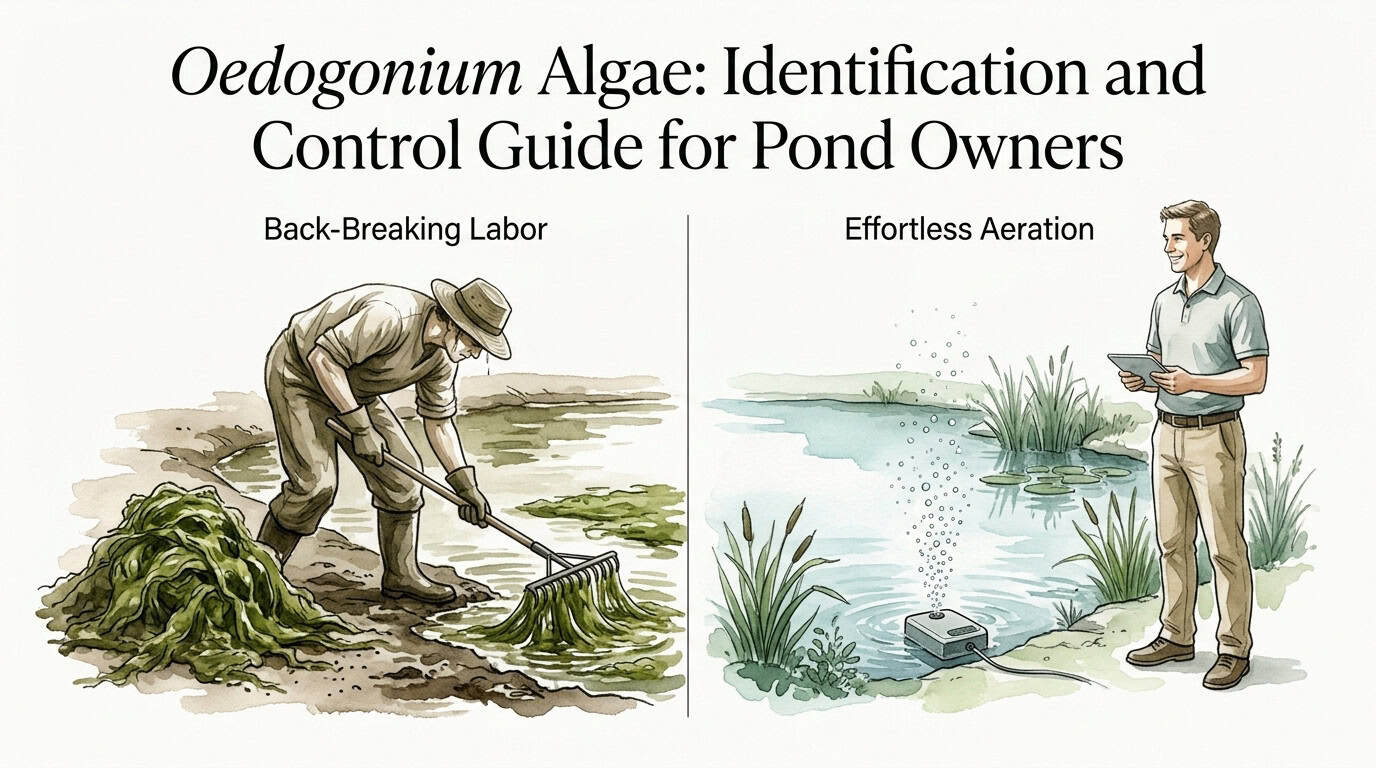
Work smarter, not harder. Discover how simple physics can defeat Oedogonium algae. Stop raking and start aerating. Oedogonium loves stagnant, nutrient-rich water. Here is how to fix the environment and kill the algae.
Oedogonium is a genus of filamentous green algae identified by its unbranched, hair-like strands and distinct apical cap cells visible under microscopic magnification. Effective control requires a technical approach focused on reducing phosphorus and nitrogen availability while increasing dissolved oxygen via bottom-diffused aeration. Long-term management involves stabilizing pond water chemistry through alkalinity monitoring and utilizing specialized algaecides like chelated copper or sodium carbonate peroxyhydrate to disrupt the cellular metabolism of the filaments.
Oedogonium Algae: Identification and Control Guide for Pond Owners
Oedogonium is a common member of the Chlorophyceae class, specifically within the order Oedogoniales. This genus consists of approximately 400 species of freshwater algae that occupy diverse ecological niches, ranging from benthic attachments on submerged rocks and wood to epiphytic growth on aquatic macrophytes. In nutrient-rich or eutrophic ponds, these algae can transition into free-floating mats that obstruct water flow and interfere with recreational activities.
Physically, Oedogonium presents as fine, bright green to yellow-green filaments. Unlike other common pond algae such as Cladophora, which is branched, or Spirogyra, which feels slimy due to a mucilaginous sheath, Oedogonium is unbranched and has a somewhat coarse, “fuzz-like” texture. It often appears as a velvety coating on submerged surfaces before maturing into thick, filamentous clusters.

Identifying this genus with precision is critical because its physiological resistance to standard treatments differs from planktonic blooms. The presence of specialized holdfast cells allows it to anchor firmly in high-flow areas, while its unique cellular division process provides a mechanical durability that requires specific chemical concentrations to penetrate.
How It Works: The Biology of Oedogonium Proliferation
The growth of Oedogonium is driven by a unique method of intercalary cell division known as annular splitting. During this process, a ring of cell wall material forms at the upper end of a cell. When the cell divides, the parent wall ruptures at this ring, stretching the new wall material and leaving behind a “cap” or “apical ring.” This structural characteristic is the definitive diagnostic feature under a microscope. Each ring corresponds to a single division event, allowing researchers to calculate the age and growth rate of a specific filament.
Asexual reproduction occurs via multiflagellate zoospores. These motile spores possess a ring of cilia at their anterior end and are released into the water column to find new substrates. Once a zoospore attaches, it transforms into a holdfast cell and begins the development of a new filament. This rapid dispersal mechanism explains why a pond can transition from clear water to a full-scale infestation within a single growing season.
Sexual reproduction is more complex and occurs in two primary forms: macrandrous and nannandrous. In macrandrous species, male and female reproductive organs (antheridia and oogonia) develop on filaments of normal size. In nannandrous species, the male filaments are “dwarf males” that attach themselves directly to the female oogonium. This specialized reproductive strategy ensures high fertilization rates even in low-density populations, making the algae highly resilient to environmental stressors.
Physics-Based Control: The Power of Aeration
Strategic aeration is the most effective mechanical intervention for controlling filamentous algae like Oedogonium. This method relies on the principles of fluid dynamics and redox potential rather than manual removal.
Thermal Destratification
Stagnant ponds often undergo thermal stratification, where a warm upper layer (epilimnion) sits atop a cold, oxygen-depleted bottom layer (hypolimnion). This separation creates a sanctuary for nutrients. Bottom-diffused aeration systems pump atmospheric air to diffusers on the pond floor, creating a column of rising bubbles. This movement pulls cold, nutrient-dense water to the surface for atmospheric gas exchange, effectively destratifying the water column and eliminating the stagnant conditions Oedogonium prefers.

Sediment Redox Potential
Aeration increases the dissolved oxygen (DO) levels at the sediment-water interface. This shift in redox potential allows naturally occurring iron to bind with soluble reactive phosphorus (SRP). Once bound, the phosphorus precipitates into the sediment and becomes unavailable for algal uptake. Because Oedogonium is often benthic or epiphytic, it relies heavily on the nutrients released from the muck layer. Starving the algae of phosphorus at the source is more efficient than reactive chemical treatments.
Chemical Intervention and Application Metrics
When environmental adjustments are insufficient, chemical controls provide the necessary biocidal action to collapse an existing population.
Chelated Copper Algaecides
Copper ions (Cu2+) are potent inhibitors of photosynthesis and enzyme production. However, traditional copper sulfate crystals often precipitate rapidly in ponds with high alkalinity (above 200 ppm), rendering the treatment ineffective and leading to heavy metal accumulation in the soil. Chelated copper formulations “wrap” the copper ion in an organic molecule, preventing it from reacting with carbonates. This allows the copper to remain suspended in the water column longer, increasing its contact time with the algae and allowing for lower overall dosages.
Sodium Carbonate Peroxyhydrate
This granular peroxide-based algaecide offers an oxidation-based alternative to copper. Upon contact with water, it releases hydrogen peroxide, which provides immediate oxidative stress to the algal cell walls. This treatment is particularly effective for spot-treating thick mats of Oedogonium along shorelines or on rocks. It breaks down into water and oxygen, leaving no toxic residue behind, though it typically requires higher application rates and higher costs compared to copper-based solutions.
Benefits of Technical Management
Integrated management of Oedogonium offers several measurable advantages over traditional manual raking or indiscriminate chemical broadcasting.
- Efficiency: Aeration reduces the frequency of chemical treatments by addressing the root cause of nutrient loading.
- Stability: Maintaining high DO levels prevents “oxygen crashes” that often follow massive algae die-offs.
- Sustainability: Chelated formulations reduce the environmental burden of heavy metals in the pond ecosystem.
- Precision: Microscopic identification ensures that the selected algaecide is appropriate for the specific algal morphology.
Common Mistakes and Pitfalls
Many pond owners fail to control Oedogonium because they treat it as a surface problem rather than a systemic one.
Manual raking, while satisfying, often spreads fragmentation. Each broken piece of an Oedogonium filament can potentially grow into a new colony, meaning a weekend spent raking can actually seed a larger bloom for the following month. Furthermore, applying copper sulfate in water with low alkalinity (below 50 ppm) can be lethal to fish. High copper bioavailability in soft water leads to acute toxicity in non-target species.
Another frequent error is treating the entire pond at once during peak summer temperatures. When large masses of algae die, the resulting bacterial decomposition consumes massive amounts of oxygen. In a pond that is already warm and low on DO, this can trigger a total fish kill. Professionals treat only 25% to 33% of the pond at a time, allowing the ecosystem to process the dead biomass without depleting oxygen reserves.
Limitations of Control Methods
No single method is a universal solution for Oedogonium. Environmental constraints dictate the success of each approach.
Aeration systems require a continuous power source and professional sizing based on pond depth and surface acreage. In very shallow ponds (less than 6 feet), bottom-diffused aeration is less efficient than surface aerators because the bubble column has less time to interact with the water. Conversely, chemical treatments are limited by water temperature. Most algaecides are significantly less effective in water temperatures below 60°F (15.5°C) as algal metabolism slows down, reducing the uptake of the active ingredients.
Comparative Analysis of Control Strategies
| Method | Primary Mechanism | Durability | Cost (Long-term) | Technical Complexity |
|---|---|---|---|---|
| Manual Raking | Physical removal of biomass | Very Low (Days) | High (Labor) | Low |
| Copper Sulfate | Enzyme inhibition / Biocide | Medium (Weeks) | Low (Material) | Medium |
| Chelated Copper | Photosynthetic disruption | High (Weeks/Months) | Medium | Medium |
| Diffused Aeration | Nutrient sequestration / Mixing | Very High (Years) | Low (Operating) | High (Setup) |
| Phosphorus Binders | Chemical precipitation of P | High | High (Material) | High |
Practical Tips for Pond Operators
Immediate application of technical knowledge can prevent a minor growth from becoming a major infestation.
- Monitor Alkalinity: Always test your water’s total alkalinity before applying any copper-based product. If alkalinity is above 200 ppm, skip the sulfate and use a chelated product.
- Target the Holdfast: When using liquid algaecides, apply the product directly to the base of the filaments where they attach to rocks or plants. This disrupts the structural integrity of the colony more effectively than surface spraying.
- Check the Caps: Use a simple field microscope to inspect the filaments. If you see numerous apical rings (cap cells), the population is in a high-growth phase and requires aggressive intervention.
- Optimize Aeration Timing: Run aeration systems 24/7 during the summer months. Nighttime is when dissolved oxygen levels naturally dip to their lowest as plants and algae switch from photosynthesis to respiration.
Advanced Considerations: Nutrient Stoichiometry
Serious practitioners should consider the Redfield Ratio (106C:16N:1P) as a framework for pond health. Oedogonium thrives when the nitrogen-to-phosphorus ratio is skewed. In many eutrophic systems, phosphorus is the limiting nutrient. By using lanthanum-modified clay or alum to bind phosphorus, you can shift the N:P ratio into a range that favors beneficial planktonic algae over filamentous varieties.
Furthermore, the Monod kinetics model suggests that algal growth rate is a function of the most limiting nutrient. In a pond managed for Oedogonium, maintaining phosphate levels below 0.03 mg/L is generally sufficient to prevent significant filamentous blooms, even if nitrogen levels remain elevated.
Scenario Analysis: The Over-Fertilized Residential Pond
Consider a 0.5-acre pond with a maximum depth of 10 feet, surrounded by manicured lawns. The owner notices bright green “fuzz” covering the shallow shelf and clogging the overflow pipe.
Testing reveals an alkalinity of 220 ppm and a phosphorus level of 0.15 mg/L. Because of the high alkalinity, a standard copper sulfate treatment would precipitate within hours. The recommended protocol involves installing a 1/4 HP diffused aeration system to increase bottom oxygen and bind phosphorus with iron. Simultaneously, a spot treatment of chelated copper (applied at 0.5 to 1.0 ppm) is used on the thickest mats. Within 14 days, the mats turn brown and detach, and the aeration system prevents the internal loading of phosphorus from the sediment, ensuring the fuzz does not return the following season.
Final Thoughts
Successful management of Oedogonium algae is a matter of mechanical and chemical optimization rather than brute force. Transitioning from reactive manual labor to proactive ecosystem stabilization allows pond owners to maintain clear water with minimal ongoing effort. By focusing on the physics of water movement and the chemistry of nutrient binding, you can create an environment where filamentous algae simply cannot survive.
Consistency is the hallmark of professional pond management. Establishing a baseline for water quality and maintaining aeration infrastructure ensures that the pond remains a healthy, functional ecosystem. While chemical tools provide a necessary “reset” for infested waters, the long-term victory over Oedogonium is always won through environmental modification.
Frequently Asked Questions About Oedogonium Algae: Identification and Control Guide for Pond Owners
What is the most reliable way to distinguish Oedogonium from other filamentous algae?
While many filamentous algae look similar to the naked eye, Oedogonium is uniquely identified by its unbranched structure and the presence of “cap cells” or apical rings. Unlike Spirogyra, which has a distinct spiral chloroplast and a slimy feel, or Cladophora, which is characterized by branching filaments, Oedogonium feels slightly coarse or fuzzy. Under a microscope, the apical rings appear as small parallel lines near the end of certain cells, representing scars from previous cell divisions. This feature is exclusive to the order Oedogoniales. Additionally, the presence of a specialized, often colorless basal cell called a holdfast indicates that the algae is designed to anchor to surfaces, a trait less common in purely free-floating genera like Zygnema.
Can I get rid of Oedogonium just by raking it out of the pond?
Raking provides immediate cosmetic improvement but is rarely a long-term solution. In fact, mechanical removal can worsen an infestation if not done carefully. Oedogonium reproduces easily through fragmentation; when you pull at the mats, thousands of tiny filament pieces are released into the water column. Each fragment can settle on a new substrate and grow into a full colony. Furthermore, raking does nothing to address the high phosphorus and nitrogen levels in the water that fueled the growth in the first place. Unless the underlying nutrient imbalance is corrected through aeration or nutrient binding, the algae will likely return within days or weeks, often thicker than before.
Is copper sulfate safe to use for Oedogonium control in all ponds?
Copper sulfate is a common and inexpensive algaecide, but its safety and efficacy depend entirely on your pond’s water chemistry. In ponds with low total alkalinity (less than 50 ppm), copper ions become highly toxic to fish, especially sensitive species like trout or koi. In ponds with high alkalinity (above 200 ppm), the copper reacts with carbonates and precipitates out of the water almost immediately, becoming useless for algae control. For most pond owners, a chelated copper product is a safer and more effective choice. Chelated formulations keep the copper ion active in the water longer and are less likely to harm non-target aquatic life when applied according to label instructions.

How does pond aeration actually help stop algae growth?
Aeration stops algae through two primary mechanisms: physical mixing and chemical sequestration. First, bottom-diffused aeration pulls nutrient-rich, stagnant water from the bottom to the surface, disrupting the warm, still conditions that Oedogonium prefers. Second, and more importantly, it increases dissolved oxygen at the sediment layer. In an oxygen-rich environment, iron naturally binds with phosphorus, the primary food source for algae, and locks it into the pond muck. Without accessible phosphorus, Oedogonium cannot sustain rapid growth. This “starves” the algae at the source, providing a long-term preventative measure that chemicals alone cannot match.
When is the best time of year to treat an Oedogonium infestation?
The best time to treat is in late spring or early summer when water temperatures consistently stay above 60°F (15.5°C) but before the algae has formed massive, pond-wide mats. Algaecides are most effective when the algae is actively growing and the metabolism is high. Treating early in the season also reduces the risk of an “oxygen crash.” If you wait until the pond is completely covered in thick mats, the massive amount of dying vegetation will consume a significant amount of oxygen as it decomposes, which can be fatal to fish. Always aim to treat when you first notice “fuzz” on rocks or plants rather than waiting for floating mats to appear.