

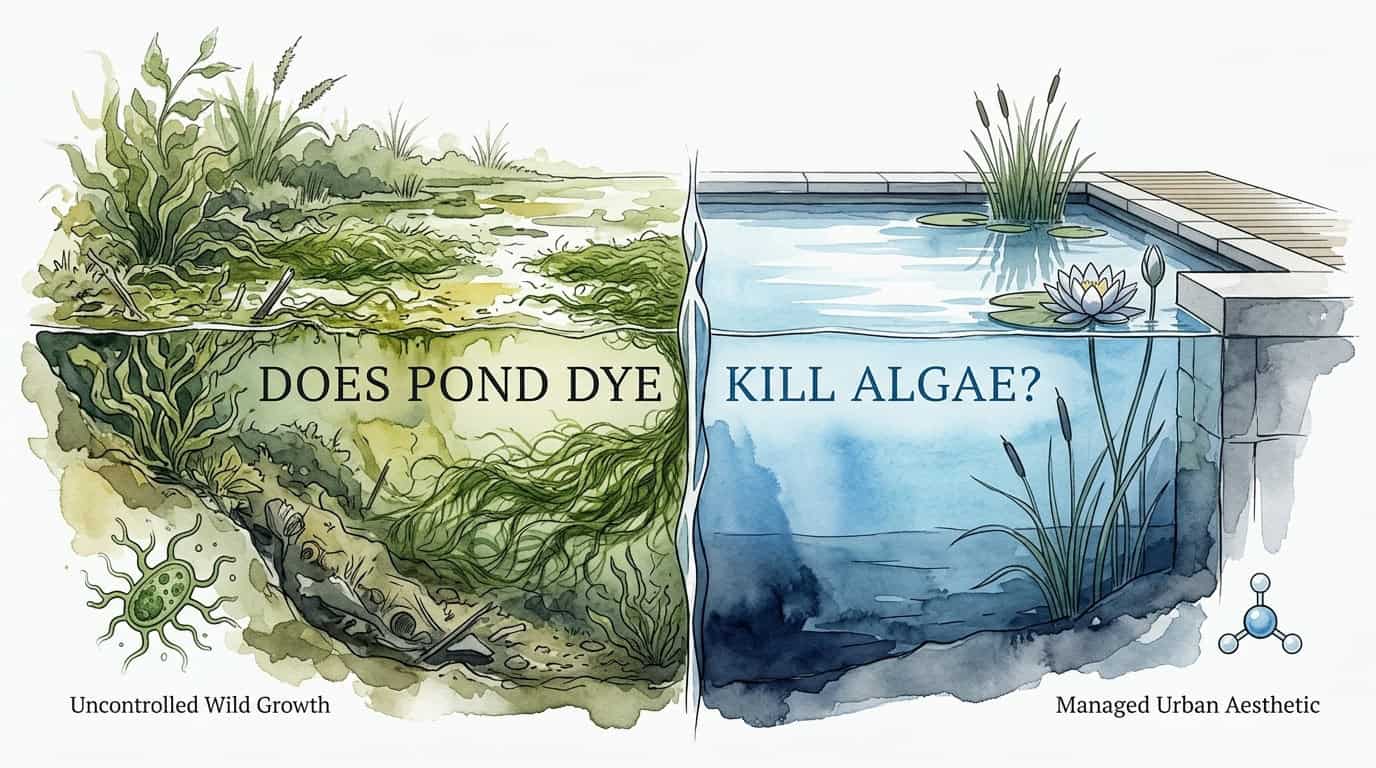
Pond dye does not kill algae through chemical toxicity or direct cellular destruction. Instead, it functions as a light-attenuating filter that blocks specific wavelengths of photosynthetically active radiation (PAR), specifically in the red-orange and blue-violet spectrums. This mechanical shading starves submerged algae of the light energy required for photosynthesis, effectively halting new growth and preventing the development of deep-water blooms without introducing biocidal agents into the ecosystem.
Pond dye isn’t a poison—it’s a shade. See how blocking the sun can starve out the green sludge. Does pond dye actually ‘kill’ algae? Not exactly. It’s better than that. It starves algae of the one thing it needs to survive: sunlight. Here is how to use shade to keep your water clear.
Effective pond management often requires a shift from reactive chemical dosing to proactive environmental modification. While traditional algaecides focus on the immediate termination of organic matter, pond dyes target the underlying energy source. This approach aligns with the shift toward a Managed Urban Aesthetic, where water clarity is maintained through precision engineering rather than constant ecological warfare.
Does Pond Dye Kill Algae?
Pond dye is an inert colorant designed to modify the optical properties of the water column. It is primarily composed of food-grade pigments, such as Acid Blue 9 and Acid Yellow 23. These compounds are highly efficient at absorbing light within the 600–700 nanometer range, which is the primary absorption peak for chlorophyll-a used by algae and cyanobacteria.

This tool exists to manage the photic zone—the depth at which sunlight penetration is sufficient for photosynthesis. By increasing the extinction coefficient of the water, the dye narrows the photic zone to the top 12 to 24 inches. In deeper water, the lack of photons prevents the activation of Photosystem II (PSII) in algal cells. This mechanical inhibition is vastly different from a “kill” because it does not trigger the rapid release of nutrients that occurs when algae cells burst and decompose.
In real-world situations, pond dyes are the standard for golf courses, decorative fountains, and commercial aquaculture. These environments require consistent visual standards and stable dissolved oxygen levels. Using a dye allows managers to maintain a predictable baseline of growth suppression while avoiding the volatile “bloom and crash” cycles associated with copper-based algaecides.
How It Works: The Physics of Photon Attenuation
The suppression of algae via pond dye is a process of spectral filtering. Visible light, or “white light,” is a spectrum of colors. Algae specifically require red and blue light to drive the metabolic processes that create sugars. Pond dyes are engineered to act as a permanent shade, selectively removing these wavelengths before they reach the bottom-dwelling algae or deep-water phytoplankton.
Effective application starts with calculating the pond’s volume in acre-feet. One acre-foot equals 325,851 gallons. Most commercial concentrates are calibrated at a rate of one gallon per four acre-feet, which results in a concentration of approximately 1 part per million (ppm). Once introduced, the dye molecules naturally disperse through Brownian motion and wind-driven currents, creating a uniform filter across the entire body of water.
The underlying principle is the Beer-Lambert Law, which describes how light is attenuated as it passes through a medium. As the concentration of the dye increases, the depth to which light can penetrate decreases exponentially. By maintaining a 1 ppm concentration, a manager ensures that the “light compensation point”—the depth where oxygen production equals oxygen consumption—is pushed significantly closer to the surface.
Advantages of Light-Based Growth Control
One of the primary benefits of using dye is the preservation of dissolved oxygen (DO). When an algaecide kills a massive bloom, the subsequent decomposition of dead organic matter consumes immense amounts of oxygen. This “biochemical oxygen demand” (BOD) often leads to fish kills. Pond dye avoids this risk by preventing the growth from occurring in the first place.

Stability is another critical advantage. Traditional chemical treatments are often “all or nothing.” Dyes provide a continuous, passive level of control. They also offer a thermal benefit; by absorbing solar energy at the surface, dyes can help keep deeper water slightly cooler. Cooler water has a higher saturation point for dissolved oxygen, which creates a more resilient environment for fish and beneficial aerobic bacteria.
Furthermore, pond dyes provide significant protection against predation. For managers overseeing valuable koi or stocked game fish, the reduced visibility from above makes it much harder for herons, ospreys, and other visual hunters to locate targets. This mechanical “shroud” serves a dual purpose of aesthetic enhancement and livestock protection.
Common Mistakes and Operational Pitfalls
The most frequent error in pond dye application is attempting to use it as a curative treatment for an existing, heavy bloom. If the water is already covered in a thick mat of filamentous algae or a dense “pea soup” phytoplankton bloom, the dye will only sit on top of the organic matter or fail to penetrate the surface. Dyes are preventative tools; they must be applied before the growing season begins, typically in early spring when water temperatures reach 50°F.
Another pitfall is underestimating the water exchange rate. In ponds with significant inflow and outflow—such as those fed by large watersheds or active springs—the dye will wash out rapidly. Managers often fail to account for “hydraulic residence time.” If a pond flushes its entire volume every two weeks, a single application of dye will lose its effectiveness within days. In these scenarios, metered dosing or more frequent supplemental applications are required.
Over-application is also a concern. While the dye is non-toxic, applying it at triple or quadruple the recommended rate can lead to an “aquatic blackout.” If no light reaches even the shallowest littoral zones, you may inadvertently kill off beneficial submerged macrophytes that provide habitat and compete with algae for nutrients. Balance is required to maintain a Managed Urban Aesthetic without creating a biological dead zone.
Limitations and Environmental Constraints
Pond dye has specific physical limitations that prevent it from being a universal solution. It is largely ineffective in water shallower than two feet. In these “littoral fringes,” light penetration is often sufficient for photosynthesis regardless of the dye concentration. Consequently, you may still see filamentous algae growth around the very edges of the pond.
Environmental factors like UV degradation also play a role. Solar radiation slowly breaks down the dye molecules over time. Most applications require a “booster” dose every 4 to 8 weeks to maintain the required spectral density. Additionally, dyes do not affect floating plants like duckweed or water lilies. Because these plants have leaves on or above the surface, they have direct access to unfiltered sunlight and will continue to grow regardless of the water color.
Finally, the presence of suspended solids or high turbidity can interfere with the dye’s performance. If the water is muddy or brown due to clay particles, the dye may bind to these particles and settle out of the water column. In such cases, a flocculant or clarifier may be necessary before the dye can be effectively applied.
Pond Dye vs. Copper Sulfate Algaecides
Selecting the right tool requires understanding the fundamental differences between mechanical shading and chemical termination. The following table highlights the metrics for decision-making.
| Feature | Pond Dye (Preventative) | Copper Sulfate (Curative) |
|---|---|---|
| Mechanism | Light attenuation (PAR blocking) | Direct cellular toxicity |
| Impact on Existing Algae | Minimal; slows growth speed | Rapid termination of cells |
| Dissolved Oxygen Risk | Low; prevents BOD spikes | High; risk of post-kill crash |
| Longevity | 4–8 weeks (UV dependent) | Days (precipitates into sediment) |
| Toxicity | Non-toxic; food-grade dyes | Toxic to sheep, trout, and snails |
Best Practices for Mechanical Suppression
To maximize the efficiency of pond dye, start with a Secchi disk measurement. A Secchi disk is a black-and-white plate lowered into the water to measure transparency. The goal of a professional dye application is to reduce the “Secchi depth” to approximately 24 inches. If the disk is still visible at 4 feet, the light penetration is too high to effectively suppress algae.
Dye should be applied in several spots around the perimeter. While the dye will eventually diffuse, placing it near an aerator or fountain intake will significantly speed up the homogenization process. For larger lakes, applying from a boat along the midline ensures that the concentration is consistent across the entire surface area.
Maintain a log of application dates and quantities. By tracking how long the color remains vibrant, you can calculate the “washout rate” of your specific pond. This allows for a more scientific approach to maintenance, where you apply “booster doses” based on visual metrics rather than just a calendar schedule.
Advanced Considerations: Thermal Stratification
Serious practitioners must consider the impact of dye on the thermal profile of the water. Because dyes absorb solar radiation at the surface, they can intensify thermal stratification. This is the process where a warm, less dense layer of water (the epilimnion) sits on top of a cold, dense, and often oxygen-poor layer (the hypolimnion).
In a dyed pond, the “thermocline”—the transition zone between these layers—can become more pronounced. To prevent the bottom water from becoming anaerobic, it is highly recommended to use bottom-diffused aeration in conjunction with pond dye. The aerator breaks the stratification, ensuring that the oxygen-rich surface water is circulated to the bottom, even as the dye blocks the light from reaching those depths.
This combination of dye (to block light) and aeration (to move oxygen) creates a “light-limited, oxygen-rich” environment. This is the gold standard for high-performance pond management, as it simultaneously suppresses algae growth and accelerates the decomposition of organic muck on the bottom.
Scenario: Managing a 1-Acre Stormwater Pond
Consider a typical 1-acre stormwater pond with an average depth of 4 feet. This pond contains 4 acre-feet of water. In early April, a manager applies 1 gallon of blue dye concentrate. Within 24 hours, the Secchi depth drops from “unlimited” to 22 inches.
Throughout May and June, the pond experiences several heavy rain events totaling 6 inches. This inflow dilutes the dye. By July, the Secchi depth has increased to 36 inches, and small patches of filamentous algae begin to appear in the shallows. The manager identifies this “drift” and applies a 1-quart booster dose, returning the transparency to the target 24 inches.
By proactively managing the light levels, the manager prevents a major bloom that would have required expensive algaecide treatments and potential water use restrictions. The total cost of the dye for the season is roughly 20% of what a series of emergency copper treatments would have cost, with zero risk to the pond’s resident turtle population.
Final Thoughts
Pond dye represents a shift toward mechanical and physical optimization in water management. It provides a reliable, non-toxic method for growth suppression by manipulating the light spectrum. While it does not “kill” algae in the traditional sense, its ability to inhibit photosynthesis makes it a superior long-term tool for maintaining water quality and aesthetic standards.
By understanding the physics of light attenuation and the biology of the photic zone, pond owners can move away from reactive chemical interventions. Using dye as part of a multi-layered strategy—including aeration and nutrient management—ensures a stable, clear, and healthy aquatic ecosystem.

Success with pond dye depends on timing, volume accuracy, and consistent monitoring. When applied correctly, it provides a cost-effective shield that keeps the green sludge at bay while enhancing the natural beauty of the landscape.
Frequently Asked Questions About Does Pond Dye Kill Algae?
Will pond dye hurt my fish or frogs?
No. Commercial pond dyes are formulated from food-grade pigments that are non-toxic to aquatic life. They do not contain biocides or heavy metals. In fact, many fish species thrive in dyed water because the reduced light levels lower their stress and provide cover from predatory birds. The only indirect risk to fish comes from extreme over-application in very shallow ponds without aeration, which could potentially limit oxygen production from beneficial plants. When used at the recommended 1 ppm concentration, it is completely safe for all wildlife, including amphibians and livestock.
Can I use pond dye to get rid of existing algae mats?
Pond dye is not effective at removing existing, established algae mats or thick surface blooms. Because the dye works by blocking light from reaching the bottom where growth begins, it cannot “reach” or “kill” algae that is already on the surface. If you have an active bloom, you must first physically remove the algae or use a targeted algaecide to clear the water. Once the existing mass is reduced, apply pond dye immediately to prevent the next generation of algae from germinating and reaching the surface.
How long does a single application of dye typically last?
In a static pond with no outflow, a single application usually lasts between 4 and 8 weeks. However, the lifespan of the dye is heavily influenced by two factors: UV radiation and water exchange. High-intensity summer sun will break down the dye molecules over time, causing the color to fade. More significantly, heavy rain or a constant flow from a spring will dilute and wash the dye out of the system. To maintain effective algae suppression, you should monitor the water color and add a small “booster” dose whenever you notice the transparency increasing.
Does the color of the dye (Blue vs. Black) change its effectiveness?
While all pond dyes provide shading, black dye is generally the most effective at blocking light penetration. Black dye creates a highly reflective, mirrored surface that reflects a larger percentage of solar radiation back into the atmosphere. Blue dye is the most popular for aesthetic reasons and is highly effective at blocking the red spectrum of light. “Blue-Black” or “Midnight” blends offer a middle ground, providing deep shading while maintaining a natural appearance. For the specific purpose of algae suppression, the most important factor is the concentration of the dye, not the specific hue.
Why is my dye not working to stop algae in the shallow parts of my pond?
Pond dye has a physical limitation in shallow water, typically anything less than 18 to 24 inches deep. In these areas, the water column is too short for the dye to absorb enough photons to stop photosynthesis. Even in heavily dyed water, enough sunlight can often reach the bottom in very shallow fringes to support growth. This is why you may still see “rim” algae around the edges of a dyed pond. To manage these areas, you may need to use supplemental methods such as manual raking, barley straw, or spot-treatments with a liquid algaecide.