

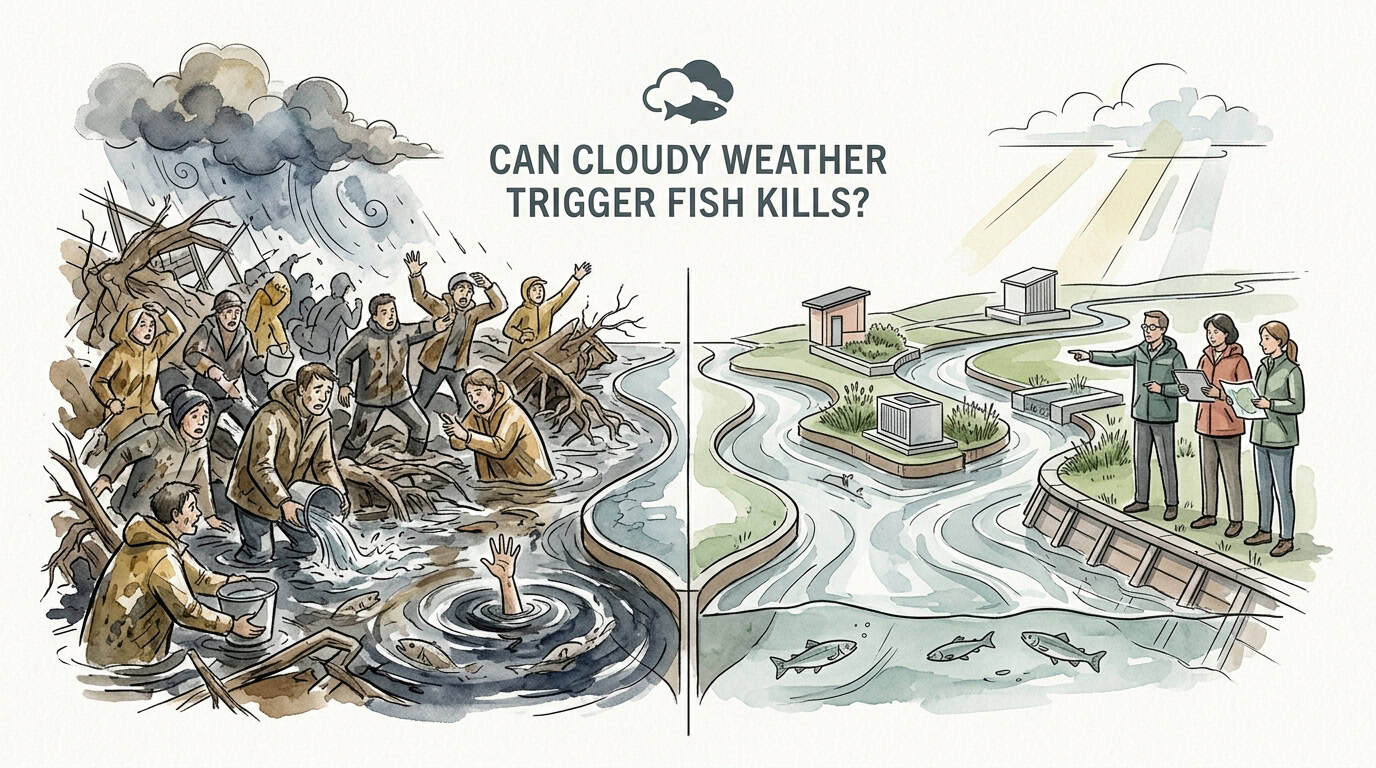
Three days of clouds can be a death sentence for a healthy pond. Without sunlight, pond plants can’t produce oxygen. Learn why a string of cloudy days is the perfect storm for a fish kill and how to prepare.
Managing a pond ecosystem requires an understanding of the delicate balance between biological oxygen production and system-wide respiration. While many pond owners focus on water clarity or fish growth rates, the most critical metric for long-term stability is the concentration of Dissolved Oxygen (DO). In a standard pond environment, oxygen levels fluctuate throughout a 24-hour cycle, a phenomenon known as the diurnal oxygen curve. During the day, sunlight drives photosynthesis in phytoplankton and aquatic plants, releasing oxygen as a byproduct. At night, this process ceases, and every living organism in the pond—from the fish to the microscopic bacteria—consumes oxygen through respiration.
When this cycle is interrupted by consecutive days of heavy cloud cover, the pond enters a state of net oxygen deficit. Photosynthetic rates can drop by as much as 75%, while respiration rates remain constant or even increase due to higher summer temperatures. This imbalance rapidly depletes the “oxygen bank” of the water column. Understanding the mechanical and biological triggers of these events is essential for transitioning from manual panic to strategic prevention.
Can Cloudy Weather Trigger Fish Kills?
Cloudy weather is one of the most frequent environmental triggers for mass fish mortality in stagnant water bodies. This occurs because the primary source of oxygen in a pond is not atmospheric diffusion, but rather the metabolic activity of phytoplankton. These microscopic algae are responsible for up to 80% of the dissolved oxygen in a typical managed pond. When thick cloud cover persists for 48 to 72 hours, the available light energy falls below the “compensation point”—the level at which oxygen production from photosynthesis exactly equals oxygen consumption from respiration.

In this state, the pond becomes a closed system with a shrinking supply of life-sustaining gas. As DO levels fall below 3.0 mg/L (milligrams per liter), most warm-water fish species like Largemouth Bass and Bluegill begin to experience physiological stress. If the concentration drops below 2.0 mg/L, mass mortality—or a “fish kill”—becomes imminent. Large fish are typically the first to succumb because they have a higher total oxygen demand and a lower gill-surface-to-body-mass ratio compared to smaller juveniles.
Mechanisms of Oxygen Depletion and Biological Demand
The failure of a pond during cloudy weather is a result of three converging factors: reduced light, high water temperature, and high Biological Oxygen Demand (BOD). Sunlight provides the photons necessary for the light-dependent reactions of photosynthesis. On a clear summer day, phytoplankton can supersaturate the surface water, sometimes reaching 150% or 200% of the normal air-saturation level. This surplus acts as a buffer for the night hours.
Cloud cover removes this buffer. Without the midday “recharge,” the pond starts its nighttime respiration cycle with a significantly lower starting concentration. Furthermore, warm summer water has a lower physical capacity to hold dissolved gases. For example, water at 50°F can hold roughly 11.3 mg/L of oxygen at saturation, whereas water at 86°F can only hold 7.5 mg/L. This reduced “ceiling” means there is less room for error when photosynthetic production slows down.
Biological Oxygen Demand (BOD) represents the total amount of oxygen required by bacteria to break down organic matter. In ponds with high nutrient loading—often from fish waste, excess feed, or decaying plant matter—the BOD is exceptionally high. During cloudy periods, if a portion of the algal bloom begins to die off due to lack of light (a “bloom crash”), the bacteria decomposing that dead algae will consume massive amounts of oxygen, further accelerating the DO crash.
How Mechanical Aeration Mitigates Weather Risks
Mechanical aeration serves as an insurance policy against the unpredictability of weather patterns. The goal of aeration is to increase the rate of gas exchange between the water and the atmosphere. This is governed by the gas transfer equation, which dictates that the rate of oxygen movement depends on the surface area of the water-air interface and the “oxygen deficit” (the difference between current DO levels and the saturation point).
There are two primary methods of mechanical aeration: surface aeration and bottom-diffused aeration. Surface aerators, such as fountains or paddlewheels, work by splashing water into the air. This increases the surface area (A) and introduces turbulence, which disrupts the liquid-film coefficient at the water’s surface. Bottom-diffused systems use an onshore compressor to pump air through weighted tubing to diffusers on the pond floor. As the bubbles rise, they create a “chimney effect,” pulling oxygen-depleted water from the bottom to the surface where it can vent harmful gases and pick up atmospheric oxygen.

Sizing an aeration system is a technical calculation based on the pond’s volume, shape, and biomass. A common industry standard is to provide at least 1 Horsepower (HP) of aeration per surface acre of water for high-biomass ponds. This ensures that even during a three-day cloud event, the mechanical input can maintain DO levels above the 3.0 mg/L safety threshold.
Benefits of Strategic Oxygen Management
Maintaining stable dissolved oxygen levels through strategic aeration provides several measurable advantages for pond health and fish productivity. Consistent DO concentrations prevent the periodic “stunting” of fish growth that occurs during low-oxygen stress events. When DO is low, fish reduce their metabolic activity and stop feeding to conserve energy, leading to poor Feed Conversion Ratios (FCR).
- Reduced Nutrient Accumulation: High oxygen levels at the pond bottom facilitate aerobic decomposition. Aerobic bacteria are significantly more efficient than anaerobic bacteria at breaking down organic “muck,” preventing the buildup of nitrogen and phosphorus.
- Prevention of Toxic Gas Buildup: Aeration helps vent hydrogen sulfide (H2S) and methane (CH4), which are byproducts of anaerobic decay and can be toxic to fish in high concentrations.
- Enhanced Ammonia Processing: The conversion of toxic ammonia to nitrite and eventually nitrate is an oxygen-dependent process (nitrification). High DO levels ensure this cycle remains active, protecting fish from ammonia burn.
- Thermal Destratification: By mixing the water column, aeration prevents the formation of a “thermocline,” ensuring that oxygen-rich water reaches the bottom and preventing a sudden “turnover” during summer storms.
Challenges and Common Mistakes in Pond Management
The most common mistake pond owners make is over-reliance on natural processes without monitoring the system’s limits. Overstocking is a frequent precursor to fish kills. A pond has a “carrying capacity” defined by its ability to provide oxygen for the total weight of fish. As fish grow, their oxygen demand increases exponentially, meaning a pond that was safe three years ago may be a ticking time bomb today.
Another pitfall is the late-season application of algaecides. Killing a massive algal bloom in the middle of a hot, cloudy week creates a massive spike in BOD. The oxygen consumed by the bacteria breaking down the dead algae, combined with the loss of the oxygen-producing phytoplankton, almost guarantees a crash. Management actions should always be timed with weather forecasts in mind.
Mechanical failures often occur when systems are most needed. High-heat periods put maximum stress on aeration compressors. Failure to perform routine maintenance, such as cleaning air filters or replacing diaphragms, can result in a system shutdown during a critical three-day cloud front. Monitoring DO levels with a digital meter is the only way to know the true status of the pond, yet many owners wait for visual signs like “piping” (fish gasping at the surface) when it is often too late to intervene.
Limitations of Atmospheric Re-oxygenation
Atmospheric diffusion is a relatively slow and inefficient process in stagnant water. Without wind or mechanical agitation, oxygen only penetrates the top few inches of the water column. In a deep pond, the majority of the water volume can remain hypoxic even if the surface appears healthy. This limitation is exacerbated by barometric pressure changes. Low-pressure systems, which often accompany cloudy and stormy weather, physically reduce the amount of oxygen that can be held in solution.
Furthermore, there is a limit to how much oxygen can be forced into water using air alone. Because air is only 21% oxygen, the saturation point is relatively low. In extreme aquaculture scenarios where biomass is exceptionally high, air-based aeration may be insufficient, requiring the injection of pure oxygen (O2) to maintain levels. For the average pond owner, the limitation is usually electrical. A power outage during a storm can silence aerators exactly when the lack of sunlight has halted photosynthesis, creating a dual-threat scenario.
Strategic Prevention vs. Manual Panic
Strategic prevention involves building a system that can withstand environmental stressors without constant human intervention. Manual panic is the result of insufficient infrastructure and a lack of data.
| Factor | Manual Panic (Reactive) | Strategic Prevention (Proactive) |
|---|---|---|
| Aeration | Turning on a pump only when fish are gasping. | 24/7 automated aeration sized for peak biomass. |
| Monitoring | Visual observation of dead fish or “piping.” | Regular DO testing and diurnal curve tracking. |
| Vegetation | Occasional massive chemical kills of weeds. | Continuous nutrient management and mechanical harvesting. |
| Stocking | Adding fish until they “stop growing.” | Stocking based on calculated carrying capacity. |
Practical Tips for Pond Security
To protect a pond during a period of heavy cloud cover, immediate and long-term steps should be taken. If a cloud front is forecasted, stop all supplemental feeding of fish. Digestion is a high-oxygen process, and uneaten feed increases the BOD. Reducing the metabolic load on the fish and the bacterial load on the water column can save critical milligrams of oxygen.
Verify that all aeration equipment is functioning at peak efficiency. For diffused systems, check that the “boil” at the surface is vigorous, indicating that the diffusers are not clogged with silt or algae. If using surface aerators, ensure they are positioned to maximize the circulation of the entire water body, not just a small corner.
Consider installing a DO monitoring system with an alarm. Some advanced systems can send an alert to a smartphone if oxygen levels drop below a pre-set threshold, allowing for a response before mortality begins. In an emergency where a crash is in progress, a trash pump can be used to spray water into the air and create temporary localized aeration. The intake should be kept near the surface to avoid pulling up anaerobic, toxic water from the bottom.
Advanced Considerations: The Physics of Gas Transfer
For serious practitioners, understanding the Standard Oxygen Transfer Rate (SOTR) and the Actual Oxygen Transfer Rate (AOTR) is vital for system optimization. SOTR is measured in a laboratory with clean, deoxygenated water at 20°C and 1 atmosphere of pressure. In a real-world pond, the AOTR is almost always lower. This is because the presence of dissolved solids, organics, and varying temperatures changes the “alpha” and “beta” factors of the water—coefficients that represent how easily oxygen moves through the specific water chemistry of your pond.
Furthermore, Henry’s Law dictates that the solubility of a gas is directly proportional to its partial pressure. This means that diffusers placed deeper in the pond are theoretically more efficient at transferring oxygen because the pressure at depth increases the solubility of the air bubbles. However, this must be balanced against the increased horsepower required to overcome the hydrostatic pressure at those depths. Finding the “sweet spot” for diffuser depth—usually between 6 and 12 feet for most ponds—is a key mechanical optimization for energy efficiency.
Example Scenario: The 1-Acre Pond Crash
Consider a 1-acre pond in mid-August with a water temperature of 84°F. The pond is stocked with 500 lbs of channel catfish and 200 lbs of bluegill. It has a healthy green “bloom” of phytoplankton with a Secchi disk reading of 18 inches. On a sunny day, the DO at 4:00 PM is 10.0 mg/L (supersaturated).
A three-day storm front moves in, bringing heavy clouds and no wind. By the end of Day 1, the 4:00 PM DO only reached 6.0 mg/L because of limited light. By dawn on Day 2, the level has dropped to 3.0 mg/L due to overnight respiration. Because Day 2 is also cloudy, the pond only recovers to 4.5 mg/L by late afternoon. By 2:00 AM on Day 3, the DO hits 1.5 mg/L. The largest catfish begin to “pipe” at the surface. Without mechanical intervention, the combination of high fish metabolism (driven by the 84°F water) and the collapse of the algal bloom (lack of light) results in a total kill of the large fish by dawn of Day 3.
Final Thoughts
The transition from a healthy, vibrant pond to a site of mass mortality can happen with startling speed during a period of sustained cloud cover. The biological mechanics are relentless: when the demand for oxygen exceeds the supply, the most sensitive and valuable components of the ecosystem—the fish—are the first to fail. By understanding the diurnal oxygen cycle and the impact of light attenuation, pond managers can move beyond guesswork.
Investment in mechanical aeration and regular monitoring of dissolved oxygen are the only ways to guarantee stability against the variables of summer weather. The cost of a professional-grade aeration system is often significantly less than the cost of restocking a pond and waiting years for the ecosystem to recover.
Ultimately, successful pond management is a game of managing margins. Cloudy weather narrows those margins to the breaking point. By preparing for the “perfect storm” of high heat, high biomass, and low light, you ensure that your pond remains a resilient and productive resource regardless of what the forecast holds.