

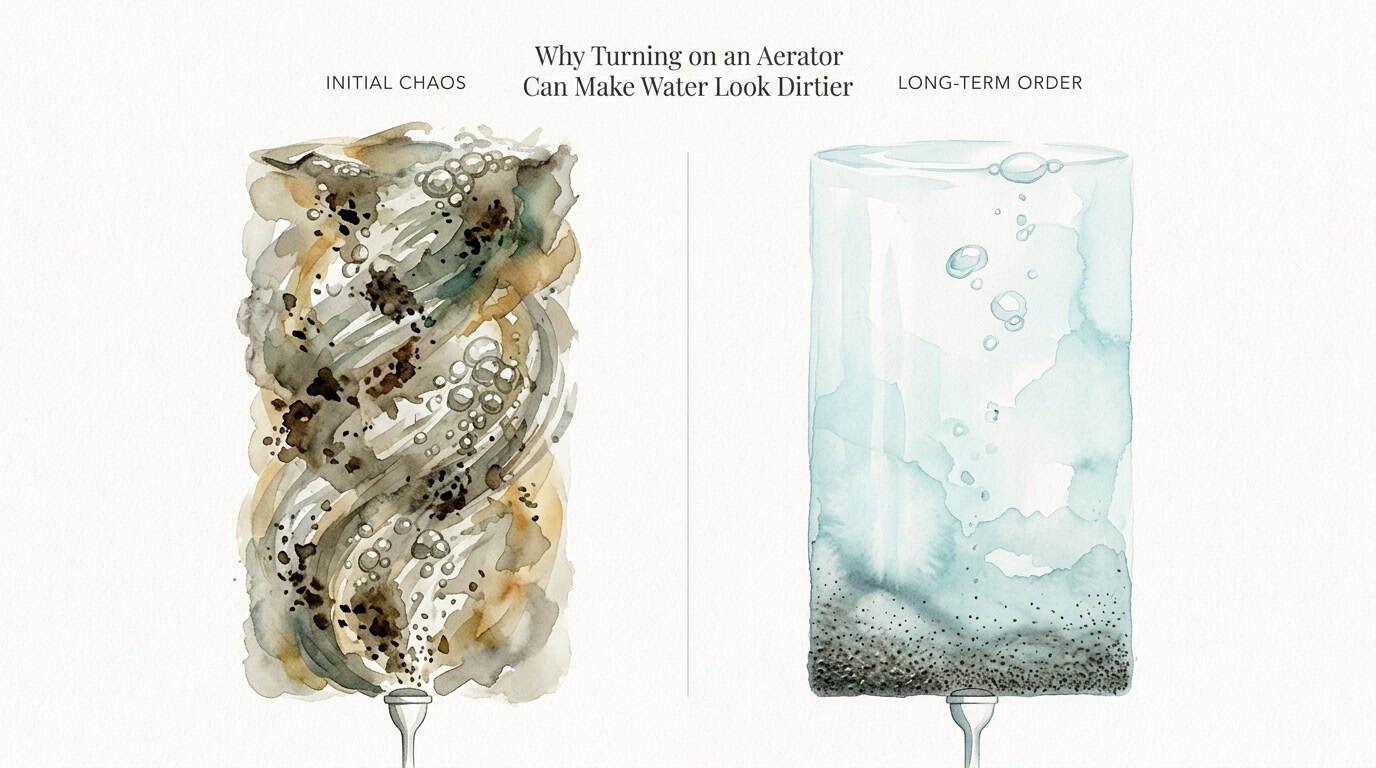
It gets worse before it gets better, and that’s actually a good sign. Scared by the brown cloud after turning on your aerator? Don’t be. That’s the sound of your pond finally breathing and the cleanup process beginning. This phenomenon is a predictable mechanical reaction within a closed aquatic ecosystem.
Aeration systems are designed to disrupt the status quo of a water body. When a system is first activated, it initiates a series of physical and chemical shifts that can temporarily degrade visual clarity. Understanding the mechanical principles behind this “brown cloud” is essential for proper pond management and long-term water quality optimization.
This article provides a technical deep dive into the physics of destratification, the biological implications of increased dissolved oxygen, and the engineering specifications required to maintain a healthy aquatic environment. We will examine why initial turbidity occurs and how to transition from a state of chaotic suspension to stabilized clarity.

Why Turning on an Aerator Can Make Water Look Dirtier
The immediate appearance of murky, brown, or gray water upon activating an aeration system is primarily due to the physical disturbance of the benthic zone. The benthic zone is the lowest ecological region of a body of water, including the sediment surface and sub-surface layers. Over time, organic matter, silt, and decomposing debris settle at the bottom, forming a layer of “muck” or anaerobic sludge.
Sub-surface aeration systems, particularly diffused air systems, work by releasing compressed air through a diffuser located at the pond’s floor. As these bubbles rise, they create a vertical current known as an airlift. This upward movement of water displaces the stagnant, oxygen-depleted water at the bottom and forces it toward the surface. In this process, the localized velocity of the water at the diffuser head is sufficient to suspend fine particulate matter from the sediment layer.
This suspension of solids is technically referred to as increased turbidity. Turbidity is the measure of relative clarity of a liquid, and in this context, it is caused by the mechanical mixing of previously settled solids. While the water looks “dirty,” it is actually an indication that the system is successfully moving the entire water column, which is a prerequisite for effective gas exchange.
Thermal destratification also plays a role. In a stratified pond, the water is divided into layers based on temperature and density. The bottom layer (hypolimnion) is often dense, cold, and devoid of oxygen. When an aerator breaks the thermocline—the transition layer between warm surface water and cold deep water—it mixes these layers. The sudden introduction of nutrient-rich but oxygen-poor bottom water to the surface often contains suspended organic tannins and minerals that contribute to a darker, more opaque appearance.
The Mechanics of Benthic Suspension
The volume of water moved by a single diffuser can be substantial. A standard fine-bubble diffuser can move several thousand gallons of water per minute via the “toroidal” circulation pattern it establishes. As the bubbles rise, they expand due to the reduction in hydrostatic pressure, which increases the lift capacity of the column. This high-volume displacement ensures that no part of the pond remains stagnant, but it necessitates the initial redistribution of accumulated organic loads.
The Physics of Gas Transfer and Destratification
Aeration is not merely about “blowing bubbles” into the water; it is about maximizing the Standard Oxygen Transfer Rate (SOTR). The physics of this process is governed by Henry’s Law, which states that the amount of dissolved gas in a liquid is proportional to its partial pressure above the liquid. By introducing air bubbles at the bottom of the pond, we increase the surface area available for oxygen to diffuse into the water under higher pressure.

Oxygen transfer occurs at two primary interfaces: the bubble-water interface as the bubbles rise and the air-water interface at the surface. Fine-bubble diffusers are engineered to produce bubbles between 1 and 3 millimeters in diameter. Smaller bubbles provide a much larger total surface area per cubic foot of air than larger bubbles, significantly increasing the efficiency of oxygenation. This process is quantified as Standard Aeration Efficiency (SAE), measured in pounds of oxygen per horsepower-hour (lb O2/hp-hr).
Mechanical destratification is the secondary, and often more important, function of an aeration system. By eliminating the thermocline, the system ensures that the entire volume of the pond is available for aerobic biological activity. This prevents the “dead zones” that typically characterize the bottom of deeper ponds during summer months.
Benefits of Mechanical Aeration
Implementing a high-efficiency aeration system provides several measurable benefits to the aquatic environment. These advantages are rooted in the stimulation of aerobic metabolic pathways, which are significantly more efficient than anaerobic pathways at processing organic waste.
- Acceleration of Organic Decomposition: Aerobic bacteria process organic matter up to 20 times faster than anaerobic bacteria. By saturating the benthic zone with oxygen, the “muck” layer is gradually oxidized and reduced in volume.
- Nutrient Sequestration: Proper oxygenation helps bind phosphorus to minerals like iron in the sediment. This prevents phosphorus from becoming bioavailable to fuel harmful algal blooms.
- Elimination of Toxic Gases: Aeration facilitates the venting of hydrogen sulfide (H2S), methane (CH4), and carbon dioxide (CO2). These gases are byproducts of anaerobic decomposition and can be lethal to fish in high concentrations.
- Reduction in Biological Oxygen Demand (BOD): As the organic load is processed, the overall demand for oxygen in the system decreases, leading to more stable dissolved oxygen (DO) levels throughout the diurnal cycle.
- Habitat Expansion: By oxygenating the entire water column, fish are no longer restricted to the upper few feet of water. This increases the carrying capacity of the pond and improves fish growth rates.
Long-term data suggests that ponds with consistent aeration exhibit lower levels of nitrogen and phosphorus, higher transparency (after the initial turnover period), and a more balanced ecological profile.
Challenges and Common Implementation Mistakes
The primary challenge when starting an aeration system in an established pond is the risk of “turnover-induced hypoxia.” If a system is turned on at full capacity in a pond that has been stagnant for years, the rapid mixing of oxygen-depleted bottom water with oxygenated surface water can result in an overall DO level that is too low to support fish life. This is often exacerbated by the sudden suspension of high-BOD sediment.
Another common mistake is improper system sizing. Using a compressor with insufficient Cubic Feet per Minute (CFM) output for the pond’s depth or surface acreage will fail to achieve full destratification. This results in “localized aeration,” where only a small area near the diffuser is oxygenated, leaving the rest of the pond in a stagnant state.
Incorrect diffuser placement is also a frequent issue. Placing diffusers in the deepest part of the pond is generally recommended to maximize the airlift effect, but if the pond has a complex shape or multiple basins, a single diffuser will be insufficient. Mechanical efficiency drops if the air lines are too long or have too many tight bends, leading to friction loss and reduced CFM at the diffuser head.
Limitations and Environmental Constraints
Aeration is a powerful tool, but it is not a panacea for all pond issues. Certain environmental and physical constraints can limit the effectiveness of a system. For instance, in very shallow ponds (less than 4-5 feet deep), diffused air systems are less efficient because the bubbles do not have enough “travel time” to create a significant vertical current. In these scenarios, surface aerators or circulators are often more effective.
High water temperatures also pose a physical limit. Warm water has a lower saturation point for dissolved oxygen than cold water. In the height of summer, even a high-output aerator may struggle to maintain DO levels above 5 mg/L if the organic load is excessively high. Furthermore, if the pond is receiving a constant influx of nutrients from agricultural runoff or fertilizer, aeration alone may not be enough to prevent algal growth without additional nutrient mitigation strategies.
Electrical constraints are another factor. Remote ponds may require solar-powered aeration systems. While these are effective during daylight hours, they often lack the battery capacity for 24/7 operation, which can lead to DO fluctuations during the night when photosynthesis ceases and plants begin consuming oxygen (respiration).
Comparison: Diffused Air vs. Surface Aeration
Choosing the correct mechanical approach requires a comparison of efficiency metrics and application suitability. The following table outlines the primary differences between diffused sub-surface aeration and surface aeration (fountains/paddles).
| Feature | Diffused Aeration (Bottom-Up) | Surface Aeration (Top-Down) |
|---|---|---|
| Primary Mechanism | Laminar lift/Vertical circulation | Surface splashing/Turbulence |
| Operating Depth | Most efficient in > 6 feet | Most efficient in < 5 feet |
| Efficiency (SAE) | High (2.0 – 4.0 lb O2/hp-hr) | Moderate (1.5 – 2.5 lb O2/hp-hr) |
| Visual Impact | Minimal (bubbles at surface) | High (fountain spray) |
| Maintenance | Compressor/Diffuser cleaning | Motor/Propeller cleaning |
| Electrical Safety | No electricity in water | Submersible motor in water |
Diffused aeration is generally superior for ponds where the primary goal is muck reduction and destratification. Surface aeration is better suited for shallow ponds, aesthetics, or rapid emergency oxygenation of the surface layer.
Practical Tips for System Startup and Best Practices
To avoid the risks associated with rapid turnover, a graduated startup schedule is mandatory for any pond that has been stagnant for more than a few weeks. This allows the system to slowly integrate the bottom water and gas loads without overwhelming the pond’s biological capacity.
- Day 1: Run the system for 30 minutes, then turn it off for the remainder of the day.
- Day 2: Run the system for 1 hour.
- Day 3: Run the system for 2 hours.
- Day 4: Run the system for 4 hours.
- Day 5: Run the system for 8 hours.
- Day 6: Run the system for 12 hours.
- Day 7: Initiate 24/7 operation.
Monitor the water for unusual odors, such as a “rotten egg” smell (Hydrogen Sulfide), during this period. If odors are strong, do not increase the run time until the smell dissipates. Furthermore, ensure that the compressor is housed in a ventilated, weather-proof cabinet to prevent overheating and premature diaphragm failure. Regularly check the pressure gauge; an increase in PSI usually indicates a clogged diffuser, while a decrease indicates a leak in the air line.
Advanced Considerations: Sizing and SAE Optimization
For serious practitioners, sizing an aeration system involves calculating the total volume of the pond and the desired turnover rate. A common goal is to achieve one complete turnover per 24 hours. The formula for turnover involves calculating the total volume in acre-feet and then determining the GPM (gallons per minute) moved by the diffusers based on their depth and CFM input.
The Standard Oxygen Transfer Rate (SOTR) is influenced by the “alpha factor,” which accounts for the difference between oxygen transfer in clean water versus wastewater or pond water containing surfactants and organic matter. In ponds with high dissolved solids, the alpha factor is lower, meaning the system will be less efficient than its factory rating. To compensate, practitioners should over-size the system by 20-30% to ensure adequate performance under peak loading conditions.
Furthermore, the choice of diffuser membrane material impacts long-term efficiency. EPDM (Ethylene Propylene Diene Monomer) is the industry standard due to its durability and resistance to fouling. However, in environments with high mineral content, silicone membranes may be preferred as they exhibit better “flexing” properties to shed calcium carbonate scale.
Example Scenario: Restoration of a 1-Acre Pond
Consider a 1-acre pond with an average depth of 8 feet and a maximum depth of 12 feet. This pond has been stagnant for 10 years and has a 12-inch layer of anaerobic muck. The total water volume is approximately 3.26 million gallons (8 acre-feet).
Using a 1/2 HP rocking piston compressor providing 4.5 CFM, we install two dual-disc diffusers in the deepest areas. Based on the depth-to-lift ratio, these diffusers will move approximately 4,000 gallons per minute (GPM) total. At this rate, the entire volume of the pond is circulated every 13.6 hours (3,260,000 / 4,000 = 815 minutes). This exceeds the target of one turnover per day, providing a safety margin for the high organic load.

During the first week of operation, the “brown cloud” is significant. Turbidity readings move from 24 inches of Secchi disk visibility down to 6 inches. However, by week four, the suspended solids begin to settle or are processed by aerobic bacteria. By month three, the Secchi disk visibility increases to 48 inches—double the original clarity—as the nutrient cycling becomes more efficient and the muck layer begins to consolidate.
Final Thoughts
The appearance of murky water after activating an aeration system is a temporary physical consequence of a necessary mechanical process. It signifies the successful mobilization of stagnant bottom water and the beginning of aerobic restoration. By understanding the physics of destratification and the biological importance of oxygen saturation, pond managers can navigate this initial phase with confidence.
Consistency is key to the success of any aeration strategy. Intermittent operation can lead to “partial turnover” events that stress the ecosystem. Operating a properly sized, high-efficiency system 24/7 is the most effective way to reduce organic muck, manage nutrient levels, and maintain a stable environment for aquatic life. As the system stabilizes, the initial “dirty” water will give way to a clearer, more biologically active water body.
For those looking to optimize their systems further, investigating the integration of beneficial bacteria treatments alongside aeration can accelerate muck reduction even further. The synergy between mechanical oxygenation and biological augmentation represents the current gold standard in pond management technology.