

Pond Talk is an Amazon Associate. As an Amazon Associate we earn from qualifying purchases.
Stop watching your property wash away with every summer rainstorm. Without a ‘living shield,’ your pond bank is a ticking clock. Every storm steals an inch of your land, muddying the water and killing your fish habitat. We compare the collapse of bare shorelines against the iron-tight grip of a mature cattail defense system that actually grows stronger over time.
Pond bank erosion is a mechanical failure of the soil-water interface. In unmanaged systems, hydraulic forces—specifically wave energy and fluctuating water levels—exceed the shear strength of the shoreline soil. This leads to a process known as bank slumping or calving. While traditional engineering often relies on “hard armor” like rip-rap or concrete, biological engineering offers a self-repairing alternative that utilizes the structural properties of specific aquatic plants.
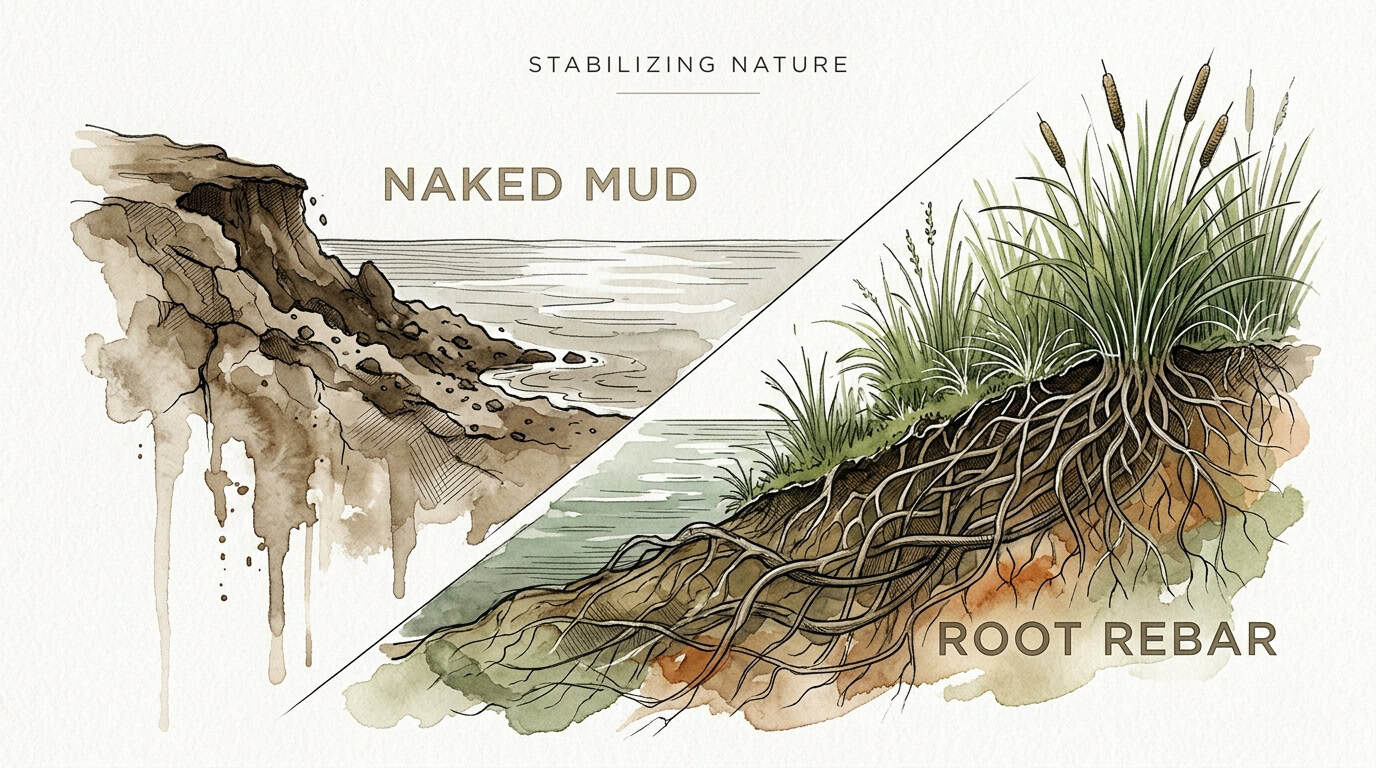
The concept of a “living shield” involves the strategic deployment of emergent vegetation to stabilize the riparian zone. By integrating the root systems of plants like cattails into the soil matrix, property owners can transform unstable “naked mud” into a reinforced composite material. This technical guide examines the mechanics of natural erosion control, focusing on the geotechnical and hydrological advantages of vegetative systems.
How To Stop Pond Bank Erosion Naturally
Natural pond bank erosion control is the application of soil bioengineering to stabilize shorelines using living plant materials. This method prioritizes the use of native vegetation to provide both surface protection and deep-tissue soil reinforcement. Unlike mechanical barriers, natural systems are dynamic; they adapt to changing water levels and increase in structural density as the plants mature.
In a real-world context, this is achieved by establishing a “Root Rebar” system. This term refers to the dense, interconnected network of rhizomes and fibrous roots that permeate the soil. When these roots interlock with soil particles, they increase the soil’s cohesion—the internal force that holds soil together. This is particularly effective in coastal plains or areas with sandy soils, where structural integrity is naturally low.
Natural stabilization is used in private ponds, municipal stormwater basins, and agricultural reservoirs. It functions as a multi-stage defense system: the above-water foliage dissipates wave energy, while the below-water root mass anchors the bank toe. This dual-action approach addresses the two primary drivers of erosion: hydraulic scour and mass wasting.
Mechanics of Vegetative Stabilization: The Root Rebar Effect
To understand how plants stop erosion, one must look at the geotechnical impact of root systems on soil shear strength. Soil is naturally strong in compression but weak in tension. Plant roots, which are strong in tension, compensate for this weakness when they are embedded in the soil matrix.
The process of stabilization involves several mechanical stages:
- Interlocking Matrix: As rhizomatous plants like cattails (Typha latifolia) expand, their roots create a grid-like structure. This acts as a physical mesh that prevents soil particles from being washed away by sub-surface currents.
- Pore Water Pressure Regulation: Plant transpiration removes excess water from the bank soil. This reduces pore water pressure, which is a leading cause of bank slumping during the rapid drawdown of water levels after a storm.
- Friction and Adhesion: The surface area of thousands of fine root hairs increases the friction between the roots and the soil. This prevents the “sliding” of soil layers along a failure plane.
Mathematical models, such as the Wu-Waldron Model, quantify this as “additional cohesion” (c_r). Research indicates that high-density root systems can increase the shear strength of soil by over 100% in optimal conditions. For a pond owner, this means the bank can withstand higher degrees of saturation and steeper angles without collapsing.
How to Establish a Mature Cattail Defense System
Effective natural erosion control requires a systematic approach to planting and site preparation. Simply tossing seeds into the mud is rarely successful because young seedlings are easily washed away before they can establish their root rebar.
1. Slope Gradient Optimization
The most critical factor in bank stability is the slope angle. Slopes steeper than a 3:1 ratio (three feet of horizontal distance for every one foot of vertical rise) are prone to undercutting. Before planting, the bank should be graded to a 3:1 or 4:1 slope to reduce the gravitational pull on the soil and allow for deeper root penetration.
2. Species Selection and Density
Species selection should prioritize native, non-invasive varieties. For North American ponds, Typha latifolia (Broadleaf Cattail) is a primary candidate due to its aggressive rhizomatous growth and high stem density. Targeted planting density should be approximately 1 to 2 plugs per square foot along the waterline to ensure rapid canopy closure.
3. Protection During Establishment
Newly planted vegetation is vulnerable. Using biodegradable “soft armor” like coconut coir logs or erosion control blankets can provide temporary stability for the first 12–24 months. These materials hold the soil in place while the “living shield” develops its permanent grip. Once the plants reach maturity, the coir logs decompose, leaving a self-sustaining biological barrier.
Benefits of the Living Shield Approach
The primary advantage of biological armoring is its longevity and self-repairing capability. While rip-rap or bulkheads eventually succumb to scouring and require expensive replacement, a vegetative system becomes more robust over time as the root network densifies.

Data suggests several measurable benefits:
- Wave Attenuation: Mature cattail stands can reduce wave energy by up to 60–80%. The flexible stems act as biological shock absorbers, breaking the momentum of waves before they reach the soil surface.
- Sediment Trapping: The dense foliage of emergent plants slows down runoff, causing suspended sediments to settle. This effectively “builds” the bank over time rather than letting it wash away.
- Nutrient Sequestration: Cattails are highly efficient at absorbing nitrogen and phosphorus. This prevents algae blooms and improves overall water clarity, which is essential for healthy fish habitats.
- Cost Efficiency: On a linear-foot basis, vegetative stabilization typically costs 50–70% less than installing hard armor like rock rip-rap or seawalls.
Challenges and Common Technical Mistakes
Failure in natural erosion control is rarely a failure of the plants themselves, but rather a failure of the implementation strategy. One common mistake is ignoring the “bank toe”—the point where the bank meets the pond bottom. If the toe is not stabilized, the weight of the vegetation above can actually accelerate a collapse.
Another frequent error is the introduction of invasive hybrids. In some regions, Typha x glauca (a hybrid cattail) can create such a dense monoculture that it chokes out all other biodiversity and creates a “floating mat” that eventually detaches from the shore. This leaves the bank exposed and creates a navigational hazard in the pond.
Over-saturation is also a risk. If a pond experiences constant, high-level flooding without a proper overflow system, even the strongest root systems can become “buoyant,” leading to large chunks of the bank floating away. Managing the pond’s hydrology is a prerequisite for successful bioengineering.
Limitations: When Natural Methods May Fail
While biological systems are powerful, they have physical limits. Natural erosion control may not be ideal in the following scenarios:
- High-Velocity Channels: In areas with constant high-velocity flow (such as a spillway), the shear stress of the water may exceed the pull-out resistance of the plants. In these cases, a “hybrid” approach using rock at the base and plants above is required.
- Extreme Verticality: If a bank is nearly vertical and cannot be graded due to property lines, plants alone cannot hold the weight of the soil. A retaining structure would be necessary.
- Intense Shading: Cattails and most emergent aquatic plants are heliotropic (sun-loving). In heavily wooded areas with dense canopy cover, they may not grow thick enough to provide adequate protection.
Comparison: Biological Armoring vs. Hard Armor
The following table compares the two most common methods of pond bank stabilization based on performance metrics and lifecycle costs.
| Factor | Living Shield (Biological) | Rip-Rap (Mechanical) |
|---|---|---|
| Initial Cost | $6 – $22 per linear foot | $30 – $85 per linear foot |
| Maintenance | Low (Occasional thinning) | Moderate (Stone replacement) |
| Erosion Resistance | Increases over time | Decreases over time |
| Ecological Impact | Highly positive (Habitat & Filter) | Neutral to Negative |
| Longevity | Indefinite (Self-regenerating) | 15 – 25 years |
Practical Tips for Maintaining Your Living Shield
Once established, a natural bank system requires minimal but specific maintenance to remain effective. The goal is to maintain a healthy density of “root rebar” without allowing the vegetation to become overgrown or senescent.
- Pruning and Harvesting: Every 2-3 years, remove dead stalks in the late fall. This prevents a buildup of organic “muck” at the shoreline, which can become soft and prone to erosion.
- Monitoring for Undercutting: Periodically check the area behind the plants. If you see small holes or “soil piping,” it may indicate that water is getting behind the root mass. Filling these with a mix of clay and gravel can prevent larger failures.
- Wildlife Management: Muskrats and geese are the primary biological threats to a new cattail shield. Muskrats eat the rhizomes, while geese trample the young shoots. Implementing temporary exclusion fencing for the first two seasons is often necessary.
Advanced Considerations: The Physics of Fetch and Wave Action
For large ponds or lakes, the concept of “fetch”—the distance wind can travel over water without hitting an obstruction—is vital. A larger fetch results in larger waves. If your pond has a fetch of more than 500 feet, a single row of cattails will not be sufficient.
In high-fetch environments, advanced practitioners use a “tiered” planting approach. This involves planting three distinct zones:
1. A submerged zone of pondweeds to break bottom-wave energy.
2. An emergent zone of cattails or bulrushes for primary wave dissipation.
3. A riparian buffer of deep-rooted grasses and shrubs on the upper bank.
By stacking these biological layers, the system can dissipate significantly more energy than a single-species stand.
Example Scenario: Calculating Erosion Reduction
Consider a 1-acre pond with a 100-foot section of eroding bank. The bank is currently “naked mud” with a slope of 2:1. During a 2-inch rain event, the hydraulic pressure and wave action result in the loss of 2 cubic yards of soil annually.
By grading the bank to a 3:1 slope and installing a 5-foot-wide “shield” of Typha latifolia at a density of 1.5 plants/sq. ft., the owner achieves two things:
1. The reduction of slope stress (Geotechnical).
2. The introduction of 150 linear feet of rhizomatous reinforcement (Structural).
After three years of growth, the stem density reaches a point where wave attenuation is calculated at 75%. Soil loss in subsequent storm events is reduced to near-zero, and the “Root Rebar” now holds an estimated 4,000 lbs of soil in place that would otherwise have calved into the pond.
Final Thoughts
Shoreline erosion is not an inevitable consequence of owning a pond; it is a symptom of an unprotected soil-water interface. By transitioning from a bare, vulnerable bank to a “living shield” of native vegetation, you are employing a sophisticated form of biological engineering. This system does not just resist the elements; it thrives on them, using the water and nutrients that would otherwise cause damage to build a stronger defense.
The transition from “naked mud” to “root rebar” is a technical process that requires patience and precision. However, the data is clear: biological armoring is more cost-effective, more durable, and more environmentally beneficial than mechanical alternatives. Start by assessing your slope gradients and species options, and begin building a defense system that will protect your property for decades to come.
Investing in a natural defense system today prevents the catastrophic failure of tomorrow. Whether you are managing a small backyard pond or a large-scale reservoir, the principles of vegetative stabilization remain the same. Build with biology, and let the plants do the heavy lifting.
Amazon and the Amazon logo are trademarks of Amazon.com, Inc, or its affiliates.