

Pond Talk is an Amazon Associate. As an Amazon Associate we earn from qualifying purchases.
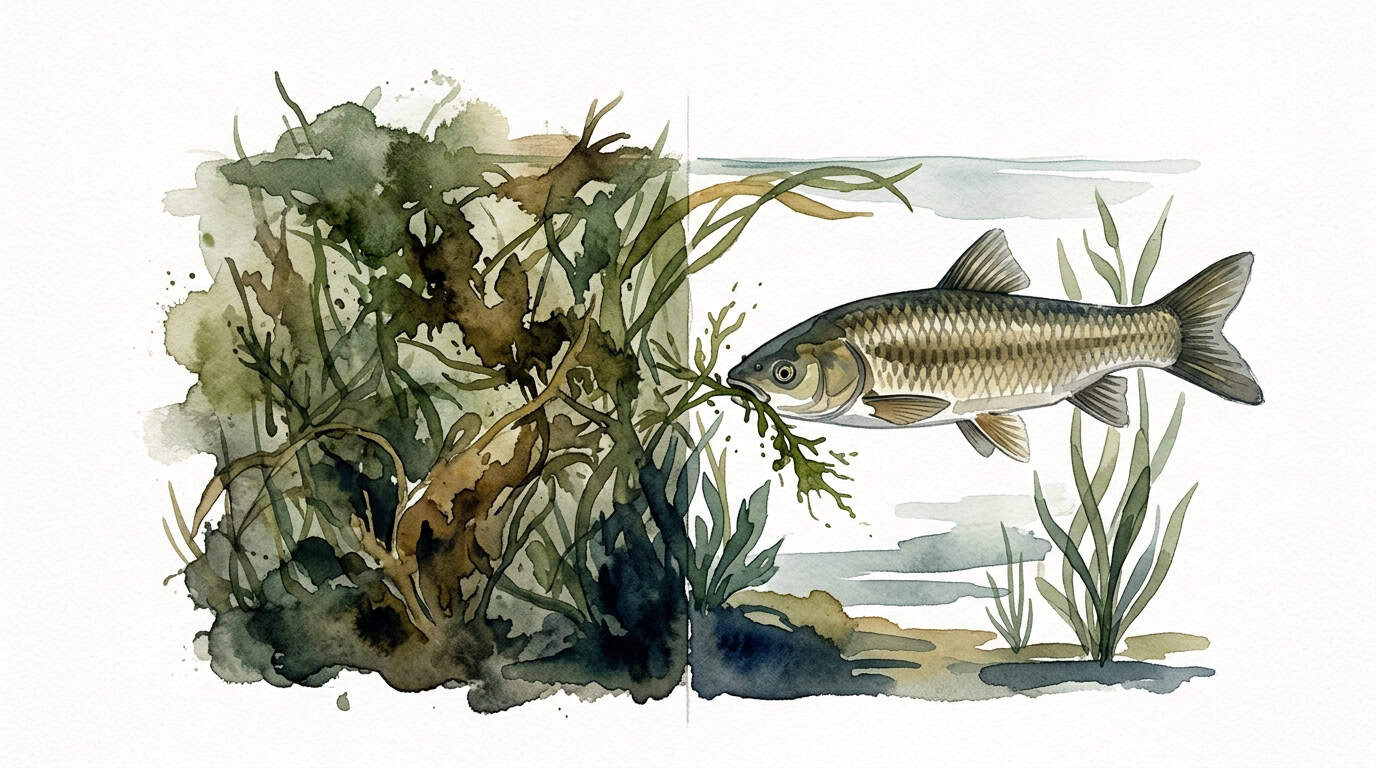
Most people see an invader, but the smartest pond owners see a 24/7 maintenance crew that never asks for a paycheck. Are grass carp the villains of the river or the heroes of the homestead? While wild populations can wreak havoc on native ecosystems, sterile triploid carp are the ultimate secret weapon for pond owners. Instead of dumping chemicals into your water, why not hire a fish that eats its weight in weeds every single day?
The use of grass carp (Ctenopharyngodon idella) represents a biological approach to aquatic vegetation management. These fish function as mechanical harvesters with high-frequency feeding cycles. Implementing a grass carp strategy requires an understanding of biomass conversion, species-specific palatability, and hydrologic containment. When managed correctly, they provide a long-term, self-sustaining solution for submersed weed control.
Grass Carp Weed Control Benefits For Ponds
Grass carp weed control benefits for ponds center on the fish’s unique role as a specialized herbivore. Unlike the common carp (Cyprinus carpio), which is an omnivore that disturbs sediment and increases turbidity, the grass carp is primarily a consumer of submerged plants. This distinction is critical for maintaining water clarity while reducing biomass.

These fish are native to the large rivers of East Asia and were introduced to the United States in 1963 for study at the Fish Farming Experimental Station. Their primary function is to graze on nuisance vegetation, specifically targeting soft-stemmed submerged species. Because they lack true teeth in their jaws, they utilize pharyngeal teeth located in their throat to grind plant matter against a hard plate. This anatomical specialization allows them to process vast quantities of vegetation that other fish species cannot digest.
Real-world applications range from small private ponds to large-scale irrigation canals. In these environments, grass carp act as a biological buffer, preventing the rapid expansion of invasive species like hydrilla or southern naiad. Their presence reduces the reliance on repetitive chemical applications, which often provide only temporary relief and can lead to nutrient spikes as plants decay simultaneously.
Mechanical Digestion and Biological Function
Understanding how a grass carp functions requires looking at its internal processing system. The fish has a remarkably short digestive tract for an herbivore, which results in a low digestive efficiency of approximately 60% to 70%. While this might seem like a biological disadvantage, it is the key to their effectiveness as a weed control tool. Because they cannot extract all the nutrients from each bite, they must consume significantly higher volumes of vegetation to satisfy their metabolic requirements.
During peak growth phases and in optimal water temperatures, an adult grass carp can consume its own body weight in wet vegetation daily. In some juvenile stages (2 to 2.5 pounds), consumption rates have been recorded as high as 300% of their body weight. The fish’s metabolism is heavily dependent on thermal conditions. Optimal consumption occurs between 70°F and 86°F (21°C to 30°C). As temperatures drop below 55°F (13°C), feeding activity decreases significantly, and it ceases entirely as water approaches freezing levels.
The biological “machinery” of the grass carp is most effective when the target vegetation is in its early growth stage. The fish prefer young, succulent tissues over mature, fibrous stems. This makes them an excellent preventive tool. By grazing on new growth as it emerges from the sediment, the carp prevent the formation of dense mats that would eventually reach the surface and obstruct the water body.
Palatability and Plant Selection Metrics
Not all aquatic plants are equal in the eyes of a grass carp. Success in biological control depends entirely on whether the target weed is high on the fish’s palatability index. If a pond owner stocks carp to control an unpalatable species while highly palatable native plants are present, the carp will ignore the nuisance weed and decimate the beneficial vegetation first.
High-Preference Species
- Hydrilla (Hydrilla verticillata): Often considered the primary target for grass carp. They can consume hydrilla faster than almost any other plant.
- Chara (Muskgrass): A calcified algae that carp find highly desirable due to its structure.
- Naiads (Najas spp.): Soft, succulent plants that are easily processed by pharyngeal teeth.
- Pondweeds (Potamogeton spp.): Including curly-leaf pondweed and sago pondweed.
- Common Elodea: Highly palatable and often eradicated quickly.
Moderate-Preference Species
- Duckweed (Lemna minor): While consumed, its rapid reproduction rate often outpaces the carp’s ability to provide total control.
- Bladderwort: Eaten when higher-preference plants are unavailable.
- Fanwort (Cabomba): Generally controlled but at a slower rate than hydrilla.
Low-Preference / Non-Target Species
- Filamentous Algae: Commonly called “pond scum,” this is rarely controlled by grass carp. They lack the mouth structure to graze it effectively.
- Cattails and Bulrushes: These are too fibrous and woody for the carp to process.
- Water Lilies: While they may nibble on new pads, they cannot control established lily populations.
- Coontail (Ceratophyllum demersum): The “horn-like” projections on the leaves can irritate the carp’s throat, making it a last-resort food source.
Stocking Rates and Density Calculations
Determining the correct number of fish to stock is the most critical variable in any management plan. Overstocking leads to a “bowling alley” effect where the pond is stripped of all vegetation, leading to a collapse of the fishery and potential algal blooms. Understocking results in negligible impact as plant growth outpaces consumption.
Stocking rates are typically calculated based on the surface acreage of the pond and the percentage of vegetation coverage. A general guideline for moderate control is 5 to 10 fish per surface acre. However, if the goal is complete eradication of an invasive species like hydrilla, rates may climb to 15 fish per acre.
| Infestation Level | Coverage Percentage | Recommended Fish Per Acre |
|---|---|---|
| Slight | Less than 30% | 2 – 5 |
| Moderate | 30% – 60% | 5 – 10 |
| Heavy | Greater than 60% | 10 – 15 |
It is important to note that many state agencies cap the maximum stocking density at 15 fish per acre. If biological control is being integrated with chemical treatments, the stocking rate can often be reduced. A common strategy involves using an herbicide to knock back 70% of the biomass and then stocking carp to manage the remaining 30% and prevent regrowth.
Benefits of Using Triploid Grass Carp
The primary advantage of using grass carp over mechanical or chemical alternatives is the duration of control. Once established, a population of grass carp provides continuous maintenance for 5 to 7 years before their feeding efficiency begins to decline. This long-term suppression is significantly more cost-effective than annual herbicide applications.
Economic metrics show that while the initial cost of purchasing 10-12 inch triploid carp (typically $10 to $25 per fish) may be higher than a single chemical treatment, the cost amortized over five years is substantially lower. Chemical treatments for a one-acre pond can range from $150 to $500 per application, often requiring multiple treatments per season. In contrast, 10 grass carp represent a one-time investment that works autonomously.

Another advantage is the reduction in “dead biomass” spikes. When herbicides are used on heavy infestations, the sudden death of massive amounts of plant material can deplete dissolved oxygen levels as it decays, leading to fish kills. Grass carp consume the material slowly and convert it into fish biomass, providing a more stable oxygen profile for the pond’s existing ecosystem.
Challenges and Technical Pitfalls
The most frequent cause of failure in grass carp programs is “illegal escapement.” Grass carp are riverine fish by nature and are highly attracted to flowing water. During heavy rain events, they will actively seek out spillways and overflow pipes. If they escape, the pond owner loses their investment, and the fish enter the public watershed, where they can damage native habitats.
Emigration barriers are a technical necessity. These are typically constructed as parallel bar screens installed on spillways. The spacing between bars is a critical specification. For 8-inch fish, the maximum gap should be no more than 1 inch. For larger fish (12 inches+), the gap can be slightly wider, but keeping it at 1 inch prevents debris from clogging the screen too easily while still containing the fish.
Predation is the second major challenge. Largemouth bass and large catfish are efficient predators of juvenile carp. Stocking 2-4 inch fingerlings in a pond with established bass populations is essentially providing an expensive snack for the bass. To ensure survival, it is a best practice to stock fish that are at least 10 to 12 inches in length. At this size, they are too large for most pond predators to consume.
Limitations of Biological Control
Grass carp are not a “set it and forget it” solution for every pond problem. Their primary limitation is their inability to control filamentous algae. Because algae is one of the most common complaints of pond owners, many people stock carp only to find their weed problem replaced by a thick mat of green moss that the carp refuse to touch.
Environmental constraints also play a role. In high-salinity environments (above 9 parts per thousand), grass carp stop feeding. Similarly, in ponds with low dissolved oxygen (below 2 ppm), they will prioritize survival over grazing. If a pond is heavily shaded or located in a region with short growing seasons, the metabolic rate of the carp may never reach the levels required to stay ahead of aggressive plant growth.
The “nutrient recycling” effect is a realistic trade-off. Because grass carp have a low digestive efficiency, a significant portion of the phosphorus and nitrogen contained in the plants is returned to the water as waste. This can lead to increased phytoplankton growth (green water) or even harmful algal blooms if the pond is already nutrient-rich. In these scenarios, the carp have successfully removed the rooted plants, but the underlying nutrient problem remains.
Grass Carp vs. Chemical Control Comparison
Choosing between biological and chemical control depends on the speed of results required and the specific plant species present.
| Factor | Triploid Grass Carp | Chemical Herbicides |
|---|---|---|
| Speed of Control | Slow (6 – 12 months) | Fast (3 – 14 days) |
| Duration | Long-term (5 – 7 years) | Short-term (weeks to months) | High (eats preferred first) | Targeted (based on chemical) |
| Cost Efficiency | High (low per-year cost) | Low (requires re-application) |
| Oxygen Impact | Low (slow removal) | High (risk of sudden decay) |
Chemicals are ideal for “surgical” removal or quick fixes for events like weddings or fishing tournaments. Grass carp are the choice for baseline maintenance and preventing the “rebound effect” that often follows herbicide use.
Practical Tips for Successful Integration
To maximize the efficiency of a grass carp stocking program, timing and preparation are essential. The best time to stock is in the early spring when water temperatures reach 60°F. This allows the fish to acclimate before the peak growing season of the plants. If you stock in mid-summer when the pond is already “choked” with weeds, the fish will be overwhelmed, and mortality rates from handling stress are much higher in warm water.
Before the fish arrive, identify the plants in your pond using a diagnostic tool or by sending samples to an extension office. If the dominant species is coontail or milfoil, you will need to stock at a 50% higher rate than you would for hydrilla. If the pond is dominated by filamentous algae, consider stocking tilapia (in warmer climates) or using a specialized algaecide in conjunction with the carp.
Maintain your barriers religiously. A single heavy thunderstorm can wash your entire $500 investment over the spillway in minutes. Check the screens for debris every week. A clogged screen can cause water to back up, potentially threatening the integrity of the dam or allowing fish to swim over the top of the barrier.
Advanced Considerations: Conversion Ratios
For serious practitioners, looking at the biomass conversion ratio (FCR) is helpful. To gain one pound of body weight, a grass carp must consume approximately 5 to 6 pounds of dry plant matter. Given that aquatic plants are 90-95% water, the “wet weight” consumption required for growth is immense. This is why younger, rapidly growing fish are more effective than old, maintenance-level adults.
Once grass carp reach 10 to 15 pounds, their growth rate slows, and their metabolic demand shifts from growth to maintenance. At this stage, they consume roughly 20-30% of their body weight daily. It is a common mistake to assume that a 30-pound carp is twice as effective as a 15-pound carp. In reality, the 15-pound fish is likely more active and efficient at seeking out new growth. Many professional pond managers recommend supplemental stocking of a few new fish every 3 to 4 years to ensure a mix of age classes.
Scenario Analysis: 2-Acre Residential Pond
Imagine a 2-acre pond with a 50% infestation of southern naiad. The owner wants to reduce the weeds enough to allow for bank fishing but wants to keep some habitat for largemouth bass.
A “Moderate” stocking rate of 5 fish per acre would call for 10 fish. However, because only 1 of the 2 acres is actually vegetated, the owner might calculate based on “vegetated acres” rather than surface acres. In this case, stocking 10-12 fish is appropriate. If the owner stocks 30 fish (the 15/acre max), they will likely eradicate every plant in the pond within 18 months, leaving no cover for the bass and potentially causing a collapse in the forage fish population. The middle-ground approach—starting with 10 fish and evaluating after two seasons—is the more stable technical decision.
Final Thoughts
Grass carp offer a powerful, efficient, and cost-effective mechanism for aquatic vegetation control, provided they are treated as a biological tool rather than a miracle cure. Their ability to process massive amounts of biomass through specialized pharyngeal teeth and a high-throughput digestive system makes them unmatched in the world of biological management.
Success requires a technical approach to stocking densities, barrier maintenance, and species identification. By aligning the fish’s natural feeding preferences with the pond’s specific nuisance weeds, owners can achieve a balanced ecosystem that remains clear of obstructions for years.
Ultimately, the goal is to move away from the “all or nothing” cycle of chemical eradication. Using triploid grass carp allows for a steady, incremental reduction in plant biomass that preserves water quality and supports a healthy fishery. Experimenting with these biological mowers can transform a high-maintenance pond into a self-regulating homestead asset.
Amazon and the Amazon logo are trademarks of Amazon.com, Inc, or its affiliates.