

Pond Talk is an Amazon Associate. As an Amazon Associate we earn from qualifying purchases.
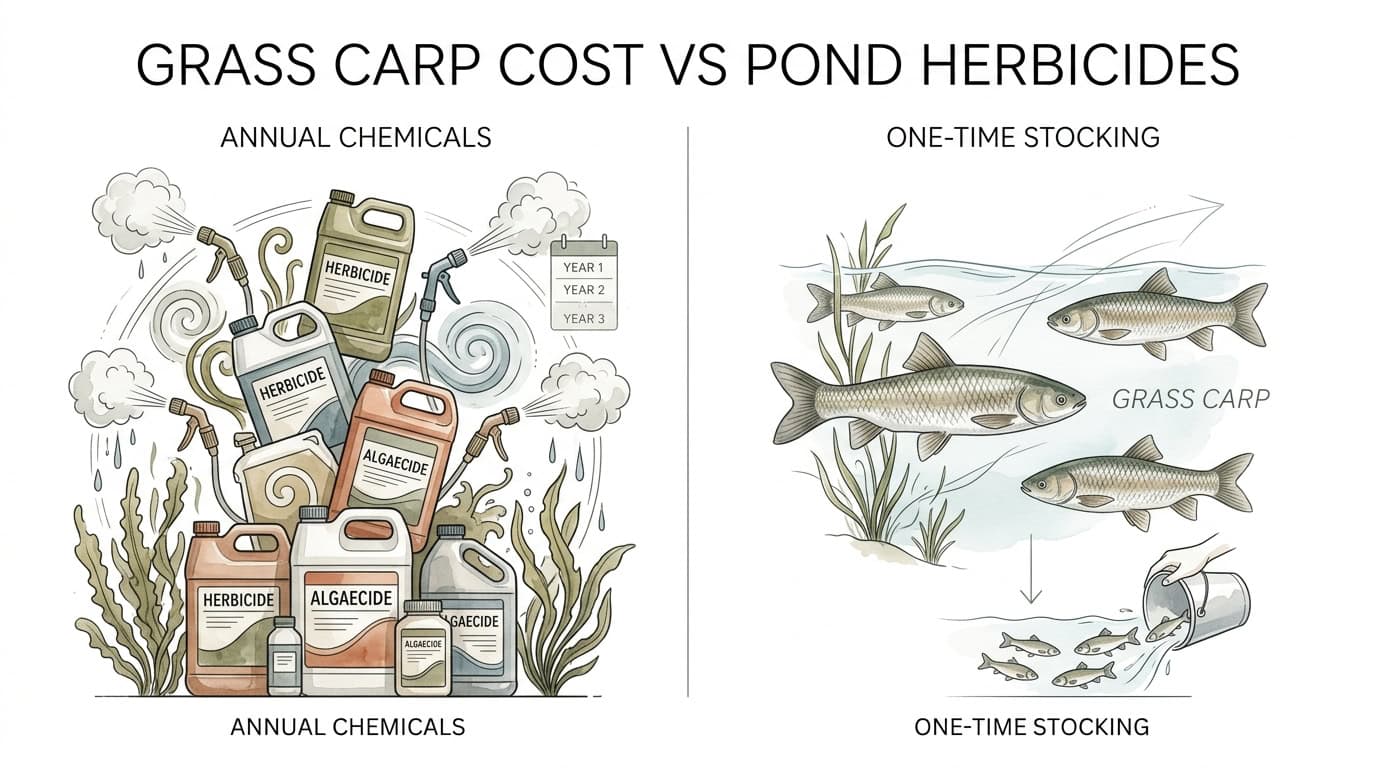
Are you buying a clear pond every summer, or are you building one that stays clear for free? The chemical industry wants you on a subscription plan for your pond. Every year the weeds come back, and every year you buy more spray. A single grass carp costs less than one gallon of herbicide and works for up to a decade. Stop the cycle of spending and switch to biological management.
Grass Carp Cost Vs Pond Herbicides
Biological control through the introduction of triploid grass carp (Ctenopharyngodon idella) represents a fundamental shift from episodic chemical intervention to continuous biomass management. In technical terms, the cost-benefit analysis favors biological agents due to their multi-year operational lifespan and low maintenance requirements once established. A single triploid grass carp, typically ranging from $10 to $25 depending on size and regional permit requirements, functions as a self-propelled unit of vegetation consumption.
Herbicide applications represent a recurring operational expense with significant volatility. Contact herbicides such as Diquat or copper-based algaecides require frequent re-application as they only treat the visible biomass without addressing the reproductive structures or the underlying nutrient load. Systemic herbicides like Fluridone (Sonar) offer more comprehensive control but at a significantly higher price point, often exceeding $500 to $1,000 per surface acre per treatment. Over a ten-year horizon, the cumulative cost of chemical management often exceeds the initial investment of a biological stocking program by a factor of ten or more.

The efficiency of the grass carp is measured by its metabolic conversion of aquatic vegetation into fish tissue. During peak growth phases, juvenile fish can consume between 50% and 300% of their body weight in soft-tissue vegetation daily. This continuous grazing prevents the accumulation of massive weed mats, thereby bypassing the need for the large-scale biomass “kills” associated with chemical treatments. This mechanical optimization of the pond ecosystem ensures that energy is diverted into fish growth rather than the production of nuisance vegetation.
Biological Specifications and Stocking Calibration
Effective pond management requires precise calibration of stocking densities based on the specific species of vegetation present and the total estimated biomass. Triploid grass carp are not universal consumers; their effectiveness is highly dependent on the palatability and structural integrity of the target plants. They possess specialized pharyngeal teeth located in the throat that allow them to grind fibrous plant material, but they prioritize soft, submerged macrophytes.
Vegetation Palatability Hierarchy
Success in biological control is predicated on matching the consumer to the resource. Grass carp demonstrate a clear preference for specific submerged species. High-priority targets include Hydrilla, Southern Naiad, Elodea (Waterweed), and various Pondweeds (Potamogeton spp.). These species are easily masticated and offer high nutritional value per unit of effort.
Secondary targets, which carp will consume only after preferred sources are exhausted, include Coontail, Bladderwort, and Muskgrass (Chara). These plants often contain higher levels of calcium carbonate or have feathery, less calorie-dense structures. Understanding this hierarchy is essential for pond managers; if the pond is dominated by non-preferred species, stocking rates must be adjusted upward, or supplemental management techniques must be integrated.
Stocking Rate Calculation Metrics
Stocking rates are typically calculated based on the percentage of pond surface area covered by vegetation. Precise acreage measurement is the first step in this calculation. For light infestations (less than 30% coverage), a rate of 2 to 5 fish per acre is often sufficient to maintain clarity. This lower density allows for some native vegetation to persist, which is often desirable for game fish habitat.
For moderate infestations (30% to 60% coverage), the recommended rate increases to 5 to 12 fish per acre. In heavy infestations exceeding 60% coverage, stocking rates of 15 to 25 fish per acre may be required to achieve visible results within a 12-to-24-month window. It is important to note that biological control is a gradual process; the system requires time to reach an equilibrium where the rate of consumption exceeds the rate of plant regeneration.
Efficiency Metrics and Long-Term Advantages
The primary advantage of biological management is the stabilization of dissolved oxygen levels within the water column. Chemical herbicides induce a rapid die-off of large biomass volumes. As this dead organic matter decomposes, aerobic bacteria consume significant quantities of dissolved oxygen. In high-temperature summer conditions, this can trigger a rapid “oxygen crash,” resulting in the total loss of the pond’s game fish population.
Grass carp eliminate this risk by providing continuous, low-impact removal. Because the vegetation is consumed and digested, there is no sudden influx of decaying matter. The nutrient recycling process is slowed, allowing the pond’s natural filtration systems and phytoplankton communities to adapt to the shifting chemical balance. This results in a more resilient aquatic ecosystem that is less prone to the boom-and-bust cycles characteristic of chemical dependency.
Furthermore, the operational lifespan of a triploid grass carp provides long-term amortized savings. While a fish may reach its maximum size within five years, it remains an active consumer for up to a decade. The cost of maintaining clear water over this ten-year period is essentially restricted to the initial purchase price and the one-time permit fee. Compared to the annual labor and material costs of herbicides, the biological approach offers superior ROI metrics.
Systemic Risks and Management Pitfalls
Transitioning to biological control involves managing a living system, which introduces specific variables not found in chemical management. One of the most significant risks is the predation of newly stocked fish. Large-mouth bass, herons, and otters frequently target juvenile carp. To mitigate this risk, managers should stock fish that are at least 8 to 12 inches in length. This size threshold significantly increases the survival rate in ponds with established predator populations.
Another critical pitfall is the failure to account for seasonal metabolic shifts. Grass carp are poikilothermic, meaning their metabolic rate is directly tied to water temperature. Consumption peaks when water temperatures are between 70°F and 85°F. In colder water, their activity levels drop significantly. Stocking should ideally occur in the spring, allowing the fish to establish themselves and begin grazing as the growing season for aquatic weeds commences.

Escapement is also a primary concern, both from a financial and regulatory perspective. Grass carp have a natural instinct to swim against current and will readily exit a pond through overflow pipes or spillways during heavy rain events. Losing the fish not only resets the weed growth clock but can also result in legal penalties if the fish enter public waterways. The installation of physical barriers is a non-negotiable requirement in many jurisdictions.
Limitations and Environmental Constraints
Pond managers must recognize the limits of biological agents. Grass carp are generally ineffective against emergent vegetation with woody or highly fibrous stems. This includes Cattails, Bulrushes, Water Lilies, and Alligatorweed. These plants have structural defenses and chemical deterrents that make them unpalatable. If these species are the primary concern, mechanical removal or targeted herbicide “spot treatments” remain the only viable options.
Additionally, grass carp are poor candidates for the control of filamentous algae. While they may consume small amounts of “pond scum” incidentally while grazing on macrophytes, they cannot keep pace with the rapid reproduction of most algae species. Over-stocking carp to solve an algae problem can actually backfire. By removing all the submerged plants that compete for nutrients, the carp can inadvertently trigger a massive phytoplankton bloom, turning the pond water a turbid green.
Regulatory constraints are another significant limitation. Due to the invasive potential of the species, most states prohibit the stocking of fertile (diploid) grass carp. Only certified triploid fish—which have been genetically modified to have three sets of chromosomes, rendering them sterile—are permitted. Obtaining the necessary permits often requires a site inspection and the verification of adequate screening on all pond exits.
Comparative Analysis: Biological vs. Chemical
To evaluate the efficiency of these two methods, we must look at the measurable factors of cost, duration, and ecosystem impact. The following data table summarizes the performance metrics of triploid grass carp versus standard annual herbicide treatments for a typical 1-acre pond over a 10-year period.
| Factor | Triploid Grass Carp (Biological) | Annual Herbicides (Chemical) |
|---|---|---|
| Initial Cost | $200 – $400 (Fish + Permit) | $300 – $800 (Chemicals + Labor) |
| Recurring Annual Cost | $0 | $300 – $800 |
| 10-Year Total Cost | $400 – $600 (includes restock) | $3,000 – $8,000 |
| Speed of Results | Slow (12 – 24 months) | Fast (3 – 14 days) |
| Oxygen Depletion Risk | Minimal (continuous grazing) | High (rapid biomass decay) |
| Labor Requirement | One-time stocking | Annual multi-day application |
| Target Specificity | Specific (Picky eater) | Broad-spectrum to Highly Selective |
Practical Tips and Best Practices
Implementation of a biological control program requires attention to mechanical details. To prevent the loss of your investment, the installation of spillway barriers is essential. Use parallel bar screens with a spacing of 1 to 2 inches. This prevents the fish from escaping while allowing organic debris like leaves to pass through without clogging the system. Clogged screens can lead to dam failure during flood events, so regular inspection is mandatory.
When selecting fish, prioritize health and size over quantity. It is better to stock ten 12-inch fish than twenty 6-inch fish. The larger fish have a higher metabolic capacity and are much less likely to be consumed by resident bass. If the pond is currently choked with weeds, consider a “reset” treatment using a short-lived contact herbicide. This reduces the initial biomass and allows the grass carp to manage the tender new growth, which they much prefer over mature, woody plants.
- Measure precisely: Use satellite imagery or GPS tools to calculate exact surface acreage before ordering fish.
- Verify species: Ensure your target weeds are on the “preferred” list for grass carp.
- Time the stocking: Aim for water temperatures between 60°F and 70°F for maximum acclimation success.
- Install barriers: Secure all pond exits with vertical or horizontal bar screens.
- Be patient: Allow at least two full growing seasons to evaluate the success of the stocking.
Advanced Nutrient Cycling Considerations
Experienced pond managers must understand that grass carp do not remove nutrients from the pond ecosystem; they recycle them. When a carp consumes a plant, the nitrogen and phosphorus contained within that plant are either incorporated into the fish’s tissue or excreted back into the water as waste. This waste provides an immediate nutrient source for phytoplankton and algae.
In ponds with high nutrient loading (from fertilizer runoff or livestock waste), the removal of all submerged macrophytes can lead to a shift from a clear-water state to a turbid-water state. Submerged plants act as “nutrient sinks,” locking up phosphorus in their roots and stems. When the carp eliminate these plants, the phosphorus is released, often fueling intense algae blooms. To counteract this, serious practitioners should combine grass carp with aeration systems or nutrient binders like lanthanum-modified clay to manage the internal phosphorus load.
Furthermore, the age of the fish significantly impacts the system’s efficiency. As grass carp mature and reach their maximum size, their metabolic rate slows. A 30-pound carp does not eat as much relative to its body weight as three 10-pound carp. To maintain consistent control, a “staggered stocking” approach is often best. Adding a few new fish every 3 to 5 years ensures a constant presence of young, aggressive grazers within the population.
Example Scenario: The 2-Acre Reclamation
Consider a 2-acre farm pond that has been neglected for five years. It currently has 70% coverage of Hydrilla and Southern Naiad. The owner has been spending $600 per year on Diquat and copper sulfate, yet the weeds return with more vigor every June. The cost of a professional herbicide application with a systemic product like Fluridone is quoted at $1,200 for a one-time treatment, with no guarantee of multi-year control.
Instead, the owner opts for biological management. Following state permitting, they install a $150 spillway screen. They then stock 30 triploid grass carp (15 per acre) at a size of 10-12 inches. The total cost for the fish and transport is $450. The initial investment is $600—the same as one year of the “chemical subscription.”
In year one, the results are subtle. The weeds stop reaching the surface but remain visible. By the end of year two, the Hydrilla mats have vanished, and the pond is open for fishing. For the next seven years, the owner spends $0 on weed control. The carp continue to graze the new growth as it appears. By year ten, the owner has saved over $5,000 compared to the previous chemical regimen, and the pond ecosystem is more stable and productive for the resident game fish.
Final Thoughts
Transitioning from a chemical-based pond management strategy to a biological one is a move toward systemic efficiency. While herbicides offer the gratification of immediate results, they ignore the underlying biology of the pond and create a cycle of dependency. Triploid grass carp provide a continuous, low-cost alternative that aligns with the natural rhythms of the aquatic environment. By acting as “underwater cows,” these fish convert nuisance biomass into fish growth without the risks associated with chemical oxygen crashes.
Successful management requires a technical approach: identifying weed species, calculating precise stocking rates, and protecting the investment with proper screening. It is not a “fire and forget” solution, but a management tool that requires patience and an understanding of nutrient cycling. For the pond owner willing to trade instant results for long-term stability, grass carp represent the most cost-effective tool in the arsenal.
Apply these principles to your own water body and observe the shift in clarity and cost. As you reduce external inputs, the pond’s natural resilience will increase. Consider looking into related systems like supplemental aeration or vegetative buffers to further optimize your aquatic ecosystem and ensure the long-term success of your biological management plan.
Amazon and the Amazon logo are trademarks of Amazon.com, Inc, or its affiliates.