

Pond Talk is an Amazon Associate. As an Amazon Associate we earn from qualifying purchases.
What if your pond’s biggest problem was actually the secret to your family’s food security? Most people see pond weeds as trash to be removed. A grass carp sees them as fuel. Stocking these herbivores allows you to literally turn a nuisance ‘waste’ product into pounds of healthy, lean protein. It’s the ultimate closed-loop system for the modern homestead.
This strategy shifts the paradigm of pond management from a maintenance-heavy liability to a productive asset. Instead of applying chemical herbicides that require recurring financial outlays, you utilize a biological converter that translates unwanted biomass into edible tissue. This process relies on the unique physiology and metabolic efficiency of the grass carp, a species engineered by nature to process cellulose at an industrial scale.
Implementing a grass carp program requires more than simply releasing fish into a body of water. Success depends on understanding stocking densities, environmental variables, and the specific culinary techniques required to process this unique protein source. This guide provides the technical data and mechanical optimizations necessary to integrate grass carp into a sustainable food production system.

Grass Carp As A Food Source
The grass carp (Ctenopharyngodon idella), also known as the white amur, is a large herbivorous freshwater fish belonging to the family Cyprinidae. It is native to the large rivers of East Asia, specifically the Amur River system on the border of China and Russia. While often categorized as a “trash fish” in North American sport-fishing circles, it is actually the most widely farmed freshwater fish in the world by total tonnage.
Global aquaculture data from the Food and Agriculture Organization (FAO) indicates that grass carp production exceeds 5.7 million metric tons annually. This volume is driven by the species’ ability to thrive in varied climates and its reliance on low-cost, vegetation-based diets. In many cultures, it is prized for its firm, white flesh and high protein-to-fat ratio.
The nutritional profile of grass carp is comparable to other popular freshwater species like tilapia and perch. Analysis shows that a market-sized grass carp contains approximately 19% crude protein and less than 2% fat, depending on its specific diet. This lean profile makes it an efficient protein source for those seeking a healthy alternative to traditional livestock.
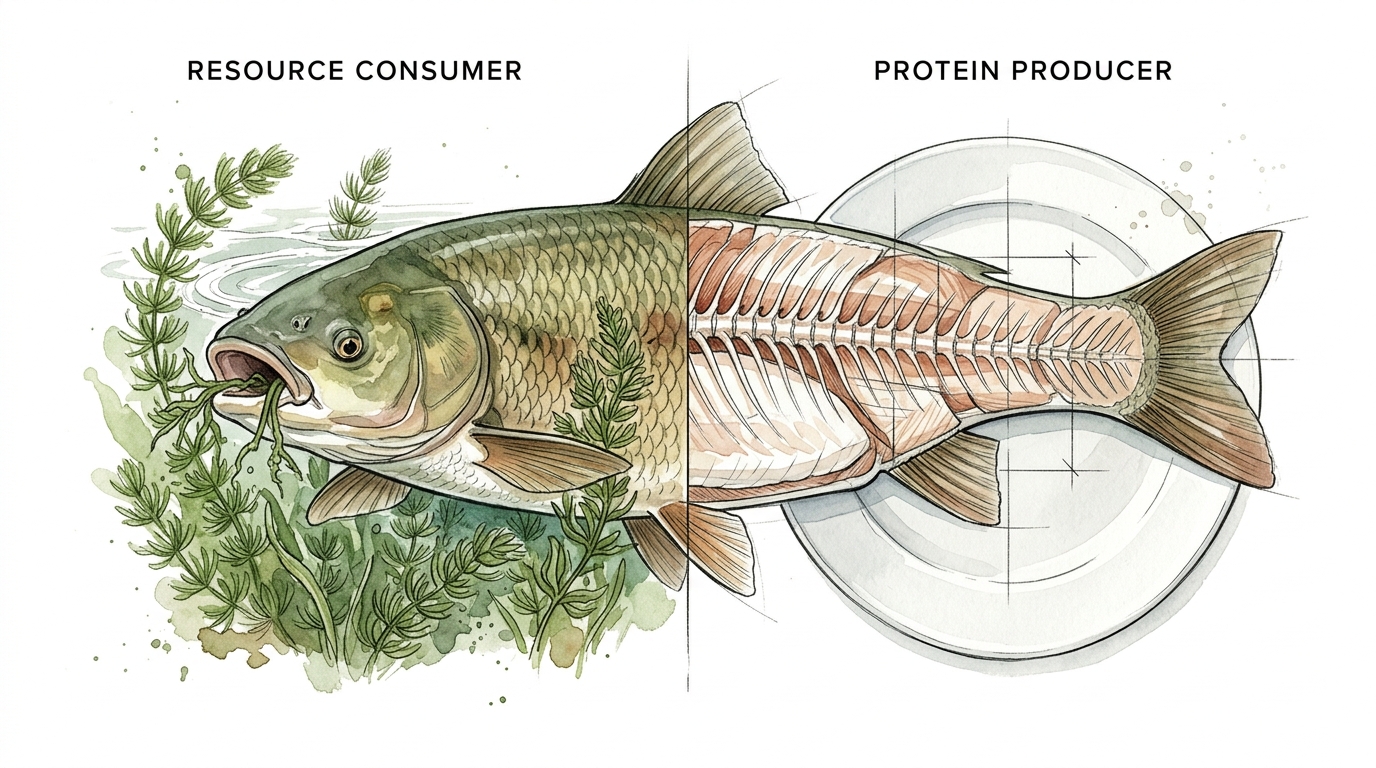
Visualizing the grass carp as a food source requires looking past its role as a “weed eater.” It functions as an aquatic cow, grazing on submersed vegetation and converting solar energy—captured by plants—into muscle tissue. This conversion is the fundamental principle of the protein producer model, where inputs are largely free and local.
How The Biological Conversion System Works
The primary mechanism of the grass carp’s efficiency is its specialized digestive anatomy. Unlike many other fish, the grass carp possesses powerful pharyngeal teeth located in its throat. These teeth are designed to grind and rasp tough aquatic vegetation, breaking down cell walls before the material enters the gut.
This mechanical breakdown is necessary because the grass carp has a relatively short intestinal tract for an herbivore. Efficiency is prioritized through high-volume consumption rather than slow fermentation. A juvenile grass carp can consume up to 100% of its body weight in fresh vegetation daily under optimal conditions.
Metabolic rates are heavily influenced by water temperature. Peak feeding activity occurs between 78°F and 90°F (25°C to 32°C). When temperatures drop below 55°F (12.7°C), consumption rates plummet, and the fish enters a semi-dormant state. Understanding this thermal window is critical for predicting growth rates and harvest windows.
Feed conversion ratios (FCR) for grass carp on a natural weed diet are different from those on commercial pellets. While commercial feed might offer an FCR of 1.5:1, a natural diet of aquatic macrophytes requires a higher volume of intake. It typically takes between 10 and 20 pounds of wet vegetation to produce one pound of fish weight, making the “waste” biomass of a pond an essential fuel source.
The Practical Benefits of Stocking Herbivores
Utilizing grass carp offers several measurable advantages for the self-sufficient homestead. The most immediate benefit is the reduction or elimination of aquatic herbicides. Chemical treatments are expensive, temporary, and can disrupt the pond’s delicate ecosystem. Grass carp provide a continuous, self-regulating solution that maintains water clarity without synthetic inputs.
Biological control leads to a significant reduction in labor. Removing weeds manually with rakes or cutters is physically demanding and must be repeated several times a season. Once established, a population of grass carp works 24 hours a day to keep submersed vegetation in check. This frees up time for other high-value homesteading tasks.
Protein yield is the secondary, yet equally vital, benefit. A 10-pound grass carp provides approximately 3 to 4 pounds of clean, boneless fillets when processed correctly. In a one-acre pond stocked with 15 fish, you are effectively sitting on 150 pounds of potential live-weight protein that is growing at zero cost to the operator.

Environmental stability is enhanced through the cycling of nutrients. Aquatic weeds store nitrogen and phosphorus; when they die and decay, they can cause oxygen crashes. Grass carp consume this biomass and excrete nutrients in a form that is more easily processed by the pond’s microorganisms, stabilizing the system over the long term.
Challenges and Technical Hurdles
Processing grass carp for the table presents two primary challenges: flavor and bone structure. Many freshwater fish are susceptible to geosmin, a compound produced by certain algae that imparts a “muddy” or “earthy” taste. Because grass carp live in the same environment where these algae thrive, the meat can absorb these flavors if not handled correctly.
The second challenge is the presence of intramuscular bones, often referred to as “Y-bones.” These are not part of the main skeleton but are suspended in the muscle tissue of the fillet. Standard filleting techniques used for bass or trout will leave these bones in the meat, making the fish difficult to eat for those accustomed to store-bought fillets.
Regulatory compliance is another hurdle that varies by geography. Because grass carp are highly efficient at consuming vegetation, they can be devastating to native ecosystems if they escape into public waterways. Consequently, many states require the use of “Triploid” grass carp—fish that have been sterilized through a pressure or heat-shock process at the egg stage.
Obtaining permits and purchasing certified sterile fish can add to the initial setup cost. In some northern regions, the fish are prohibited entirely. Homesteaders must verify local fish and wildlife regulations before attempting to stock their private ponds. Ignoring these laws can lead to significant fines and ecological damage.
Limitations and Environmental Constraints
Grass carp are not a universal solution for every pond. They have specific preferences and will consume certain plants while ignoring others. For example, they highly prefer submersed plants like hydrilla and pondweed but often avoid filamentous algae or tough, woody plants like cattails. If your pond’s primary problem is algae, stocking grass carp may result in the fish eating the desirable plants first, leaving the “scum” untouched.
Water quality is a non-negotiable constraint. While grass carp are hardy, they require dissolved oxygen levels above 3 ppm to survive and above 4 ppm to feed actively. Heavily weed-choked ponds often experience oxygen dips at night when plants stop producing oxygen and start consuming it. This can lead to fish kills if the biomass is too high for the water volume.
Growth rates diminish as the fish ages. A grass carp is most effective as a weed-control tool and a rapid protein producer during its first 5 to 7 years of life. After reaching 15 to 20 pounds, their metabolic rate slows, and they consume less vegetation per pound of body weight. This necessitates a rotational stocking and harvesting strategy to maintain system efficiency.
Escape prevention is mandatory for any pond located in a flood-prone area. Grass carp are strong swimmers and will instinctively swim upstream or downstream during a heavy rain event. If a pond overflows, the fish will likely exit through the spillway. Installing sturdy screens or grates on all outlets is essential to protect your investment and the local environment.
Comparative Efficiency Metrics
To understand where grass carp fit into a homesteading strategy, it is helpful to compare them against other common aquaculture species. The following table outlines key performance indicators for a natural, low-input pond system.
| Metric | Grass Carp | Channel Catfish | Tilapia |
|---|---|---|---|
| Primary Food Input | Aquatic Vegetation (Free) | Pellets / Invertebrates (Costly) | Algae / Pellets (Moderate) |
| Growth Rate (lbs/year) | 3 – 10 lbs | 1 – 2 lbs | 0.5 – 1.5 lbs |
| Cold Tolerance | High (Survives under ice) | Moderate (Dormant in winter) | Low (Dies below 50°F) |
| Maintenance Level | Low (Self-foraging) | Moderate (Needs daily feeding) | High (Invasive potential/temp care) |
This comparison demonstrates that for a RESOURCE CONSUMER vs PROTEIN PRODUCER analysis, the grass carp is the superior choice for high-volume, low-input growth. While catfish require high-protein feed (which is a resource drain), the grass carp produces protein by consuming a liability (weeds).
Practical Tips for Harvesting and Preparation
Optimal results depend on the quality of the harvest and the precision of the butchery. Purging is the single most effective way to eliminate “muddy” off-flavors. If possible, catch the fish alive and place them in a tank of clean, running water for 3 to 7 days. This allows the fish to metabolize any geosmin stored in its fat and flush its system, resulting in a significantly cleaner taste profile.
Bleeding the fish immediately after harvest is another professional technique. Severing the gills or cutting the tail allows the heart to pump out the blood, which is often where the strongest fishy flavors reside. Once bled, the fish should be packed in ice immediately to maintain the texture of the white muscle fibers.
Removing the lateral line is a mandatory step during filleting. This “bloodline” of dark red meat along the side of the fish contains high concentrations of fat and strong-flavored compounds. Trimming this away leaves only the mild, white meat. For the Y-bones, many chefs recommend “scoring” the fillet—making vertical cuts every 1/8 inch—which allows heat to soften the bones during frying, or using the fish for “minced” applications like fish cakes where bones can be removed through a sieve or grinder.
Cooking methods should reflect the fish’s firm texture. Grass carp holds up exceptionally well to steaming, smoking, and deep-frying. In traditional Chinese cuisine, the fish is often steamed whole with ginger and scallions, a method that allows the meat to slide easily off the bones. Smoking is another excellent option, as the long, slow heat renders the intramuscular fat and makes the bones easier to identify and remove.
Advanced Considerations: Polyculture Systems
Serious practitioners often look beyond monoculture and move toward polyculture systems. In a balanced pond, grass carp can coexist with other species to maximize every niche of the environment. For example, stocking grass carp alongside bluegill and bass creates a multi-layered food web. The carp manage the vegetation, providing open water for the bass to hunt, while the bluegill provide a secondary food source for the homesteader.
Managing stocking density is a precision task. A general rule of thumb is 10 to 15 fish per acre for moderate weed control. However, if your goal is primarily food production, you may choose to stock at a higher density and supplement their diet with terrestrial grasses, such as lawn clippings (provided they are pesticide-free) or hay. This allows for a higher “harvestable biomass” per square foot of water.
Monitoring the “recruitment” of your fish is vital in states where diploid (fertile) fish are legal. In most US states, triploid fish will never reproduce, meaning you must restock every few years as you harvest your older fish. Keeping a detailed log of the number of fish added, their approximate weight, and the dates of harvest ensures you never over-extract from the system.
Bioenergetics plays a role in advanced management. The more energy a fish spends swimming or fighting current, the less energy it puts into growth. If you have a choice between a high-flow area and a stagnant pond, the pond will generally yield faster growth. However, adding a solar-powered aerator can increase oxygen levels, allowing for even higher metabolic activity and faster weight gain during the summer months.
Example Scenario: The 1-Acre Homestead Pond
Consider a homestead with a one-acre pond that is 40% covered in hydrilla and pondweed by mid-June. This represents several tons of wet biomass. By stocking 12 triploid grass carp at a size of 10 inches, the homesteader initiates a biological cleanup. Within the first season, those 10-inch fish (roughly 1 pound each) will likely triple in size, consuming a significant portion of the surface weeds.
By the second autumn, the fish will average 8 to 10 pounds each. At this stage, the homesteader can begin a rotational harvest. Taking three fish provides approximately 30 pounds of live weight, or roughly 12 pounds of high-quality fillets. This harvest provides several family meals while leaving nine fish to continue managing the pond and growing for future seasons.
Replacing the harvested fish with three new fingerlings each year maintains a steady-state population. This “staggered age” approach ensures that there are always large fish for weed control and younger, faster-growing fish for future protein needs. It turns the pond into a self-sustaining pantry that requires almost zero external input.
Final Thoughts
Transforming a weed-choked pond into a protein-producing machine is a matter of biological engineering and technical application. Grass carp offer a unique opportunity to turn a common maintenance problem into a high-value food source. Understanding the mechanics of their digestion, the constraints of their environment, and the techniques for their preparation allows any homesteader to gain a higher level of self-sufficiency.
Success in this endeavor requires a commitment to quality over quantity. From the selection of certified triploid fish to the precision of the purging process, every step influences the final output. The result is a lean, healthy protein source that grows silently in your own backyard, powered entirely by the “waste” products of the natural world.
Experimenting with grass carp as a food source may feel unconventional at first, but the data supports its efficiency. As global food systems become more complex and expensive, the value of a closed-loop, localized protein system becomes undeniable. Start small, follow the regulations, and let the biology of the white amur work in your favor.
Amazon and the Amazon logo are trademarks of Amazon.com, Inc, or its affiliates.