

Pond Talk is an Amazon Associate. As an Amazon Associate we earn from qualifying purchases.
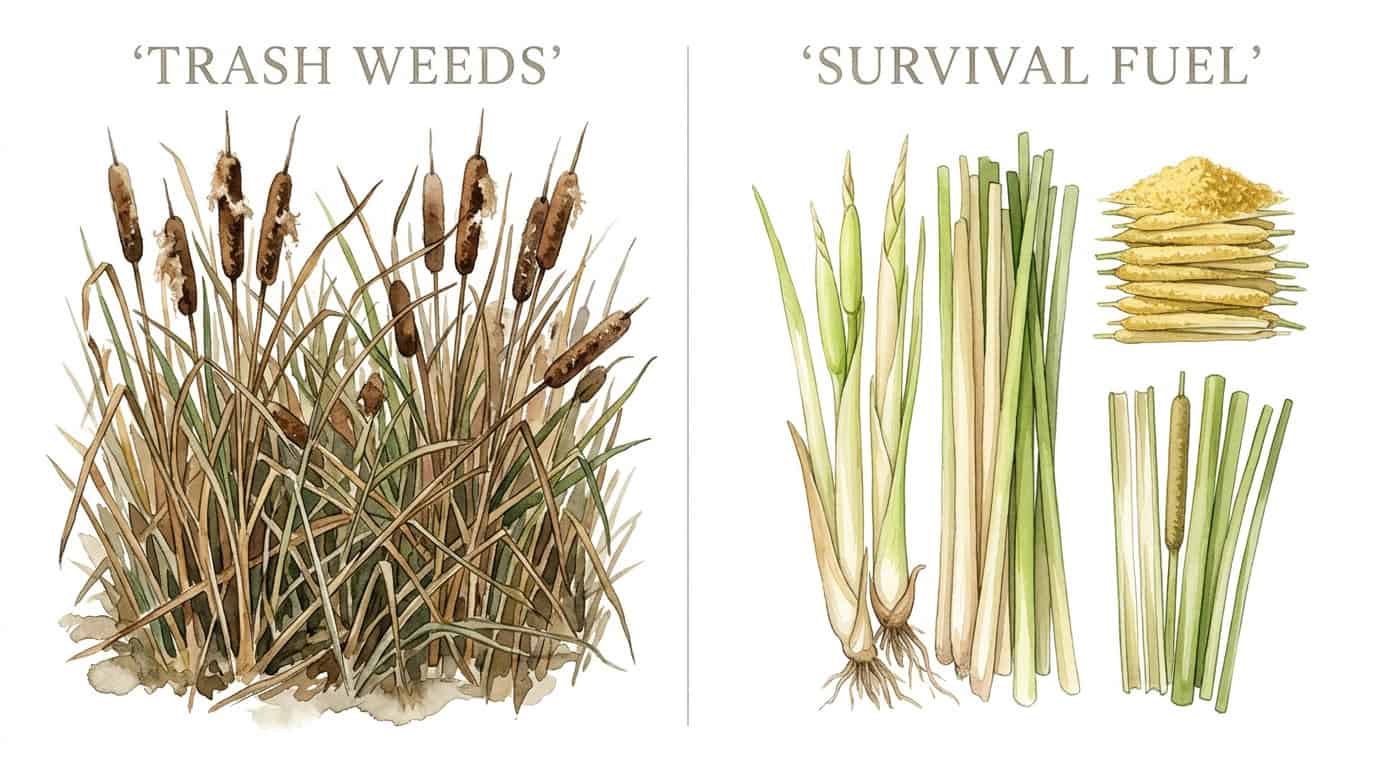
Most people see a nuisance in the ditch, but survivalists see a four-season grocery store. What if the ‘weed’ you’re trying to eradicate from your pond is actually the most versatile calorie source in the wild? From bread flour to tender ‘marsh asparagus,’ the cattail is the ultimate swamp fuel.
The genus Typha, commonly known as the cattail, represents one of the highest energy-return-on-investment (EROI) flora species in North American wetlands. This perennial plant is not merely a survival food; it is a technical resource capable of providing starch, protein, mechanical fiber, and high-BTU fuel. Understanding the mechanical and chemical properties of the cattail allows a practitioner to transition from opportunistic foraging to systematic resource extraction.
Foraging Cattails For Food Guide
The cattail is a wetland macrophyte characterized by its distinctive brown, cylindrical flower spikes and long, sword-like leaves. In North America, the two primary species are Typha latifolia (broadleaf) and Typha angustifolia (narrowleaf), along with their hybrid, Typha x glauca. These plants function as biological pumps, sequestering solar energy into dense underground rhizome systems that store complex carbohydrates for multi-year survival.

Identification is critical due to the presence of toxic look-alikes. The cattail grows in saturated soils or standing water up to three feet deep. A mature plant reaches heights of 3 to 10 feet. The leaves are flat, slightly convex on the back, and lack a prominent midrib, which distinguishes them from the poisonous Iris family. The base of the plant is white and succulent, containing the highest concentration of immediate-use nutrients during the spring growth phase.
Caloric density varies significantly by plant part and season. The rhizomes, or underground stems, provide the most substantial energy reserve. These structures are approximately 30% to 40% starch by dry weight. During peak autumn storage, a single hectare of cattails can yield up to 22.4 tons of biomass, providing a theoretical caloric output that rivals traditional agricultural crops like potatoes or corn.
How the Foraging Cycle Operates Across Seasons
Extraction of nutrients from Typha requires a chronological strategy. The plant allocates energy differently depending on the thermal and photoperiodic conditions of the environment. A successful harvesting protocol must align with these biological shifts to maximize efficiency and minimize energy expenditure.
In early spring, the plant initiates the “shoot” phase. Emerging stems, often referred to as “Cossack asparagus,” are harvested by pulling the inner core from the leaf sheaths. These shoots are low in complex starch but high in simple sugars and moisture, making them an ideal source for immediate hydration and micro-nutrients. Technical analysis shows these shoots contain approximately 25 to 26 calories per 100 grams, with a protein content of 1.2%.
Summer transitions the plant into the reproductive phase. The green bloom spikes, found above the female flower, are harvested before they turn brown and woody. These spikes are high in minerals and provide a texture similar to corn on the cob. Following this, the plant produces vast quantities of yellow pollen. Cattail pollen is a concentrated protein source, containing up to 15% to 19% protein and significant levels of Vitamin K and Manganese.
Autumn and winter represent the starch-harvesting window. As the aerial portions of the plant die back, the complex carbohydrates migrate downward into the rhizomes. These rhizomes consist of a fibrous core surrounded by a starchy parenchyma. Harvesting during the dormant season ensures the highest possible starch-to-fiber ratio, optimizing the energy return of the extraction process.
Mechanical Methods for Starch and Flour Extraction
Extracting edible flour from the rhizomes is a mechanical process involving the separation of starch granules from the cellulose fiber matrix. The energy required for processing must be weighed against the final caloric yield to maintain a positive EROI.
The most efficient manual method is the “wet milling” technique. First, the rhizomes are cleaned of mud and the outer fibrous skin is peeled away. The white, starchy core is then submerged in water and crushed. This mechanical agitation breaks the cell walls, allowing the starch granules to settle at the bottom of the vessel as a white paste.
Once the fibers are removed, the water is decanted, and the remaining starch is dried. This “cattail flour” is a high-grade carbohydrate source. Technical data indicates that Typha angustifolia rhizomes contain roughly 13.51% amylose, contributing to their functionality as a thickener or flour substitute. The resulting flour can be used in a 1:1 ratio with wheat flour in various applications, though it lacks gluten and requires a binding agent for structural stability in leavened products.
Benefits of Typha as a Survival Resource
Typha species offer measurable advantages over other wild forage due to their ubiquity and multi-purpose utility. The plant functions not only as a food source but as a technical material for shelter and tool production.
The energy return is perhaps the most significant benefit. Research indicates that cattails are capable of producing up to 3,000 kg of harvestable biomass per hectare with a 50% harvest rate. The calorific value of the dried biomass is approximately 16 to 20 Megajoules per kilogram (MJ/kg), which is comparable to standard wood pellets used in industrial heating. This makes the plant an excellent secondary fuel source for thermal regulation in survival scenarios.

Mechanical properties of the leaves add further value. Extracted cattail fibers exhibit a tensile strength ranging from 30 to 1106 MPa. This strength-to-weight ratio makes the leaves ideal for cordage, weaving, and even as reinforcement in composite materials. The “fluff” or seed down has an impressive R-value, providing high-efficiency insulation for clothing or sleeping systems when kept dry.
Challenges and Common Identification Mistakes
The primary risk in foraging cattails is the misidentification of the plant during its early growth stages. Iris pseudacorus (Yellow Flag Iris) and Acorus calamus (Sweet Flag) often inhabit the same ecological niches as Typha.
Yellow Flag Iris is toxic and contains iridin, a compound that causes severe gastrointestinal distress. To distinguish between the two, foragers must examine the leaf structure. Iris leaves are flat and arranged in a fan shape, while cattail leaves are rounded at the base and grow in an overlapping, circular pattern. Furthermore, Iris leaves possess a distinct, raised midvein that is absent in the cattail.
Another challenge involves the mechanical effort required for rhizome extraction. Rhizomes are often embedded in thick, anaerobic mud. The physical cost of digging, cleaning, and processing must be accounted for in any survival calorie budget. Inefficient harvesting in deep mud can result in a net caloric loss if the practitioner spends more energy on extraction than the resulting starch provides.
Limitations: Environmental Constraints and Safety
The most significant technical limitation of the cattail is its role as a hyperaccumulator of environmental toxins. Cattails are frequently used in wastewater treatment and phytoremediation because they excel at sequestering heavy metals and chemical pollutants from the soil and water.
Research confirms that Typha latifolia translocates Zinc, Copper, Cadmium, and Chromium into its tissues, specifically the roots and rhizomes. Studies have recorded Zinc levels exceeding 10,000 mg/kg of dry biomass in contaminated sites. If the water source is downstream from industrial runoff, agricultural drainage, or septic systems, the plant may contain dangerous concentrations of these elements.
Foragers must conduct a site assessment before harvesting. Standing water in urban ditches or near intensive livestock operations should be avoided. The plant does not filter these toxins out for the consumer; it stores them. Consequently, the safety of the food source is directly tied to the purity of the local watershed.
Comparison: Cattail Rhizomes vs. Agricultural Staples
To understand the value of Typha as a “survival fuel,” it is useful to compare its performance metrics against common agricultural staples. The following table highlights the efficiency and nutritional output of cattails compared to potatoes and wheat.
| Metric | Cattail (Rhizome) | Potato (Tuber) | Wheat (Grain) |
|---|---|---|---|
| Caloric Yield (per 100g) | ~260 kcal (as flour) | ~77 kcal | ~340 kcal |
| Starch Content (%) | 30% – 40% | 17% – 20% | 60% – 70% |
| Harvest Effort (Mechanical) | High (Mud Extraction) | Medium (Soil Digging) | Low (Mechanical) |
| Environmental Requirements | Wetlands/Lowland | Well-drained Soil | Arable Land |
While wheat offers higher caloric density, the cattail requires zero agricultural inputs—no fertilizer, no irrigation, and no tilling. This makes it a superior resource in a “low-input” or “no-input” survival economy.
Practical Tips for Yield Optimization
Maximizing the efficiency of cattail foraging requires a systematic approach to tools and techniques. Advanced practitioners use specific strategies to reduce energy expenditure during the extraction phase.
One effective technique is the use of a “harvesting rake” or a long-handled hoe to pull rhizomes from the mud without entering the water, which minimizes thermal loss to the body. If harvesting by hand, work in a “backward” motion to avoid stepping on the very rhizomes you are trying to extract.
The processing of pollen should be done during the narrow 7-to-10-day window in early summer. To optimize yield, place a paper bag over the mature yellow spike and shake vigorously. High-quality pollen is extremely fine and can be used to significantly boost the protein content of any wild-foraged meal. For long-term storage, the pollen must be kept in an airtight container to prevent moisture absorption and mold growth.
Advanced Considerations: Mechanical Properties and Biofuels
Beyond nutrition, the Typha genus is a subject of intense research for its industrial potential. The leaves contain a distinctive bionic structural model consisting of epidermis and aerenchyma. This structure provides buoyancy and chemical stability, which can be leveraged in creating advanced bioproducts.
Alkaline retting is the most efficient degumming process for extracting high-quality fibers from the leaves. Treatment with solutions like KOH or NaOH at 80°C for several hours can yield up to 40% fiber by mass. These fibers have been tested for use in fiber-reinforced composites, showing a modulus of elasticity that makes them competitive with flax or hemp.
The combustion profile of cattails is also highly favorable. When compressed into fuel pellets, cattails produce only 3% to 6% ash. The high concentration of phosphorus in the ash makes it a valuable secondary resource, as it can be recycled back into agricultural soil as a slow-release fertilizer. This creates a “closed-loop” energy system where the plant provides heat, and its waste product fuels further growth.
Examples and Scenarios for Practical Application
Consider a survival scenario where an individual requires 2,500 calories per day to maintain baseline metabolic function. If relying solely on cattail shoots in the spring, the individual would need to consume approximately 10 kilograms of raw shoots daily. This is physically impossible and energetically inefficient.
However, in the late autumn, the strategy shifts to rhizome starch. A well-processed batch of rhizomes can yield 500 grams of dry flour. At 260 calories per 100 grams, this provides 1,300 calories, or over 50% of the daily requirement, from a single processing session. By supplementing this with high-protein pollen stored from the summer (at 15% protein), the individual can achieve a balanced nutritional profile.
Mechanical efficiency also applies to insulation. A standard “foraging bag” filled with 1 kilogram of dry cattail fluff can provide enough loft to increase the thermal rating of a makeshift sleeping pad by several degrees. This dual-use capability—food and thermal protection—is what classifies Typha as a “survival fuel” rather than just a snack.
Final Thoughts
The cattail is a masterclass in biological efficiency. It transforms stagnant water and solar energy into a dense, starchy resource that remains accessible throughout the most brutal winters. For the practitioner, it represents a bridge between the unpredictability of the wild and the stability of a reliable fuel source.
Success with Typha depends on moving past the “nuisance” mindset and adopting an engineering perspective. Every part of the plant—the shoots, spikes, pollen, leaves, and rhizomes—functions as a specific component in a larger survival system. By mastering the timing of the harvest and the mechanics of extraction, one can turn a simple ditch into a self-sustaining caloric powerhouse.
Whether you are preparing for a long-term survival situation or simply exploring the technical limits of wild foraging, the cattail remains the most consistent asset in the wetland. Apply these principles of extraction and identification, and you will never look at a swamp the same way again. Experiment with the starch yields in your local area and begin building your own database of seasonal availability to truly master this ultimate swamp fuel.
Amazon and the Amazon logo are trademarks of Amazon.com, Inc, or its affiliates.