

Pond Talk is an Amazon Associate. As an Amazon Associate we earn from qualifying purchases.
Why buy firewood when your pond produces high-BTU fuel every single autumn? Every year, pond owners spend hours raking up dead cattails and hauling them to the landfill. They aren’t just throwing away plants; they’re throwing away home heating. Discover how to turn ‘swamp trash’ into high-efficiency bio-fuel that can heat your home for zero dollars.
Cattail Biomass Fuel Pellets Guide
Cattail biomass fuel pellets are a densified form of energy derived from the Typha genus of wetland plants. These plants are ubiquitous across North American wetlands and pond margins, often viewed as invasive or problematic due to their aggressive growth patterns. From a technical standpoint, however, cattails represent a high-yield perennial energy crop capable of producing substantial dry matter per hectare.
The transition from raw plant material to fuel pellets involves mechanical dehydration, size reduction, and high-pressure extrusion. Unlike wood pellets, which rely on the forestry industry’s waste stream, cattail pellets utilize an “ecological biomass” that actively removes excess phosphorus and nitrogen from water bodies during its growth phase. This makes the fuel not only carbon-neutral but also a tool for aquatic remediation.

In real-world applications, these pellets serve as a direct substitute for cordwood or commercial wood pellets. Research indicates that the calorific value of cattail pellets ranges between 16 and 20 megajoules per kilogram (MJ/kg), placing them in the same energy bracket as premium hardwoods. They are utilized in specialized biomass boilers, pellet stoves, and industrial co-firing plants where high-ash feedstocks can be managed effectively.
Engineering the Conversion: Technical Processing Steps
Processing Typha into a combustible fuel requires a systematic approach to moisture management and physical densification. Raw cattails can contain up to 80% moisture when harvested green. Successful pelletization requires this level to drop below 15% to ensure structural integrity and combustion efficiency.
The first stage is harvesting, ideally performed in late autumn or early winter. Harvesting standing dead material allows for natural pre-drying, reducing the mechanical energy required for moisture removal. Specialized aquatic harvesters or modified agricultural equipment are used to cut the stalks 10-20 cm above the water line, preserving the plant’s respiratory “stubble” for next year’s growth.
Once harvested, the material must pass through a hammer mill. This machine grinds the fibrous stalks into a consistent “fluff” or powder with a particle size typically under 5mm. This uniformity is critical for the next stage, where the material enters a pellet mill. Inside the mill, a die and roller system apply intense pressure, heating the material and activating the natural lignins. These lignins act as a biological adhesive, binding the fibers into cylindrical pellets without the need for synthetic additives.
Mechanical Parameters for Pelletization
- Hammer Mill Screen Size: 4mm to 6mm for optimal flow into the die.
- Die Compression Ratio: 1:8 to 1:12 depending on the fiber density and lignin content.
- Internal Temperature: 70°C to 90°C during extrusion to ensure lignin melting and sterilization.
- Target Moisture: 10% to 12% for the finished product to maximize durability and storage life.
Thermal Efficiency and Energy Metrics
The energy density of cattail pellets is their primary technical advantage. Analytical tests show that densified Typha provides approximately 7,500 to 8,200 BTU per pound. This energy output is comparable to standard wood pellets and significantly higher than the 3,500 to 5,000 BTU/lb found in raw, non-densified agricultural residues.
Combustion efficiency in modern biomass stoves can exceed 80% when using these pellets. This is due to the uniform surface area and low moisture content, which allow for a consistent air-to-fuel ratio. In contrast, burning raw cattail bundles or “sodden debris” often results in incomplete combustion, high smoke output, and lower thermal recovery because energy is wasted evaporating internal water.
Another metric of interest is the Pellet Durability Index (PDI). Well-processed cattail pellets typically achieve a PDI of 97% or higher. This indicates they can withstand mechanical handling in automated auger systems without breaking down into “fines” (dust), which can clog feeders and cause erratic burn rates.
Advantages of Cattail Bio-Fuel
The primary advantage is the decoupling of home heating from the commercial timber or fossil fuel markets. Pond owners have access to a self-renewing feedstock that requires zero input of fertilizers or pesticides. This “waste-to-energy” model provides a high degree of energy independence.
Environmentally, harvesting cattails is a form of nutrient mining. For every ton of biomass removed, approximately 2 to 3 kilograms of phosphorus are removed from the aquatic ecosystem. This prevents the “internal loading” of nutrients that leads to toxic algae blooms and pond stagnation. The combustion process also sequesters carbon that would otherwise be released as methane—a more potent greenhouse gas—during the natural anaerobic decomposition of the plants in the muck.
Furthermore, the ash produced from burning cattail pellets is rich in potassium and phosphorus. Unlike coal ash, which is a hazardous waste, cattail ash can be recycled back into garden soil as a high-quality mineral fertilizer. This creates a closed-loop system of nutrient management and energy production.
Challenges and Common Mistakes
The most frequent error in cattail pellet production is harvesting at the wrong moisture threshold. Attempting to pelletize material with more than 20% moisture leads to “steam explosions” inside the die or soft, crumbly pellets that rot in storage. Conversely, material that is too dry (below 8%) will not bind correctly and will cause excessive wear on the pellet mill rollers.

Another technical challenge is silica management. Cattails naturally accumulate silica and other minerals from the water. When burned at high temperatures, these minerals can fuse into “clinkers”—hard, glass-like deposits that block the airflow in a stove’s burn pot. Operators often fail to account for this, leading to system shutdowns or mechanical failure of the ash removal augers.
Mechanical wear is also higher than with wood. The high fiber content and mineral inclusions in cattails are abrasive. Using standard carbon steel dies often results in a short service life. Upgrading to high-chrome stainless steel dies and rollers is necessary for long-term operational efficiency.
Limitations and System Constraints
Cattail pellets are not a “drop-in” replacement for all heating systems. Their ash content is significantly higher than wood—typically 5% to 10%, compared to less than 1% for premium wood pellets. Most residential pellet stoves designed for “premium” fuel cannot handle this volume of ash. The ash will overflow the burn pot within hours, requiring frequent manual cleaning.
Industrial or “multi-fuel” stoves are required for 100% cattail pellet use. These systems feature active agitation or “bottom-feed” designs that physically break up clinkers and push ash into a large collection bin. Without such a system, the maintenance requirements of burning cattail fuel can become prohibitive for the average homeowner.
Geographic and seasonal constraints also apply. Harvesting in deep water or during a wet autumn can be dangerous or mechanically impossible with standard equipment. The energy required to mechanically dry wet cattails can sometimes negate the energy gained from the pellets themselves, making the process thermally inefficient if natural air-drying is not possible.
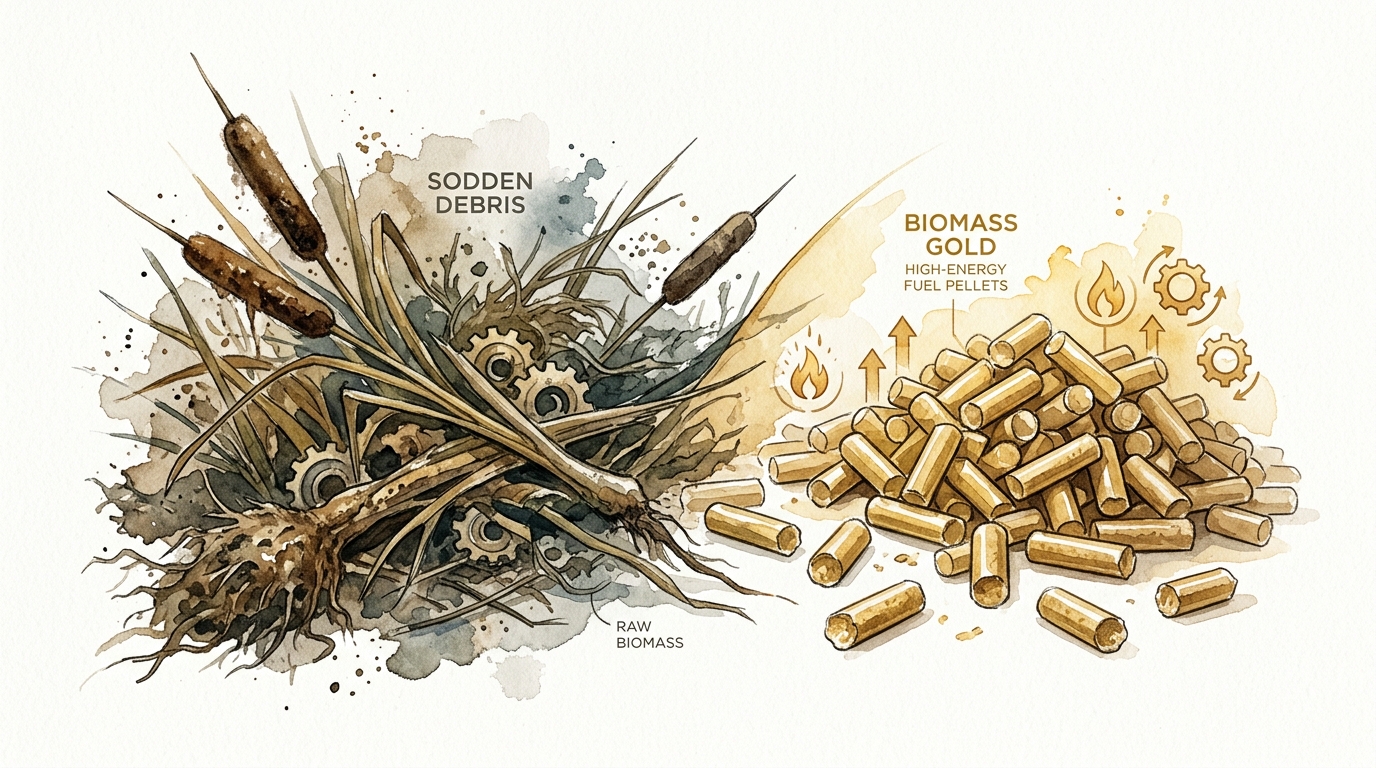
Technical Comparison: SODDEN DEBRIS vs BIOMASS GOLD
| Parameter | Raw ‘Sodden’ Debris | Processed ‘Biomass Gold’ |
|---|---|---|
| Moisture Content | 50% – 80% | 10% – 12% |
| Energy Density | 2,500 – 3,500 BTU/lb | 7,500 – 8,200 BTU/lb |
| Ash Management | High smoke, erratic residue | High mineral ash, low smoke |
| Storage Requirement | High volume, rot risk | Compact, stable in dry bins |
| Combustion Efficiency | 30% – 45% (Direct burn) | >80% (Pellet stove) |
Practical Tips and Best Practices
To optimize the fuel quality, blend cattails with wood sawdust at a 50:50 ratio. This reduces the overall ash content and helps lubricate the pellet mill die, extending its lifespan. This “hybrid pellet” often burns well in standard multi-fuel stoves that struggle with pure cattail pellets.
Always test the moisture of your feedstock before a production run. A cheap handheld moisture meter used for firewood is an essential tool. If the material is too dry, use a fine mist sprayer to add a specific percentage of water (calculated by weight) to the hammer-milled fluff before it enters the pelletizer.
Implement a “die flushing” routine. After finishing a batch of cattail pellets, run a small amount of oil-soaked sawdust through the machine. This prevents the high-ash cattail residue from hardening inside the die holes, which would otherwise require drilling out before the next use.
Advanced Considerations: Nutrients and Scaling
For large-scale practitioners, the timing of the harvest is a trade-off between energy and ecology. Harvesting in late summer captures the maximum amount of phosphorus within the plant tissue, which is ideal for pond remediation. However, the plant is at its highest moisture content during this phase, requiring significant energy for drying.
In contrast, a winter harvest provides the driest material (often 15% moisture), but much of the phosphorus has already translocated back into the rhizomes beneath the muck. Serious practitioners must balance these variables based on whether their primary goal is home heating or water quality improvement. Many choose a “middle ground” harvest in late October when the stalks have begun to turn brown but haven’t yet collapsed into the water.
Scaling up also requires consideration of “clinker inhibitors.” Adding a small amount of kaolin clay or calcium carbonate to the mix during the pelleting process can raise the ash fusion temperature. This prevents the minerals from melting into glass, allowing them to remain as a fine powder that the stove’s automatic cleaning system can handle easily.
Example Scenario: Energy Self-Sufficiency
Consider a half-acre pond dominated by hybrid cattails. A typical stand of this size can yield approximately 3 to 4 tons of dry biomass per year. After processing through a pellet mill, this results in roughly 3 tons of high-density fuel.
At 8,000 BTU per pound, those 3 tons represent 48 million BTUs of total energy. Assuming an 80% efficient pellet boiler, the homeowner recovers 38.4 million BTUs of usable heat. For a well-insulated 1,500 sq. ft. home in a temperate climate, this is often enough to cover 50% to 75% of the total annual heating requirement.
The cost to produce this fuel consists primarily of the electricity for the 5HP pellet mill and the time for harvesting. Compared to the $900 to $1,200 cost of purchasing 3 tons of commercial wood pellets, the return on investment for the processing equipment is often realized within two to three heating seasons.
Final Thoughts
The conversion of pond debris into high-efficiency bio-fuel is a technical solution to both energy costs and aquatic management. By understanding the mechanical requirements of pelletization and the thermal properties of Typha, pond owners can transform a maintenance headache into a reliable source of heat. The process requires precision in moisture control and ash management, but the rewards are measurable in both BTUs and improved water health.
Efficiency in this system relies on the right hardware—specifically multi-fuel stoves designed for high-ash feedstocks. While wood remains the standard for ease of use, cattail pellets offer a compelling alternative for those willing to manage the mechanical variables. Experimenting with blending feedstocks and optimizing harvest timing can lead to a highly resilient, zero-cost heating strategy.
Amazon and the Amazon logo are trademarks of Amazon.com, Inc, or its affiliates.