

Pond Talk is an Amazon Associate. As an Amazon Associate we earn from qualifying purchases.
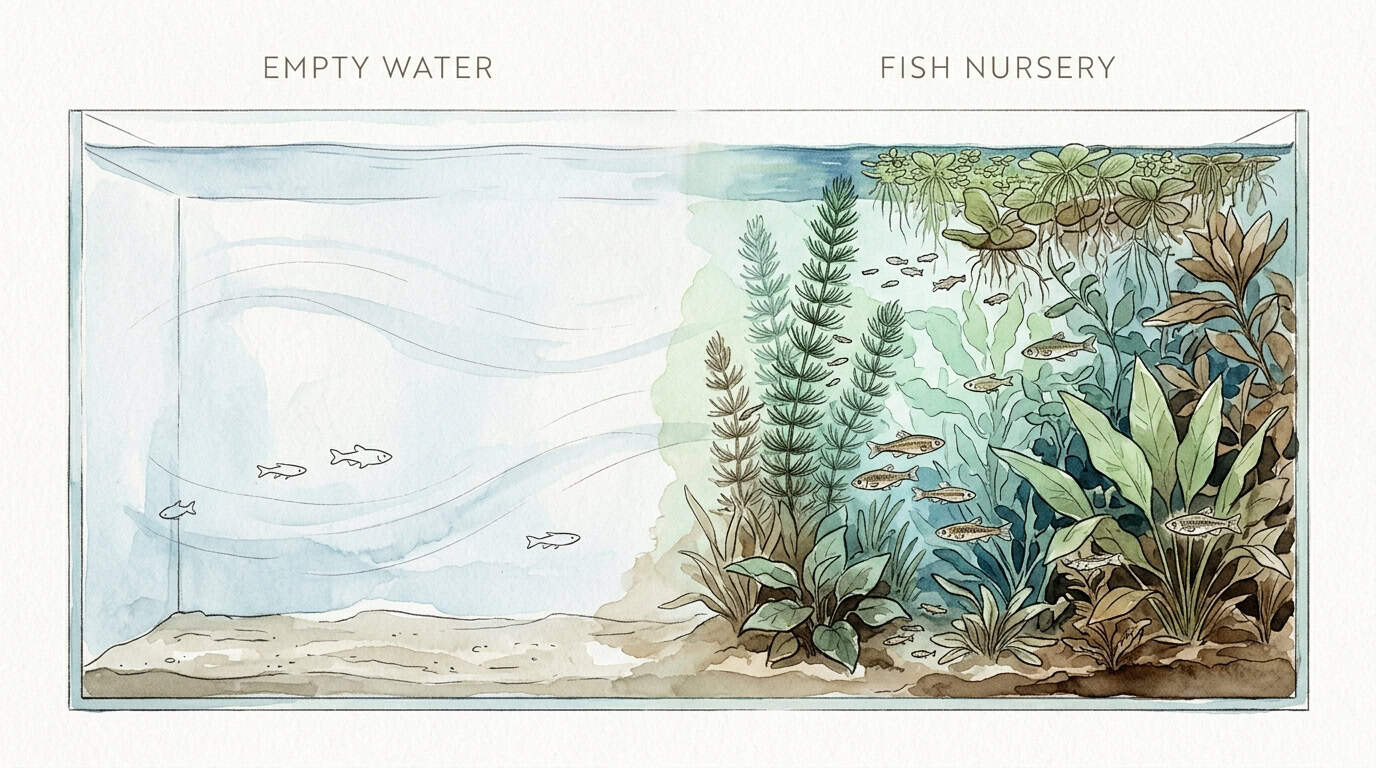
If you pull your cattails, you’re effectively evicting your pond’s next generation. Anglers often hate cattails because they snag hooks, but without them, your pond is a desert. These stalks provide the ‘infrastructure’ for the entire food chain, protecting the fry that become next year’s trophy fish.
Managing a pond ecosystem requires a shift from viewing aquatic plants as weeds to viewing them as biological machinery. High-quality fish habitat is not simply about aesthetics; it is a calculated balance of nutrient sequestration, dissolved oxygen production, and structural complexity. Understanding the mechanics of these plants is essential for any practitioner aiming to optimize fish growth and recruitment.
Best Plants For Fish Habitat
Aquatic vegetation is categorized by its growth habit relative to the water column. Effective habitat design utilizes a mix of emergent, submerged, and floating-leaf plants to maximize niche availability for different life stages of fish.
Emergent Vegetation
Emergent plants are rooted in the sediment with the majority of their biomass extending above the water surface. These plants serve as the primary interface between the terrestrial and aquatic environments. Common examples include Pickerelweed (Pontederia cordata) and Water Willow (Justicia americana). These species are highly resilient and provide stable shoreline protection against erosion. Their rigid stems offer excellent spawning substrate for species like Northern Pike and various sunfish.
Submerged Aquatic Vegetation (SAV)
Submerged plants grow entirely underwater and are critical for dissolved oxygen production. American Pondweed (Potamogeton nodosus) and Sago Pondweed (Stuckenia pectinata) are top-tier choices for fisheries. These plants provide high surface area for the growth of periphyton—a complex mixture of algae, cyanobacteria, and heterotrophic microbes. This periphyton acts as a primary food source for macroinvertebrates, which are subsequently consumed by juvenile fish.
Floating-Leaf Plants
Floating-leaf species, most notably White Water Lily (Nymphaea odorata), provide surface shade and temperature regulation. The broad leaves reduce light penetration, which can help suppress the growth of less desirable filamentous algae in the deeper littoral zones. These plants provide “roof” cover for ambush predators like Largemouth Bass, allowing them to conserve energy while waiting for prey.
How Aquatic Plants Function in a Pond Ecosystem
The presence of aquatic vegetation initiates several mechanical and biological processes that directly impact the health of the fishery. These processes function as a self-regulating filtration and production system.
Nutrient Cycling and Sequestration
Plants act as biological “sinks” for nitrogen ($N$) and phosphorus ($P$). They absorb these nutrients directly from the water column and the substrate, incorporating them into their tissues. This sequestration is vital for preventing eutrophication, a state where excess nutrients trigger massive algae blooms. Native plants typically grow in a controlled manner compared to invasive species, ensuring that nutrients are utilized for stable biomass rather than volatile algae cycles.
Dissolved Oxygen Dynamics
Photosynthesis is the primary driver of dissolved oxygen ($DO$) in a pond. During daylight hours, plants consume carbon dioxide and release oxygen into the water. This process can lead to supersaturation in well-vegetated areas. However, this system is cyclical. At night, the process reverses through respiration, where plants consume oxygen. A healthy pond maintains a balance where the daytime production exceeds the nighttime consumption, keeping $DO$ levels above the 3–5 mg/L threshold required for most warmwater fish.
Trophic Transfer Efficiency
Structure provided by plants increases the “trophic transfer efficiency” of the pond. This metric describes how effectively energy moves from the sun and nutrients up to the apex predators. Without plants, the primary production is dominated by phytoplankton, which can be difficult for higher organisms to utilize if the bloom is too dense or toxic. Plants provide a physical platform for a more diverse food web, including snails, dragonfly larvae, and scuds, which are higher-quality protein sources for growing fish.
Benefits of Strategic Plant Management
The measurable advantages of maintaining 20–25% plant coverage in a pond are significant. These benefits manifest in fish health metrics and water quality data.
Increased Recruitment Rates
Recruitment refers to the number of juvenile fish that survive to reach reproductive age. Dense stands of cattails or pondweed provide a “nursery” effect. Small fry can navigate the tight spaces between stems to evade larger predators. Studies indicate that ponds with adequate vegetation cover see significantly higher survival rates for young-of-year Bluegill and Bass compared to “clean” ponds with bare bottoms.
Improved Water Clarity
Aquatic plants contribute to water clarity through two mechanisms. First, their root systems stabilize the bottom sediment, preventing wind-driven turbidity. Second, by competing with algae for nutrients, they keep the water from turning into a “pea soup” green. Clearer water allows sight-feeding predators, like Bass, to hunt more efficiently, leading to better growth rates.
Enhanced Relative Weight (Wr)
Relative Weight is a measure of a fish’s “plumpness” compared to a standard for its length. Fish in vegetated ponds often show higher $W_r$ scores because the food supply is more consistent. The presence of vegetation ensures a steady supply of terrestrial and aquatic insects throughout the growing season, preventing the “stunting” often seen in over-stocked, under-vegetated water bodies.

Challenges and Common Pitfalls
While plants are beneficial, they require active management to prevent them from becoming a liability. Uncontrolled growth can lead to several ecological failures.
The Monoculture Trap
Invasive species like Hydrilla or Curly-leaf Pondweed often form dense monocultures. Unlike native plants, these invasives grow with such density that they block all fish movement and light penetration. This “choking” effect creates stagnant water zones with zero dissolved oxygen, which can lead to localized fish kills. Practitioners should always prioritize native species and monitor for any sudden dominance by a single plant type.
Diel Oxygen Crashes
Heavy vegetation increases the risk of a “diel oxygen crash,” particularly during hot, cloudy summer days. If the sun is blocked by clouds, photosynthesis slows down, but respiration and decomposition continue. In a pond that is 80–90% covered in plants, the $DO$ can drop to near-zero levels by 4:00 AM. This is a common cause of “summer kill,” where large trophy fish are the first to perish due to their higher oxygen requirements.
Nutrient Loading from Decay
Plants do not remove nutrients from the system permanently unless they are physically harvested. When plants die in the fall, they sink to the bottom and decompose. This process releases all the stored $N$ and $P$ back into the water, often fueling late-season algae blooms. Excessive organic “muck” buildup on the bottom can also reduce the pond’s depth over time, a process known as succession.
Limitations of Plant-Based Habitat
Vegetation is not a universal solution for every pond. Certain environmental and physical constraints can limit its effectiveness.
The 40% Threshold
Fisheries research suggests that once plant coverage exceeds 40% of the pond’s surface area, the growth rates of Largemouth Bass begin to decline. At this density, the prey (Bluegill) find it too easy to hide, and the predators cannot hunt effectively. This leads to a population of “skinny” bass and over-populated, stunted sunfish. Maintaining the coverage between 20% and 30% is the recognized “sweet spot” for a balanced trophy fishery.
Depth and Light Constraints
Plants are limited by the “photic zone”—the depth to which sunlight can penetrate. In very turbid or deep ponds, vegetation may only grow in a narrow band around the shoreline. If the pond has steep banks, the amount of available littoral zone for plant growth is restricted, regardless of how many plants are introduced. Engineering the pond’s slope to a 3:1 or 4:1 ratio is often necessary to provide enough shallow water for habitat.
Chemical and Biological Incompatibility
Certain water chemistry profiles, such as extremely high alkalinity or salinity, will kill many beneficial native plants. Additionally, the presence of certain fish species, like Grass Carp or Common Carp, can make it nearly impossible to establish vegetation. Grass Carp are non-selective herbivores and will often strip a pond of all beneficial plants before touching the “weeds” the owner intended for them to eat.
Artificial vs. Natural Habitat
In some scenarios, practitioners must choose between natural vegetation and artificial structures. Both have specific performance metrics.
| Feature | Natural Vegetation | Artificial Structures (PVC/Wood) |
|---|---|---|
| Nutrient Uptake | High; active filtration. | Zero; no biological uptake. |
| Longevity | Self-sustaining but seasonal. | Permanent; 10–20 year lifespan. |
| Food Production | High (insects, biofilm, seeds). | Moderate (biofilm only). |
| Maintenance | Requires thinning/monitoring. | Low; set and forget. |
| Dissolved Oxygen | Produces $O_2$ (day) / Consumes (night). | Neutral. |
Artificial structures are excellent for providing “holding” spots for adult fish in deep water where plants cannot grow. However, they lack the “nursery” capacity of plants because they do not produce the insect life required to feed fry. A hybrid approach is generally the most effective strategy for a high-performance pond.
Practical Tips for Establishing Habitat
Successful plant establishment requires more than just throwing seeds into the water. It involves precise timing and placement.
- Select Native Transplants: Use “plugs” or “rhizomes” rather than seeds for faster establishment. Species like Water Willow can be transplanted by simply pushing a stem cutting into moist soil at the water’s edge.
- Use Protection Cages: Newly planted vegetation is highly vulnerable to turtles and waterfowl. Enclosing small plots in wire mesh cages until they are established is often the difference between success and total loss.
- Control the Depth: Most emergent plants thrive in 0–18 inches of water. Submerged plants typically prefer 2–4 feet. Do not plant species in water deeper than their biological limit, as they will lack the light needed for root development.
- Plan for Access: Design the plant layout with “lanes” or “pockets” to allow for fishing access. A solid wall of cattails around the entire perimeter makes the pond unusable for anglers.
Advanced Considerations: The Role of Periphyton
For the serious practitioner, the real value of aquatic plants lies in the Periphyton. This is the “slime” that covers submerged stems and leaves. Periphyton is a biological powerhouse, often responsible for up to 50% of a pond’s total primary productivity in clear-water systems.
Microscopic analysis of healthy periphyton reveals a massive community of diatoms and rotifers. These organisms are the bridge between raw nutrients and fish protein. By selecting plants with high “surface-area-to-volume” ratios—such as Coontail (Ceratophyllum demersum)—you are effectively increasing the square footage of your pond’s “factory floor.” This allows for a higher density of forage fish per acre than could be supported by phytoplankton alone.
Furthermore, the vertical structure of plants like Eelgrass (Vallisneria americana) creates a complex thermal environment. During the heat of the day, the shade provided by the leaf canopy can keep the lower water column 3–5 degrees cooler, reducing metabolic stress on the fish.
Example: A 1-Acre Pond Restoration
Consider a 1-acre pond that has been “cleaned” of all vegetation. The water is turbid (Secchi disk reading of 12 inches), and the Bass are stunted at 10 inches with low Relative Weights.
The restoration begins by planting American Pondweed in the 2-to-4-foot depth zone and Pickerelweed along the northern shoreline. Within one growing season, the plants begin to sequester phosphorus. The water clarity improves to a Secchi reading of 30 inches.
In the second year, the increased clarity allows for better Bluegill recruitment. The Bass, now able to see their prey and finding a higher abundance of “snack-sized” Bluegill, show a 15% increase in $W_r$. By the third year, the pond has reached the target 25% coverage, and the ecosystem has stabilized into a self-filtering, high-production fishery.
Final Thoughts
Aquatic plants are the mechanical foundation of a productive pond. They are not merely “weeds” to be eradicated, but biological assets that must be managed with precision. By providing infrastructure for the food chain, they ensure that the energy flowing into the pond from the sun and nutrients is converted into healthy, fast-growing fish.
Transitioning to a plant-based management strategy requires patience. It takes time for native species to establish and for the nutrient cycles to balance out. However, the result is a more resilient ecosystem that requires fewer chemical interventions and provides a far superior fishing experience.
Always remember that a pond without “infrastructure” is just a hole filled with water. Whether you are managing for trophy Bass or a balanced family fishing hole, the plants you choose and protect will dictate the success of your water body for years to come. Applying these technical principles will move you from being a spectator of your pond to a true engineer of its ecology.
Amazon and the Amazon logo are trademarks of Amazon.com, Inc, or its affiliates.