

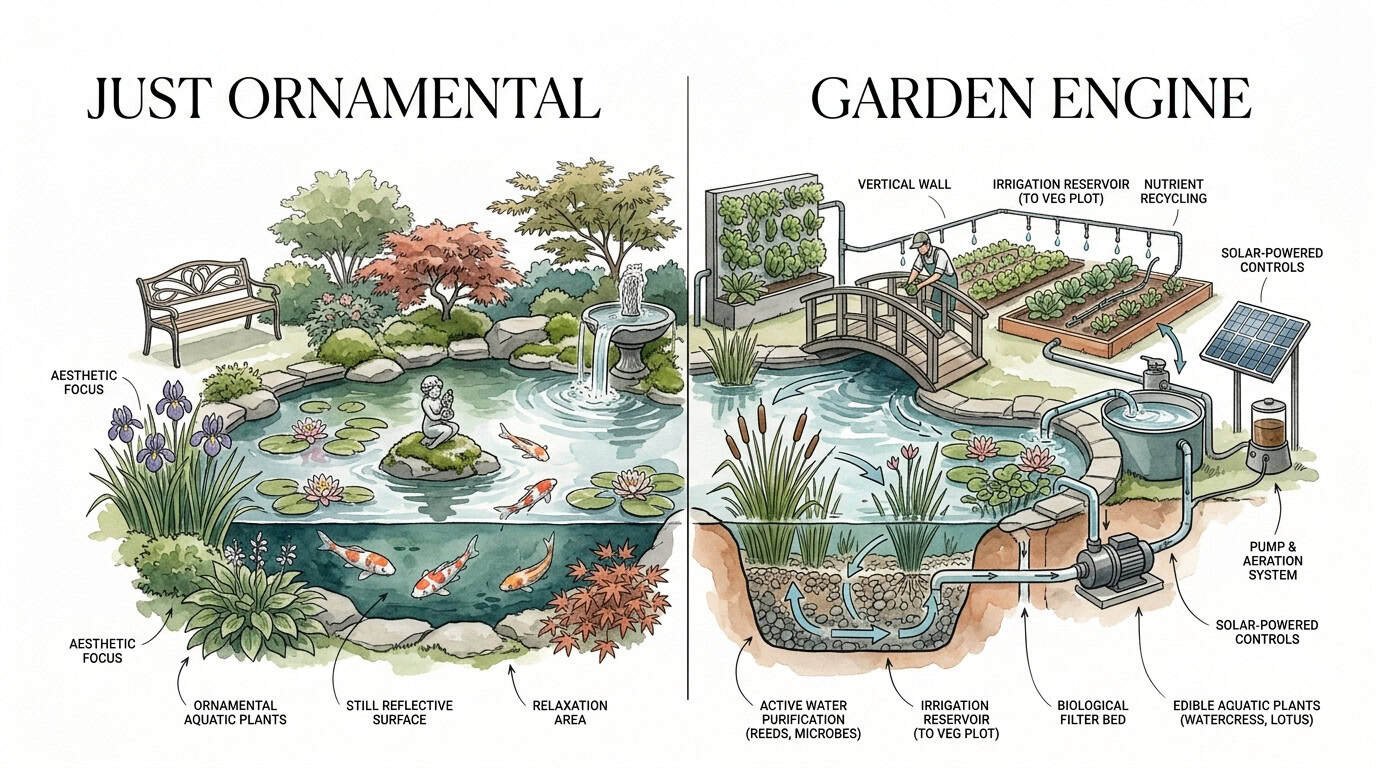
Is your pond just a pretty face, or is it the hardest working employee in your garden? Why have a pond that just sits there? In a small garden, every square inch must pay rent. From growing edible aquatic herbs to serving as a nutrient-rich reservoir for your watering can, your pond should be the heart of your garden’s production, not just a decoration.
Multi-purpose garden pond design is an engineering discipline that integrates water features as functional components of a productive landscape. It utilizes tiered depth zones and biological filtration to manage stormwater, facilitate nutrient-rich irrigation, and cultivate edible biomass. By functioning as a thermal mass and nitrogen-cycling hub, these systems optimize microclimates and resource efficiency, transforming a passive landscape element into a mechanical engine for garden-wide production.
Multi-purpose Garden Pond Design
Multi-purpose garden pond design refers to the systematic planning and construction of a water feature intended to serve multiple ecological and utilitarian functions simultaneously. Unlike traditional ornamental ponds, which prioritize aesthetics and may rely on chemical treatments, a multi-purpose system is designed as a “garden engine.” It functions as a biological filter, a food production zone, a thermal regulator, and a resource reservoir.
In real-world applications, these systems are used in permaculture sites and urban micro-farms to maximize land-use efficiency. For instance, a pond located near a vegetable patch can act as a natural fertilizer source. The water accumulates nitrogen and phosphorus from organic decay and fish waste, which is then siphoned off to provide nutrient-dense irrigation. This reduces the need for external inputs and creates a closed-loop system where waste becomes a resource.

Analogous to a multi-tool, these ponds are engineered with specific zones. Shallow marginal areas (0–15cm) act as biological scrubbers where plants remove toxins. Deeper benthic zones (60–100cm) provide thermal stability, ensuring the water remains cool in summer and resists freezing in winter. This depth allows the pond to serve as a heat sink, moderating the surrounding air temperature and extending the growing season for nearby sensitive crops.
How Multi-purpose Systems Function
The operational efficiency of a multi-purpose pond depends on its hydraulic and biological integration. The system works through a continuous cycle of nutrient conversion and mechanical circulation. Water is moved through various filtration stages, each designed to address specific chemical or physical pollutants.
Hydraulic Circulation and Pump Sizing
The heart of the system is the circulation pump. For a multi-purpose pond, the water volume must be turned over at least once every one to two hours to maintain oxygenation and nutrient distribution. If the pond houses fish for aquaculture, the turnover rate should be increased to once per hour. Calculating the required Gallons Per Hour (GPH) is a critical technical step.
To determine the pond volume, the formula (Average Length) x (Average Width) x (Average Depth) x 7.5 provides the total gallons. For a system with a vertical water feature or an integrated bog filter, “head height” must be factored in. Head height is the vertical distance the pump must lift water. As the distance increases, the GPH decreases due to gravity and friction within the pipes. Using the largest possible diameter for tubing reduces friction loss and maximizes the pump’s output efficiency.
Biological Filtration (The Bog Filter)
A multi-purpose pond often employs a helophyte or “bog” filter. This is a shallow, gravel-filled area where water is pumped through the root systems of aquatic plants. These plants, along with beneficial nitrifying bacteria, perform the “heavy lifting” of the nitrogen cycle. Ammonia ($NH_3$), which is toxic to fish and contributes to algae blooms, is converted by *Nitrosomonas* bacteria into nitrites ($NO_2$), and subsequently by *Nitrobacter* into nitrates ($NO_3$). Nitrates are the primary nutrient for plant growth and are easily absorbed by both the aquatic plants and the terrestrial garden when the pond water is used for irrigation.
Tiered Depth Architecture
A well-engineered pond profile typically resembles an “upside-down hat.” This structure includes a deep center for thermal stability and wide shelves (approximately 35cm wide and 20cm deep) around the perimeter. The shelves serve as the primary production zone for edible aquatic plants and provide access for beneficial wildlife like frogs and birds, which contribute to Integrated Pest Management (IPM) by controlling garden pests.

Benefits of Production-Focused Ponds
The advantages of transitioning from a purely ornamental feature to a production-focused engine are measurable in terms of resource savings and ecological resilience.
- Nutrient Cycling: The accumulation of organic matter in the pond sediment provides a rich “pond muck” that is high in phosphorus and nitrogen. This can be harvested annually and applied as a potent soil amendment.
- Microclimate Moderation: Large bodies of water possess high thermal mass. During the day, the pond absorbs solar radiation, preventing the surrounding area from overheating. At night, it releases this stored energy, raising the ambient temperature and protecting nearby plants from light frosts.
- Increased Biodiversity: Ponds are biodiversity hotspots. Even a small water feature can support thousands of species, from microscopic algae to beneficial insects. This increases the overall resilience of the garden ecosystem against disease and pests.
- Water Harvesting: Ponds integrated with swales or roof runoff systems act as retention basins during heavy rain. This prevents soil erosion and recharges the local groundwater table.
Challenges and Technical Pitfalls
Designing a multi-functional pond requires careful management of nutrient loads. A common mistake is allowing the system to become “eutrophic”—a state where excessive nutrients (primarily nitrogen and phosphorus) lead to rapid algae growth. Algae blooms deplete dissolved oxygen levels, which can lead to the death of fish and anaerobic (stinking) conditions.
Another frequent error is the use of improper liner materials. While PVC liners are inexpensive, they are highly susceptible to UV degradation and punctures. In a production pond where you may frequently step into the water to harvest plants or clean filters, a more durable material like EPDM or RPE is required. Punctures in a liner can lead to catastrophic water loss, which not only destroys the pond’s ecosystem but can also saturate and destabilize the surrounding soil.
Avoid placing ponds directly under deciduous trees. The high volume of falling leaves creates an excessive “carbon load” that the biological filter may be unable to process, leading to sludge buildup and oxygen depletion. If location under trees is unavoidable, mechanical skimmers or leaf nets must be deployed to manage the debris.
Limitations of Multi-purpose Designs
While highly efficient, these systems have realistic constraints. Environmental limitations, such as extreme aridity, can lead to high evaporation rates. In hot, dry climates, a pond may lose several inches of water per week, requiring a constant source of top-up water which might offset the benefits of rainwater harvesting.
In urban areas, legal regulations often impose depth constraints. Many jurisdictions require a safety fence for any body of water deeper than 18 inches (approximately 45cm). This can complicate the design of a pond intended to have a deep “thermal sink” zone. Furthermore, the weight of the water—roughly 8.3 pounds per gallon—means that large ponds on sloped sites require professional geotechnical assessment to prevent landslides or structural failure of the embankment.
Liner Material Comparison: EPDM vs. RPE
Selecting the correct barrier is the most important mechanical decision in pond construction. For high-use, multi-purpose ponds, the durability of the liner determines the system’s longevity.
| Feature | EPDM (Rubber) | RPE (Reinforced Polyethylene) |
|---|---|---|
| Weight | Heavy (Harder to install solo) | Light (1/3 the weight of EPDM) |
| Puncture Resistance | Moderate (Requires underlayment) | High (Often requires no underlayment) |
| Flexibility | Extremely flexible (Conforms to tight curves) | Stiffer (Harder to fold in small corners) |
| UV Stability | Good (Best if covered) | Excellent (Rated for full exposure) |
| Cost | Higher | Lower to Moderate |
Practical Best Practices
For those looking to optimize their pond’s performance, following established engineering best practices is essential.
- Zone the Planting: Use floating plants like *Pistia stratiotes* (Water Lettuce) to provide shade and reduce evaporation, while using submerged oxygenators like *Ceratophyllum demersum* (Hornwort) to directly compete with algae for nutrients.
- Implement Aeration: If the pond lacks a waterfall or fountain, install a solar-powered air stone. Dissolved oxygen is the “fuel” for beneficial bacteria; without it, the nitrogen cycle stalls.
- Manage Harvest: Regularly harvest edible aquatic plants and biomass. Removing plant matter is the only way to physically remove excess phosphorus from a closed pond system.
- Overflow Management: Always design a “spillway”—a rock-lined path where excess water can exit during storms. This should lead toward thirstier garden beds or a rain garden to maximize water use.
Advanced Considerations: The Phosphorus Cycle
For the serious practitioner, understanding the limiting factors of aquatic growth is vital. While nitrogen is often the focus, phosphorus is usually the “limiting nutrient” for algae in freshwater systems. One gram of phosphorus can support up to 100 grams of algal biomass. Managing phosphorus requires keeping external runoff (like lawn fertilizers) out of the pond and ensuring that the biological filter is sized correctly. A general rule for production ponds is that the bog filter should comprise approximately 20-30% of the pond’s total surface area to ensure adequate nutrient sequestration.
Scaling these systems also requires consideration of “hydraulic retention time” (HRT). This is the average time water spends within the filtration zone. To maximize nutrient uptake by edible herbs, the HRT should be long enough for the roots to process the water but short enough to prevent the water from becoming stagnant and warm.
Production Scenario: The 500-Gallon Garden Engine
Imagine a 500-gallon pond integrated into a backyard vegetable garden. The pond surface is roughly 50 square feet. On the shallow shelves, 15 square feet is dedicated to *Nasturtium officinale* (Watercress). Given proper flow from a 600 GPH pump, this watercress can yield up to 2 kilograms of edible greens per month during the peak growing season.
Simultaneously, the pond water is used to fill a 10-liter watering can twice daily for nearby tomatoes. This “fertigation” provides a steady stream of nitrates. Over the course of a season, the pond saves 2,000 liters of tap water and provides the equivalent of several kilograms of balanced liquid fertilizer. The presence of the water also attracts hoverflies and dragonflies, which reduce the aphid population on the tomato plants by up to 40% through natural predation.
Final Thoughts
Transforming a pond from a decorative feature into a functional garden engine requires a shift from aesthetic gardening to ecological engineering. By focusing on turnover rates, tiered zones, and biological nutrient cycling, a pond becomes more than a visual asset—it becomes a vital piece of infrastructure that supports the productivity of the entire landscape.
The integration of water into the garden provides a unique opportunity to close nutrient loops and create a more resilient micro-ecosystem. While the technical requirements—such as pump sizing and liner selection—are more demanding than those of a simple water feature, the return on investment in the form of food production and resource conservation is significant.
Practical experimentation is the best way to refine these systems. Every garden has a unique microclimate and soil profile, and a multi-purpose pond will eventually adapt to its specific environment. Start with the basics of circulation and filtration, and gradually expand the production capabilities as the system reaches biological equilibrium.
Frequently Asked Questions About Multi-purpose Garden Pond Design
What are the best edible plants for a small multi-purpose pond?
In a small-scale system, focus on fast-growing leafy greens and herbs. *Nasturtium officinale* (Watercress) is the gold standard for its high nitrate uptake and rapid growth. Other excellent choices include *Mentha aquatica* (Water Mint) for teas, *Ipomoea aquatica* (Water Spinach) for stir-fries, and *Sagittaria latifolia* (Duck Potato) for edible tubers. These plants are efficient at “cleaning” the water by sequestering nitrogen and phosphorus, making them dual-purpose as both food and filtration components. Ensure you check local regulations, as some aquatic plants can be invasive in certain regions.
How deep should a multi-purpose pond be for thermal regulation?
For effective thermal mass and microclimate moderation, the center of the pond should be at least 60cm (24 inches) deep. In climates with extreme heat or hard winters, 90cm (36 inches) is preferable. This depth ensures that the bottom layers of water remain stable regardless of surface air temperature. This stability prevents the water from overheating in summer, which causes oxygen depletion, and prevents it from freezing solid in winter, which protects the biological activity of the sediment. A deep pond acts as a “heat battery” for the surrounding garden.
Can I use pond water directly for watering my vegetable garden?
Yes, pond water is an excellent “fertigation” tool. It is typically rich in dissolved nitrogen, phosphorus, and potassium (NPK) derived from fish waste and decaying organic matter. Using a submersible pump or a simple bucket to irrigate with pond water provides a low-concentration, slow-release fertilizer that is easily absorbed by terrestrial plants. However, avoid using pond water on vegetables that are eaten raw (like lettuce) if the pond has a high population of waterfowl (ducks), as their waste can contain pathogens like E. coli. For root crops and fruiting crops like tomatoes, it is highly beneficial.
How do I prevent my multi-purpose pond from becoming a mosquito breeding ground?
The most effective way to prevent mosquitoes is through constant water circulation and biological control. Mosquitoes require stagnant water to lay their eggs; a pump that turns the water over at least once per hour creates enough surface agitation to discourage them. Additionally, a healthy multi-purpose pond will attract natural predators like dragonflies, damselflies, and frogs. If you include small native fish like Orfe or even goldfish, they will actively consume any mosquito larvae that do manage to hatch. A balanced ecosystem is far more effective than chemical treatments.
Is a liner necessary, or can I use a natural clay-bottom pond?
In a small garden setting, a liner is almost always necessary to ensure the pond remains a “reservoir.” Natural clay-bottom ponds (earthen dams) require specific soil types with at least 20-30% clay content and significant compaction to prevent leaking. In urban or suburban gardens, soil is often too porous or has been disturbed by construction, leading to constant water loss. High-quality liners like RPE or EPDM provide a guaranteed seal, which is critical if the pond is being used as a dependable source for irrigation or as a bio-filtration unit where water levels must remain consistent for plant health.
