

Pond Talk is an Amazon Associate. As an Amazon Associate we earn from qualifying purchases.
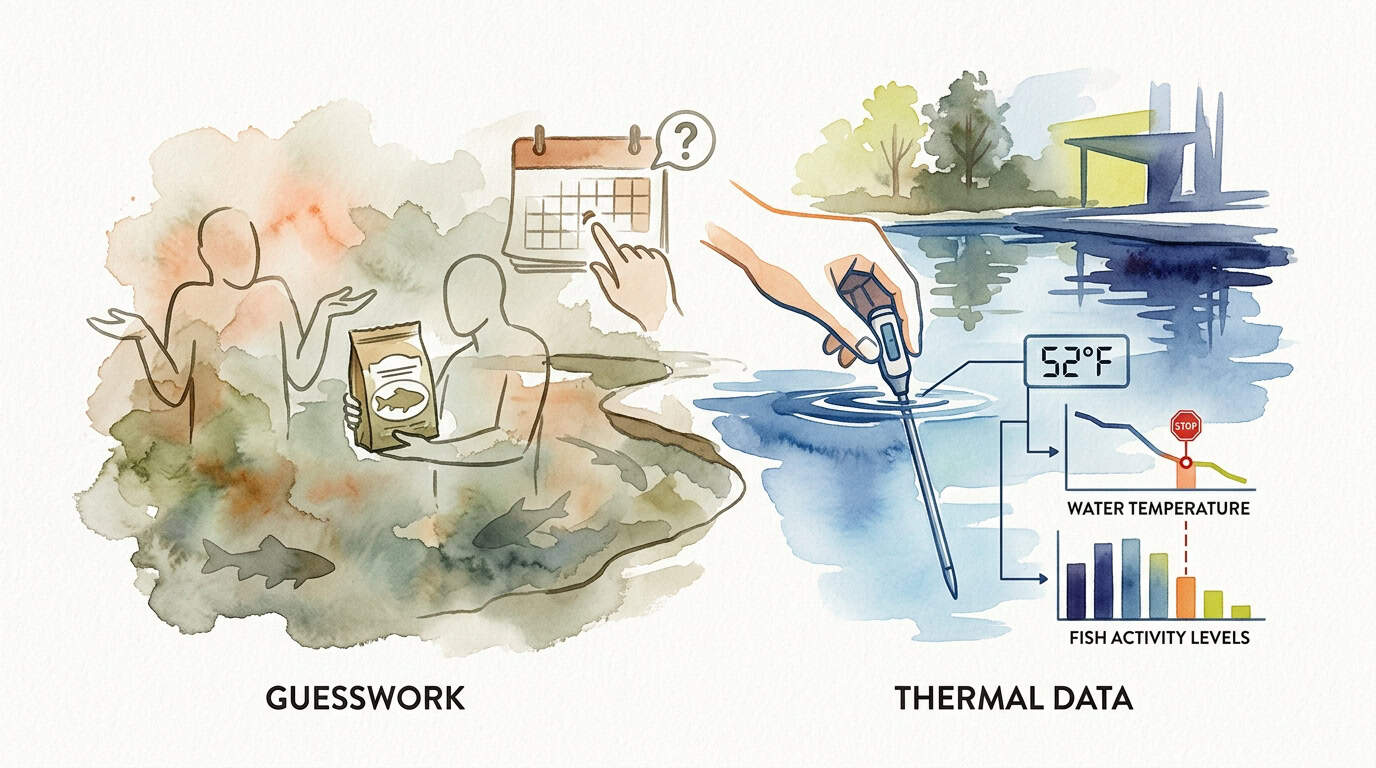
Feeding your fish at the wrong temperature is the fastest way to crash your pond’s health. Fish metabolism isn’t a guess—it’s physics. Feeding high-protein food in cold water leads to internal rot. Use a thermometer to switch to wheat-germ or stop feeding entirely when the mercury drops.
Managing a pond through the autumn transition requires a shift from observational care to data-driven management. Unlike mammals, koi and goldfish are poikilothermic, meaning their internal body temperature and metabolic rate are governed strictly by the surrounding water. This relationship between thermal data and biological function is the most critical factor in overwintering success.
When water temperatures fluctuate, the enzymatic processes required to break down complex proteins simply stop functioning. Ignoring these thermal thresholds leads to undigested organic matter stagnating in the fish’s intestinal tract, which provides a breeding ground for opportunistic bacteria. Precise monitoring is the only way to ensure your pond remains a stable environment rather than a liability.

When To Stop Feeding Pond Fish In Fall
The decision to stop feeding is determined by the specific thermal threshold of 40°F (4.5°C) for most temperate pond species, including koi and goldfish. While some practitioners stop at 50°F (10°C) to be conservative, the 40°F mark represents the point where metabolic activity reaches a near-stasis known as torpor. At this temperature, the fish’s demand for energy is minimal, and their ability to process even highly digestible carbohydrates is virtually non-existent.
In real-world applications, this transition isn’t an overnight event but a sliding scale of reduced frequency and altered nutritional profiles. As the heat of summer dissipates, the biological “machinery” of the pond begins to wind down. If you continue to introduce nutrients when the fish are too lethargic to consume them, you are effectively dumping waste directly into a system that has lost its primary biofiltration capacity.
Think of the pond as a biological reactor. During the summer, the reactor runs at high speed, processing high-protein inputs and converting them into growth. In the fall, the reactor’s RPMs drop. If you don’t reduce the fuel input to match the mechanical speed, the system overflows with toxic byproducts like ammonia and nitrite.
The Biological Mechanism of Cold-Water Digestion
Fish digestion relies on specific enzymes such as protease, amylase, and lipase. These enzymes are catalysts that require specific thermal ranges to activate. In warmer water (above 65°F), these enzymes are highly efficient, allowing koi to process high-protein diets designed for growth and color.
When the water drops below 60°F, the production of these enzymes slows significantly. Koi do not possess a true stomach like mammals; instead, they have a long, specialized intestinal tract. Because they lack a high-acid gastric chamber to break down large protein molecules, they rely entirely on enzyme-driven chemical breakdown along the length of the gut.
In cold water, the transit time for food through the intestinal tract increases from a few hours to several days. If high-protein pellets are sitting in the gut for 72 hours at 45°F, they begin to decompose internally. This process, often referred to as “gut rot,” allows pathogens to enter the bloodstream, frequently leading to systemic infections or death once the fish enters the stressful “Aeromonas Alley” phase of late fall and early spring.
Benefits of Adhering to Thermal Feeding Protocols
Maintaining a strict adherence to temperature-based feeding offers measurable advantages for both fish health and water chemistry. The primary benefit is the prevention of ammonia spikes. Since nitrifying bacteria in the filter also slow down in cold water, they cannot process the waste produced by active feeding.
Reducing or stopping feed preserves the dissolved oxygen levels in the pond. Decaying uneaten food and fish waste consume oxygen through aerobic decomposition. In cold weather, while water naturally holds more oxygen, a buildup of organic sludge can create localized anaerobic zones that release harmful gases like hydrogen sulfide.
Furthermore, a period of fasting allows the fish’s system to reset. In the wild, carp (the ancestors of koi) naturally fast during the winter. This period of dormancy is a biological necessity that prevents the over-accumulation of fat in the liver and kidneys, ensuring the fish are lean and robust for the spring spawning season.
The most significant challenge for pond owners in the fall is a period known as “Aeromonas Alley.” This occurs when water temperatures sit between 40°F and 55°F. In this specific window, pathogenic bacteria like Aeromonas and Pseudomonas are active and can multiply, but the fish’s immune system is still mostly dormant.
During this period, the fish are at their most vulnerable. Feeding them during this time can be catastrophic. If the food is not digested quickly, the stress of the internal decomposition further suppresses an already weakened immune system. This often leads to “winter kill” or fish that appear healthy in December but succumb to ulcers and fin rot in the first weeks of spring.

Another challenge is the “yo-yo” effect of autumn weather. A sudden warm spell may bring fish to the surface, begging for food. However, if the water temperature is still below 50°F, or if a cold front is predicted within 48 hours, feeding them is a tactical error. The energy gained from a single meal is outweighed by the risk of that food being trapped in the gut when the temperature drops again.
Limitations of General Feeding Guidelines
While the 40°F-50°F rule applies to koi and goldfish, it does not apply to all pond inhabitants. Sturgeon and sterlets, for example, do not enter a state of torpor. They remain active and require sinking, high-protein food throughout the winter. If you have a mixed pond, you must find a way to feed the sturgeon without the koi consuming the food, which often involves target-feeding using a PVC pipe.
Environmental factors also create limitations. A shallow pond (less than 3 feet deep) will experience much sharper temperature swings than a deep pond. In shallow systems, the standard feeding charts may be too risky; practitioners often stop feeding entirely once the water hits a consistent 55°F to account for the lack of thermal mass.
Ponds with high-performance heating systems are another exception. If you maintain your water at a constant 65°F through the winter, you can continue to feed staple diets. However, even in heated ponds, many professionals recommend a “rest period” of reduced feeding to mimic natural cycles and prevent long-term metabolic exhaustion.
Practical Tips for Precision Thermal Monitoring
Accurate data is the foundation of fall pond management. Do not rely on air temperature or “feel.” Water temperature can lag behind air temperature by 24 to 48 hours depending on the volume of the pond.
- Use a Submersible Probe: Floating thermometers are often inaccurate because they measure the surface layer, which is influenced by sun and wind. Use a weighted probe that measures the temperature at the bottom where the fish congregate.
- Monitor the Trend: Look for “consistent” temperatures. Do not change your feeding schedule based on a single afternoon high. Wait until the 3-day average stays within a specific range.
- Switch to Wheat Germ Early: When the water hits a consistent 60°F, stop using high-protein growth food immediately. Transition to a wheat-germ based diet, which is high in carbohydrates and easier to digest in cooling water.
- Clear the Bio-Filter: As you reduce feeding, perform a final backwash of your mechanical and biological filters. This removes the “summer sludge” before the bacteria go dormant for the season.
Nutritional Comparison: Protein vs. Wheat Germ
The choice of food in the fall is a matter of molecular complexity. High-protein foods are designed for building tissue, but they require significant metabolic energy to process. Wheat-germ foods prioritize energy over mass.
| Feature | High-Protein Diet | Wheat-Germ Diet |
|---|---|---|
| Optimal Temp | Above 65°F | 40°F – 60°F |
| Primary Benefit | Growth & Muscle Mass | Easily Digestible Energy |
| Waste Production | High Ammonia Output | Low Ammonia Output |
| Transit Time | Fast (in warm water) | Moderate (in cold water) |
Advanced Considerations: Ammonia and pH in Cold Water
Serious practitioners must understand the chemical shift that occurs as temperatures drop. Ammonia toxicity is a function of both temperature and pH. In cold water, ammonia (NH3) is technically less toxic than it is in warm water, but this creates a false sense of security.
Nitrifying bacteria (Nitrosomonas and Nitrobacter) begin to go dormant at temperatures below 50°F. If you overfeed during a late autumn warm spell, you may create a massive ammonia spike that the filter cannot handle. Because the bacteria are dormant, that ammonia will persist in the water for weeks, stressing the fish’s gills and making them more susceptible to cold-water parasites like Costia.
Furthermore, autumn leaves falling into the pond release tannins and organic acids. This can cause a “pH crash” in ponds with low alkalinity (KH). A low pH combined with even trace amounts of ammonia is a lethal combination in a dormant pond. Always check your KH levels and maintain a minimum of 100 ppm to ensure the water remains stable after you stop feeding.
Operational Scenario: The October Transition
Consider a 2,000-gallon pond in a temperate climate. In mid-September, the water is a consistent 68°F, and the fish are being fed a high-protein growth diet three times per day.
By the first week of October, a cold front drops the water temperature to 58°F. The practitioner immediately ceases all high-protein feeding. After checking the forecast to ensure the drop is stable, they switch to a wheat-germ pellet and reduce the frequency to once daily, ideally between 11:00 AM and 2:00 PM when the water is at its daily peak.
In late October, a second cold front pushes the water down to 48°F. The fish are now staying at the bottom. The practitioner reduces feeding to twice per week. By the second week of November, the water probe reads a consistent 39°F. Even though the fish may still “nudge” the surface if a human approaches, the practitioner stops all feeding entirely. No further food will be introduced until the water hits a stable 50°F the following spring.
Final Thoughts
Mastering the autumn feeding transition is about moving from an emotional connection with your fish to a technical one. While it may feel counterintuitive to “starve” your pets as the weather gets harsh, you are actually protecting them from their own biology. By respecting the 40°F threshold and the limitations of cold-water enzymes, you ensure that your fish emerge from winter with their health intact.
Precision feeding is the hallmark of an advanced pond keeper. Using high-quality wheat germ and accurate thermal data prevents the majority of health issues that plague ponds in the spring. If you follow the data, you remove the guesswork and replace it with a controlled, optimized environment for your aquatic livestock.
Success in pond keeping is rarely about what you do; it is often about what you stop doing at the right time. As the mercury drops, put away the food bag and focus on monitoring. Your fish have millions of years of evolutionary history that has prepared them for a winter fast—your job is simply to let physics take its course.
Amazon and the Amazon logo are trademarks of Amazon.com, Inc, or its affiliates.