

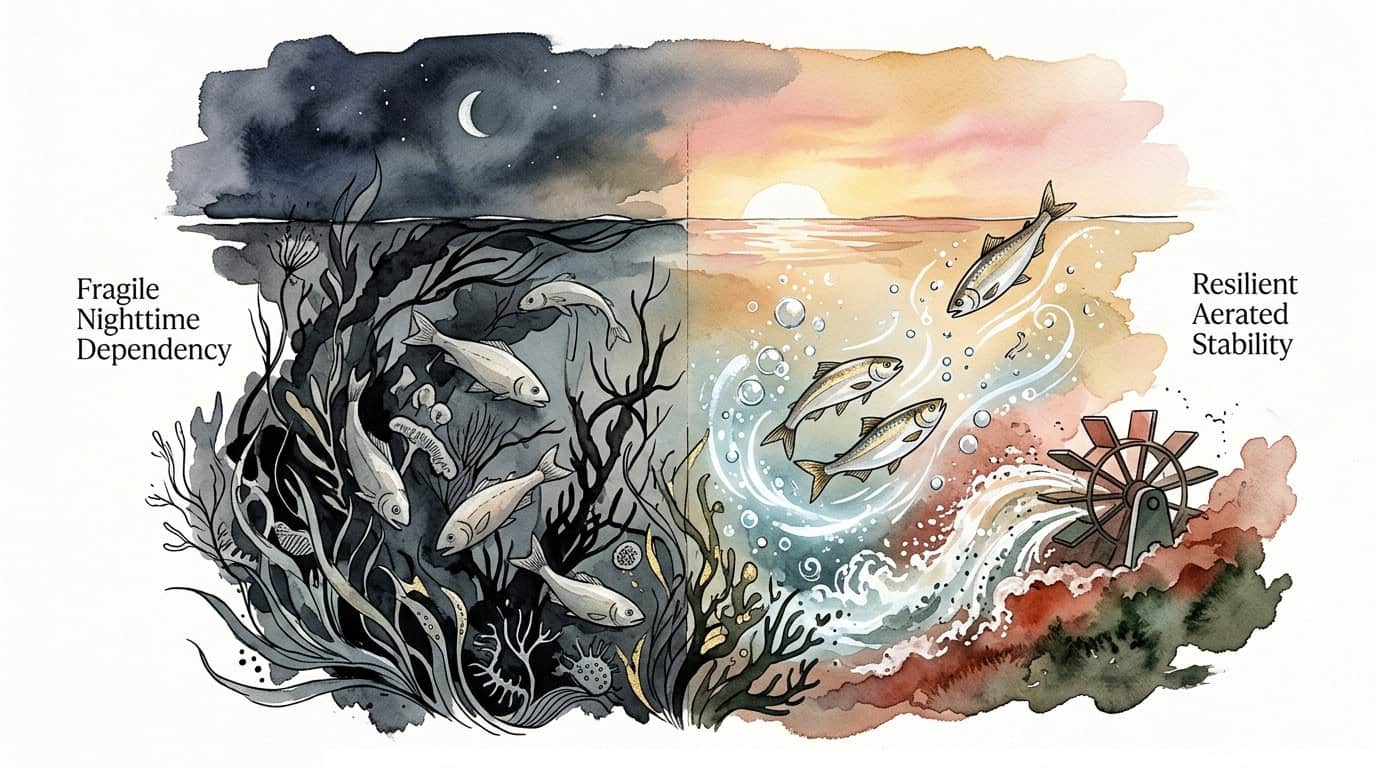
The most dangerous time for your fish is while you’re still asleep. Do you know why dawn is the ‘dead zone’? When the sun goes down, the oxygen levels start to drop. If your pond isn’t built for resilience, the pre-dawn hours could be a death trap. Here’s how to stop it.
Pre-dawn fish kills occur because dissolved oxygen (DO) levels reach their 24-hour minimum just before sunrise. This phenomenon is driven by the diurnal oxygen cycle, where photosynthetic oxygen production ceases at sunset while the continuous respiratory demands of fish, plants, and aerobic bacteria deplete available reserves overnight. In nutrient-rich or high-biomass systems, this consumption often exceeds the oxygen supply, leading to lethal hypoxia before the sun can restart the production cycle.
Why Fish Kills Usually Happen Just Before Sunrise
The primary driver behind pre-dawn fish mortality is the diurnal oxygen cycle. This is a predictable, 24-hour fluctuation in dissolved oxygen (DO) concentrations within an aquatic ecosystem. During daylight hours, aquatic plants and phytoplankton undergo photosynthesis, a process that utilizes solar energy to convert carbon dioxide and water into glucose and oxygen. In high-density environments, this process can lead to “supersaturation,” where DO levels exceed 100% of their normal carrying capacity at a given temperature.
However, once the sun sets, photosynthesis stops immediately. At this point, the system enters a phase of net oxygen consumption. Every aerobic organism in the water—from the largest game fish to the microscopic bacteria decomposing organic matter on the pond floor—continues to breathe. This collective requirement is known as total ecosystem respiration. Because there is no new oxygen being produced, the “oxygen bank account” established during the day is slowly drained. The lowest point of this depletion typically occurs between 4:00 AM and 6:00 AM, just before the first rays of light allow photosynthesis to resume.

In a balanced system, the oxygen reserve is sufficient to last the night. In an imbalanced system—one with excessive algae, high fish stocking densities, or significant organic “muck”—the oxygen reaches zero or near-zero levels before dawn. This results in a fish kill, where the largest fish typically die first because they have the highest metabolic oxygen requirements.
The Mechanics of Nighttime Respiration and Oxygen Depletion
Understanding why the “dead zone” occurs requires a technical look at the factors that accelerate oxygen loss. Oxygen does not simply vanish; it is utilized in specific biological and chemical pathways that become aggressive under certain environmental conditions.
Photosynthesis vs. Respiration Balance
During the day, the rate of photosynthesis usually exceeds the rate of respiration. This creates a surplus of oxygen. At night, the equation flips. The rate of respiration remains relatively constant (though it increases with temperature), but the production rate drops to zero. The “slope” of the oxygen decline is determined by the Biochemical Oxygen Demand (BOD). If a pond has a heavy “bloom” (dense algae), the daytime production is massive, but the nighttime “sink” is equally massive because those same algae cells must respire to stay alive in the dark.
The Role of Temperature and Gas Solubility
Water temperature plays a critical role in the timing and severity of fish kills. The relationship between temperature and dissolved oxygen is inverse: as water gets warmer, its physical capacity to hold oxygen molecules decreases. For instance, freshwater at 32°F (0°C) can hold approximately 14.6 mg/L of oxygen at saturation. At 86°F (30°C), that capacity drops to roughly 7.5 mg/L.
Simultaneously, fish are ectotherms, meaning their internal body temperature and metabolic rate are governed by the surrounding water. A fish’s metabolism roughly doubles for every 18°F (10°C) increase in temperature. This creates a “perfect storm” in the summer: the water holds the least amount of oxygen exactly when the fish and bacteria require the most.
Sediment Oxygen Demand (SOD)
A significant and often overlooked consumer of oxygen is the organic layer at the bottom of the pond, often called “muck.” This layer consists of fish waste, dead plant matter, and fallen leaves. Aerobic bacteria living in this layer work 24/7 to decompose this material. In older ponds with deep muck layers, the Sediment Oxygen Demand can account for over 50% of the total nighttime oxygen depletion. This is why fish kills often happen after a period of calm, hot weather that allows the bottom water to become completely anoxic (devoid of oxygen).

How Environmental Triggers Accelerate the Crash
While the diurnal cycle happens every day, certain triggers can turn a routine nightly dip into a lethal crash. Recognizing these variables is essential for proactive management.
Cloudy Weather and Reduced Sunlight
Photosynthesis is light-dependent. If a pond experiences two or three consecutive days of heavy cloud cover, the “recharge” of oxygen during the day is significantly reduced. However, the respiration of fish and bacteria does not slow down. By the third night, the starting oxygen level is already low, making it nearly certain that the pond will hit the lethal threshold before sunrise.
Algal Bloom Crashes
Large populations of phytoplankton (green water) are unstable. If the algae reach a density where they begin to shade one another out, or if they exhaust the available nutrients, a “die-off” or “bloom crash” occurs. When millions of algae cells die simultaneously, they stop producing oxygen and instead become a massive load of organic matter. The bacteria that rush in to decompose these dead cells consume oxygen at an exponential rate, leading to a sudden, catastrophic DO collapse that often happens overnight.
Thermal Stratification and Turnover
During summer, ponds often separate into two distinct layers: a warm, oxygen-rich upper layer (epilimnion) and a cold, oxygen-depleted bottom layer (hypolimnion). This is called thermal stratification. If a sudden cold rainstorm or high winds occur, these layers can “turn over” or mix rapidly. The anoxic bottom water, which may also contain toxic gases like hydrogen sulfide, mixes with the thin surface layer, instantly dropping the average DO level below the survival threshold for fish.
The Benefits of Proactive Oxygen Management
Implementing a system that stabilizes dissolved oxygen levels offers more than just the prevention of fish kills. It fundamentally changes the efficiency and health of the aquatic environment.
- Increased Carrying Capacity: Higher, stable DO levels allow for higher stocking densities and faster fish growth rates because the fish are not wasting energy struggling to breathe.
- Accelerated Decomposition: Maintaining oxygen at the pond floor supports aerobic bacteria, which decompose organic muck much faster and more completely than anaerobic bacteria.
- Reduced Nutrient Loading: Oxygen helps keep phosphorus “locked” in the bottom sediments. When oxygen is lost, phosphorus is released into the water column, fueling the very algae blooms that cause oxygen crashes.
- Improved Feed Conversion: In managed fisheries, fish convert feed into body mass more efficiently when they are not in a state of chronic respiratory stress.
Common Challenges and Pitfalls in Prevention
The most frequent mistake made in pond management is relying on reactive aeration. Many owners wait until they see fish “piping” (gulping for air) at the surface at dawn before turning on a pump. By the time fish are visible at the surface, they have already suffered physiological damage, and a portion of the population may already be dead at the bottom.
Another common pitfall is the use of decorative fountains as a primary oxygen source. While fountains are aesthetically pleasing, they often only circulate the top 12 to 24 inches of water. In deep ponds, this leaves the vast majority of the water volume un-aerated and prone to stratification. A technical solution requires bottom-diffused aeration or high-volume surface aerators designed for gas exchange, not just display.
| Temperature (°F) | Temperature (°C) | 100% Saturation (mg/L) |
|---|---|---|
| 32 | 0 | 14.6 |
| 50 | 10 | 11.3 |
| 68 | 20 | 9.1 |
| 77 | 25 | 8.3 |
| 86 | 30 | 7.5 |
Practical Tips for Preventing Pre-Dawn Fish Kills
To ensure your pond remains resilient through the “dead zone,” follow these technical best practices:
- Deploy Subsurface Aeration: Use a diffused air system that places “stones” or membranes at the deepest point. This utilizes the “airlift” principle to bring oxygen-depleted water to the surface for gas exchange.
- Monitor During Peak Risk: Use a digital DO meter to take readings at 5:00 PM (the high) and 6:00 AM (the low). If the dawn reading is consistently below 3.0 mg/L, your system is at high risk.
- Manage Nutrient Inputs: Limit the use of fertilizers in the watershed and avoid over-feeding. Excess nutrients lead to excessive “BOD” that drains oxygen at night.
- Perform Partial Vegetation Control: Never treat more than 25% of a pond’s weeds or algae at one time. Treating the whole pond causes a massive decomposition load that will crash the oxygen.
- Run Aerators 24/7 in Summer: Do not use timers to save electricity during the hottest months. The most critical time for the aerator to be running is exactly when you are tempted to turn it off—at night.
Advanced Considerations: The Standard Aeration Efficiency (SAE)
For professional managers, choosing an aeration system involves calculating the Standard Aeration Efficiency (SAE). This metric measures how many pounds of oxygen an aerator can transfer into the water per horsepower-hour (lb O2/hp-hr).
Diffused air systems generally offer higher efficiency in deeper water because the bubbles have a longer “residence time” to transfer oxygen as they rise. Surface aerators, however, are often superior in shallow ponds (less than 6 feet) where they can move massive volumes of water quickly. When designing a system, the total Oxygen Transfer Rate (OTR) must exceed the calculated Biochemical Oxygen Demand (BOD) of the pond’s biomass and muck layer.
Example Scenario: The Summer Storm Crash
Consider a 1-acre pond in July. The water temperature is 85°F. The pond has a healthy-looking algae bloom and 500 lbs of fish. On a Friday, the afternoon DO is 9.0 mg/L (supersaturated).
That evening, a heavy thunderstorm rolls in, followed by a Saturday that is dark and overcast. Because there is no sun, photosynthesis on Saturday is negligible. By Sunday morning at 5:00 AM, the oxygen has been consumed by the fish and the “muck” for 36 hours with almost no replenishment. The DO drops to 1.2 mg/L. The largest largemouth bass begin to die first, followed by the bluegill. This is a classic “weather-induced” kill that could have been prevented by a subsurface aerator maintaining the “oxygen floor.”
Final Thoughts
The hours before sunrise represent the most significant biological hurdle for any aquatic ecosystem. The intersection of zero oxygen production and maximum respiratory demand creates an inevitable dip in dissolved oxygen that can easily turn lethal in managed ponds. Relying on natural diffusion is rarely enough in systems with high fish densities or significant nutrient loads.
Protecting a fishery requires a shift from viewing the pond as a static body of water to seeing it as a dynamic, breathing system. By maintaining mechanical aeration and monitoring the diurnal cycle, you can eliminate the “dead zone” and ensure that the most dangerous time for your fish is no longer a threat. Proactive management isn’t just about saving fish; it’s about optimizing the chemical environment to support a thriving, resilient ecosystem.
Frequently Asked Questions About Why Fish Kills Usually Happen Just Before Sunrise
Why do the largest fish always die first during a pre-dawn fish kill?
Large fish are more susceptible to oxygen crashes because they have a higher total metabolic demand and less efficient oxygen transfer across their gill surfaces relative to their body mass. While a small minnow might survive on the tiny amount of oxygen found in the top millimeter of the water’s surface film, a large bass or catfish requires a much higher volume of oxygenated water to maintain its complex physiological functions. Consequently, as dissolved oxygen levels drop below 2.0 or 3.0 mg/L, the larger specimens reach their respiratory limit first, while smaller fish may persist for several more hours.
Can I prevent a fish kill by just adding fresh water from a hose?
In most cases, no. While adding fresh water might provide a very localized area of relief, the volume of a standard garden hose is insignificant compared to the total volume of a pond. Furthermore, well water is often devoid of oxygen (anoxic) and can be high in carbon dioxide, which may actually worsen the stress on the fish. To effectively raise oxygen levels across a one-acre pond, you would need to move thousands of gallons of water per minute or use a mechanical aeration system designed to facilitate gas exchange with the atmosphere.
Does a green pond produce more oxygen than a clear pond?
A green pond, which is usually colored by a phytoplankton bloom, produces significantly more oxygen during the day than a clear pond. However, this comes with a high “hidden cost.” Those same algae cells that produce oxygen in the light must respire in the dark. This leads to massive diurnal swings—extremely high oxygen in the afternoon and dangerously low oxygen at dawn. Clearer ponds have more stable, albeit lower, oxygen levels. The goal of management is to maintain a moderate bloom while using mechanical aeration to “clip” the bottom of the nightly oxygen curve.
What are the first warning signs that an oxygen crash is about to happen?
The most reliable warning sign is fish “piping” or “gulping” at the surface, particularly in the very early morning. You may also notice fish congregating near any incoming water sources or where wind is creating ripples. Another subtle sign is a sudden change in water color—if a bright green pond suddenly turns brown, gray, or clear (a “bloom crash”), a massive oxygen depletion is likely imminent. In managed systems, a sudden drop in fish feeding activity is often the first behavioral indicator that the fish are under respiratory stress.
Should I turn off my pond aerator during the day to save energy?
Turning off an aerator during the day is generally a mistake, especially in the summer. While it is true that oxygen is being produced by photosynthesis during the day, the aerator serves a second critical purpose: destratification. Continuous aeration prevents the pond from separating into a warm top layer and a dead, anoxic bottom layer. If you turn the aerator off during the day, the pond can stratify in just a few hours. When the aerator kicks back on at night, it may mix that newly formed “dead water” into the top layer, causing an accidental fish kill. Continuous 24/7 operation is the safest protocol.