

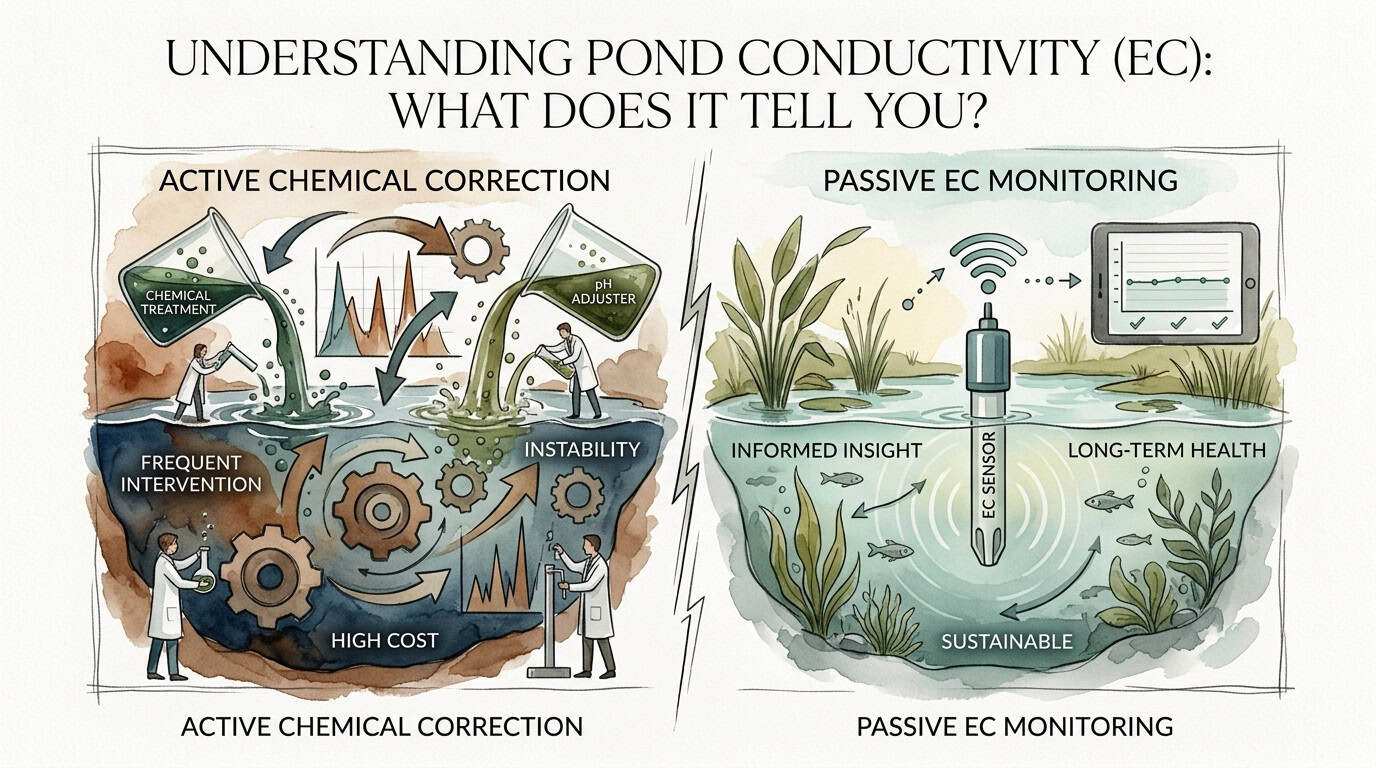
Conductivity is the ‘pulse’ of your pond. Are you ignoring the heartbeat of your ecosystem? Stop guessing and start measuring. Conductivity tells you everything about your pond’s dissolved solids and stability. Here is why it’s your best diagnostic tool.
Pond conductivity measures the concentration of dissolved ions in the water, serving as a reliable proxy for Total Dissolved Solids (TDS). It provides immediate data on water stability, nutrient strength, and the accumulation of minerals or waste. By tracking shifts in electrical conductivity (EC), operators can identify evaporation rates, detect pollution events, and determine when water exchanges are required to prevent “old water syndrome.”
Understanding Pond Conductivity (EC): What Does It Tell You?
Electrical Conductivity, or EC, is a numerical representation of a solution’s ability to carry an electric current. In a pond environment, this capability is dictated by the presence of dissolved inorganic substances that have dissociated into charged particles known as ions. Pure water is an insulator; it is the “stuff” dissolved within the water—salts, minerals, and metals—that allows electricity to flow. Therefore, EC serves as a comprehensive, though non-specific, metric for the total mineral and salt content within the aquatic system.
This measurement exists as a fundamental pillar of water quality analysis because it is instantaneous and highly sensitive to change. While a pH test tells you about the acidity or alkalinity, and a nitrate test reveals a specific nutrient level, the EC reading provides an “all-hands-on-deck” count of the total ionic load. In real-world applications, such as commercial aquaculture or high-end koi keeping, EC is used to monitor the baseline health of the water and to trigger maintenance protocols when values drift outside of established parameters.

Consider the analogy of a crowded room. If pure water is an empty hall, ions are the people inside. As more people enter, it becomes easier to pass a message (current) from one side to the other. EC doesn’t tell you the names of the people (the specific types of ions), but it tells you exactly how crowded the room is. This “crowdedness” directly affects the osmotic pressure exerted on your fish and the availability of nutrients for aquatic plants.
How Electrical Conductivity Works in Aquatic Systems
To master EC monitoring, you must understand the underlying physics. Conductivity is measured by a probe that applies a small AC voltage between two or more electrodes. The ions in the water migrate toward the electrode with the opposite charge, creating a current. The meter measures this current and calculates the conductance, which is the reciprocal of electrical resistance. The standard unit of measurement for freshwater ponds is microsiemens per centimeter (µS/cm) or millisiemens per centimeter (mS/cm).
The primary contributors to conductivity in a pond are the major cations and anions. These include:
- Cations (Positive Charge): Sodium (Na+), Calcium (Ca+2), Magnesium (Mg+2), and Potassium (K+).
- Anions (Negative Charge): Chloride (Cl-), Sulfate (SO4-2), Carbonate (CO3-2), and Bicarbonate (HCO3-).
While nitrates, phosphates, and ammonium also contribute to the EC reading, they are typically present in much lower concentrations than the major minerals. However, in a closed system like a pond, the gradual accumulation of these metabolic byproducts, alongside the minerals left behind by evaporation, causes the EC to climb over time. This process is the mechanical basis for what hobbyists often call “Old Water Syndrome,” where the water becomes so concentrated with dissolved solids that it stresses the biological functions of the inhabitants.
Temperature is the most significant variable in EC measurement. As water temperature increases, the viscosity of the water decreases, allowing ions to move more freely. This increased mobility results in a higher conductivity reading even if the number of ions remains constant. Most modern meters utilize Automatic Temperature Compensation (ATC) to normalize readings to a standard temperature, usually 25°C (77°F). Without ATC, your data would fluctuate wildly based on the time of day, rendering it useless for diagnostic tracking.
Benefits of Monitoring Pond Conductivity
Regular EC measurement offers several technical advantages over traditional chemical testing alone. First and foremost is the detection of pollution events. If a pond has a stable baseline of 300 µS/cm and suddenly spikes to 800 µS/cm after a rainstorm, it indicates that runoff has carried fertilizers, road salts, or soil minerals into the system. This allows for immediate corrective action before fish show signs of stress.

Another benefit is the precision of salt management. Many pond keepers use non-iodized salt (sodium chloride) to reduce osmotic stress or treat parasites. Since salt is a highly conductive ion, an EC meter provides a far more accurate measurement of salinity than a hydrometer. You can precisely hit a target concentration, such as 0.3%, by monitoring the EC rise. For reference, 1.0 mS/cm is approximately equal to 500-700 ppm of TDS, depending on the conversion factor used.
EC monitoring also serves as the ultimate water change indicator. Instead of performing water changes on a rigid calendar schedule, you can use the “EC Creep” method. When the pond’s conductivity exceeds the source water (tap water) by more than 50-100%, it is a data-driven signal that dissolved solids have reached a level that warrants dilution. This optimizes water usage and ensures consistent environmental stability for the fish.
Challenges and Common Mistakes
One of the primary challenges in EC monitoring is the lack of specificity. An EC meter will tell you that the total ionic load has increased, but it cannot distinguish between beneficial calcium carbonates and toxic nitrates or heavy metals. Users often make the mistake of assuming a “good” EC reading means the water is safe. You must still perform specific chemical tests for ammonia, nitrite, and KH to have a complete picture.
The calibration error is another frequent pitfall. Conductivity probes are sensitive instruments that drift over time. Many practitioners fail to calibrate their meters monthly using a standard solution (usually 1413 µS/cm). Using an uncalibrated meter leads to inaccurate data, which can cause you to perform unnecessary water changes or miss a genuine spike in pollutants. Furthermore, air bubbles trapped on the electrode surface during measurement can provide artificially low readings; always gently tap the probe to dislodge them.
A technical misunderstanding regarding TDS conversion often causes confusion. Many meters display both EC and TDS. However, TDS is not measured directly; it is a calculation based on the EC. Different meters use different conversion factors (usually 0.5 or 0.7). If you are comparing data with another pond keeper, always use the raw EC value in µS/cm or mS/cm to ensure you are speaking the same language.
Limitations of the Measurement
Conductivity only detects charged particles. Non-ionic contaminants, such as oil, grease, certain pesticides, and many organic molecules (like sugars or uncharged proteins), do not conduct electricity. A pond could be significantly contaminated with organic toxins and still show a “normal” EC reading. This is why EC should be viewed as a component of a broader monitoring strategy, not a standalone health metric.
Environmental limitations also exist. In very soft water or distilled-quality water, the EC is so low that standard probes may struggle with accuracy due to the lack of ions. Conversely, in highly saline environments, the relationship between ion concentration and conductivity becomes non-linear as ions begin to interfere with each other’s movement. For the average freshwater pond (100–1,500 µS/cm), this is rarely an issue, but it is a critical consideration for brackish or saltwater systems.
EC vs. TDS: Which Should You Use?
While often used interchangeably, EC and TDS represent different ways of looking at the same data. EC is the physical measurement of electrical flow, while TDS is an estimation of the total mass of dissolved solids in a given volume of water (mg/L or ppm).
| Metric | Measurement Basis | Primary Application | Consistency |
|---|---|---|---|
| EC (Electrical Conductivity) | Direct current flow through ions. | Research, precision aquaculture, nutrient tracking. | High; universal units (µS/cm). |
| TDS (Total Dissolved Solids) | Calculated estimate based on EC. | General hobbyist use, drinking water standards. | Variable; depends on conversion factor (0.5-0.7). |
For serious practitioners, EC is the superior metric because it avoids the ambiguity of conversion factors. If you report an EC of 400 µS/cm, that data is technically precise across any calibrated meter in the world. Reporting 200 ppm of TDS could mean several different things depending on how the meter was programmed.
Practical Tips and Best Practices
The most important step in EC monitoring is establishing your source water baseline. Test your tap or well water today. If your source water is 200 µS/cm, and your pond is currently 500 µS/cm, you have a baseline “load” of 300 units. Your goal should be to keep the pond within a 25% margin of the source water baseline through regular maintenance.
Implementation of log-keeping is essential. Record the EC weekly at the same time of day. This data allows you to see the impact of heavy feedings, rain events, and seasonal changes. If you notice the EC rising by 10 units every day, you can calculate the exact rate of evaporation or waste accumulation, allowing for more efficient mechanical filtration or water exchange scheduling.
Proper probe maintenance is non-negotiable. Clean the electrodes with a mild detergent and a soft brush if they appear fouled with biofilm. Store the probe according to the manufacturer’s instructions—usually in a storage solution or dry, depending on the sensor type (2-pole vs. 4-pole). Never touch the electrodes with your fingers, as skin oils can degrade the accuracy of the reading.
Advanced Considerations: Ion Complexing and K-Factors
For those looking to go beyond basic monitoring, understand that not all ions are created equal. Different ions have different “molar conductivities.” For example, a chloride ion is more conductive than a larger bicarbonate ion. In very mature ponds with high organic loads, ion complexing can occur, where ions pair up and reduce their ability to carry a current. This can lead to a slightly lower EC reading even though the actual dissolved solids remain high.
Advanced practitioners also consider the Cell Constant (K) of their probes. Probes with a K factor of 0.1 are designed for ultra-pure water, while K=1.0 is standard for freshwater ponds, and K=10 is for seawater. Using a probe with the wrong cell constant for your environment will lead to increased noise in the data and a loss of linearity. Always ensure your equipment is matched to the expected conductivity range of 100 to 2,000 µS/cm for freshwater applications.
Example Scenarios
Scenario A: The Evaporation Spike. A pond operator observes an EC rise from 400 µS/cm to 550 µS/cm over a week of hot, dry weather. The water level has dropped two inches. Because only pure water evaporates, the minerals are concentrated. The operator adds top-off water, and the EC returns to 400 µS/cm. This confirms the change was purely mechanical (concentration) rather than biological (waste buildup).
Scenario B: The Nutrient Flush. After a heavy thunderstorm, the EC jumps from 300 µS/cm to 900 µS/cm. The water level is high, not low. This indicates that runoff from the surrounding lawn—likely containing fertilizers or soil salts—has entered the pond. The operator immediately performs a 50% water change to dilute the unknown contaminants and prevents an algae bloom or fish toxicity.
Final Thoughts
Conductivity is the most underrated tool in the pond keeper’s arsenal. While it may seem like a simple number, it represents the sum total of every ionic interaction happening in your water column. By shifting your focus from reactive chemical testing to proactive EC monitoring, you gain a real-time window into the stability of your ecosystem.
The goal of using an EC meter is not to hit a “perfect” number, but to maintain a consistent environment. Fluctuations are often more dangerous than a steady, slightly high value. High-performance aquatic systems rely on data, not guesswork. If you master the interpretation of conductivity, you master the mechanical stability of your pond.
Start by testing your source water today. Track the changes. Use the data to dictate your maintenance schedule. When you stop guessing and start measuring, you move from being a hobbyist to a steward of a thriving, high-efficiency aquatic environment.
Frequently Asked Questions About Understanding Pond Conductivity (EC): What Does It Tell You?
What is a “normal” EC range for a freshwater koi pond?
There is no universal “normal” because EC is heavily influenced by your source water. However, most healthy koi ponds operate within a range of 100 µS/cm to 600 µS/cm. The key is the relationship to your tap water. If your tap water is 200 µS/cm, a pond reading of 300-400 µS/cm is generally considered stable. If the reading climbs to double or triple your source water, it indicates a high accumulation of dissolved solids and the need for a water change to prevent osmotic stress on the fish.

How often should I calibrate my EC meter for accurate readings?
For a standard backyard pond, monthly calibration is sufficient. If you are using the meter for high-precision applications like managing salt levels for parasite treatment or monitoring a commercial aquaculture system, weekly calibration is recommended. Always use a fresh calibration standard, typically 1413 µS/cm, and ensure the probe is clean and free of biofilm before beginning the process. Drift in conductivity probes is common, so regular calibration ensures that your “EC Creep” data is actually based on water changes rather than equipment error.
Can high conductivity harm my fish or plants?
Indirectly, yes. While a high EC reading isn’t toxic in the same way ammonia is, it indicates a high osmotic pressure. Fish must work harder to maintain their internal salt balance (osmoregulation) when the surrounding water is overly “thick” with dissolved solids. This chronic stress weakens the immune system, making fish more susceptible to bacterial infections and parasites. For plants, excessively high EC can interfere with nutrient uptake or cause “salt burn,” though most aquatic plants are quite resilient until the EC enters brackish levels (over 2,000 µS/cm).
Does a high EC reading always mean the water is dirty?
Not necessarily. A high EC reading simply means there are many dissolved ions. This could be due to beneficial minerals, such as high calcium and magnesium (hard water), or it could be due to beneficial salts added by the owner. However, in a closed pond system, a rising EC over time is almost always a sign of “aging” water—meaning waste products, nitrates, and minerals from evaporated water are concentrating. It is a sign of “chemical density” rather than “visual dirt,” which is why even crystal-clear water can have a dangerously high EC.
How does rain affect the conductivity in my pond?
Rainwater is essentially distilled water and has a very low EC (often below 30 µS/cm). Theoretically, a heavy rain should dilute your pond and lower the EC. However, in practice, rain often causes a spike in EC because it washes minerals, dust, and fertilizers from the surrounding landscape or roof into the pond. If your EC drops after a rain, it is simple dilution. If it rises significantly, it is a warning sign that your pond is receiving uncontrolled runoff from its environment, which may contain harmful chemicals.