

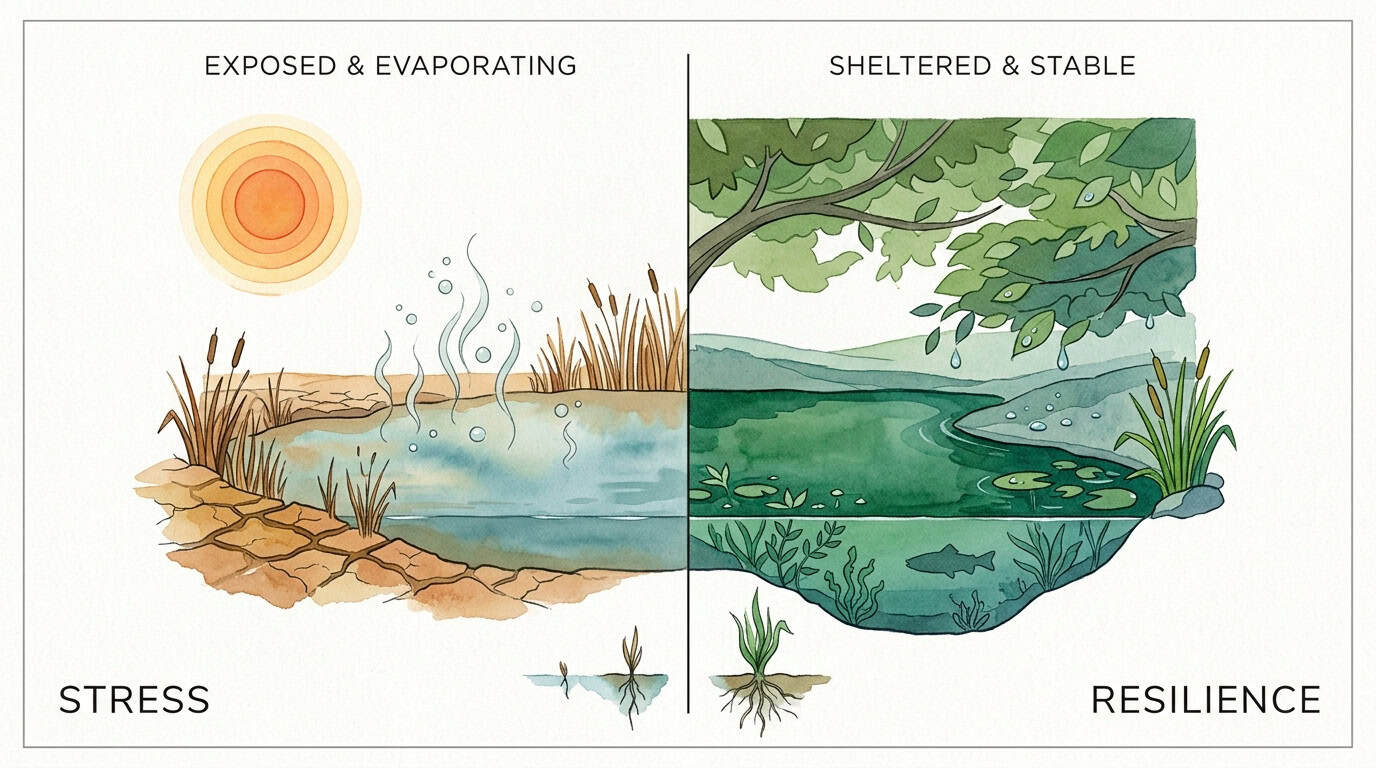
Is your pond surviving the summer or just simmering? Hot water holds less oxygen. Without shelter, your pond becomes a biological pressure cooker. Learn how to use biological shade to keep your ecosystem cool.
During a heat wave, your pond undergoes a rapid decrease in dissolved oxygen capacity while the metabolic demand of its inhabitants spikes. Water at 95°F holds approximately 30% less oxygen than at 60°F, forcing fish to respire faster in an environment with dwindling resources. Simultaneously, higher temperatures and pH levels convert relatively harmless ammonium into toxic un-ionized ammonia, significantly increasing the risk of a total ecosystem collapse.
What Happens to Your Pond During a Heat Wave?
A heat wave represents a period of extreme thermal stress where the energy input from solar radiation exceeds the pond’s ability to dissipate heat through evaporation and convection. In technical terms, the pond moves away from a state of thermal equilibrium. As the surface temperature rises, the water’s density decreases, leading to thermal stratification. This process creates a warm upper layer (epilimnion) and a cooler, often oxygen-depleted bottom layer (hypolimnion).
The chemical stability of the water is also compromised. According to Henry’s Law, the solubility of gases in a liquid is inversely proportional to the temperature. For a pond owner, this means that as the thermometer climbs, the water physically loses the ability to hold the oxygen your fish need to survive. While this is occurring, the biochemical oxygen demand (BOD) increases because bacteria and algae are processing organic matter at an accelerated rate.

Furthermore, the nitrogen cycle is affected by thermal fluctuations. Total Ammonia Nitrogen (TAN) exists in two forms: the ionized ammonium ion (NH4+) and the un-ionized ammonia gas (NH3). The latter is highly toxic to aquatic life. At higher temperatures and alkaline pH levels—common during summer algae blooms—the equilibrium shifts toward the toxic NH3 form. This creates a lethal combination of low oxygen and high toxicity.
How Thermal Stress Impacts Aquatic Mechanics
Understanding the mechanical and biological processes that occur during high-temperature events is essential for effective pond management. These processes are governed by predictable physical laws and biological scaling factors.
Metabolic Scaling and the Q10 Quotient
Most pond fish, such as koi and goldfish, are poikilothermic ectotherms, meaning their internal body temperature is dictated by the surrounding water. The Q10 temperature quotient is a measure of the rate of change of a biological or chemical system as a consequence of increasing the temperature by 10°C. In most aquatic species, the metabolic rate doubles or even triples for every 10°C (18°F) rise in temperature. This means that if your pond warms from 70°F to 88°F, your fish require twice as much oxygen and produce twice as much waste, despite the water’s reduced capacity to provide that oxygen.
Dissolved Oxygen Saturation Curves
The relationship between temperature and dissolved oxygen (DO) is non-linear. Data indicates that at 60°F (15.5°C), freshwater reaches 100% saturation at approximately 10.0 mg/L. When the temperature reaches 90°F (32.2°C), that saturation point drops to roughly 7.4 mg/L. In a high-density koi pond, these margins are razor-thin. When DO levels fall below 5.0 mg/L, fish begin to experience stress; below 2.0 mg/L, mass mortality events are likely.
Evaporative Cooling and Heat of Vaporization
Ponds dissipate the majority of their heat through evaporation. The latent heat of vaporization for water is approximately 1,000 BTUs per pound of water evaporated. This process is the pond’s primary “mechanical” cooling system. During a heat wave, a pond can lose 0.5% to 1.0% of its total volume daily to evaporation. While this loss of volume is a concern, the energy removal it represents is what prevents the water temperature from reaching ambient air temperature peaks.
Benefits of Proactive Thermal Management
Implementing strategies to combat heat waves provides measurable improvements to the pond’s stability and the health of its biological components.

Maintaining a stable temperature range prevents thermal shock, which can suppress the immune systems of fish and make them vulnerable to opportunistic pathogens like Aeromonas or Costia. Consistent cooling also supports the efficiency of nitrifying bacteria. While these bacteria are active in warm water, they are sensitive to the low-oxygen conditions that often accompany heat waves. Keeping the water cooler ensures that the biological filter continues to neutralize ammonia effectively.
Another advantage is the reduction of eutrophication. Warm water and intense sunlight accelerate the growth of filamentous algae and cyanobacteria. By managing the temperature and light penetration, you limit the nutrient uptake by these nuisance species, leading to clearer water and more stable pH levels. A stable pH is critical because it prevents the daily “pH swing” that further stresses aquatic life during the summer months.
Challenges and Common Mistakes
Many pond owners inadvertently exacerbate the problems caused by heat waves by failing to account for the technical requirements of the ecosystem.
Feeding fish during a peak heat event is a frequent error. Because the metabolic rate is high, owners assume the fish need more food. However, digestion requires a significant amount of oxygen (Specific Dynamic Action). Feeding in low-oxygen conditions forces the fish’s system to prioritize digestion over basic survival, often leading to mortality. Furthermore, uneaten food adds to the organic load, increasing the BOD and further depleting oxygen.
Improper aeration timing is another significant pitfall. While aeration is necessary, running a surface fountain during the hottest part of the day can actually warm the water by increasing the surface area exposed to hot air. Conversely, running a subsurface diffuser in a deep, stratified pond during the heat of the day can force warm surface water down into the cooler depths, eliminating the only thermal refuge the fish have left. The most efficient time to aerate for cooling is at night, when the ambient air temperature is lower than the water temperature.
Lastly, many owners perform large water changes using tap water that has not been properly dechlorinated or temperature-matched. A sudden 5-degree drop in temperature combined with chlorine exposure can be more lethal than the heat itself.
Limitations of Standard Cooling Methods
Environmental constraints often dictate the effectiveness of various cooling techniques. High ambient humidity is a primary limiting factor for evaporative cooling. In regions with high relative humidity, the air’s ability to absorb moisture is reduced, which slows the rate of evaporation and prevents the pond from shedding heat efficiently. This is why “dry heat” regions often see cooler pond temperatures than “humid heat” regions at the same ambient temperature.
Pond geometry also plays a role. Shallow ponds (under 2 feet deep) have a high surface-area-to-volume ratio, making them highly susceptible to rapid thermal gains. These systems may reach lethal temperatures regardless of aeration if they are not shaded. Deep ponds (over 4 feet) offer better thermal mass but are more prone to dangerous stratification where the bottom water becomes anaerobic.
Exposed and Evaporating vs Sheltered and Stable
The following table compares the performance metrics of a pond exposed to full sun versus one utilizing biological and structural shade during a standard heat wave (ambient 95°F).
| Metric | Exposed and Evaporating | Sheltered and Stable |
|---|---|---|
| Peak Water Temp | 88°F – 92°F | 78°F – 82°F |
| Daily Evaporation | 1.0% of volume | 0.4% – 0.6% of volume |
| Dissolved Oxygen | 6.5 – 7.0 mg/L | 8.0 – 8.5 mg/L |
| Algae Proliferation | High (Blooms common) | Low to Moderate |
| Maintenance Level | High (Frequent top-offs) | Medium (Plant pruning) |
Practical Tips for Heat Wave Mitigation
Immediate action can be taken to reduce the thermal load on your pond ecosystem. These steps focus on maximizing oxygen transfer and minimizing solar gain.
- Increase Shade Coverage: Aim for 50% to 70% surface coverage using floating plants like water lilies or water hyacinth. These provide “biological shade” that blocks UV rays while allowing for gas exchange at the uncovered edges.
- Optimize Aeration Schedules: Run high-output aerators primarily at night. Nighttime air is cooler and denser, facilitating better oxygen transfer and more efficient cooling through surface agitation.
- Suspend Feeding: Stop all feeding when water temperatures exceed 85°F. Your fish have enough fat reserves to survive several days without food, and the reduction in waste will keep the water chemistry safer.
- Top-Off with Care: Use an automated float valve for small, consistent additions of water rather than large, manual dumps. This maintains a steady temperature and prevents the concentration of nitrates and minerals that occurs when water evaporates.
Advanced Considerations for Serious Practitioners
For those managing high-value stock or complex ecosystems, more technical solutions may be required. One such solution is the use of an aquarium chiller or a heat exchanger. These units use a refrigeration cycle to actively remove heat from the water, though they are energy-intensive and require a closed-loop system for maximum efficiency.
Another advanced technique is the implementation of a bakki shower or trickle filter. These filters utilize a high degree of splashing, which maximizes oxygen saturation and facilitates evaporative cooling. In dry climates, a bakki shower can reduce water temperature by several degrees through the latent heat of vaporization. However, the increased evaporation rate means that an automated top-off system is mandatory to prevent the pump from running dry.
Serious practitioners also monitor ORP (Oxidation-Reduction Potential). A drop in ORP during a heat wave indicates a buildup of organic pollutants and a decrease in the water’s “self-cleaning” capacity. Monitoring this metric allows for precise adjustments to aeration and filtration before a visible problem occurs.
Scenario: The 1,000-Gallon Exposed Pond
Consider a 1,000-gallon pond with a surface area of 100 square feet located in a region where the ambient air temperature reaches 100°F. Without shade, the solar radiation can contribute up to 300 BTUs per square foot per hour. Over an 8-hour period, this adds 240,000 BTUs to the system. Since one BTU raises one pound of water by 1°F, and 1,000 gallons of water weighs approximately 8,340 pounds, this solar input could theoretically raise the pond temperature by nearly 28°F in a single day, ignoring losses.
By adding 60% plant coverage, you reduce the solar gain significantly. If the pond loses 10 gallons to evaporation during this period, it sheds approximately 83,400 BTUs (10 lbs per gallon x 1,000 BTUs/lb). The net result of combined shade and evaporation is a much more manageable temperature increase of only 4°F to 6°F, keeping the water within the safe range for koi (below 85°F).
Final Thoughts
Protecting a pond during a heat wave is a matter of managing energy inputs and chemical thresholds. The physical properties of water work against the ecosystem as temperatures rise, making oxygen less available exactly when it is needed most. By understanding the mechanics of dissolved oxygen saturation and the toxic shifts in the nitrogen cycle, you can move from reactive troubleshooting to proactive management.
Biological shade, optimized aeration, and strict nutrient management are the most effective tools for maintaining stability. These methods prioritize the fundamental needs of the pond’s biology while working within the constraints of physical laws like Henry’s Law and the Q10 quotient. Successful summer management ensures that your pond remains a stable, thriving environment rather than a high-risk biological experiment.
Continued focus on efficiency and data-driven adjustments will provide the best results. As you apply these techniques, you may find that a more sheltered and stable pond requires less intervention overall, allowing the ecosystem to regulate itself even during extreme weather events.
Frequently Asked Questions About What Happens to Your Pond During a Heat Wave?
How can I tell if my fish are suffering from low oxygen?
Fish suffering from hypoxia, or low oxygen, will typically congregate near the water surface or the base of waterfalls and aerators. You may observe them “piping,” which is a behavior where they appear to be gasping for air at the surface. Other signs include lethargy, a complete loss of appetite, and erratic swimming patterns. In a technical sense, the fish are attempting to access the thin layer of water at the very surface which has the highest concentration of dissolved oxygen due to atmospheric contact. If you see this behavior, immediate emergency aeration is required.
Is it safe to add ice to my pond to cool it down?
Adding ice to a pond is generally an inefficient and potentially dangerous method of cooling. To lower the temperature of a 1,000-gallon pond by just 1°F, you would need to add approximately 60 pounds of ice. This creates localized “cold spots” that can cause thermal shock to fish if they swim through them. Furthermore, if the ice is made from chlorinated tap water, it will release toxins into the pond as it melts. A more efficient approach is to use evaporative cooling and shade, which address the root cause of the heat gain without risking chemical or thermal shock.

Why does my pond water turn green during a heat wave?
Warm water and increased solar radiation create the ideal environment for Chlorella and other single-celled algae to reproduce rapidly. Heat waves also accelerate the decomposition of organic matter, releasing a surge of nitrates and phosphates into the water column. This combination of high light, high heat, and high nutrients leads to an “algae bloom.” While the algae produce oxygen during the day via photosynthesis, they consume it at night through respiration, which can lead to dangerously low oxygen levels in the pre-dawn hours. Controlling these blooms requires a combination of UV clarification and nutrient management.
Can I use a garden hose to cool my pond?
You can use a garden hose for cooling, but it must be done with extreme caution. Adding large volumes of cold tap water can rapidly change the pond’s temperature and pH, leading to stress. Most importantly, tap water contains chlorine or chloramines, which are toxic to fish and beneficial bacteria. If you must use a hose, use a “trickle” method to slowly add water while simultaneously using a high-quality water conditioner to neutralize toxins. A better use of the hose is to mist the air above the pond, which can lower the immediate ambient temperature through evaporative cooling without altering the pond’s chemistry.
Does a deeper pond stay cooler than a shallow one?
Deep ponds generally have more “thermal mass,” meaning they take much longer to heat up and cool down than shallow ponds. A pond that is 4 to 5 feet deep will often have a cooler layer of water at the bottom where fish can retreat during the heat of the day. However, depth alone is not a guarantee of safety. Without circulation, deep ponds can stratify, leading to an anaerobic bottom layer that is uninhabitable. The goal is to have enough depth for thermal buffering while maintaining enough circulation to ensure that oxygen reaches the bottom without completely destroying the cooler thermal refuge.